Fashion ads sell clothing, shoes, bags or jewelry, or the fashion brand itself. The ones people remember rest on one idea: a product detail, a line, a date or an impossible scene. Eight fashion ads from 2007 to 2025 show the pattern. An agency can reuse the idea and the format. It cannot reuse the faces, the brand marks or the celebrity budget.
Take an agency with eight fashion clients. Each client wants a new campaign every season, and one brief says “something like Jacquemus”. The galleries show the famous picture. They do not show the idea under it, or which parts a mid-size brand may copy.
This guide is for that agency. Each example below was checked against a source read in October 2026.
Key Takeaways
-
Eight fashion ads, one shape. Each one rests on a single idea: a product detail, a line, a date or a scene.
-
The idea travels. The face does not. New York and California require consent before a person’s name or likeness appears in an ad. An AI copy of a real person’s face is still that person’s likeness.
-
A model’s digital replica needs written approval in New York. Since 19 June 2025, the model approves the scope, purpose, pay and length of use in writing.
-
Another brand’s marks belong to that brand. US trademark law covers anything likely to suggest that another company approved your ad.
-
AI labels depend on the platform. TikTok asks for a label on AI-made ad media. Meta adds a label itself when it detects third-party AI.
-
The famous image is one file. The client needs the set: versions, sizes and languages of one approved ad.
What are fashion ads?
Fashion ads, or fashion advertising, are paid messages that sell clothing, footwear, bags, jewelry or a fashion brand. They run in print, on posters, in video and in social feeds. Clothing ads on Meta and TikTok are the daily version. A fashion ad campaign is a set of ads around one idea, made for one season or one launch.
Eight fashion ads and what each one shows
These eight fashion ad campaigns run from a 2007 blog clock to a 2025 plan for AI models. Each was checked against a source read in October 2026.
| Year | Brand and ad | What happens | What carries it |
|---|---|---|---|
| 2007 | Uniqlo, “Uniqlock” | A blog clock shows dancers in Uniqlo clothes, set to music | Something people keep on their page |
| 2010 | Diesel, “Be Stupid” | Posters show people doing foolish stunts | One line on every poster |
| 2011 | Patagonia, “Don’t Buy This Jacket” | A full-page newspaper ad asks people to buy less, on Black Friday | One product and one date |
| 2011 | Benetton, “Unhate” | Edited photos show world leaders kissing | Real faces and a cause |
| 2014 | Calvin Klein, “show yours. #mycalvins” | Influencers post photos that show the waistband | One product detail people can show |
| 2023 | Jacquemus, Le Bambino bags | Giant bags drive through Paris traffic in a short clip | One product at an impossible size |
| 2024 | Mango Teen, “Sunset Dream” | The campaign images are made with AI, from photos of the real garments | Real garments, generated models |
| 2025 | H&M, digital twins | H&M plans AI copies of 30 of its own models | Consent and pay for each use |
The details behind each row, with the source:
- Uniqlo, 2007. Uniqlo launched Uniqlock on 15 June 2007 to promote its DRY garments. It describes the idea as music, dance and a clock, made “to transcend all language barriers” (uniqlo.com, October 2026). Projector in Tokyo made it. It won the Cyber Grand Prix at Cannes Lions in 2008 (campaignasia.com, October 2026), then the Titanium Grand Prix (campaignasia.com, October 2026).
- Diesel, 2010. Anomaly New York made “Be Stupid” for Diesel. It won an Outdoor Grand Prix at Cannes Lions in 2010. Campaign reported that the jury chose it for its willingness to take risks and get people talking (campaignlive.co.uk, October 2026).
- Patagonia, 2011. Patagonia placed the ad in The New York Times on Black Friday. It chose the paper because it is “considered the ‘paper of record’”, and the day because it “launches the retail holiday season”. The ad was part of its Common Threads Initiative, which asked everyone to consume less (patagonia.com.au, October 2026).
- Benetton, 2011. The “Unhate” campaign used fake photos of political rivals kissing. Benetton pulled the image of Pope Benedict XVI on the day the campaign launched, about an hour after the Vatican protested (cbc.ca, October 2026).
- Calvin Klein, 2014. PVH, which owns Calvin Klein, launched “show yours. #mycalvins” on 19 February 2014 as a global campaign across channels. It started with posts by influencers and asked people to show the Calvin Klein waistband (pvh.com, October 2026).
- Jacquemus, 2023. Jacquemus posted an 8-second Instagram clip of its Bambino bags driving through Paris. PAPER reported that many viewers could not tell if it was AI, CGI or real. The 3D artist Ian Padgham made it (papermag.com, October 2026).
- Mango, 2024. Mango called its Sunset Dream campaign for the Mango Teen line its first campaign made entirely with AI. The team shot real photos of each garment and trained a generative AI model to place those garments on a model. The art team then selected, retouched and edited the images in Mango’s photo studio (mi-3.com.au, October 2026).
- H&M, 2025. H&M told CNN in March 2025 that it plans 30 “digital twins” of its models. The company said the models would own the rights to their twin and “get paid on each occasion” it is used (cnn.com, October 2026).
For a longer record of brands that use AI models, see fashion brands using AI models.
What an agency can reuse from these fashion ads
Four parts of these ads work without a star: one product detail, one line, one date and one impossible scene. An agency can build each of them from the client’s own products and the client’s own calendar.
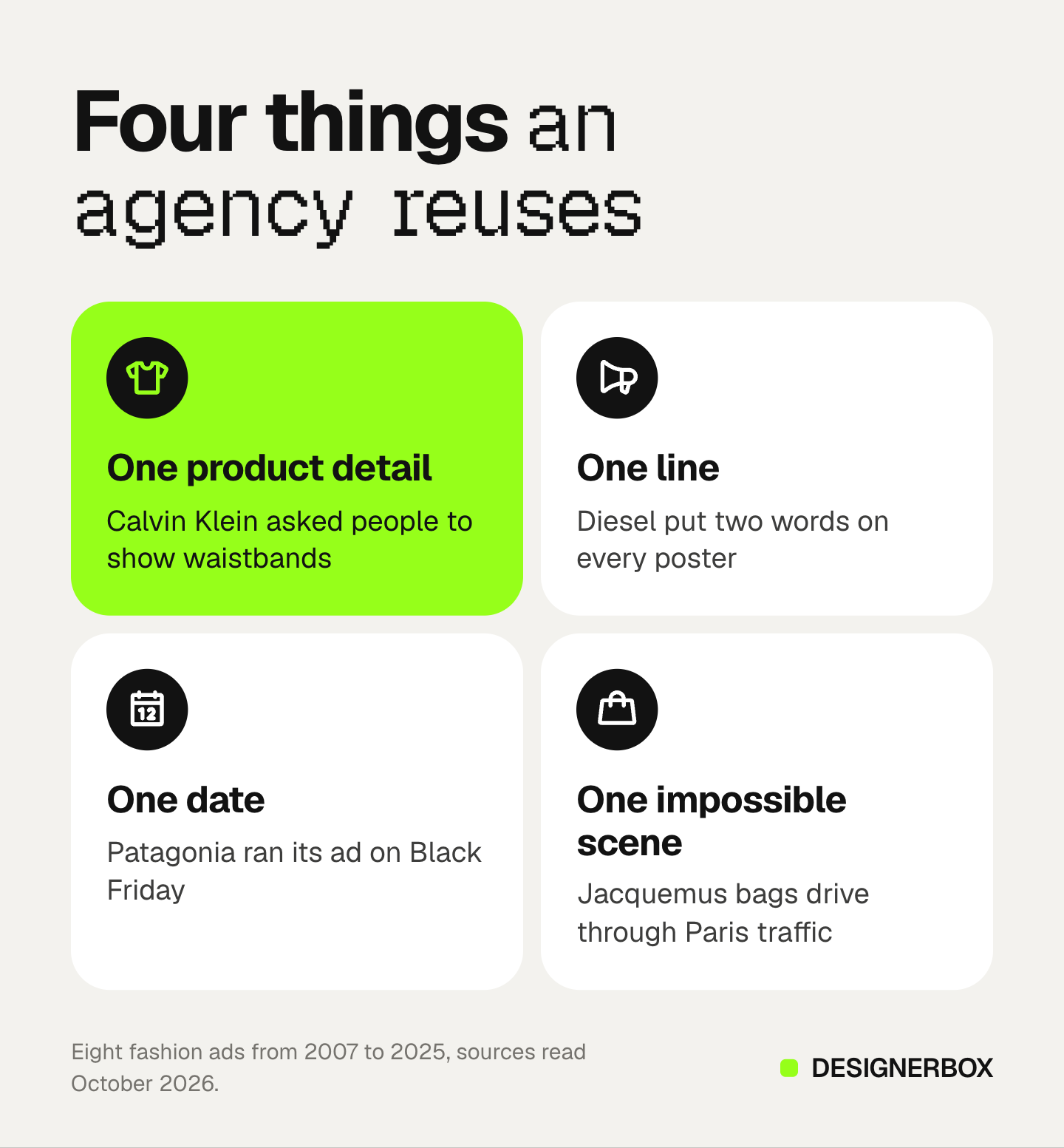
One product detail. Calvin Klein built a global campaign on a waistband. Patagonia showed one jacket. Pick the detail a customer can name.
One line. Diesel put two words on every poster. A short line works at every size. Check that it still works in every language the client sells in. Uniqlo built its ad to work across languages, with music and dance in place of words.
One date. Patagonia ran its ad on Black Friday because the day “launches the retail holiday season”. A drop date, the first cold week or a store opening gives an ad a reason to run now.
One impossible scene. The Jacquemus bags could not drive through Paris, and that is why people watched. A generated scene can show a product at a size or in a place that no shoot can reach. Label it where the platform asks.
To pitch one of these ideas before a prospect signs, see how to make a spec ad. Sports brands use the same logic: sports ads compares seven examples and what a small brand can copy.
How to turn one fashion ad idea into a full set
The famous fashion ad is one picture. A client campaign is a set: the hero, its versions, its sizes and its languages. Make them in this order, so a change late in the job touches as few files as possible.
- Approve one ad first. Show the client the hero ad before any sizes exist. A change after the sizes are made is a change on every file.
- Make versions of the winner. Change one thing in each version: the product, the background, the headline or the model. Then you can see which change moved the result. Our guide to ad creative testing covers how to read the test.
- Make the sizes. Feed, story and banner placements each need their own layout. Check that the text and the logo stay inside the safe area of each one.
- Make the languages. A headline in German or French is often longer than in English, so the layout has to change with it. Localize ads without rebuilding them walks through it.
- Check and label. Check every file for the logo, the garment’s print and the text. Then add the AI label each platform asks for.
For the full process of one ad from brief to file, see how to make an ad. Photo choice and return rates decide whether a set earns its cost. The fashion ROAS guide explains which images move which number.
What an agency cannot copy
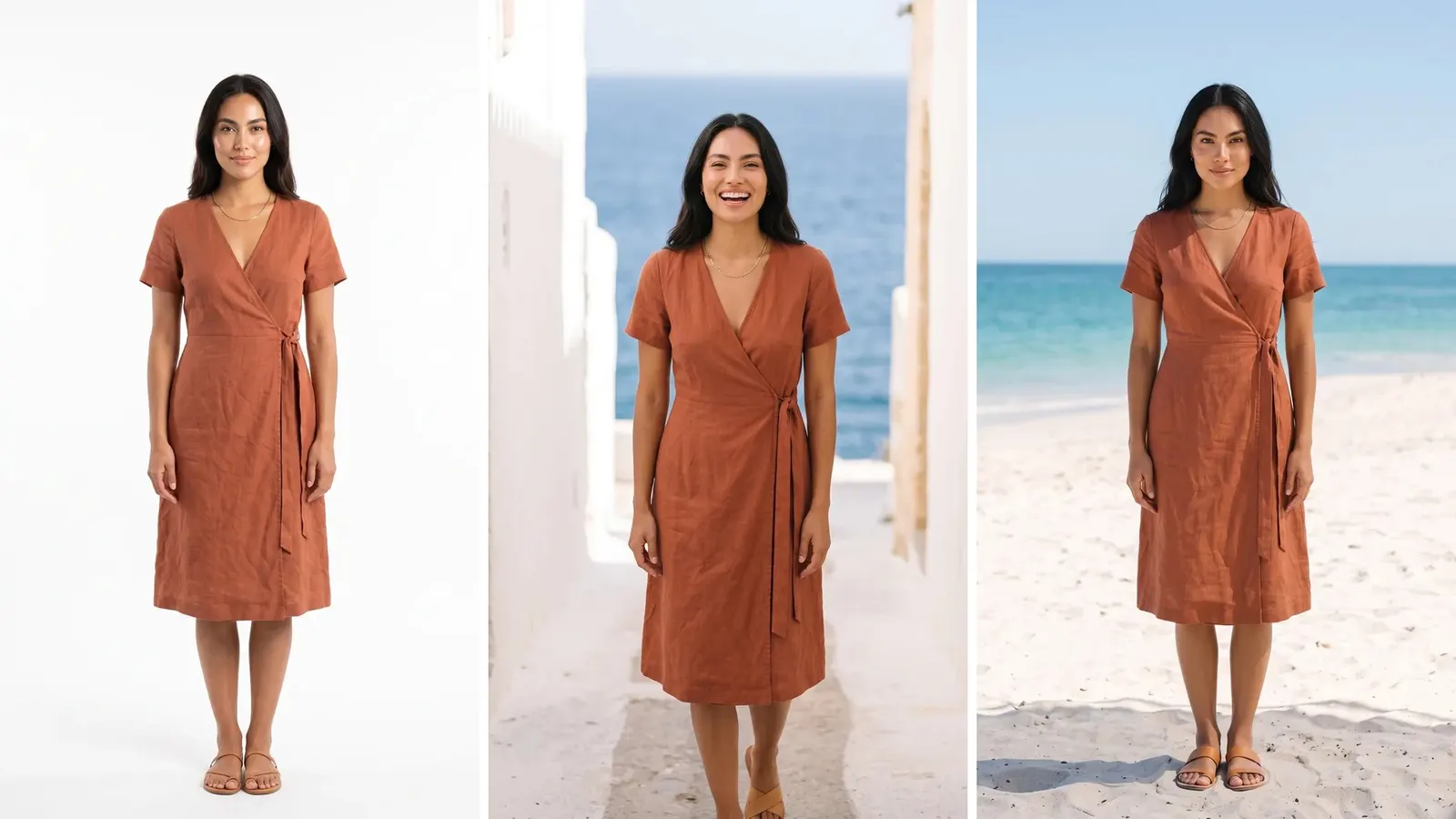
Three parts of famous fashion ads belong to someone else: the person, the model’s digital replica and the other brand’s marks. This is general information, not legal advice.
| What you want to use | Who controls it | The source |
|---|---|---|
| A real person’s name, face or voice | That person | State laws such as New York Civil Rights Law 50 and California Civil Code 3344 |
| A model’s digital replica | The model | New York Fashion Workers Act |
| A public figure who seems to endorse the product | The public figure | TikTok’s rules on AI content |
| Another brand’s name or logo | That brand | US trademark law, 15 U.S.C. 1125 |
The person. In New York, you need a person’s written consent before you use their name, portrait, picture or voice in advertising (nysenate.gov, October 2026). California requires prior consent to use a person’s name, voice, signature, photograph or likeness in advertising (leginfo.legislature.ca.gov, October 2026). An AI face that copies a real person is still that person’s likeness. TikTok does not allow AI content that falsely shows a public figure making an endorsement (support.tiktok.com, October 2026). Benetton pulled its Pope image about an hour after the Vatican’s protest.
The model’s digital replica. Under New York’s Fashion Workers Act, you need a model’s written approval before you make or use their digital replica. The model approves the scope, purpose, rate of pay and length of time it will be used. A new campaign that the first approval did not cover needs new approval (dol.ny.gov, October 2026). H&M’s plan follows the same shape: the model owns the twin and is paid for each use. The routes for a client’s own model are in our AI model agency guide.
The other brand’s marks. US federal law makes a company liable for using a name or symbol that is likely to cause confusion about the “sponsorship, or approval” of its goods by another company (law.cornell.edu, October 2026). A pitch can borrow the Jacquemus idea of a giant product. It cannot show a Jacquemus bag, or a logo from any brand that is not the client.
AI labels on fashion ads: Meta, TikTok and Google
-
Meta. Meta checks ads for signs of third-party AI, such as C2PA metadata. When it finds them, it adds an “AI info” label. In most cases, the label is in the three-dot menu under “About this ad” (facebook.com/business/help, October 2026). Advertisers must disclose AI themselves only in ads about social issues, elections or politics.
-
TikTok. An ad with fully AI-made or heavily AI-edited media needs the AIGC label, or your own clear disclaimer, caption, watermark or sticker. TikTok says an AI ad with no disclosure “will be rejected or restricted” (ads.tiktok.com, October 2026). Changes to lighting or color and background removal need no label.
-
Google and YouTube. Since July 2026, Google permits text or visual AI labels inside image and video ads, and it added an AI label setting to Google Ads and Merchant Center. Google says the setting does not guarantee compliance with any law (support.google.com, October 2026).
For on-model pictures, how to label AI-generated fashion images covers the marketplaces as well.
Fashion ad production for clients in DesignerBox
Anyone can make an AI picture. Making hundreds that still look like your brand is the hard part. For an agency, that brand belongs to the client, and there are eight of them.
DesignerBox is AI creative production for brands and agencies. You save each client’s brand once: logo, colors, fonts, voice, rules, products and reference pictures. You build the ad job once as a workflow, and the workflow reads that client’s brand on every run. Batch runs it over a sheet, so the standard is the same on row one and row two hundred. The cost is shown before the run.
Three apps cover the set from the section above. Versions of an ad makes versions of an approved winner. Ad in other sizes turns one ad into four sizes. Ad in other languages rebuilds one ad in another language and redraws the layout. Before you resize, Reviews sends the client a page of pictures. The client opens the link with no account and ticks the ones they want. A review costs no credits, and the link works for 30 days. Our guide to letting the client pick the ads shows the full round.
The versions, the sizes, the languages and each client’s brand rules sit in one account. No file moves between tools from the first ad to the last size.
The limits, stated plainly:
- Seats. Every plan below Ultra is one seat. Team features, shared brand kits and white label are on the Ultra plan.
- Delivery. DesignerBox does not send ads to an ad account. You download the results and upload them yourself.
- Video. The video editor and AI video start on the Premium plan. An 8-second clip costs 40 to 560 credits, depending on the model.
Uploading your own photos and the commercial license start on the Pro plan. Plans and credits are on the pricing page.
A demo for your agency
See one client’s ad set built as a workflow, then resized, translated and sent for review.
FAQ
What makes a good fashion ad?
A good fashion ad rests on one idea that a viewer gets in a second: a product detail, a line, a date or a scene. The eight examples in this guide each carry one idea, not five.
What are some famous fashion ad campaigns?
Lists often include Uniqlo’s “Uniqlock” from 2007, Diesel’s “Be Stupid” from 2010, Patagonia’s “Don’t Buy This Jacket” from 2011 and Calvin Klein’s “#mycalvins” from 2014. Jacquemus’s bags on Paris streets in 2023 is a recent social example.
Can an agency use a celebrity’s face in an AI fashion ad?
Only with that person’s consent. New York requires written consent, and California requires prior consent, to use a person’s likeness in advertising. An AI copy of a real face is still that person’s likeness.
Can a fashion ad show another brand’s logo?
Not in a way that suggests the other brand approved it. US trademark law covers a name or symbol that is likely to cause confusion about sponsorship or approval. Use the client’s own products and marks only.
Do AI fashion ads need a label?
It depends on the platform. TikTok requires the AIGC label or a clear disclaimer on ads with fully AI-made or heavily AI-edited media. Meta adds an “AI info” label itself when it detects third-party AI. Google added an AI label setting to Google Ads in July 2026.
What is the difference between fashion ads and a fashion campaign?
A fashion ad is one file in one placement. A fashion campaign is the set of ads around one idea: the versions, the sizes and the languages, made for one season or launch.
Sources
- Uniqlo, UNIQLOCK project page: uniqlo.com, accessed October 2026
- Campaign Asia, Uniqlo Japan wins Cyber Grand Prix at Cannes, June 2008: campaignasia.com, accessed October 2026
- Campaign Asia, Japan’s Uniqlo wins Titanium Grand Prix at Cannes, June 2008: campaignasia.com, accessed October 2026
- Campaign, Anomaly’s Be Stupid lands Outdoor Grand Prix, June 2010: campaignlive.co.uk, accessed October 2026
- Patagonia, Don’t Buy This Jacket, Black Friday and the New York Times, first published November 2011: patagonia.com.au, accessed October 2026
- CBC News (The Associated Press), Benetton pulls ad with Pope kissing imam, November 2011: cbc.ca, accessed October 2026
- PVH, Calvin Klein Underwear launches global multimedia campaign, February 2014: pvh.com, accessed October 2026
- PAPER, How Jacquemus’ viral bags-on-wheels stopped traffic, April 2023: papermag.com, accessed October 2026
- Mi3, Mango launches first fully AI-generated fashion campaign, July 2024: mi-3.com.au, accessed October 2026
- CNN, H&M plans to use AI clones of its models, March 2025: cnn.com, accessed October 2026
- New York Civil Rights Law section 50: nysenate.gov, accessed October 2026
- California Civil Code section 3344: leginfo.legislature.ca.gov, accessed October 2026
- New York State Department of Labor, Fashion Workers Act FAQs: dol.ny.gov, accessed October 2026
- 15 U.S.C. 1125, false designations of origin: law.cornell.edu, accessed October 2026
- TikTok Support, AI-generated content: support.tiktok.com, accessed October 2026
- TikTok ads policy, misleading and false content: ads.tiktok.com, accessed October 2026
- Meta Business Help Center, AI info labels on ads: facebook.com/business/help, accessed October 2026
- Google Ads policy, AI labels in ad creatives: support.google.com, accessed October 2026
- DesignerBox apps and pricing pages (designerbox.ai/product/apps and designerbox.ai/pricing), October 2026: apps, plan gates and video cost range
Campaign facts, laws and platform rules verified against the linked sources as of October 2026. Individual results vary.