

A spec ad is an ad that nobody ordered. A filmmaker, a designer or an agency makes it for a real brand, without a brief, a contract or a fee. “Spec” is short for speculative. The maker hopes the ad will win paid work later. It has two uses: a portfolio piece, and a pitch piece made for one prospect with that prospect’s own product.
AI has made a spec ad cheap to produce. That changes what decides its value. Production is no longer the hard part. Three other things are: an accurate product, a clear label, and a limit on the unpaid hours.
Key Takeaways
- A spec ad is unpaid and uncommissioned. The brand did not ask for it. A spec commercial is the same thing in video form.
- Spec work is the wider term. It covers any unpaid work done in the hope of payment. AIGA, the US design association, asks designers to know the risks before they do it.
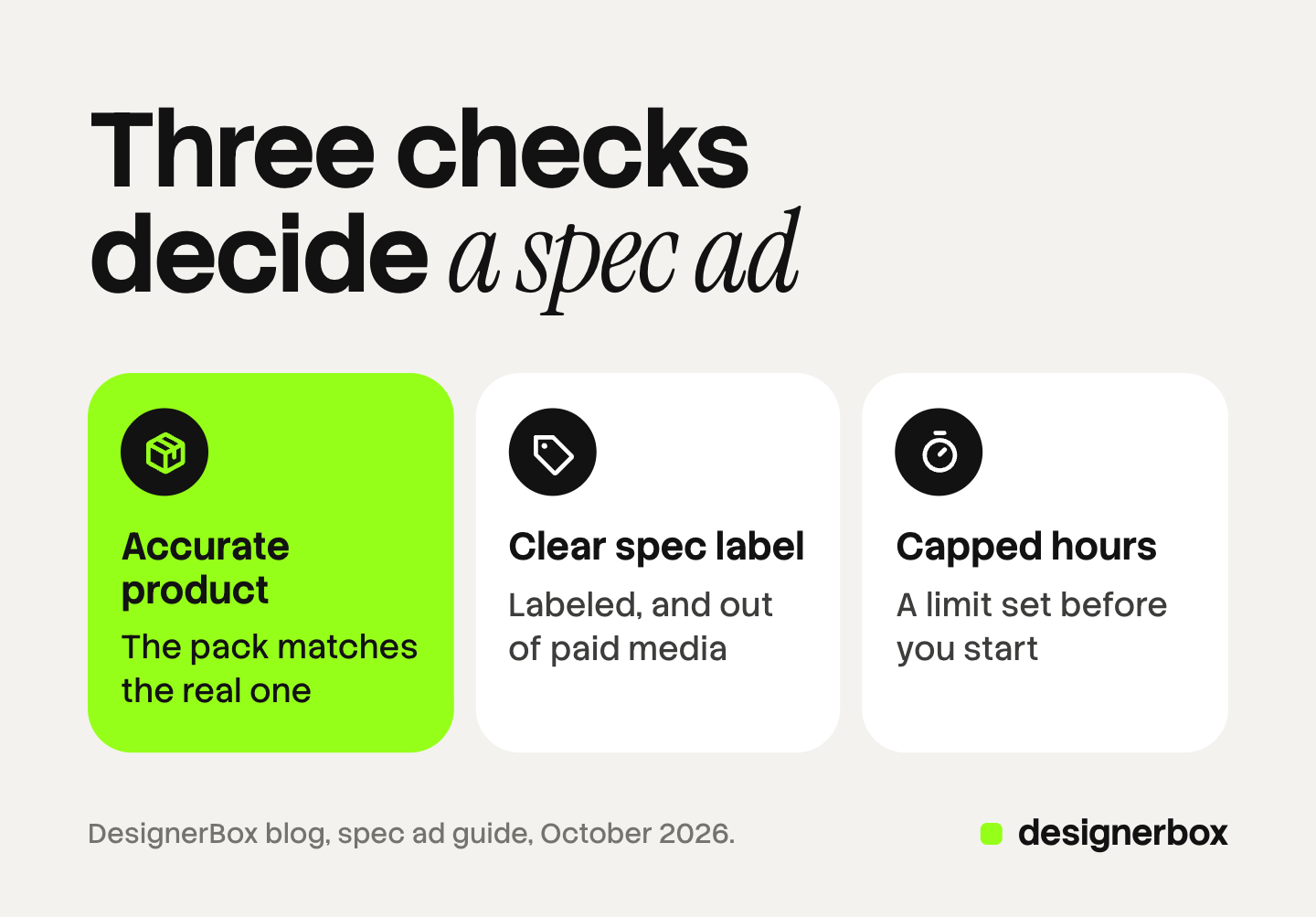
- Three checks decide whether a spec ad helps. The product is accurate, the file is labeled as spec, and the hours have a cap.
- Five steps make one. One idea, a real product reference, the frames, the cut or the layout, and the label.
- A private pitch file and a public post are different situations. The trademark and advertising risk grows with the number of people who see the piece.
What is a spec ad?
A spec ad is an advertisement made on the maker’s own initiative for a brand that did not commission it. Runway, a video model vendor, defines it this way: “A spec ad, short for speculative advertisement, is a mock commercial built for a company or client that never commissioned it” (runwayml.com, October 2026).
The phrase “on spec” is older than advertising film. Cambridge Dictionary defines it as “taking a chance, without being sure that you will get what you want” (dictionary.cambridge.org, October 2026).
A spec ad can be a still or a video. A spec commercial is the video form, and directors have used it for a long time to show a client what they can do. Runway’s guide says spec ads “have circulated in advertising for decades, mostly as portfolio pieces”.
The two uses need different work:
| Portfolio piece | Pitch piece | |
|---|---|---|
| Who sees it | Anyone who opens your portfolio | One prospect, in a meeting or an email |
| Which brand | A brand whose category you want to work in | The prospect’s own brand |
| Which product | Any real product from that brand | The product the prospect sells now |
| What it must prove | Your taste and your craft | That you understand this brand’s rules |
| Where it lives | Your site or your reel, with a label | A private file or link, with a label |
A portfolio piece shows range. A pitch piece shows one buyer its next campaign as your team would make it.
Spec ad vs spec work
Spec work is any work done without pay, in the hope of payment later. A spec ad is one kind of spec work. A free logo for a contest is another kind. So is a full campaign that a prospect requests from three agencies before it picks one.
AIGA, the professional association for design in the United States, publishes a position on it. The position lists the forms of unpaid work and defines the first one as “Speculative or “spec” work: work done for free, in hopes of getting paid for it” (aiga.org, October 2026).
AIGA does not ban spec work. It says that “professional designers should be compensated fairly for their work”, and it “strongly encourages designers” to “be aware of all potential risks before entering into speculative work”. The position names three risks:
- For the client. “Clients risk compromised quality.” The research and testing that a paid project includes get little time.
- For the maker. “Designers risk being taken advantage of”. Some clients may treat spec as a source of free work.
- For both. “There are legal risks for both parties should aspects of intellectual property, trademark, and trade-dress infringements become a factor.”
The same page gives the other side. It says “many designers choose to do unpaid work for a variety of reasons”, and that “the designer and client make the decision and must accept the associated risks”.
There is a useful line between two cases. In requested spec work, a prospect asks several teams for free creative and pays one of them, or none. In self-started spec work, you choose the brand, the idea and the hours. A spec ad for your portfolio is self-started. You control the cost, so you can cap it.
Brands also react in different ways. Runway’s guide says some companies “treat spec campaigns as unpaid pitches worth a call back, while others see them as noise”. No public data that we could verify shows how often a spec ad leads to paid work, so this article gives no number.
When is a spec ad worth the time?
A spec ad is worth the time when three checks pass. The product in it is accurate. The file is labeled as spec and stays out of paid media. The unpaid hours have a cap that you set before you start.
AI moved the cost. An image model, a video model and an editor can now produce a finished-looking piece in days. The idea still decides the quality. Runway’s guide says it plainly: “AI tools won’t make a bad idea good”. For how viewers respond to AI-made ads, see what 369 million impressions show about AI generated ads.
Use this table before you start. The hour figures are examples of a cap, and they come from no survey. Set your own.
| Question | Make it | Skip it |
|---|---|---|
| Is there a real opening? | The prospect has a launch, a new market or a review of its agencies | You have no contact and no reason to write now |
| Do you know the brand? | You can name its colors, its tone and its current campaign | You admire the brand but have not studied it |
| Can you get the real product? | You own it, or you have clear photos of the current pack | You would have to guess the label or the shape |
| Can you reuse the work? | The idea, the frames or the method serve your portfolio or the next pitch | Everything depends on this one prospect |
| Is the time capped? | You set a limit first, for example two working days | The work has no end date |
Two “skip it” answers are a reason to stop. A smaller piece often does the same job. One strong still, or a timed storyboard, shows the idea for a fraction of the hours. Our guide to the animatic covers that rough form.
Requested spec work needs a different answer. If a prospect asks for a free campaign, you can offer a paid test instead. Agency creative pricing covers how to price a pilot when AI cuts the production hours.
How to make a spec ad in five steps
The method is the same for a still and for a video. A model is one step in it. The idea and the product reference come first.
- Pick one idea. Write the ad in one sentence: who it is for, what it promises and why they would believe it. A spec ad with one clear idea beats one with three. Our guide to the creative concept shows how to write and test that sentence.
- Get a real product reference. Buy the product and photograph it, or use photos you have the right to use. Capture the front, the side, the label text and the true color. Every later frame starts from this reference, so the model does not invent the pack.
- Make the frames. Give an image model the product photo and a description of the scene, the light and the framing. Make the hero frame first, then two or three supporting frames in the same style. Check each frame against the reference before you continue.
- Cut the video or lay out the still. For a still, add the headline, the logo placement and the format sizes. For a video, animate the frames that need motion, add a voice and music, and cut to a real ad length such as 15 or 30 seconds. One camera move for each shot is enough.
- Label it. Put “Spec ad. Not commissioned by the brand.” on the first frame or the last frame, in the file name and in the caption. If AI made the pictures, say that too.
Step 2 is the one that AI makes more important. A model that works from a text description alone can draw a pack that looks right from far away and wrong up close. The prospect knows its own label better than anyone in the room. Our guide to AI product mockups covers how to place a real product in a scene and where a mockup may not go.

For the planning stage between the idea and the frames, see AI storyboard generators.
Rights and labels for a spec ad
This section is general information, not legal advice. It quotes US sources. The law is different in other countries, and a lawyer should check any plan to publish.
A spec ad uses another company’s name, logo and product without permission. The risk depends on what people who see it are likely to believe.
Trademark. The US Patent and Trademark Office defines the problem this way: “Trademark infringement is the unauthorized use of a trademark or service mark on or in connection with goods and/or services in a manner that is likely to cause confusion, deception, or mistake about the source of the goods and/or services” (uspto.gov, October 2026). The federal statute also covers confusion about “affiliation, connection, or association” and about “sponsorship, or approval” (15 U.S.C. 1125(a), October 2026).
The practical point is confusion. A viewer should never think that the brand made, paid for or approved the spec ad. That is the job of the label. A label does not make a use lawful. It reduces the chance that someone believes the ad is real.
Claims. The Federal Trade Commission says an ad “must be truthful, not misleading, and, when appropriate, backed by scientific evidence” (ftc.gov, October 2026). Its guide for small businesses adds: “Advertisers must have evidence to back up their claims” (FTC advertising FAQ, October 2026). You have no evidence for a product you do not make. So a spec ad should carry no performance claim, no price and no result that you invented.
AI labels. A platform can have its own rule. YouTube says: “we require creators to disclose when they use AI to meaningfully alter or generate photorealistic content” (YouTube Help, October 2026). A realistic spec commercial made with a video model fits that description. Our guide to AI disclosure in advertising covers the rules for ads that run.
Private and public use are different situations. A file that one prospect sees in a meeting reaches no consumer. A post on a public feed reaches many. This article cannot tell you where a court would draw the line. These four habits keep the risk low:
- Keep a pitch piece private. Send a file or a link that only the prospect can open.
- Never put a spec ad in paid media. No spend, no promoted post, no ad account.
- Label a portfolio piece on the piece itself, where a screenshot will still show the label.
- Remove a piece if the brand asks you to.
Six checks before a prospect sees it
A spec ad can hurt a pitch. Each mistake below tells the prospect that the team did not look closely. Run these checks on the finished piece.
| Check | What to look for |
|---|---|
| Label text on the pack | Every word on the product matches the real pack, letter for letter |
| Shape and details | The cap, the handle, the stitching and the proportions match the reference |
| Brand color | The brand color matches the brand’s own materials on a second screen |
| Logo | The logo is the current version, with no stretch and no redraw |
| Claims | The ad has no invented result, award, review or price |
| Spec label | The piece says it is spec, and nobody presents it as the brand’s real ad |
Look hardest at the first two checks with AI pictures. A model can change small text and small parts. Zoom in to full size on every frame, and replace a frame that fails.
The last check is about people as much as files. A spec ad in a credentials deck should sit under a “spec” heading, apart from paid client work. A prospect who learns later that a “campaign” was never commissioned will doubt the rest of the deck.
Pitch sets as a saved workflow
DesignerBox is AI creative production for brands and agencies. Anyone can make an AI picture. Making hundreds that still look like your brand is the hard part.
For an agency of 3 to 15 people, a pitch set is a job that repeats. Each new prospect needs the same pieces: a hero still, a few scenes, the ad formats and maybe a short video. In DesignerBox you build that set once as a workflow. For the next prospect, you change the brand and the product photo and run it again.
The prospect’s rules go into a brand record: the logo, the colors, the fonts, the voice and the rules. You add the product with its photo and its colors. The workflow reads the record before each run, and a critic step scores each result against the rules. A person still zooms in on the label text. No step replaces that check.
You can publish the workflow as an app. An app is a workflow with a form, so a colleague adds the product photo and presses Run. The cost is shown before the run, so you can cap the spend on unpaid work as well as the hours.
For a spec commercial, the video editor puts the clips on a timeline with captions, a voice and music. You download one video file. An 8-second clip costs 40 to 560 credits, depending on the model. The full workflow from the first product photo to the finished ad, in one subscription.
Here are the limits. DesignerBox makes the files. It does not place them in an ad account, which suits spec work: you download the results, or send them with a webhook or an S3 step. Every plan below Ultra is one seat, and team seats and shared brand kits are on the Ultra plan. Uploading your own photos and the commercial license start on the Pro plan. AI video, virtual try-on, upscaling, the image editor and the video editor start on the Premium plan. Plans and credits are on the pricing page.
FAQ
What is spec work?
Spec work is work done without pay, in the hope of payment later. AIGA defines it as “work done for free, in hopes of getting paid for it” (aiga.org, October 2026). A spec ad, a contest logo and a free pitch campaign are all spec work. AIGA asks designers to know the risks before they agree to it.
Is a spec ad legal?
A spec ad that uses a real brand carries legal risk, and the size of the risk depends on how you use it and where you are. In the United States, trademark law looks at whether the use is likely to confuse people about who made or approved the ad (uspto.gov, October 2026). A clear label and private use reduce that chance. Ask a lawyer before you publish a spec ad that uses a real brand.
Do spec ads get you hired?
Sometimes. We found no reliable public data on how often. A spec ad helps most when a real opening exists, the product in it is accurate, and the idea fits the brand. It helps least when the maker sends it cold to a brand with no reason to look.
How long should a spec ad be?
Match a real placement. Many video ads run 15 or 30 seconds, so a spec commercial of that length shows that the idea fits the time. A still spec ad needs one hero image and two or three format sizes. Short and finished beats long and rough.
Can you make a spec ad with AI?
Yes. An image model makes the frames from a real product photo, a video model adds motion, and text to speech reads the script. The maker still writes the idea, checks the product in every frame and adds the spec label. In DesignerBox, the cost of a run is shown before the run.
Can I put a spec ad in my portfolio?
Yes, with a label. Mark it as spec on the piece itself, state that the brand did not commission it, and make no claim about results. Keep it out of paid media. Remove it if the brand asks.
Sources
- AIGA, “AIGA Position on Spec Work”: the definition, the three risks and the sample letter (revised May 2024): aiga.org, October 2026
- Runway, “How to make a spec ad with AI” (14 August 2026): the definition of a spec ad: runwayml.com, October 2026
- Cambridge Dictionary, “on spec”: dictionary.cambridge.org, October 2026
- US Patent and Trademark Office, “About Trademark Infringement”: uspto.gov, October 2026
- Lanham Act, 15 U.S.C. 1125(a), text at the Legal Information Institute: law.cornell.edu, October 2026
- Federal Trade Commission, “Truth in Advertising”: ftc.gov, October 2026
- Federal Trade Commission, “Advertising FAQ’s: A Guide for Small Business”: ftc.gov, October 2026
- YouTube Help, “Disclosing use of GenAI content”: support.google.com, October 2026
- DesignerBox workflows, brand, apps, video editor and agencies pages (designerbox.ai), October 2026
- DesignerBox plans and feature gating: DesignerBox pricing page (designerbox.ai/pricing), October 2026
Definitions, positions and legal texts checked against each source’s own pages as of October 2026. The hour figures in the decision table are examples. Individual results vary.