An AI model agency is a business that supplies on-model images made with AI. The name covers three different businesses. One licenses digital replicas of real, signed models. One owns invented characters and rents them for campaigns. One produces your on-model images as a service. A fourth route is to make the images in-house. The main difference is who owns the face.
This guide is for an apparel brand with 20 to 500 products, and for the agency that makes its on-model images. It compares the four routes in one table and lists eight questions to ask before you sign.
Key Takeaways
- One name, three businesses. A replica licensor, a synthetic-talent agency and a production service all use the name.
- The face has an owner. A real model owns her digital replica. An agency owns its invented character. A face you make in-house is the one your brand controls.
- A replica needs written consent. Since June 19, 2025, New York’s Fashion Workers Act requires a model’s clear written approval of the scope, purpose, pay rate and length of use.
- An invented face can still need a label. New York requires a disclosure in ads with a synthetic performer. The EU’s Article 50 has applied since August 2, 2026.
- The license sets the use. Term, territory, paid ads and exclusivity belong in the contract.
What is an AI model agency?
An AI model agency supplies images or video of a person who was made, or partly made, with AI. Some represent real models and license their digital twins. Some own characters that never existed. Some are production teams that deliver finished on-model images. The search term also covers AI modeling agency and AI fashion model agency, and all three kinds answer to it.
This guide covers the buyer’s side: what a brand receives, and what it should get in writing. If you only need software, our comparison of AI fashion model generators maps 11 tools to the shots a product drop needs.
The three kinds of AI model agency
The three kinds differ in what sits behind the face. The first starts from a real person who agreed to it. The second starts from a character the agency invented and owns. The third starts from your brief, and the team may use either kind of face.
Kind 1: a replica license from a real model
A real model is photographed, and a system learns to reproduce her. The brand then licenses her digital twin for a campaign.
H&M ran the best-known version in 2025. The retailer said it would create digital twins of 30 models. It said the models would keep the rights over their digital replicas, including their use by other brands. It also said the models would be paid in a similar way to current arrangements, at rates agreed by their agent (BBC News, 2025, read October 2026).
Companies now offer this as a service to other brands:
- Alva. Its founder describes it as a talent AI company that creates, licenses and protects digital twins of real talent. She says the ownership stays with the talent, and each project is licensed with the talent’s approval (Scandinavian MIND interview, April 9, 2026).
- ModelManagement.com. Its page says each twin is a virtual version of a real, ID-verified model, built with consent. The model must approve a published campaign, is paid for the use, and can withdraw consent at any time (modelmanagement.com/digital-twins, October 2026).
Kind 2: a synthetic-talent agency
The agency invents a character, gives it a name and a look, and owns it. A brand rents the character for a campaign, the way it would book an influencer.
The Clueless, based in Barcelona, is a known example. Its site describes it as a media tech agency. It offers virtual talent led by its character Aitana López, and it lists more than 100 avatars (theclueless.ai, October 2026). We cover this side of the market in our guide to AI influencer marketing.
For a clothing brand, the point is the owner. The character belongs to the agency, so the same face can appear in another brand’s campaign unless your contract says otherwise.
Kind 3: a done-for-you production service
A production team takes your garments and your brief, runs the generator software, and delivers finished images.
Seraphinne Vallora made the AI models for a Guess campaign that ran as an ad in the August 2025 print edition of Vogue. Its founders told the BBC they created 10 draft models and Guess’s co-founder chose two to develop. They said their process includes hiring a real model and a photographer, to see how the product looks on a person (BBC News, July 2025, read October 2026).
Pixelz offers a service it calls Digital Twins. Its page says the digital models are created from real models who gave consent, in partnership with agencies and the models. It says the images are generated in-house and then go through its post-production (pixelz.com/digital-twins, October 2026). So a production service can also use licensed replicas. Kind 3 describes who does the work. Kinds 1 and 2 describe who owns the face.
The four routes compared
A brand has four routes to an AI on-model image. Three go through an outside company, and one stays in-house. They differ in who owns the face, what arrives in your inbox, and which document protects you.
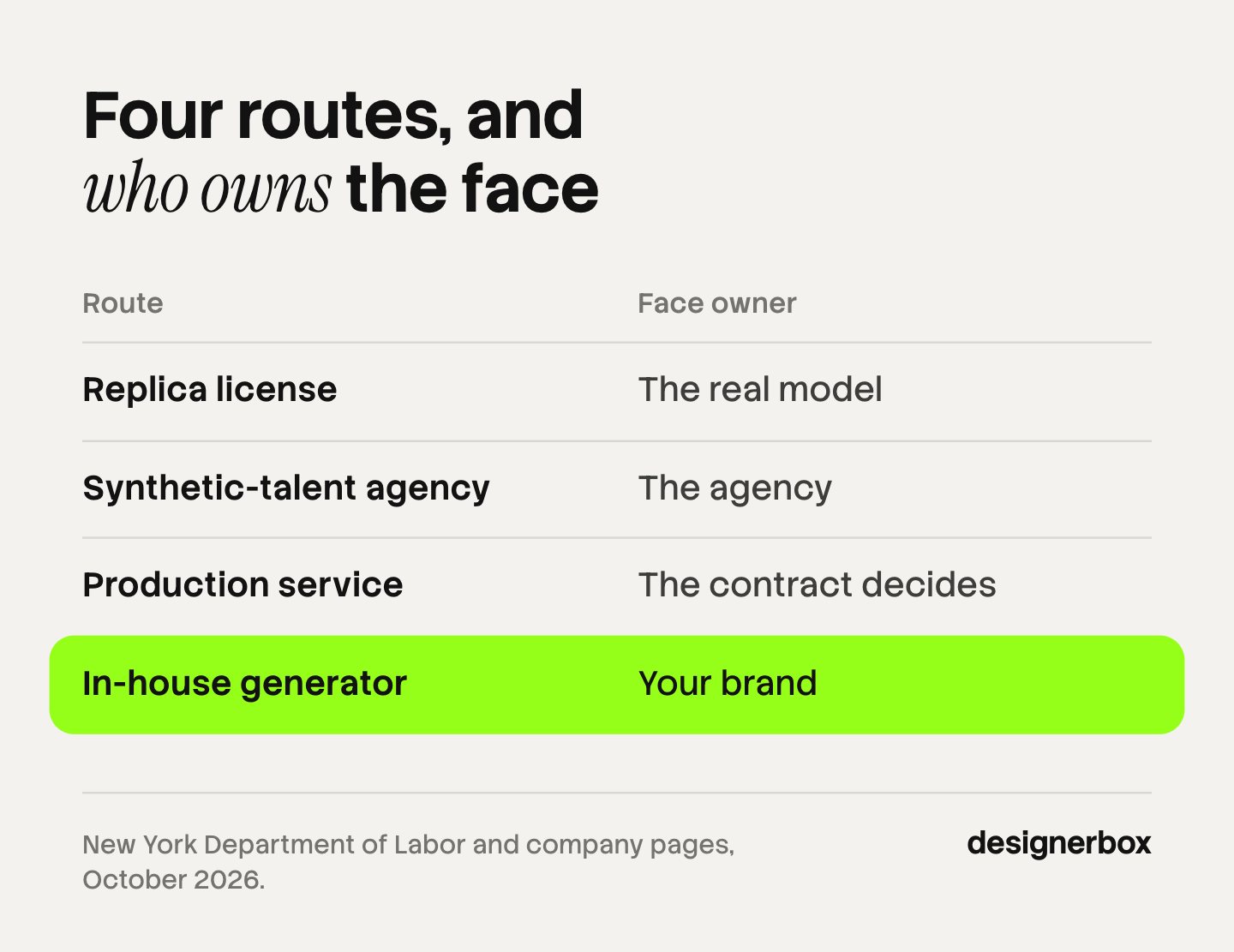
| Route | Who owns the face | What you receive | What to get in writing |
|---|---|---|---|
| Replica license from a real model | The real model | Images of a recognizable person, licensed per project | Her written consent: scope, purpose, pay rate, length of use |
| Synthetic-talent agency | The agency | A campaign with the agency’s character | Term, territory, paid-ads use, exclusivity |
| Done-for-you production service | The contract decides | Finished images of your garments | Who owns the model, source files, garment sign-off |
| In-house generator | Your brand, under the tool’s terms | Software, and a model you save and reuse | The tool’s commercial license terms |
The fourth row has a condition. A face you make with a tool is yours only as far as the tool’s terms say. Read the commercial license before a face goes into a paid ad. Our guide on how to create an AI fashion model covers the first frame of a model you plan to reuse.
Who owns the face, and what does the license cover?
The face is the asset, and it always has an owner. A real model owns her digital replica. An agency owns the character it invented. With a production service, the contract decides. The license then sets what your brand can do with the images: how long, in which countries, in which media, and whether another brand can use the same face.
Term. A license runs for a set time. A product page can stay live for years, so ask what happens to live images when the term ends.
Territory. A license names the countries. Match the list to the markets your store ships to.
Paid ads. A license can treat paid media as a separate use. If the image will run as an ad, the contract has to say so.
Exclusivity. Ask whether the same face can appear for a competitor.
Garment accuracy sits beside the license. An AI image can change a print, a seam or a logo. Agree who compares each result with the real garment, and who pays for a redo. Our comparison of AI models and real models lists where each one fits in a catalog.
Which laws and platform rules apply?
Two questions decide the rules: is the person real, and where does the image run? A replica of a real model needs her written consent under New York’s Fashion Workers Act. An invented person in an ad needs a disclosure in New York. In the EU, a realistic AI person can count as a deep fake, which needs a label. Ad platforms add their own label rules.
New York’s Fashion Workers Act. It took effect on June 19, 2025. The New York State Department of Labor says a client must obtain clear written approval from a model before creating or using her digital replica. The model must approve in writing the scope, purpose, rate of pay and length of time. A new campaign needs a new approval. The act applies to model management companies that do business in New York State, and to clients who contract for modeling services (dol.ny.gov, read October 2026).
Routine edits, such as color correction and minor retouching, are not digital replicas (dol.ny.gov definitions, read October 2026).
New York’s synthetic performer rule. General Business Law section 396-b covers the invented face. A person who makes an ad, and knows it contains a synthetic performer, must disclose that in the ad in a way people notice. A synthetic performer is a digitally created asset that looks like a human performer and is not recognizable as any identifiable real performer (nysenate.gov, read October 2026).
The EU AI Act, Article 50. It has applied since August 2, 2026. A brand that publishes a deep fake must disclose it, clearly, the first time a person sees it. The European Commission says the simulated person only needs to resemble someone who exists or can plausibly exist (Commission FAQ, read October 2026). So a realistic invented model can fall in scope.
TikTok ads. TikTok’s ad policy allows AI-generated content if the ad carries the AIGC label or a clear disclaimer, caption, watermark or sticker. It says an ad with undisclosed AI-generated content will be rejected or restricted (TikTok advertising policies, read October 2026).
This is general information, not legal advice. Our guide to labeling AI-generated fashion images goes through the label rules one channel at a time.
Eight questions to ask before you sign
Ask these eight questions of any AI model agency, and ask for each answer in writing. They cover consent, the license, the garment and the end of the contract.
- Is the face a real person, an invented character, or made for us? The answer tells you which of the three kinds you are hiring.
- If it is a real person, can we see the consent? Ask for the written approval that names scope, purpose, pay rate and length of use.
- What is the license term and territory? Get the dates and the countries.
- Does the license cover paid ads? Name the media: product pages, email, organic social, paid social, marketplaces, print.
- Is the face exclusive to us? If not, ask which categories are blocked.
- Who signs off garment accuracy? Name the person, and the number of redo rounds included.
- Do we receive source files, and who adds the AI label? Ask for full-size files, and agree who labels the images for each channel.
- What happens when the contract ends? Ask whether live images must come down, and whether the model can be reused.
How do you choose a route?
Choose by what the campaign needs most. A known face with her own audience points to a replica license. A character with a following points to a synthetic-talent agency. A team with no time points to a production service. A catalog that needs the same shot on every product, at every drop, points to the in-house route.
Volume changes the choice. A campaign is a handful of hero images, and an outside team suits it. A catalog is the same shots on every product, and it returns with every drop. Our guide to fashion brands using AI models covers how named brands have used them.
The in-house route: one model, every product
Anyone can make an AI picture. Making hundreds that still look like your brand is the hard part.
In-house, the face is a model you make once and reuse. In DesignerBox, an avatar run returns nine fixed poses for 25 credits. You save that model as a reference for every later run.
The garment comes from your own photo. Virtual try-on puts the garment on the model. It is garment-only. The Dress my model app does the same job through a form. Clothing catalog turns one garment into four shots: front, three-quarter, back and a fabric close-up.
You save these steps once as a workflow. The workflow reads your brand rules on every run. So the next product gets the same model, light and framing. A batch runs that workflow over a sheet, one product per row. Row one and row two hundred get the same standard. You see the cost before you press Run.
Review happens in the sheet. You keep or discard each result, and you re-run one row on its own. The page for fashion brands covers this job.
The full workflow from the first product photo to the finished ad, in one subscription.
Uploading your own photos and the commercial license start on the Pro plan. Virtual try-on starts on the Premium plan. Plans and credits are on the pricing page.
When an agency fits better
- You want a real person’s likeness. DesignerBox is software. It does not represent real models, and it does not license a real person’s likeness. A replica license does.
- You want someone else to do the work. DesignerBox does not produce the shoot for you. A production service does.
- You sell shoes or accessories. Try-on is garment-only. Shoes and accessories go through an image set, with a product photo as the reference.
- You need images sent to a store automatically. DesignerBox does not publish to a store. You download the results, or send them with a webhook or an S3 step.
- Your team needs several seats. Every plan below Ultra is one seat.
A free plan for your first run
Start from a template and see how a reusable model and a garment step fit together. The free plan runs on sample products.
FAQ
What is an AI model agency?
An AI model agency is a business that supplies on-model images made with AI. The name covers three kinds of business. One licenses digital replicas of real models. One owns invented characters and rents them. One produces on-model images for brands as a service.
Do I need consent to use a digital twin of a real model?
In New York, yes. Since June 19, 2025, the Fashion Workers Act requires a model’s clear written approval before a client creates or uses her digital replica. The approval must name the scope, purpose, pay rate and length of use.
Do AI generated models need a label in ads?
Often, yes. New York requires a disclosure in ads that contain a synthetic performer. The EU’s Article 50 requires a label on deep fakes, and a realistic invented person can count. TikTok requires an AIGC label or a clear disclaimer on AI-generated ad content.
Can I use an AI model for clothing product pages?
Yes. A replica license, a production service and an in-house generator can all deliver on-model images for a product page. Check two things first: that the license covers the product page for as long as the product is live, and that someone compares each image with the real garment.
What does the in-house route cost in DesignerBox?
An avatar run returns nine fixed poses for 25 credits. For every other step, the cost is shown before the run. Virtual try-on starts on the Premium plan. There is a free plan, and it runs on sample products.
Sources
- New York State Department of Labor, Fashion Workers Act FAQs: effective June 19, 2025, written approval of scope, purpose, rate of pay and length of time, new approval for a new campaign, who the act binds (dol.ny.gov, read October 2026)
- New York State Department of Labor, Fashion Workers Act definitions: digital replica, client, model management company (dol.ny.gov, read October 2026)
- New York General Business Law section 396-b: synthetic performer definition and the disclosure duty in ads (nysenate.gov, read October 2026)
- European Commission, FAQ on the transparency obligations under Article 50 of the AI Act: application from August 2, 2026, disclosure at first exposure, persons who can plausibly exist (digital-strategy.ec.europa.eu, read October 2026)
- TikTok advertising policies, misleading and false content: the AIGC label or a disclaimer, undisclosed AI content rejected or restricted (ads.tiktok.com, read October 2026)
- BBC News, H&M to use digital clones of models in ads and social media: 30 digital twins, models retain rights, pay arrangements (bbc.com, 2025, read October 2026)
- BBC News, on the Guess ad in Vogue: Seraphinne Vallora’s 10 draft models, the August 2025 print edition, a real model and photographer in the process (bbc.com, July 2025, read October 2026)
- Scandinavian MIND, interview with the founder of Alva: digital twins of real talent, ownership stays with the talent, licensed per project with approval (scandinavianmind.com, April 9, 2026, read October 2026)
- ModelManagement.com, digital twins: ID-verified models, consent, approval and pay for published campaigns, consent can be withdrawn (modelmanagement.com/digital-twins, October 2026)
- The Clueless: media tech agency, virtual talent led by Aitana López, more than 100 avatars (theclueless.ai, October 2026)
- Pixelz, Digital Twins: digital models from consenting real models, in-house generation and post-production (pixelz.com/digital-twins, October 2026)
- DesignerBox batch, apps and plan gates: DesignerBox batch page (designerbox.ai/product/batch) and DesignerBox pricing (designerbox.ai/pricing), October 2026
Laws, platform rules and company pages verified on the pages listed above in October 2026. Each company’s description of its own service is quoted from its own page or from the named press report. This is general information, not legal advice. Rules and services change, so check each page before you sign.