

Fashion marketing is the work of creating demand for clothing, shoes and accessories. It decides who a collection is for, which story sells it, which channels carry it and when each one goes live. Most of that work reaches the shopper as pictures and video. So every fashion marketing strategy is also a list of content, and each item on that list has a date.
That second part is where plans go wrong. Take one client’s spring drop: 12 looks. The plan has a brand campaign, product pages on the brand’s own site and on Amazon, paid social, creator seeding, email, a market launch abroad and a lookbook for wholesale buyers. That is seven strategies. The production calendar often has one shoot.
This guide is for agencies and in-house teams that run fashion accounts. It covers what fashion marketing is, the calendar it runs on, and seven strategies with the content each one needs. Then it covers where the content supply breaks, how to measure the work, how to run it for several client brands, and the AI label rules that now apply.
Key Takeaways
- Fashion marketing has three layers. The brand layer sells the image, the product layer sells the item, and the channel layer puts both in front of a buyer. Most strategy lists mix the three.
- Each strategy is a content list with a deadline. A brand campaign, a product page, a paid social plan and a wholesale lookbook each need different pictures from the same looks.
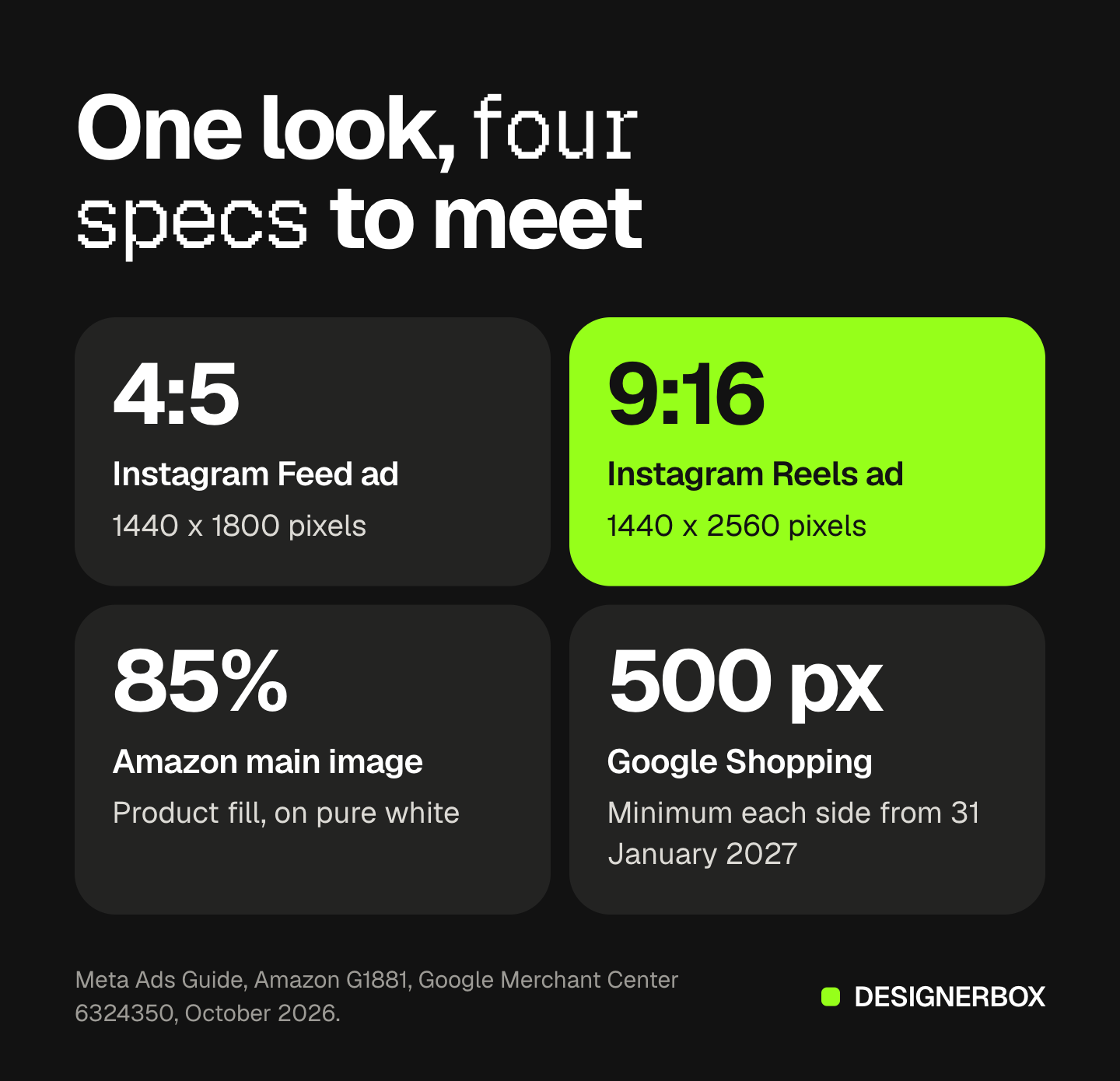
- The specs differ by channel. Meta recommends 4:5 at 1440 x 1800 pixels for an Instagram Feed image ad, and 9:16 at 1440 x 2560 for Reels. Amazon wants the main image on pure white, with the product at 85% of the frame.
- Paid social eats content every week. Motion’s 2026 benchmarks put new Meta creatives at 2.8 a week for accounts under $10K a month and 18.8 for accounts above $1M. About 5% of creatives become winners.
- Returns change the math. The National Retail Federation estimates that 19.3% of online sales were returned in 2025, so measure cost per kept order, not cost per order.
- Creators are now a main channel. IAB projects US creator ad spend at $37 billion for 2025, and 48% of ad buyers call creators a “must buy”.
- AI labels apply in the EU. Article 50 of the EU AI Act has applied since 2 August 2026. A realistic AI person in an ad can count as a deep fake, which you must disclose.
What is fashion marketing?
Fashion marketing is the planning and promotion that turns a collection into sales. It covers research on who buys, positioning against other brands, the story for each season, the channels that carry it and the content each channel shows. It sits between design and sales. Design makes the product, merchandising decides what to buy and how to price it, and marketing makes people want it.
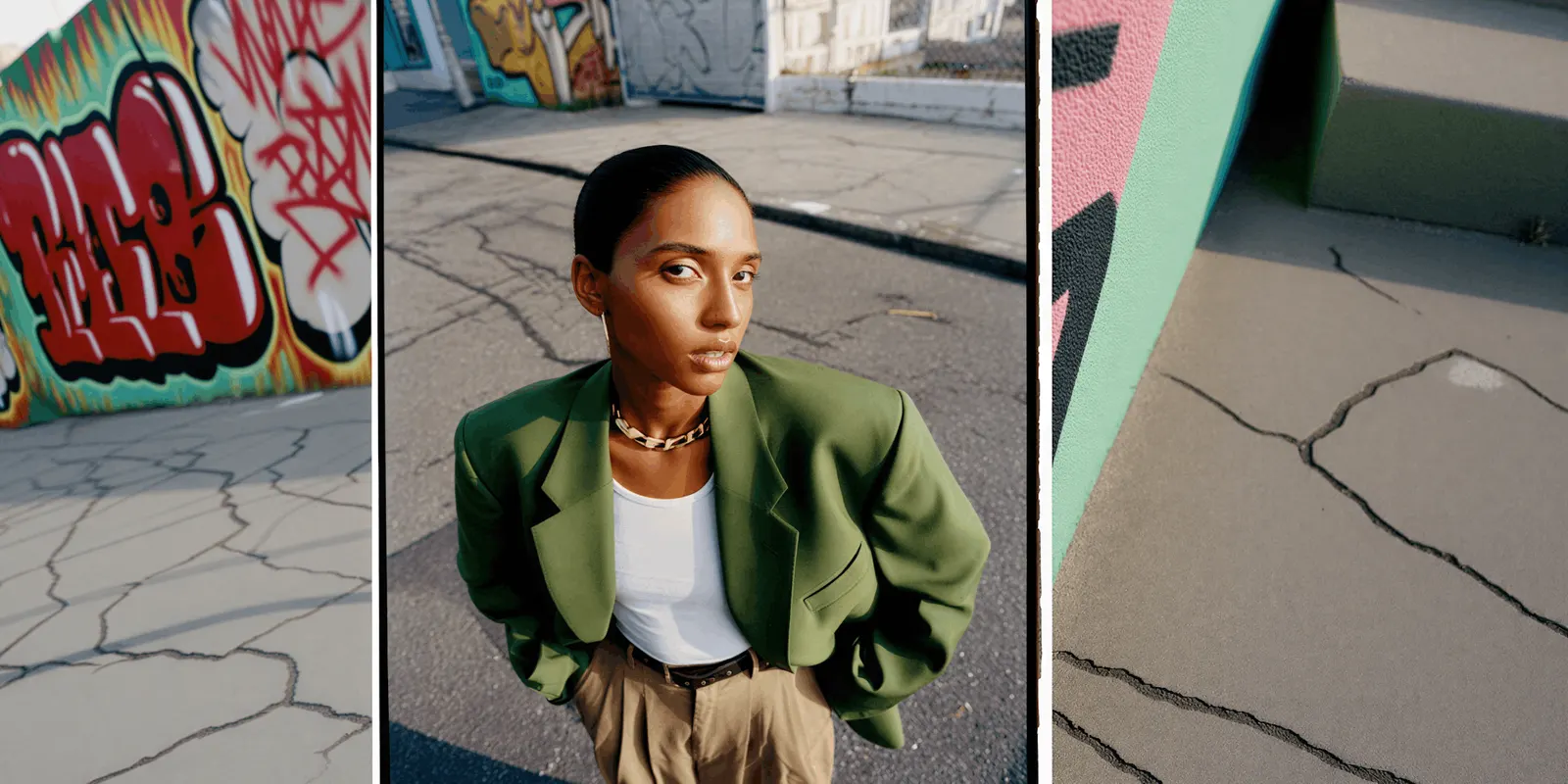
It helps to split the work into three layers, because each layer needs different content.
| Layer | What it sells | Typical content | Who sees it |
|---|---|---|---|
| Brand | The image and the story of the season | Campaign images, a short film, editorial frames | Everyone, before they look for a product |
| Product | One item, in one color and size | Packshots, on-model shots, detail shots, size notes | A shopper on a product page or a marketplace |
| Channel | The brand and the product, placed where people buy | Ad variants, creator content, email banners, a lookbook | People in a feed, an inbox or a buyer’s showroom |
A strategy that lives in one layer fails when another layer is empty. A strong campaign drives people to product pages with one flat photo. A strong paid social plan has nothing new to show by week three.
The fashion marketing calendar
Most fashion brands plan around two main seasons, spring/summer and autumn/winter. Many add pre-collections, capsules and monthly drops, plus sale periods. The marketing plan works back from the date stock lands in the warehouse.

That date sets the hard part of the calendar. Content has to exist before launch, and final samples can arrive late. So the shoot window is short, and anything missing from the call sheet waits for the next season.
A drop also has a long tail. The campaign runs for a few weeks, but product pages, ads and emails need new content for as long as the stock sells. Plan the content by week, not by shoot day.
Seven fashion marketing strategies and what each needs
Each strategy below has a job and a content list. Use the lists to build the shot list before the shoot, not after it.
1. The brand campaign
The campaign sets the story of the season. It runs on the homepage, in paid social, in press and in the brand’s own feed. It needs a small set of strong images, usually a short film, and cuts of both in every format the channels use. One hero image in one ratio does not cover a campaign.
2. Product pages and marketplace listings
The product page closes the sale, so it carries the most content per item. A typical set is a packshot, an on-model front and back, a detail shot of the fabric and a styled frame. Each marketplace has its own rules:
- Amazon clothing. The main image must be on a pure white background. Amazon’s clothing guide says main images must be photographed on a model, with exceptions for some items, and that only photos are allowed, not sketches or drawings (sellercentral.amazon.com, October 2026). Its general guide asks for the product to fill 85% of the image (sellercentral.amazon.com, October 2026).
- Google Shopping. Google will require product images of at least 500 x 500 pixels for all products from 31 January 2027, and it recommends 1500 x 1500 or more (support.google.com, October 2026).
Our guide to fashion photography at scale covers the product layer in detail.
3. Paid social
Paid social is a main way fashion brands find new customers, and it uses content fast. The formats are fixed by the placement. Meta recommends a 4:5 ratio at 1440 x 1800 pixels for an Instagram Feed image ad, and 9:16 at 1440 x 2560 pixels for Reels (facebook.com/business/ads-guide, October 2026).
Volume matters as much as format. Motion’s 2026 Creative Benchmarks cover 578,750 creatives from 6,015 advertiser accounts and $1.29 billion in Meta spend. Accounts launched 2.8 new creatives a week under $10K a month and 18.8 a week above $1M a month (motionapp.com, October 2026). About 5% of creatives became winners, meaning ads that spent at least 10 times the account median (motionapp.com, October 2026). Our guide to fashion ecommerce ROAS covers which pictures move ad results, and our guide to how to make an ad covers the parts of one variant.
4. Creators and influencers
Creators are now a main channel for brands. IAB projects US creator economy ad spend at $37 billion in 2025, up 26% on 2024. In the same report, 48% of ad buyers called creators a “must buy”, behind only social media and paid search (iab.com, October 2026).
The content work here is support. Creators need product shots for their own posts, a short brief and approved claims. If the brand runs creator posts as ads, it needs each post in the ad formats too. In the US, the creator must disclose a paid relationship with the brand. The FTC says words such as “ad” and “sponsored” work, and a hashtag such as #ad is fine (ftc.gov, October 2026).
5. Email and retention
Email sells to people who already bought once. It needs a banner per drop, product tiles for each new item, and pictures for automated flows such as back in stock and abandoned cart. The set is small, but it changes with every drop, and the product tiles have to match the product pages. Our guide to email banner size covers the formats.
6. A new market
Selling in a new country is a marketing strategy of its own. The campaign needs text in the local language, sizes and prices for that market, and sometimes a different season or setting. A translated headline can run longer than the original, so the layout often has to change too. Our guide to localizing ads without rebuilding them covers the steps.
7. Wholesale and lookbooks
Wholesale buyers see the collection before shoppers do. They need a lookbook with every look, a line sheet with style numbers and prices, and clean product shots they can use in their own stores. The lookbook often has to be ready before final samples exist. Our guide to the digital lookbook covers the tools and the layout.
What one look needs across channels
Put the seven lists side by side and the real size of the job appears. The table below is a planning list for one look, not measured data. Replace it with your own client’s channel plan.
| Strategy | Content per look | Format | How often it changes |
|---|---|---|---|
| Brand campaign | 1 to 3 hero frames, film cuts | 16:9, 4:5, 9:16 | Each season |
| Product page | Packshot, front, back, detail, styled frame | Square or 4:5 | Each new item or color |
| Marketplace | White main image, on-model extras | Per marketplace | Each new item or color |
| Paid social | Several ad variants | 4:5 and 9:16 | Every week or two |
| Creators | Product shots and a brief | Their formats | Each seeding round |
| Banner and product tiles | Email width | Each drop | |
| New market | Local versions of the above | Same as source | Each market launch |
| Wholesale | Lookbook frame and line sheet shot | Page layout | Each season |
Count each format in this planning list and one look passes 20 files. Multiply that by 12 looks and by the colors per look. A single shoot day rarely covers it, so fashion content creation is where plans stall.
Fashion content creation: where the plan breaks
The strategy deck is cheap to write. Feeding it is not. A shoot is a fixed date with fixed looks, fixed models and a fixed set of frames. Paid social wants new variants every week, product pages want every color, and a new market wants its own versions.
Returns make the gap more costly. The National Retail Federation and Happy Returns estimate that 19.3% of online sales were returned in 2025, against 15.8% of all retail sales (nrf.com, October 2026). A shopper who gets a different color or fit than the photo showed has a reason to send it back. So the product layer needs accurate color, real fabric detail and the garment on a body, for every item.
Three habits keep the supply in line with the plan:
- Build the shot list from the channel plan. Start from the table above, not from the moodboard.
- Shoot or make the reusable frames first. A clean front, back and detail of each look feed the product page, the marketplace, the ads and the lookbook.
- Plan the weekly refresh as content, not as media. If the ad plan needs six new variants a week, put six variants a week in the production plan.
Our guide to DTC marketing for fashion brands sizes the creative need for a whole drop.
How to measure fashion marketing
Measure each layer with its own number. A single blended return on ad spend hides where the problem is.
| Layer | What to measure | Why |
|---|---|---|
| Brand | Branded search and direct visits over the season | Shows whether the campaign built demand |
| Product | Product page conversion and returns by reason | Shows whether the pictures sell the right item |
| Channel | Cost per kept order, by channel | Shows what a customer who keeps the order costs |
Cost per kept order is the cost per order divided by one minus the return rate. With a cost of $40 per order and a 19.3% return rate, that is about $49.57 per kept order. That example is illustrative arithmetic. Use your own client’s return rate, by category, because it can differ between dresses, shoes and accessories.
Running fashion marketing for several client brands
An agency runs the same seven strategies for many brands at once. The work fails in the same places for each one, so the fix is a fixed setup per client:
- One brand record per client. Logos, fonts, colors, voice, rules and reference pictures, kept in one place and read on every job.
- One content list per drop. The table above, filled in for that client’s channels, before anyone books a shoot.
- One review round with the client. Send the client the pictures, let them choose, and run the next step only on what they chose.
- Labels by market. Note which markets need an AI label before the files go out.
Our guide to managing creative for multiple clients covers the setup in detail.
AI labels in fashion marketing
Many fashion teams now make part of their content with AI, so the label rules matter. This section is general information, not legal advice.
In the EU, Article 50 of the AI Act has applied since 2 August 2026. A brand that publishes a deep fake must disclose that it was made or changed with AI, clearly and the first time a person sees it (digital-strategy.ec.europa.eu, September 2026). A packshot with no misleading change is not a deep fake. A realistic person who never existed can still be one, because the Commission’s guidelines count people who could plausibly exist. Fines reach EUR 15 million or 3% of worldwide annual turnover (ai-act-service-desk.ec.europa.eu, September 2026).
The platforms add their own rules:
- Meta asks for an AI disclosure only in social issue, election and political ads. It adds an “AI info” label itself when it detects signs of third-party AI, such as C2PA data. That label usually sits in the “About this ad” menu (facebook.com/business/help, September 2026).
- Amazon asks sellers to tag images of photorealistic people made fully by AI with the keyword contains-synthetic-performer before upload (sellercentral.amazon.com, October 2026).
- Google Merchant Center says every product image made with generative AI must keep the metadata that marks it as AI-generated (support.google.com, October 2026).
Our guide to labeling AI-generated fashion images covers each rule by market.
Fashion marketing production in DesignerBox
Anyone can make an AI picture. Making hundreds that still look like your brand is the hard part.
DesignerBox is AI creative production for brands and agencies. For an agency with fashion clients, the setup follows the section above. You save each client as a brand: products, logo, colors, up to 6 fonts, voice, rules and up to 12 reference pictures. You build each content list once as a workflow, and the workflow reads that client’s brand on every run. You can publish the workflow as an app, so a junior completes a form and presses Run. Batch runs it over a sheet of up to 200 rows, one row per product, and the standard is the same on row one and row two hundred.
Several of the jobs in this guide are ready apps. Clothes on a model puts a garment on a model. Pictures for a listing makes six marketplace pictures from one product photo. Ad in other sizes turns one ad into four sizes, and Ad in other languages rebuilds an ad in another language. For the campaign film, the video editor has a timeline with several tracks, transitions, animated text and audio.
Reviews sends your client a page of pictures as a link. The client opens it with no account, ticks the pictures they want and sends the choice back. A review costs no credits, and the link works for 30 days. The pictures, the ads, the edit and each client’s brand stay in one account, from the first product photo to the last ad variant.
The cost is shown before the run.
The limits, stated plainly:
- Seats. Every plan below Ultra is one seat. Team features, shared brand kits and white label are on the Ultra plan.
- Garments only. Clothes on a model works for garments. It does not put a shoe on a foot or a bag on an arm.
- Delivery. DesignerBox does not publish to a store, a marketplace or an ad account. You download the results, or send them with a webhook or an S3 step.
- Labels. DesignerBox does not decide which market needs an AI label. Your team checks that before the files go out.
Uploading your own photos and the commercial license start on the Pro plan. AI video, virtual try-on and the video editor start on the Premium plan. Plans and credits are on the pricing page. The page for agencies covers this job.
A demo for your agency
See one fashion client’s content list built as a workflow, then run on a sheet of products.
FAQ
What is fashion marketing?
Fashion marketing is the work of creating demand for clothing, shoes and accessories. It covers who a collection is for, the story that sells it, the channels that carry it and the content each channel shows. It sits between design, which makes the product, and sales, which closes the order.
What are the main fashion marketing strategies?
Seven strategies cover the main jobs for a fashion brand: the brand campaign, product pages and marketplace listings, paid social, creators and influencers, email and retention, launches in new markets, and wholesale with lookbooks. Each one needs its own set of pictures and video from the same looks.
What is the difference between fashion marketing and fashion merchandising?
Fashion merchandising decides what the brand buys or makes, how much of it, at what price and where it is placed. Fashion marketing makes people want it. The two meet on the product page, where the merchandiser’s range meets the marketer’s pictures and copy.
How much content does a fashion brand need for one drop?
The answer comes from the channel plan, so count it per look. List every channel the brand uses, write the pictures each one needs for one look, then multiply by the looks and colors in the drop. In the planning table in this guide, one look passes 20 files once you count each format.
Do fashion brands have to label AI images?
The rules differ by market and by image. In the EU, a brand must disclose a deep fake, and a realistic AI person can count as one. A packshot with no misleading change is not a deep fake. Amazon asks for a metadata tag on photorealistic AI people, and Google asks you to keep AI metadata on product images. This is general information, not legal advice.
What does a fashion marketing agency do?
A fashion marketing agency runs some or all of the seven strategies for a brand. That usually means campaign concepts, paid social, creator programs, email and the content for each. Many agencies also produce the pictures and video for each strategy.
Sources
- Meta, Ads Guide: Instagram Feed image ad specs and Instagram Reels video ad specs (facebook.com/business/ads-guide, read October 2026)
- Motion, Creative Benchmarks 2026: scale and volume, and winners are rare (motionapp.com, read October 2026)
- National Retail Federation, 2025 Retail Returns Landscape press release, October 2025 (nrf.com, read October 2026)
- IAB, 2025 Creator Economy Ad Spend and Strategy Report press release, November 20, 2025 (iab.com, read October 2026)
- Federal Trade Commission, Disclosures 101 for Social Media Influencers (ftc.gov, read October 2026)
- Amazon Seller Central, Image guidelines for clothing, G200498950, and Product image guide, G1881 (sellercentral.amazon.com, read October 2026)
- Google Merchant Center, Image requirements, 6324350 (support.google.com, read October 2026)
- European Commission, FAQ on the transparency obligations under Article 50 of the AI Act (digital-strategy.ec.europa.eu, read September 2026)
- AI Act Service Desk, Article 99, penalties (ai-act-service-desk.ec.europa.eu, read September 2026)
- Meta Business Help, AI info labels on ads (facebook.com/business/help, read September 2026)
- DesignerBox brands, apps, batch, Reviews and plan gates: DesignerBox for agencies (designerbox.ai/for/agencies) and DesignerBox pricing (designerbox.ai/pricing), October 2026
Platform specs, market data and label rules verified on the pages listed above in September and October 2026. Specs and rules change, so check the current page before a shoot. This article is general information, not legal advice.