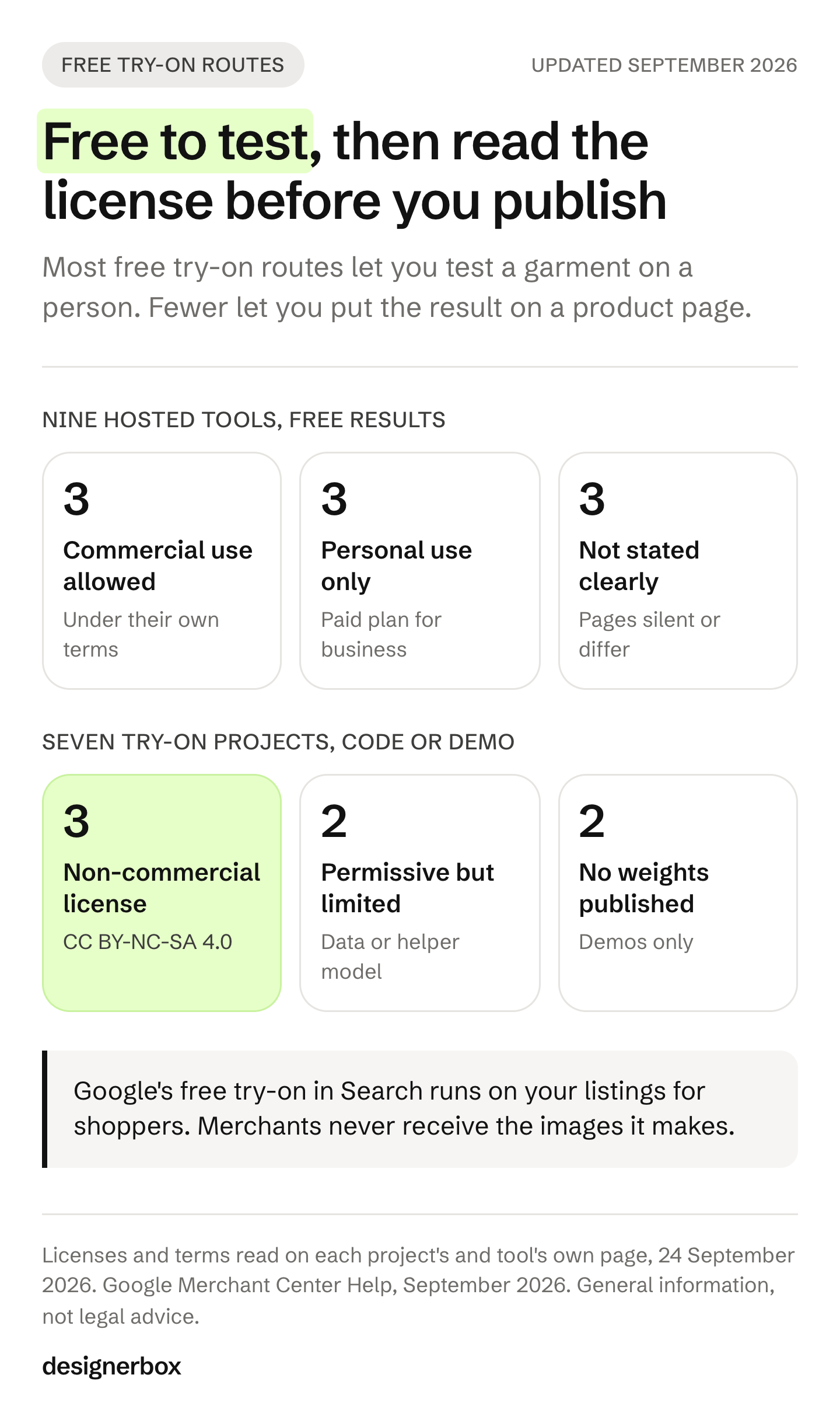
Free AI virtual try-on for a store comes in three forms: Google’s try-on in Search, open research models on Hugging Face, and hosted tools with free credits. All three let you test a garment on a person. Fewer let you publish the result. Three open models are non-commercial. Of nine hosted tools, three allow commercial use of free results. Google never gives you its try-on images.
A free try-on answers one question: does this garment work on a person? A product page asks a second question: may you show this image to buyers? The two answers often differ. A free demo can pass the first test and fail the second, because its license does not allow commercial use.
This guide is for shops and brands that sell clothing, from a solo founder with 30 products to a team with 500. It checks each free route against its own license or terms, read on 24 September 2026. DesignerBox publishes this guide and offers virtual try-on for fashion brands on its paid plans, so we are not neutral. We say where a free route is enough.
Key Takeaways
- Two jobs share one name. Shoppers use try-on to see clothes on their own body. Sellers use it to put a garment on a model for the product page. This guide covers the seller’s job.
- Google’s try-on is free for shoppers, and you do not get the images. Eligible merchants are enrolled automatically, and Google says merchants won’t have access to the generated looks (Google Merchant Center Help, September 2026).
- Three open models are non-commercial. IDM-VTON, OOTDiffusion and CatVTON are all released under CC BY-NC-SA 4.0, a license that excludes commercial use.
- Two open models use permissive licenses, and each has a limit. Leffa is MIT and FASHN VTON v1.5 is Apache-2.0. The training data or a helper model carries non-commercial terms.
- Hosted tools split three ways. Of nine hosted tools checked, three allow commercial use of free results, three keep free results for personal use, and three are silent or unclear.
- Google also sells try-on as an API. It costs $0.06 an image, and Google does not claim ownership of the result.
- DesignerBox has no free try-on. Virtual try-on starts on the Premium plan.
What does free AI virtual try-on mean for a store?
Free AI virtual try-on means an AI tool puts a garment onto a person in a photo, at no cost to you. For a store, that covers two different jobs. The shopper-facing job shows your garment on the buyer’s own body. The seller-facing job puts your garment on a model for your product page. Each job has its own free routes and its own rules.
The shopper-facing job has one large free route: Google’s try-on in Search. It may already run on your products, and the next section covers it. If you want try-on inside your own store, adding virtual try-on to your store covers the build. It also covers the privacy law for a shopper’s photo.
The seller-facing job is where most free tools compete. It is also where the license decides what you may do with the result. The rest of this guide covers that job.
The free routes at a glance
Every route below except the last one is free to test. The last column is the one that matters for a product page.
| Route | What is free | Your own model photo | Can you publish the result? |
|---|---|---|---|
| Google try-on in Search | Shoppers try on your listed garments | No, the shopper’s photo | No, merchants never receive the images |
| IDM-VTON, OOTDiffusion, CatVTON | Code, weights and Hugging Face demos | Yes | No, CC BY-NC-SA 4.0 is non-commercial |
| Leffa | Code and weights | Yes | MIT license, but trained on non-commercial data |
| FASHN VTON v1.5 | Code and weights | Yes | Apache-2.0, but a helper model is non-commercial |
| OutfitAnyone demo | A Hugging Face demo | No, preset models only | Not stated, no terms for results are published |
| Kolors Virtual Try-On demo | A Hugging Face demo | Yes | Not stated, no terms for results are published |
| ImageHub, Pincel, Botika | Free runs or trial credits | Yes, except Botika | Yes, under each tool’s terms (Botika: your own fashion business only) |
| Magic Hour, Krea, YouCam | Free runs or free credits | Yes | No, commercial use needs a paid plan |
| FASHN, The New Black, bitStudio | Free credits or free runs | Yes | We found no single clear statement |
| Google Virtual Try-On API | Nothing, it costs $0.06 an image | Yes | Yes, Google does not claim the result |
Licenses and terms were read on each project’s or tool’s own page on 24 September 2026. Terms change, so read the current version before you publish.
How does Google’s free try-on use your listings?
Google’s try-on lets a shopper see a garment from Google’s product results on their own photo. Any merchant with a shopping feed that can show free listings is enrolled automatically. The result depends on your product images, so their quality sets the quality of the try-on. You never receive the images shoppers make, and the button does not appear on Sponsored results.

Those facts come from Google’s own merchant help page on try-on (September 2026). The same page lists shoes, tops, bottoms and dresses as supported. Lingerie, bathing suits and accessories are not supported. Shoppers must be signed in and 18 or older. Google’s shopping help page lists 18 countries and regions, including the US, the UK, Canada, Australia and Japan (Google Shopping Help, September 2026).
Google also sets rules for the product image it works from. Your image must be at least 512 by 512 pixels, and ideally 1024 pixels or larger. Google’s best practices ask for the listed garment alone, shown in full, on a model who faces forward with arms down. Flat lays should not have deep folds. Hands and bags should not cover the garment.
That list is the useful part for a seller. A clean, front-facing on-model shot helps your product page. It also helps the free try-on Google runs on your listing. If you do not want the feature, ask Google Customer Support to remove the Try-on button from your Merchant Center account. Google Try-on also uses images it finds through Google Image Search. Domain owners without Merchant Center can use Google’s opt-out form to remove their domain’s images from Try-on.
Two dates are worth knowing. Since 11 December 2025, shoppers in the US can make a digital version of themselves from one selfie (Google blog, September 2026). They can then use it for try-on. Google set 30 April 2026 as the end date for its separate Doppl app (Google Labs Help, September 2026).
Which open try-on models allow commercial use?
Of seven try-on projects with public code or demos, checked on 24 September 2026, three carry a non-commercial license: IDM-VTON, OOTDiffusion and CatVTON. Two carry permissive licenses: Leffa under MIT and FASHN VTON v1.5 under Apache-2.0. Each of those two has a limit in its training data or a helper model. OutfitAnyone and Kolors Virtual Try-On publish no model weights.
Open models are a good free route for testing. You can run the public demos with no account. With a suitable graphics card, you can also run the code on your own computer. Demos on Hugging Face’s ZeroGPU hardware share a daily quota. It is 2 minutes of GPU time without an account, 5 minutes with a free account and 40 minutes on a PRO account (Hugging Face docs, September 2026).
IDM-VTON, OOTDiffusion and CatVTON
These three are research projects with public code and model weights. Use OOTDiffusion when the garment is a skirt, trousers or a dress. Its full-body model has separate settings for upper-body garments, lower-body garments and dresses (OOTDiffusion on GitHub, September 2026). Its last code change is dated 13 May 2024.
All three use the same license. IDM-VTON states that “the codes and checkpoints in this repository are under the CC BY-NC-SA 4.0 license” (IDM-VTON on GitHub, September 2026). CatVTON applies it to “code, checkpoints, and demo” (CatVTON on GitHub, September 2026). The NC in that license means non-commercial. A product page sells a product, so a result from these models belongs in your tests, not on your listing.
Leffa
Leffa’s code and weights are released under the MIT license, which allows commercial use (Leffa on GitHub, September 2026). The paper’s authors include researchers at Meta AI (arXiv, September 2026).
The limit is the training data. Leffa’s released try-on models were trained on the VITON-HD and DressCode datasets. VITON-HD is released under CC BY-NC 4.0, for non-commercial purposes (VITON-HD on GitHub, September 2026). Dress Code says the dataset “will not be released to private companies” (Dress Code on GitHub, September 2026). We found no clear answer on whether weights trained on that data are safe for commercial use. Ask a lawyer before you use Leffa for a catalog.
FASHN VTON v1.5
FASHN, a company that sells a paid try-on product, has released an open try-on model under the Apache-2.0 license (huggingface.co/fashn-ai, September 2026). It handles tops, bottoms and one-piece garments. Its results are 576 by 864 pixels, which is under the 1024 pixels Google calls ideal for a product image.
The limit is a helper model. The pipeline downloads a human parser on first use. That parser carries NVIDIA’s SegFormer license, which limits it to non-commercial use (github.com/fashn-AI, September 2026). The Apache-2.0 license on the try-on weights does not answer the question alone. To compare FASHN’s paid product with other tools, see FASHN AI alternatives.
OutfitAnyone and Kolors Virtual Try-On
Both are free demos on Hugging Face from research teams. OutfitAnyone, from the HumanAIGC group, shows your garment on a preset model, so you need no model photo of your own. Its demo says: “Models are fixed and cannot be uploaded or modified” (OutfitAnyone on Hugging Face, September 2026). Its GitHub page holds a README and demo media, with no code or weights.
Kolors Virtual Try-On comes from Kuaishou’s Kolors team. It takes your own person photo and a garment photo (Kolors Virtual Try-On on Hugging Face, September 2026). The demo code sends both images to a Kuaishou server to run the try-on. No try-on weights are published, and no terms for the results are published either. Kuaishou’s base Kolors model asks businesses to register with the licensor before commercial use (Kolors on GitHub, September 2026). If a garment is not yet released, check where its photo goes before you upload it.
Which hosted try-on tools allow commercial use on the free plan?
Hosted tools are the fastest free route: you upload a photo and get a result in a browser. Of nine hosted tools checked on 24 September 2026, three allow commercial use of free results in their own terms. Three keep free results for personal use and sell commercial rights on paid plans. Three do not say, or say different things on different pages.
| Tool | Free use | Your own model photo | Free results for commercial use? |
|---|---|---|---|
| ImageHub | Daily free runs, no account | Yes | Yes (imagehub.ai/terms, September 2026) |
| Pincel | Free credits at sign-up | Yes | Yes (pincel.app/terms, September 2026) |
| Botika | Trial credits, account needed | No, the platform supplies the model | Yes, for your own fashion business only (botika.com/legal/terms-of-service, September 2026) |
| Magic Hour | Daily free try-ons, no account | Yes | No, a paid plan or credit pack is needed (magichour.ai/terms-of-service, September 2026) |
| Krea | A free plan | Yes | No, the commercial license starts on Pro (krea.ai/pricing, September 2026) |
| YouCam Online Editor | Free credits at sign-up | Yes | No, the commercial license is on Pro (perfectcorp.com, September 2026) |
| FASHN | Free credits for new accounts | Yes, or a library model | Terms tie it to your plan and do not name free credits (fashn.ai/legal/terms-of-service, September 2026) |
| The New Black | Free credits at sign-up | Yes | We found no single clear statement (thenewblack.ai, September 2026) |
| bitStudio | Daily free try-ons | Yes | We found no single clear statement (bitstudio.ai, September 2026) |
ImageHub and Pincel are the two simplest free routes for a seller. Both take your own model photo and a garment photo. Both terms say results may be used for personal and commercial purposes. ImageHub says it adds no watermark. Its terms also say you must hold the rights of any person who appears in your images.

Botika is built for clothing brands and retailers. It puts your garment on an AI model it supplies. Its FAQ says results can be used commercially. Its terms limit that license to your own fashion business, and they say the photos belong to Botika (botika.com/legal/terms-of-service, September 2026). Read that clause before you use the trial for a catalog.
Magic Hour, Krea and YouCam all offer free use, and Magic Hour says its free results carry no watermark. All three keep commercial use for paying users. Magic Hour’s terms limit free results to “personal, non-commercial use”. Krea and YouCam put the commercial license on their Pro plans. YouCam’s pricing page also says free images are saved with a watermark.
FASHN, The New Black and bitStudio all offer free credits or free runs. FASHN’s terms tie commercial use to your subscription plan and do not mention the free credits. For The New Black and bitStudio, we found no single statement about free results. Each tool’s try-on page and pricing page use different words on commercial rights. For any of the three, ask the company in writing before you publish a free result.
Read the upload clause too. Some terms give the company a license to the photos you upload, for example to run or improve the service. That matters when the garment is part of an unreleased collection.
What does Google’s paid try-on API cost?
Google’s Virtual Try-On API is a paid route under a model vendor’s own terms. It costs $0.06 for each image made from one person photo and one clothing photo (Google Cloud pricing, September 2026). Google’s service terms say the result is your data. They also say Google does not claim ownership of it.
The model, virtual-try-on-001, has been generally available since 20 January 2026 (Google Cloud docs, September 2026). Google lists 15 March 2027 as its retirement date. One request accepts at most two images and returns up to four results. The results have the same resolution as the input. The model supports Content Credentials (C2PA), a standard label that records how an image was made. The service terms that cover the result are on Google Cloud’s service terms page (September 2026).
As an illustration, 100 garments with 4 results each is 400 images. At that rate, that is $24. The cost is low, and the work is in the setup. Someone has to build a Google Cloud project and write the calls. The API also does one step only: the try-on itself.
A five-garment test before you publish
Before you use any try-on route for a catalog, run it on five garments where try-on often fails. Compare each result with the flat product photo at full size.
- An all-over print. Check that the pattern keeps its scale and does not warp at the seams.
- A logo or text. Check that every letter is readable and spelled the same.
- A knit or textured fabric. Check that the texture looks the same up close.
- A collar, cuff or ribbed hem. Check that the ribbing and the collar shape are still there.
- A full-length dress or trousers. Check the hem length and the shape of the fabric on the body.
Also check the color against the real garment in daylight. Mark each result as publish, fix or reject. If two or more of the five fail, use that route for tests only.
Then run three rights checks.
- Whose photo is the person? If you upload a real model’s photo, your model release must cover AI edits. What a model release form has to cover lists the fields.
- Does the result change how the product looks? Since 2 August 2026, Article 50 of the EU AI Act requires deployers to disclose deep fakes (European Commission FAQ, September 2026). The Commission’s guidelines give an example: an AI product image that misleads people about how the real product looks (Commission guidelines, September 2026). Labeling AI-generated fashion images covers when a label is needed. This is general information, not legal advice.
- Does the page promise fit? Google’s own help page says its try-on “doesn’t indicate fit, suggest a size, or indicate size availability”. Virtual try-on fit accuracy covers what the research shows.
Try-on across a whole catalog
Anyone can make an AI picture. Making hundreds that still look like your brand is the hard part. A free tool works on one garment at a time. A catalog needs the same model, the same light and the same framing on every product.
DesignerBox is AI creative production for brands and agencies. Scale your images, ads and video with AI and keep your brand on every piece: build the workflow once with your brand rules, run it on every product, see the cost before each run, and keep everything from the first product photo to the finished ad in one place.
Dress my model puts one garment on a model. Clothing catalog turns one garment into four shots: front, three-quarter, back and a fabric close-up. You set the brand once, and the workflow reads it on every run. A saved workflow runs the same way on the next product, and batch runs it over the whole sheet at once. Three critic steps score the results, and best-of-N keeps the best one. For the steps in order, see how to put clothes on a model with AI. The full workflow from the first product photo to the finished ad, in one subscription.
Here are the limits, stated plainly. DesignerBox has no free try-on. There is a free plan, and it does not include virtual try-on or video. The commercial license starts on the Pro plan. AI video and virtual try-on start on the Premium plan. Team features, shared brand kits, white label and the API are on the Ultra plan, and every plan below Ultra is one seat. Plans and credits are on the pricing page.
A free route can be enough for a small range. If you sell 20 garments, ImageHub, Pincel or your own clean photos may do the job. A paid route is worth it when the same on-model job repeats across a range. See how that job runs on the DesignerBox page for fashion brands.
FAQ
Is there a free AI virtual try-on I can use for product photos?
Yes, with limits. ImageHub and Pincel state in their terms that free results may be used commercially. Botika allows commercial use for your own fashion business only (their terms pages, September 2026). Open models such as IDM-VTON and OOTDiffusion are free to test. Their CC BY-NC-SA 4.0 license excludes commercial use. Read the current terms before you publish.
Can I use Hugging Face try-on demos for my store?
Test with them, but check the license before you publish a result. IDM-VTON, OOTDiffusion and CatVTON are released under CC BY-NC-SA 4.0, which is non-commercial. OutfitAnyone and the Kolors Virtual Try-On demo publish no terms for their results.
Does Google charge merchants for its virtual try-on?
Google’s merchant help page lists no fee (support.google.com/merchants, September 2026). It says any merchant with a shopping feed that can show free listings is enrolled automatically. Merchants do not receive the images shoppers make. The feature does not appear on Sponsored results.
How do I remove my products from Google’s try-on?
Contact Google Customer Support from your Merchant Center account and ask to remove the Try-on button. Domain owners without Merchant Center can use Google’s opt-out form. Google says removing the button from your listings does not affect other merchants who sell the same product (support.google.com/merchants, September 2026).
What happened to Google’s Doppl app?
Google’s help page gave 30 April 2026 as the end date for Doppl, with the app leaving the App Store and Google Play. US shoppers can still make a digital version of themselves from a selfie. They do this inside Google’s try-on in Search and Shopping.
What product photo gives the best try-on result?
Google’s guidance works for any tool. Show one garment, in full, on a front-facing model with arms down. Use 1024 pixels or larger. Hands, bags and accessories must not cover the garment. A flat lay should have no deep folds.
Does DesignerBox have a free virtual try-on?
No. There is a free plan, and virtual try-on starts on the Premium plan. The cost of each run is shown before you run it.
Sources
- Google Try-on for merchants, enrollment, categories, image rules, opt-out and data access: Google Merchant Center Help, accessed 24 September 2026
- Google Try-on countries and shopper requirements: Google Shopping Help, accessed 24 September 2026
- Selfie try-on in the US from 11 December 2025: Google blog, accessed 24 September 2026
- Doppl end date of 30 April 2026: Google Labs Help, accessed 24 September 2026
- Virtual Try-On API model, release and retirement dates, limits and C2PA: Google Cloud docs, accessed 24 September 2026
- Virtual Try-On API price: Google Cloud pricing, accessed 24 September 2026
- Ownership of generated output: Google Cloud service terms, accessed 24 September 2026
- IDM-VTON license: GitHub, accessed 24 September 2026
- OOTDiffusion license, garment categories and last commit: GitHub, accessed 24 September 2026
- CatVTON license: GitHub, accessed 24 September 2026
- Leffa license, training data and authors: GitHub and arXiv, accessed 24 September 2026
- VITON-HD license: GitHub, accessed 24 September 2026
- Dress Code dataset terms: GitHub, accessed 24 September 2026
- OutfitAnyone preset models: Hugging Face, accessed 24 September 2026
- Kolors Virtual Try-On demo and Kolors commercial registration: Hugging Face and GitHub, accessed 24 September 2026
- ZeroGPU quotas: Hugging Face docs, accessed 24 September 2026
- EU AI Act Article 50: European Commission FAQ and Commission guidelines, accessed September 2026
- FASHN VTON v1.5 license, garment types, output size and parser license: huggingface.co/fashn-ai and github.com/fashn-AI, accessed 24 September 2026
- Hosted tool terms: imagehub.ai/terms, pincel.app/terms, botika.com/legal/terms-of-service, magichour.ai/terms-of-service, krea.ai/pricing, perfectcorp.com (YouCam Online Editor terms), yce.perfectcorp.com/pricing, fashn.ai/legal/terms-of-service, thenewblack.ai, bitstudio.ai, accessed 24 September 2026
- DesignerBox plan gates and the cost shown before each run: DesignerBox pricing page (designerbox.ai/pricing), September 2026
Licenses and terms verified on each project’s or tool’s own page as of September 2026. Terms change often, so read the current version before you publish a result. This is general information, not legal advice. Individual results vary.