
Virtual try-on fit accuracy is low in the try-on products we found. They show how a garment looks and render a good fit by default. New research from the University of Washington and Google Research, called FIT and accepted to SIGGRAPH 2026, trains on 1.13 million images with measured bodies and measured garments. That lets it render a top that is too big or too small (arxiv.org/abs/2604.08526, April 2026).
That is a real advance, and it is being read as the wrong kind of advance.
The headline going around is that fit-aware try-on will fix returns. It will not, at least not on the timeline people are implying, and the reason has nothing to do with the model quality. Virtual try-on fit accuracy is a rendering problem before it is a sizing one. This piece covers what the research built, why the returns story is softer than it looks, and the one thing fit-aware generation changes for the on-model images you are shipping to a PDP this quarter.
Key Takeaways
-
The research is real and specific. FIT is a 1.13 million-sample dataset with ground-truth body and garment measurements, plus a baseline model called Fit-VTO built on top of it (arxiv.org/abs/2604.08526, April 2026).
-
The gap it closes is rendering, not recommending. Prior try-on models default to a flattering fit regardless of the sizes involved. Fit-VTO can render a mismatch. That is a picture problem solved, not a sizing problem solved.
-
A fit-accurate render needs a measured shopper. The model conditions on body measurements. Almost no ecommerce brand holds a real measurement for a real customer, and asking for one costs conversion.
-
The returns number is not well established. The NRF projected total 2025 returns at $849.9 billion and 19.3% of online sales (nrf.com, October 2025). The share caused by size and fit is reported across a very wide range depending on who is counting.
-
The near-term payoff is catalog credibility. A model that understands drape across sizes produces on-model images that look right on a body that is not a sample size. That payoff needs no shopper data, and it is the input a credible size range on the product page depends on.
-
The authors are explicit about the limits. Upper-body garments, front-facing views, casual poses, simple structural designs. Tightness in particular is hard to represent.
How accurate is virtual try-on for fit?
Standard virtual try-on is not accurate for fit. It takes a person image and a garment image and produces a well-fitted result by default. Fit-aware virtual try-on changes that: it generates an image of a person wearing a garment while taking real body and garment measurements as an input. A fit-aware model can also produce the honest result: a size XS top rendered on a 3XL body, straining where it would strain.
The distinction sounds academic. It is the difference between a styling tool and a measurement tool, and those two things get sold as one product constantly.
Garment development has its own fit tools, and they work before any product photo exists. 3D programs such as CLO and Browzwear drape the pattern on an avatar so a team can check fit before it cuts a sample. The 3D fit tools in AI pattern making software covers what each one automates.
What the FIT research built
The work comes from Johanna Karras, Yuanhao Wang, Yingwei Li and Ira Kemelmacher-Shlizerman, across the University of Washington and Google Research (johannakarras.github.io/FIT, October 2026).
The dataset is the contribution. Real try-on data does not come with ground-truth measurements attached, so the team generated the data instead. Garments were built programmatically with GarmentCode and draped using physics simulation, then a re-texturing step converted the synthetic renders into photorealistic images while holding the geometry fixed (arxiv.org/abs/2604.08526, April 2026).
The scale, as published:
| What | Count |
|---|---|
| Training samples | 1,137,282 |
| Test samples | 1,000 |
| Distinct body shapes | 168 (82 men’s, 86 women’s) |
| Size range | XS to 3XL |
| Body poses | 528 |
| Unique garment designs | 158,483 |
Those counts come from the arXiv paper. The project page now lists 1,064,824 training samples and 5,000 test samples (johannakarras.github.io/FIT, October 2026).
The companion model, Fit-VTO, is a flow-based diffusion model fine-tuned from Flux.1-dev with a measurement encoder that lets body and garment measurements condition the generation (arxiv.org/abs/2604.08526, April 2026). As of October 2026, the project page links a dataset on Hugging Face and the code on GitHub.
Read the shape of that dataset carefully. Every body in it is synthetic and every measurement in it is exact, because that was the only way to get measurements at all. The model learns the relationship between numbers and drape. It learns it from a world where the numbers are always known.
Why “solves returns” is the wrong read
The returns problem in apparel is genuinely large. The National Retail Federation projected total US merchandise returns at $849.9 billion in 2025, or 15.8% of annual sales, with 19.3% of online sales returned (nrf.com, October 2025).
What is much less settled is how much of that is size and fit. Published estimates vary widely. Coresight Research, for example, reports that nearly 70% of US shoppers who returned clothing bought online named size and fit as the reason (FashionUnited, June 2026). Estimates disagree because they measure different things: consumer self-report surveys, retailer-reported return reason codes, and category-specific studies do not produce the same number. Anyone quoting a single confident figure has picked one methodology and dropped the rest.
The same sourcing problem runs through the wider category, which is why AI in fashion is worth reading by evidence tier rather than by feature list. The specific claim that try-on cuts returns by 25 to 40% is traced back to its sources, retailer by retailer, in does virtual try-on reduce returns.
Set the number aside, because it is not the load-bearing problem. The load-bearing problem is this:
A fit-aware model needs the shopper’s measurements, and the shopper has not given them to you.
Fit-VTO conditions on body measurements. That is the whole mechanism. To show a specific customer that a specific size will be tight across the chest, you need that customer’s chest measurement. Not their height and weight. Not their usual size in another brand. A measurement.
Ecommerce has spent a decade trying to get that number. Size finders, fit quizzes, body scanning apps, “what do you wear in these brands” comparators. Every one of them adds a step before add-to-cart, and every added step costs conversion. The research does not touch that problem. It assumes the number and renders from it.
So the pipeline reads: get a real measurement from a shopper who does not want to give one, then render, then hope the render changes the purchase decision. Fit-aware generation improves exactly one link in that chain. It is the link that was not broken.
The company that shipped try-on does not claim it shows fit
Google has run virtual try-on in Shopping since June 2023. The announcement is precise about what the feature does: it shows how clothes look on real models across body shapes and sizes, rendering realistic draping, folds and wrinkles. There is no sizing claim in it (blog.google, June 2023).
Three years later, the same organization co-publishes the paper arguing that fit accuracy is the thing try-on overlooks.
That gap is the honest state of the field, and it is worth remembering when a vendor pitch passes over it. The shipped product is a visualization tool. The fit-aware version is a research result with a limitations section. We found nothing on the market that sits between them, as of September 2026.
Which version of try-on you should be building is a separate decision, and it turns on customer data and consent rather than on model quality. We worked through that one in how to add virtual try-on to your store.
What fit-aware models change for on-model catalog images
For on-model catalog images, the gain from fit-aware models is credible drape across a size range. That gain needs no shopper data.
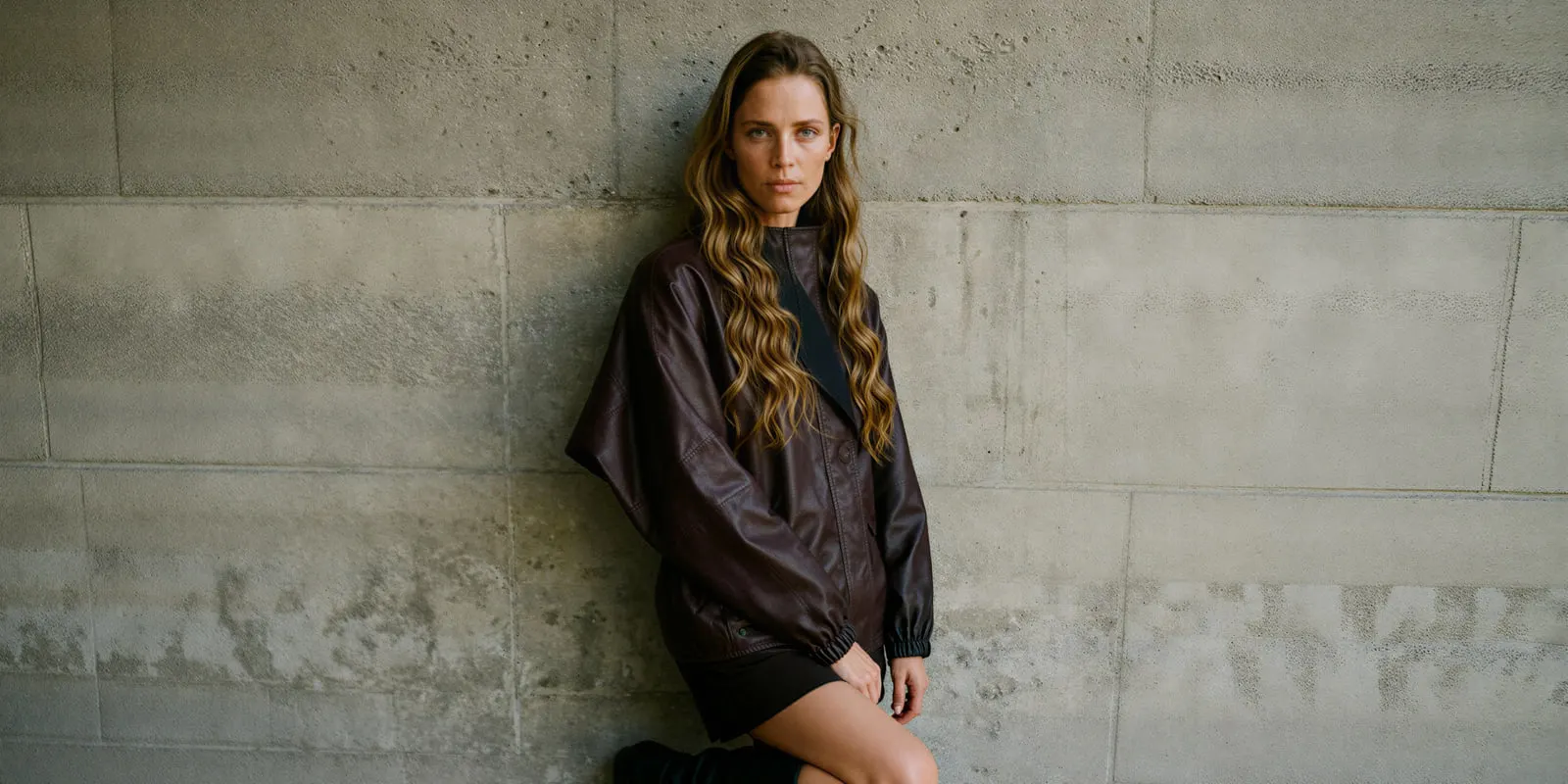
The reason on-model AI output gets rejected in review is rarely that the face looks wrong. It is that the garment reads as painted on. Fabric that does not gather where it would gather. A hem that sits at the same place on every body. Sleeves that break identically across a size run. Reviewers cannot always name it, so the note reads “this looks AI”.
A model trained on measured drape across XS to 3XL has learned what everyone in the loop was squinting at. Not a size recommendation. Physics. That is a production-quality gain, and it needs zero shopper data to collect.
Two things follow for a fashion or apparel team:
Extended sizing stops being a rendering compromise. If your range runs past a sample size and your on-model imagery does not, the imagery is telling customers something. Models that hold drape across a real size range make an honest size run producible without a shoot per size.
Garment fidelity becomes the only review question that matters. Once drape is credible, the remaining failure is whether the render is your actual product. That is a different check, and it is the one to build your approval gate around. We covered how to run it in AI product photo accuracy.
We found none of this in a shipping product, as of September 2026. FIT is a SIGGRAPH paper with a released dataset and a baseline model. It is not a product feature. Treat it as a signal about where on-model quality goes next, and plan the workflow that will absorb it.
What the authors say the model cannot do yet
The paper’s limitations section is unusually direct, and it is worth reading before anyone builds a roadmap on this (arxiv.org/abs/2604.08526, April 2026).
- Upper body only. Tops and upper-body garments, in front-facing views and casual poses. No trousers, no full looks, no movement.
- Tightness is hard. The authors note that representing degrees of tightness is difficult, because across a band of similar fits the simulated appearance is close to identical.
- Measurements are correlated. The model is sensitive to correlations between measurements, so changing one measurement independently does not work cleanly.
- Simple garments. Simple structural designs rather than complex, multi-layered apparel.
- Synthetic origin. The data comes from simulation. The team addresses the domain gap with surface normal maps and a refinement pass, which is a solution to the gap, not the absence of one.
For a womenswear brand shipping layered outerwear, that limitations list is most of the catalog.
What to do this quarter, before any of this ships
The research does not change what to do this quarter. It changes what to be ready for.
1. Separate your two try-on questions. Decide whether you are buying a shopper-facing sizing tool or a catalog production tool. They are different purchases and the second one has a return on investment you can calculate today, with the three numbers that decide AI fashion photography ROI. If you test catalog try-on on free tools first, check what each free try-on license allows before a result reaches a product page. The same split applies to video, where the returns claim runs into the same evidence gap.
2. Produce on-model imagery from the garment you sell. The output has to derive from your real product photo, not a description of it. That is the check that keeps the render honest, and it is the same check whether or not the model understands fit. The step-by-step is in how to put clothes on a model with AI.
3. Shoot the size run you sell. If you list to 3XL, put the garment on a body at 3XL in your imagery. Current models will flatter. Reviewing for that is a human job right now.
4. Make the pass repeatable. The lighting, framing, distance and model identity that got approved once should run again for the next drop without being rebuilt. A saved workflow is the difference between one good image and a consistent range. More on holding a look across a collection in consistent AI fashion images.
5. Know what your current tool is built for. The generators split on whether the garment stays anchored to your real photo, whether one model holds across a collection, and whether output ships to a PDP or needs a retoucher. We compared them in AI fashion model generators. The guide to WearView alternatives for AI fashion photos compares five more on-model tools.
DesignerBox is AI creative production for brands and agencies. It makes catalog images. It does not tell a shopper their size, and we found no try-on product that does, as of September 2026. On-model work runs through the Dress my model app, starting from the flat garment photo you already own. You set the brand once, and the workflow reads it on every run. Every size in the run then gets the same light, pose and framing. The full workflow from the first product photo to the finished ad, in one subscription. The on-model still, the size-run set and the campaign frame for a drop stay in one place. Uploading your own photos and the commercial license start on the Pro plan. Virtual try-on starts on the Premium plan. Plans and credits are on the pricing page.
Build the workflow once on one garment, with the light, the framing and the model identity fixed. A saved workflow runs the same way on the next garment in the drop, so the standard does not depend on who runs it that day. How it works shows the build-once step. You still review the drape and the garment on every result, because the try-on products we found do not render fit, as of September 2026.
Start from a template, add your brand and your products, and run it. The cost is shown before the run. See the templates.
FAQ
Does virtual try-on show real garment fit?
Not in any shipping product we found, as of September 2026. Current try-on models generate a well-fitted result by default, whatever sizes are involved. The FIT research from the University of Washington and Google Research is the first large-scale attempt to train on measured bodies and garments so a model can render a genuine mismatch (arxiv.org/abs/2604.08526, April 2026).
Will fit-aware AI reduce apparel returns?
Not on its own. A fit-aware model needs the shopper’s actual body measurements as an input, and collecting those adds friction before checkout. The rendering improves. The data problem sitting in front of it does not.
What is the FIT dataset?
FIT is a virtual try-on dataset of 1,137,282 training samples and 1,000 test samples, built with ground-truth body and garment measurements. It covers 168 body shapes across sizes XS to 3XL, 528 poses and 158,483 garment designs, generated with 3D garment simulation and photorealistic re-texturing (arxiv.org/abs/2604.08526, April 2026).
Can I use fit-aware try-on for my product catalog right now?
No. FIT is a research paper accepted to SIGGRAPH 2026, with a published dataset and a baseline model. It is not a commercial feature. For catalog work today, use an on-model tool that generates from your real garment photo and review the drape yourself.
What size range does the research cover?
XS to 3XL, across 168 distinct body shapes, 82 men’s and 86 women’s. That is broader than most published try-on datasets, and it is the part most relevant to brands selling an extended range.
What are the biggest limits of the research?
Upper-body garments only, in front-facing views and casual poses, on simple structural designs. The authors also note that degrees of tightness are hard to represent and that the model struggles to vary one measurement independently of the others.
Which DesignerBox plan includes virtual try-on?
Virtual try-on starts on the Premium plan. It makes on-model images from a garment photo you add, for catalog and campaign use.
Sources
- FIT: A Large-Scale Dataset for Fit-Aware Virtual Try-On, Karras, Wang, Li, Kemelmacher-Shlizerman, April 2026
- FIT project page, accessed 2 October 2026
- 2025 Retail Returns Landscape and the NRF press release on 2025 returns, National Retail Federation, October 2025
- Coresight Research, “Shifting the Size and Fit Paradigm”, May 2026, as reported by FashionUnited, 30 June 2026
- Google Shopping virtual try-on announcement, June 2023
- DesignerBox plans and feature gates: DesignerBox pricing page (designerbox.ai/pricing), September 2026
Research claims verified against the arXiv paper and project page, and returns data against the National Retail Federation, as of September 2026. The arXiv paper and the project page were re-read on 2 October 2026. Individual results vary.