
Video localization adapts a video for another market: the spoken words, the on-screen text, the captions and the details that belong to one country. For a fashion video ad, change the low-risk layers first: captions and text supers, then the voiceover. A dub with lip sync comes last, because it changes what a real person appears to say.
One approved 15-second ad now has to run in six markets. The English super reads “New season. Free returns.” In German the line no longer fits the frame. In France the law wants the tagline in French. In Sydney it is the wrong season. And the TikTok copy of the campaign lost its AI disclaimer when someone duplicated it.
This guide sorts the work by what carries your ad’s message, then covers what Meta and TikTok translate for you and the rules on AI dubbing. It is written for fashion brands that sell in several countries, and for the agencies that run their ads.
Key Takeaways
- Sort the ad by what carries the message. Supers need new text, a voiceover needs a new read, and only a person talking on camera raises the question of a dub.
- On-screen text breaks first. In European languages, an English string of up to 10 characters averages 200 to 300% of its length. Netflix’s subtitle limits run from 20 characters a second in US English to 4 in Japanese.
- The ad platforms translate some layers. Meta dubs a voiceover from English on single video ads. Supers burned into the video frame stay your job.
- A dub carries rules a caption does not. TikTok requires an AI label for voice cloning, and a duplicated TikTok campaign resets the AI disclaimer toggle.
- Consent comes before the clone. New York and California require consent to use a person’s voice in ads. New York’s Fashion Workers Act requires separate written consent for a model’s digital replica.
What is video localization?
Video localization is the work of adapting a video for viewers in another language and market. It covers four layers: captions, on-screen text, the audio track, and local facts such as prices, sizes and seasons. Translation is one part of the job. For an ad, localization also includes the platform rules and AI labels of each country where the ad runs.
A 2020 survey gives the case for the work. CSA Research asked 8,709 consumers in 29 countries in 2020. 76% prefer to buy products with information in their own language, and 40% will not buy from websites in other languages (csa-research.com, July 2020). The same survey found 66% would choose the cheaper of two similar products, even with no information in their language. It measured websites and product information, so it gives a direction and no lift figure for an ad.
| Layer | What changes per market | Where it goes wrong |
|---|---|---|
| Captions | Translated text, timed to the audio | Too many characters a second for the language |
| On-screen text | Supers, taglines, prices, size ranges | Longer words overflow the frame |
| Audio | A new voiceover, or a dub of the original speaker | A cloned voice or lip sync with no consent or no label |
| Local facts | Season, sizes, currency, delivery and returns | A claim that is true at home and false in the new market |
Which layers does a fashion video ad need?
Look at what carries the message in the master ad, and sort it into one of three types. Each type needs a different set of layers. Only one of them raises the question of a dub.
| What carries the message | Layers to change | Is a dub needed? |
|---|---|---|
| Music and text supers, such as a drop teaser or a lookbook cut | On-screen text, captions, local facts | No |
| A voiceover over product shots | On-screen text, captions, a new voiceover, local facts | No. A new read in the target language covers it |
| A person talking on camera, such as a try-on haul, a founder or a UGC creator | All four layers | Only if the speaker must appear to speak the new language |
The first type is the cheapest, because no one speaks. The second needs a voice in each language, and the options for that voice are compared in AI voiceover for UGC ads.
In the third type, subtitles keep the speaker’s own voice. A dub with lip sync makes the speaker appear to say words in a language they never spoke, and that is where the consent and label rules below apply. When a separate lip sync tool is worth it is covered in AI lip sync for video ads.
Why does on-screen text break first?
Text supers are short, and short strings grow the most in translation. A two-word line that fits the frame in English can overflow it in German. Captions have a second limit, reading speed, and that limit changes by language. Some countries, such as France, also require their own language in advertising.
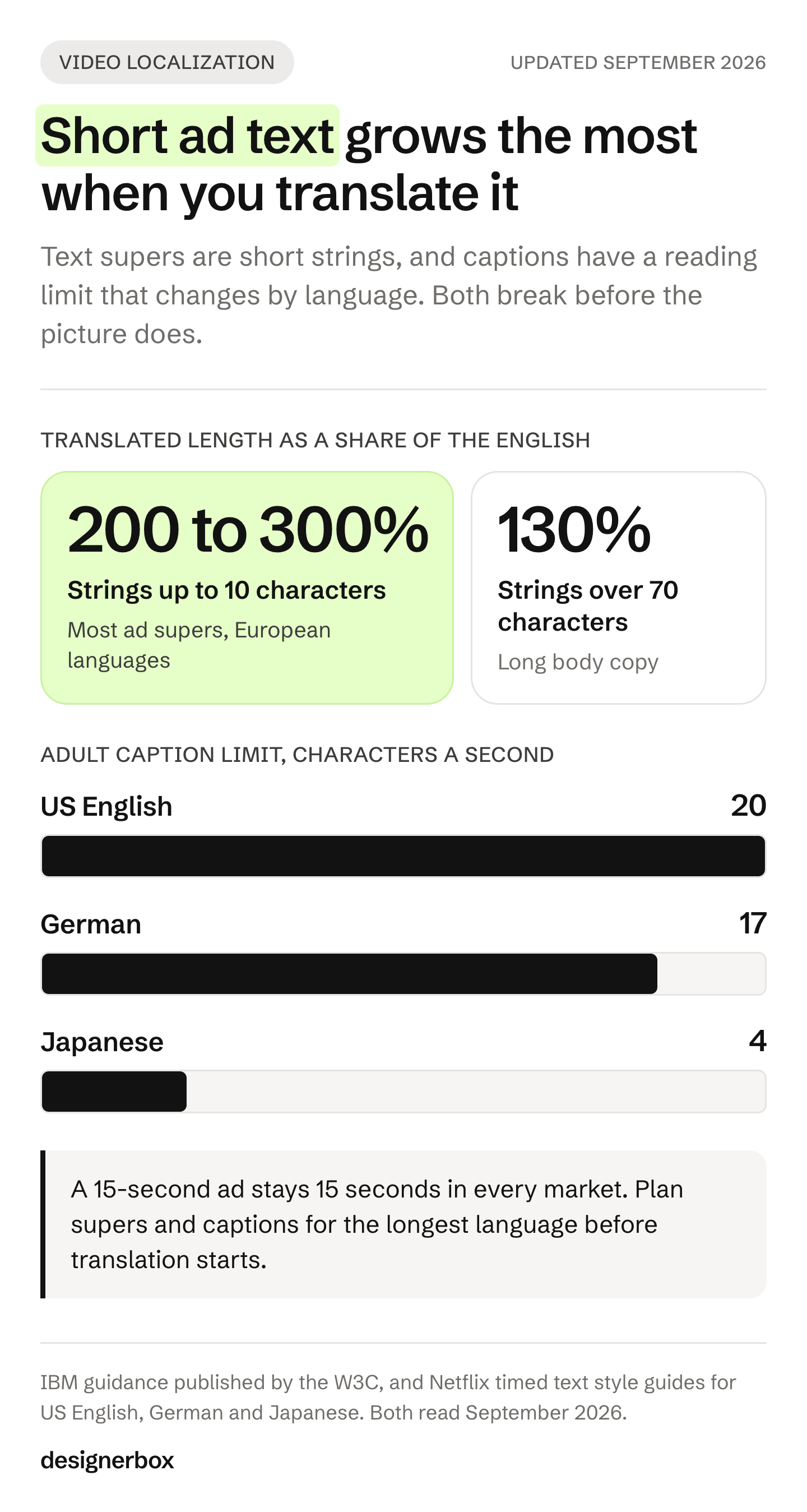
IBM’s guidance, published by the W3C, gives average expansion rates for English text translated into European languages. A string of up to 10 characters averages 200 to 300% of its English length, and a string over 70 characters averages 130% (w3.org, accessed September 2026). The same page shows Flickr’s word “views” as “visualizzazioni” in Italian, three times as long. A super is almost always the first kind. The layout fixes are in localizing ads without rebuilding the layout.
Netflix’s subtitle guides set a reading speed of up to 20 characters a second for adult programs in US English, 17 in German and 4 in Japanese (Netflix timed text guides for US English, German and Japanese, accessed September 2026). A 15-second ad stays 15 seconds in Munich, so the German caption says less. Give the translator the time limit for each line before work starts.
France adds a legal floor. The Toubon law of 4 August 1994 requires French in advertising. Its article 4 says the French version must be as legible, audible or intelligible as the foreign-language one. ARPP, the French advertising self-regulatory body, says taglines and claims in another language need a French translation. Only the foreign names of products and services sold under those names may stay untranslated. A slogan registered as a trademark still needs a translation. For an ad with sound and text, ARPP says a foreign word spoken in the audio can be translated in the audio, and a written one is translated in writing (arpp.org, accessed September 2026).
What changes for fashion besides the language?
A fashion ad can carry four local facts, and translation changes none of them. Check each one per market before translation starts. A correct translation of a false claim is still a false claim.
- Season. June to August is winter in Australia, New Zealand, South Africa and Argentina. A summer drop teaser shot for Europe runs in the wrong season there, so change the garment or the line as well as the language.
- Sizes. US, UK, EU and Japanese clothing sizes use different numbers. A size range in a voiceover or a super must change with the market, or you remove it.
- Price and currency. A price in a super must match the local store, in the local currency, including the end date of any sale.
- Delivery and returns. “Free returns” and “next-day delivery” are true only where you offer them.
These rarely need a reshoot. A new super or a different garment clip usually covers them. What AI fashion video costs against a shoot is in AI fashion video.

What do Meta and TikTok translate for you?
Meta and TikTok both translate some layers inside their ad tools, so check them before you pay for a separate version. Meta translates the ad copy, a voiceover, and the text on single image ads. TikTok’s translate and dub tool changes the voiceover and can replace subtitles. Neither help page describes a way to translate a super burned into the video frame.
Meta Ads Manager lists three AI translations (Meta Business Help Center, accessed September 2026):
- Text translations change the primary text and the headline. You cannot edit the translated text.
- Voiceover translations dub a video’s original voiceover. They work on single video ads with a voiceover, in Facebook Feed, Instagram Feed, Instagram Reels and Instagram Stories. The listed pairs start from English, into languages that include Spanish, German, French, Italian, Dutch and Polish.
- Overlay translations change the text in image overlays, on single image ads only.
Meta says these features are not in every region or language, and not in South Korea.
TikTok’s Symphony Creative Studio can translate and dub a video’s voiceover, with a clone of the original voice or a stock voice (TikTok Ads Manager help, accessed September 2026). A lip sync setting matches the speaker’s mouth to the new audio. Another setting places translated subtitles over the subtitles in the original video. TikTok says lip sync does not work with several speakers, a covered mouth, poor lighting or background noise. Every exported video gets an AI-generated label, and the feature is not available in Texas or Illinois.
So the platforms can cover the audio and the ad copy. The supers, the local facts and the review stay with your team. Meta’s translated text cannot be edited, so read the preview for product names and size terms before you publish the ad.
What are the rules for AI dubbing in ads?
Captions and a new read by a voice actor do not change what a real person appears to say. A cloned voice and lip sync do. That change can bring an AI label on the ad platform, a disclosure duty under EU law, and a consent duty to the person whose voice or face you change. This section is general information, not legal advice.

The ad platforms set the first rules:
- TikTok. TikTok allows AI-made or heavily AI-edited ad media with the AIGC label or your own clear disclaimer, and rejects or restricts undisclosed AI ads. Voice cloning and media that shows someone doing something they did not do need the label (TikTok ads policy, accessed September 2026). A new or duplicated campaign resets the AI disclaimer toggle (TikTok add disclaimers, accessed September 2026), so a copy made for a new market starts without it.
- Meta. Meta asks advertisers to disclose AI only in ads about social issues, elections or politics. For other ads, it adds an “AI info” label when it detects third-party AI signals such as C2PA metadata. Meta says this may not be available in every region. Advertisers in the European Region, California, New York, India and Taiwan can choose to disclose (Meta Business Help Center, accessed September 2026).
- Google. Google says AI rules in the EU, India and New York require labels on some ads with AI-made or AI-edited assets. When you mark an asset as made or edited with AI, Google shows that in the “How this ad was made” panel on every campaign. Campaigns that target the EU, India or New York also show a visible label on the ad (Google Ads Help, accessed September 2026). The same marked dub carries a visible label in a campaign for Berlin, and only the panel note in a campaign for Toronto.
The law sets the next rules:
- European Union. Article 50 of the EU AI Act has applied since 2 August 2026. Article 50(4) requires deployers to disclose deep fakes. If you publish a deep fake, you must say it is AI-generated or AI-edited, and people must see that the first time they see the content. A deep fake is AI-made or AI-edited image, audio or video that looks like real people, objects, places or events and could make people think it is real (European Commission FAQ, accessed September 2026). A lip-synced dub shows a real person saying words they never said, so check it against that definition. The Commission’s guidelines, published on 20 July 2026, are not binding. They say a brand that only hires an agency, with no control over how the agency uses AI, is not the deployer (European Commission guidelines, accessed September 2026). In that case the agency is the deployer.
- New York disclosure. New York’s synthetic performer law, General Business Law section 396-b, took effect on 9 June 2026. In New York, if you make an ad and you know it contains a synthetic performer, the ad must say so in a way people will notice. New York defines a synthetic performer as a digital asset, made with generative AI or software, that looks like a human performing. The person must not be recognizable as any real, identifiable performer. The law also does not apply when AI is used only to translate a human performer’s words (nysenate.gov, accessed September 2026).
- Consent. That exemption covers disclosure only. In New York you need a living person’s written consent before you use their voice or likeness in advertising (New York Civil Rights Law section 50, accessed September 2026). In California you need prior consent (California Civil Code section 3344, accessed September 2026). Since 19 June 2025, New York’s Fashion Workers Act requires separate written consent before a model’s digital replica is made or used. The Department of Labor describes a digital replica as a computer-generated or AI-enhanced representation of a model. The consent must state the scope, purpose, pay and how long the replica will be used. If the first approval did not cover a new campaign, the client must get new approval from the model (dol.ny.gov, accessed September 2026).
Read the release before you clone a voice for a new market. More on labels is in AI disclosure in advertising.
A localization order for fashion video ads
This order puts the low-risk layers first and the dub last. Every market starts from the same picture.
- Export a clean master. Keep the picture free of burned-in text, and keep music and voice on separate tracks.
- List the local facts per market. Season, size range, price and currency, delivery and returns. Fix any false claim before translation starts.
- Translate the supers to fit the frame. Give the translator a character limit for each super.
- Write captions to the reading speed. Cut words before you add time.
- Record or generate the voiceover. A new read covers an ad with a voiceover.
- Dub last, and only for on-camera speech. Check the release first, then set the AI label in each ad manager and on every duplicated TikTok campaign.
- Have a native speaker review each market. One person who reads the language checks the captions, the supers and every claim.
Localization as a saved workflow
DesignerBox is AI creative production for agencies and brand teams. The page for fashion brands shows what it makes for apparel. The ad localizer rebuilds one ad in another language. It redraws the layout. The ads resizer makes one ad in every size the ad platforms need. The ad localizer works on static ads. It does not dub a video. You find it in the static ad templates.
For the video, the video editor is a real timeline, with several tracks, transitions, animated text and audio. You change the animated text for each market and keep the picture. Transcription turns the speech in the master into text, so the translator starts from a script. Text to speech turns a script into a voice track, with 20 voices to choose from. Have a native speaker listen to each track before the ad runs.
You set the brand once, with its fonts, logos and rules. The workflow reads it on every run. A saved workflow runs the same way on the next market. Batch is coming: one workflow over a whole sheet of products.
The cost is shown before the run. AI video starts on Premium, at $75 a month billed monthly. An 8-second clip costs 40 to 560 credits, depending on the model. Every plan below Ultra is one seat. Team features need Ultra, at $200 a month billed monthly.
The first job, built once
Start from a template, add your brand and your products, and run it. The cost is shown before the run.
FAQ
What is the difference between video localization and translation?
Translation changes the words. Video localization changes what a viewer in another market needs: captions timed to the reading speed, on-screen text that fits the frame, the audio, and facts such as sizes, prices and seasons. For an ad, it also covers the AI labels and legal notices each country requires.
Should fashion video ads use subtitles or dubbing?
Use subtitles when the message is in music and text, or when you want to keep the speaker’s own voice. Use a new voiceover for an ad narrated over product shots. A dub with lip sync fits only a person talking on camera, and it needs the speaker’s consent.
Can Meta translate my video ads automatically?
In part. Meta Ads Manager can dub a video’s original voiceover from English on single video ads, and translate the primary text and headline. Its overlay translation covers single image ads only (Meta Business Help Center, September 2026).
Do I need to label a dubbed video ad as AI?
The platform, the market and the method decide it. TikTok requires a label for voice cloning. When you mark an asset as made or edited with AI, Google shows a visible label on campaigns that target the EU, India or New York. In the EU, Article 50 of the AI Act says a dub that counts as a deep fake must be disclosed the first time people see it. This is general information, not legal advice.
Can I use AI to put a model’s voice into another language?
Get consent first. New York and California require consent to use a person’s voice in advertising. New York’s Fashion Workers Act also requires separate written consent for a model’s digital replica. A new campaign that the first approval did not cover needs new approval. This is general information, not legal advice.
Sources
All accessed September 2026 unless a date is given.
- Language preference of 8,709 consumers in 29 countries, 7 July 2020: CSA Research
- Text expansion averages from IBM’s guidance, and the Flickr “views” example: W3C, Text size in translation
- Subtitle reading speed limits: Netflix Partner Help Center timed text guides for US English, German and Japanese
- The Toubon law, its article 4, and French translation in advertising: ARPP, fiche de doctrine langue française
- Meta text, voiceover and overlay translations in Ads Manager: Meta Business Help Center, advertising in multiple languages
- Meta AI disclosure for social issue, election and political ads: Meta ad standards. AI info labels and self-disclosure regions: Meta Business Help Center
- TikTok translate and dub, subtitle replacement and lip sync in Symphony Creative Studio: TikTok Ads Manager help
- TikTok AI labels in ads and the disclaimer toggle: TikTok ads policy and add disclaimers to ads
- Google AI labels, the “How this ad was made” panel and visible labels by target region: Google Ads Help
- EU AI Act Article 50 and the deep fake definition: European Commission FAQ. Deployer status of a brand that hires an agency: European Commission guidelines, 20 July 2026
- New York synthetic performer disclosure, its definition and the translation exemption: New York General Business Law section 396-b
- Consent for voice and likeness in advertising: New York Civil Rights Law section 50 and California Civil Code section 3344
- Digital replica approval under the Fashion Workers Act: New York State Department of Labor FAQ
- Plan prices, the video cost range and feature gating: DesignerBox pricing page (designerbox.ai/pricing), September 2026
Platform features verified on Meta, TikTok and Google help pages as of September 2026. Laws verified from European Commission, New York State and California sources as of September 2026. Features and rules change often, so check each ad manager before a launch. This is general information, not legal advice.