
Social media marketing for a clothing brand means making posts, clips and ads from each new garment, then sending the people who see them to your store. Plan it per drop, not per week. Decide the posts each garment needs on each platform. Brief the creators who wear it. Label AI images and video where the platform asks. Then measure sales and saves, not likes.
Most clothing brands plan social media as a calendar: three posts a week, one Reel, some Stories. Then a drop of 12 new garments arrives, and the calendar has no answer for it. Each garment needs a fit clip, an on-model photo, a detail shot and an ad. The posts that do not get made are the posts that would have sold the garment.
This guide is for brands with 20 to 500 products and for the agencies that run their social media. It covers the platforms, the post set per garment, the rules for creators, and the AI label rules, with each platform’s own pages checked in September 2026. If you want to see what a finished set looks like for a collection, the fashion brands page shows one.
Key Takeaways
- Plan per garment, not per week. A drop of 12 garments at five posts each is 60 posts, on illustrative arithmetic. A weekly calendar hides that number until the drop lands.
- Give each platform one job. Instagram shows the look, TikTok shows the fit in motion, Pinterest brings search traffic through product Pins, and YouTube Shorts reaches people outside your followers.
- Post original work. Instagram says accounts that mostly post unoriginal reels, photos or carousels may not appear in recommendations to new audiences.
- Keep Reels at 3 minutes or less. Instagram allows 20 minutes, but it does not recommend Reels over 3 minutes to new audiences.
- You are responsible for your creators. The FTC says advertisers should guide endorsers, monitor their compliance and fix problems. In the UK, a paid post needs a clear label such as #ad.
- Label realistic AI video. Meta, TikTok and YouTube ask creators to disclose realistic AI video. Pinterest adds its own “AI modified” label.
- Checkout moved off Instagram. Since September 2025, Shops on Facebook and Instagram send buyers to your website to pay.
What is social media marketing for a clothing brand?
Social media marketing for a clothing brand is the work of showing your garments to the right people on Instagram, TikTok, Pinterest and YouTube, and sending them to buy. It has three parts. You make content from each garment. You get other people to wear and post it. You pay to show your best posts to new people. Clothing differs from most products in one way: people buy with their eyes, and they want to see fit, fabric and movement before they buy.
That makes the work mostly production. Strategy fits on one page. Making five good posts for every garment, every drop, is where most brands struggle.
The rest of this guide follows the order of the work: pick the platforms, plan the posts per garment, brief creators, check the labels, then measure.
Which platforms should a clothing brand use?
Start with two platforms and do them well. For most clothing brands, those are Instagram and TikTok. Add Pinterest when your catalog is ready for product Pins, and YouTube Shorts when you already make vertical video.
| Platform | Its job for a clothing brand | Format to plan for | What the platform says |
|---|---|---|---|
| Show the look and the full outfit | Feed photos at 4:5, Reels at 9:16 | Reels up to 20 minutes, recommended to new audiences only at 3 minutes or less | |
| TikTok | Show fit and fabric in motion | 9:16 video | Realistic AI content needs a label. TikTok Shop US asks for full sizing information on apparel |
| Bring people who search for outfits | Product Pins from your catalog | Catalogs turn products into product Pins with price and stock information | |
| YouTube Shorts | Reach people who do not follow you | Vertical or square video | Shorts can run up to 3 minutes |
Sources: Instagram Help, TikTok Community Guidelines, TikTok Shop US listing policy, Pinterest Business Help, YouTube Help. All accessed September 2026.
Instagram: the look and the product tags
Instagram is where people check what your brand looks like. The grid, the Reels and the tagged products all do that job. You can tag up to 20 products in a feed photo, and you can add products to a Reel (Meta Business Help, accessed September 2026). Product tagging works only in the countries Meta lists, so check yours first.
Checkout changed. “As of September 2025, Shops on Facebook and Instagram now use website checkout” (Meta Business Help, accessed September 2026). A tagged product now sends the buyer to your store. Your product page has to match the post, or the sale stops there.
Originality matters more in 2026. Instagram’s guidelines say an account that mostly posts “unoriginal reels, photos, or carousels you didn’t create or edit in a material way” may not appear in recommendations to new audiences (Instagram original content guidelines, accessed September 2026). Reposting other accounts’ outfit photos is no longer a growth plan. Your own photos of your own garments are.
TikTok: fit in motion
TikTok is where a garment moves. A 10-second clip of a dress walking toward the camera can answer more fit questions than five still photos. Plan TikTok as video from the start, not as a photo post with music.
If you sell there, TikTok Shop has its own listing rules. For fashion items it asks you to “provide full sizing information”, and it does not allow “placeholders and digital renderings of a product” (TikTok Shop US listing policy, last updated 1 September 2026). The video rules for shop listings are in TikTok Shop product videos.
Pinterest: search, not a feed
Pinterest works more like a search engine than a feed. People search “linen summer outfit” or “wedding guest dress” and save what they find. A catalog turns your products into product Pins with price and stock information, and you can promote them as shopping ads (Pinterest Business Help, accessed September 2026). You need a business account, a claimed website and the Pinterest tag.
People find Pins through search, so a Pin can keep bringing visits after the week you post it. That makes Pinterest a good home for styling images and outfit ideas, which age more slowly than a Reel.
How do you plan social media content for a clothing drop?
Plan the content per garment. List the posts each garment needs on each platform, then multiply by the number of garments in the drop. That number is your real workload. A weekly calendar shows three posts a week and hides the 60 posts a drop of 12 garments needs.
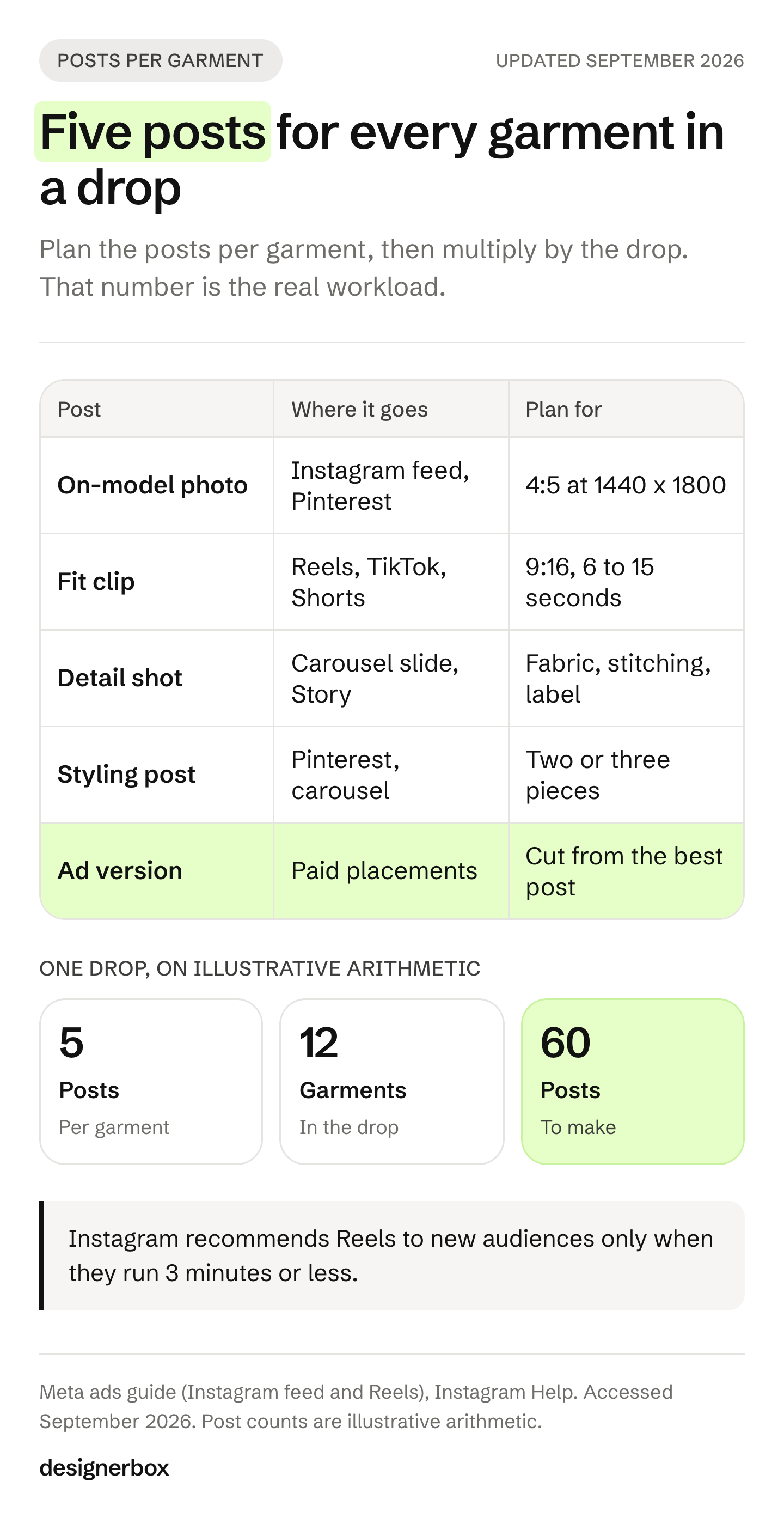
Here is a post set that covers the four platforms for one garment:
- The on-model photo. The garment on a person, full length, for the Instagram feed at 4:5 and for Pinterest.
- The fit clip. 6 to 15 seconds at 9:16. The model walks, turns, or sits. It goes to Reels, TikTok and Shorts.
- The detail shot. Fabric, stitching, the label, the fastening. It works as a carousel slide or a Story.
- The styling post. The garment with two or three other pieces from your range. It sells more than one product and suits Pinterest.
- The ad version. Your best photo or clip, cut to each ad placement.
Five posts per garment times 12 garments is 60 posts for one drop. That is illustrative arithmetic, and your numbers will differ. The point is to know the number before the drop, not after. The platform-by-platform cadence math is in how often to post on social media.
Export to each platform’s size once, from one approved master. Meta asks for 1440 x 1800 pixels at 4:5 for Instagram feed images, and 1440 x 2560 pixels at 9:16 for Reels and Stories images (Meta ads guide, accessed September 2026). A photo shot or made at those sizes needs no crop that cuts the garment.
The full process, from product photo to published post, is in the social media workflow guide.
What should a clothing brand post?
Post content that answers the questions people ask before they buy clothes. Will it fit me? What is the fabric like? What do I wear it with? Who else wears it? Each post type answers one of those questions. Each one also needs a different photo, and that photo is what you have to plan.
| Post type | The question it answers | The photo or clip it needs |
|---|---|---|
| Fit clip | Will it fit me? | The garment on a model, in motion, front and back |
| Size comparison | How does it look on my body? | The same garment on two or three body types |
| Fabric close-up | What does it feel like? | A sharp detail shot in good light |
| Outfit post | What do I wear it with? | The garment styled with other pieces |
| Customer or creator post | Do real people wear this? | A real person’s photo, with their permission |
| Drop post | What is new, and when? | The full drop in one grid or one clip |
| Behind the scenes | Who makes this? | The studio, the samples, the team |
Most of these come from the same source: good photos of the garment, front and back, on a person. If you have those, the other posts are edits. If you do not, every post is a new shoot. The fit and size questions matter most, because they drive returns.

For product photos built for the Instagram grid, see Instagram product photos. For clips, see how to make AI video for a clothing brand.
How should a clothing brand work with creators?
Pick creators whose own style matches your garments, send the product, and write the brief before they post. The brief covers what to show (fit, fabric, how they style it) and the disclosure. In the US and the UK, a paid or gifted post has to say so clearly. The brand carries part of that duty, not only the creator.

The US: the FTC puts part of the duty on the brand
The FTC’s Endorsement Guides say advertisers should “provide guidance to their endorsers”, “monitor their endorsers’ compliance” and “take action sufficient to remedy non-compliance” (16 CFR 255.1, accessed September 2026). The same section says agencies and PR firms “may be liable” for endorsements that fail to disclose a material connection. If you run social media for a clothing brand, that includes you.
Where the disclosure goes matters. For video, the FTC says “the disclosure should be in the video and not just in the description” (FTC, Disclosures 101 for Social Media Influencers, accessed September 2026). It also says: “Don’t assume that a platform’s disclosure tool is good enough.” A gifted dress counts as a material connection, not only a paid post.
Do not buy followers or views. The FTC’s rule on reviews and testimonials, in effect since 21 October 2024, makes it unlawful to buy “fake indicators of social media influence” that you knew or should have known were fake (16 CFR 465.8, accessed September 2026). The definition covers followers, views, likes, saves, shares and comments (16 CFR 465.1).
The UK: say it is an ad, upfront
The UK’s Advertising Standards Authority and the Competition and Markets Authority expect labels that “just say it how it is”, such as #Ad or #Advert. The label must be “clear, prominent, upfront, timely, appropriate for the platform and format of the content” (ASA and CMA, Influencers’ guide to making clear that ads are ads, accessed September 2026).
Customer photos
Customer photos are proof that real people wear your clothes. Ask for permission before you repost one, and keep the answer. Never present a paid model or an AI person as a customer. The FTC’s Endorsement Guides say that if an ad presents people as actual consumers, they should be actual consumers, or the ad should say clearly that they are not (16 CFR 255.2, accessed September 2026). The details for AI creator-style ads are in AI UGC ads.
This section is general information, not legal advice.
Do you have to label AI images and video on social media?
It depends on the platform and on how realistic the content is. As of September 2026, Meta, TikTok and YouTube ask creators to disclose realistic AI video, and TikTok also asks for a label on realistic AI images. Pinterest adds its own label. In the EU, a brand that publishes a deep fake has to disclose it. Color correction and cropping need no label on any of them.
| Platform or law | What it asks for | Source |
|---|---|---|
| Meta (Instagram, Facebook) | Disclose organic posts with photorealistic video or realistic audio. The rule does not apply to images. Meta adds an “AI info” label when it detects AI signals | Meta Community Standards |
| TikTok | Label AI-generated or significantly edited content that shows realistic scenes or people. Ads with AI media need the AIGC label or your own clear disclaimer | TikTok Community Guidelines, TikTok ads policy |
| YouTube | Disclose AI that meaningfully alters or generates photorealistic content, with the setting in YouTube Studio | YouTube Help |
| Pinterest adds an “AI modified” label from metadata and its own detection. You can appeal a label | Pinterest Help | |
| EU AI Act, Article 50 | A brand that publishes a deep fake must disclose it. It has applied since 2 August 2026 | European Commission FAQ |
| New York, GBL 396-b | An ad with a synthetic performer must disclose it. In effect since 9 June 2026 | NY General Business Law 396-b |
All accessed September 2026.
For clothing, the EU rule has a practical edge. The European Commission’s guidelines list “realistic AI-generated human avatars or personas” as persons, so an AI model who never existed can still count as a deep fake. An AI image that makes a garment look better than it is can also count. A real garment on an AI background, with no misleading change, usually does not. The full guide for fashion images is in labeling AI-generated fashion images.
This is general information, not legal advice. Check the rules in each market where you post and advertise.
How do you measure social media for a clothing brand?
Measure what leads to a sale: saves, shares, profile visits, link and product-tag clicks, and orders from social traffic in your store’s reports. Likes and follower counts are weak signals on their own. Then read one more number that clothing brands often skip: returns from social orders. A post that sells the wrong size sells a return.
A short scorecard per garment works better than a monthly report per platform:
- Which post type sold it. Compare the fit clip, the on-model photo and the styling post for the same garment.
- Saves and shares. People save clothes they plan to buy later. A high save count on a styling post is a signal to make more of them.
- Clicks to the product page. With checkout on your website, the click is the handover. Tag links so your store can see which post sent the visit.
- Return reasons for social orders. “Too small” and “looks different” point back to the fit clip and the photos.
Spend ad money on posts that already work. A post with strong saves and clicks is a better ad than a post made to be an ad. The creative side of that step is covered in DTC marketing for fashion brands.
Common mistakes on clothing brand social media
These are the patterns that most often break a clothing brand’s plan, and each one has a simple fix.
- Planning posts instead of garments. The calendar fills, but half the drop never appears on social media. Plan the post set per garment.
- Only front photos. A turn, a walk or a size comparison needs the back and the side. Photograph them once, at the start.
- Reposting other accounts. It keeps the grid busy, but Instagram may stop recommending an account that mostly posts unoriginal content.
- A creator brief with no disclosure line. The FTC expects you to guide and monitor. Put the disclosure in the brief.
- Posts that do not match the product page. With checkout on your website, a color or fit that differs on the product page loses the sale.
The same post set for every garment
DesignerBox is AI creative production for brands and agencies. Scale your content with AI. Keep your brand. Anyone can make an AI picture. Making hundreds that still look like your brand is the hard part. A drop of 12 garments at five posts each is 60 of them.
You build the post set once as a workflow. Then you run it on every garment in the drop.
- Put the garment on a model. The Dress my model app dresses your model in your garment. You approve the still before anything else.
- Make the clips. Your approved still becomes a short fit clip for Reels, TikTok and Shorts. The AI video ads page shows how. Video starts on the Premium plan.
- Keep the brand. You set your logos, fonts, colors and rules once in your brand record. The workflow reads it on every run.
- Run the whole drop. Batch runs one workflow over a whole sheet of products. You keep or discard each row, and you re-run one row on its own.
The cost is shown before each run. An 8-second clip costs 40 to 560 credits, depending on the model. The full workflow from the first product photo to the finished ad, in one subscription.
Three limits to know. DesignerBox does not post to your social accounts or your store: you download the results. The commercial license starts on the Pro plan, and AI video and virtual try-on start on the Premium plan. Every plan below Ultra is one seat, and team features are on the Ultra plan. Plans and credits are on the pricing page. What a finished set looks like for a collection is on the fashion brands page.
A free plan for your first run
Start from a template, add your brand and your products, and see the cost before you run it.
FAQ
How do I market my clothing brand on social media?
Pick two platforms, usually Instagram and TikTok. Plan a post set for each garment: an on-model photo, a fit clip, a detail shot, a styling post and an ad. Work with creators whose style matches yours, with a written brief and a clear disclosure. Measure saves, clicks and orders, then spend ad money on the posts that already work.
Which social media platform is best for a clothing brand?
Instagram and TikTok cover most clothing brands. Instagram shows the look and lets you tag products in photos and Reels. TikTok shows fit and fabric in motion. Pinterest suits brands with a catalog, because product Pins bring people who search for outfits. Start with the platform your buyers use most, and add the second once the first runs every week.
How often should a clothing brand post?
Post as often as you can hold for months, not weeks. A common range is three to five posts a week on Instagram. The better question is how many posts each drop needs. At five posts per garment, a drop of 12 garments needs 60 posts, on illustrative arithmetic. Plan production for that number first.
Do clothing brands have to disclose influencer posts?
Yes, in the US and the UK. The FTC expects advertisers to guide their endorsers and monitor their compliance, and it says a video disclosure should be in the video itself. The UK’s ASA and CMA expect a clear label such as #ad, placed upfront. A gifted product counts, not only a paid post. This is general information, not legal advice.
Do I have to label AI-generated clothing photos on Instagram?
For organic Instagram posts, Meta asks you to disclose photorealistic AI video and realistic audio, and it says the rule does not apply to images. Meta may still add an “AI info” label when it detects AI signals. In the EU, an AI image that could mislead people as a deep fake needs a label. New York requires ads with a synthetic performer to disclose it. This is general information, not legal advice.
What is the 5-3-2 rule for social media?
It is a common rule of thumb for mixing posts. Of every 10 posts, 5 share content from others, 3 are your own content, and 2 are personal or behind the scenes. For a clothing brand in 2026, use it with care. Instagram may stop recommending accounts that mostly post unoriginal content, so most of your posts should be your own.
Can a small clothing brand grow on social media without ads?
Yes, but slowly, and the content has to be original and regular. Organic posts build the proof that ads need: saves, comments and customer photos. Most brands add a small ad budget once a post shows strong saves and clicks, because that post has already shown it works.
Sources
- Instagram Help: Reels length, accessed September 2026
- Instagram: original content guidelines, accessed September 2026
- Meta Business Help: website checkout for Shops, accessed September 2026
- Meta Business Help: tagging products, accessed September 2026
- Meta ads guide: Instagram feed image specs, accessed September 2026
- Meta ads guide: Instagram Reels image specs, accessed September 2026
- Meta Community Standards: misinformation, accessed September 2026
- TikTok Community Guidelines: integrity and authenticity, accessed September 2026
- TikTok ads policy: misleading and false content, accessed September 2026
- TikTok Shop US: product listing policy, last updated 1 September 2026
- Pinterest Business Help: catalogs, accessed September 2026
- Pinterest Help: AI labels, accessed September 2026
- YouTube Help: three-minute Shorts, accessed September 2026
- YouTube Help: disclosing AI content, accessed September 2026
- 16 CFR 255.1: Endorsement Guides, general considerations, accessed September 2026
- 16 CFR 465.1 and 465.8: consumer reviews and testimonials rule, accessed September 2026
- FTC: Disclosures 101 for Social Media Influencers, accessed September 2026
- ASA and CMA: Influencers’ guide to making clear that ads are ads, accessed September 2026
- European Commission: Article 50 transparency FAQ, accessed September 2026
- New York General Business Law 396-b, accessed September 2026
- DesignerBox apps, fashion brands page and pricing (designerbox.ai), September 2026
Platform rules and legal requirements verified from the sources above as of September 2026. Individual results vary.