


Ad script examples show what a video ad says, second by second: the opening line, the body, the proof and the call to action. A voice reads about 3 words a second, so a 15-second script holds about 35 words, a 30-second script about 70 and a 60-second script about 145. Below are eight scripts with seconds and word counts per line.
Most ad scripts are written like a web page and then read aloud. The sentences run long. A price appears as digits and a symbol. The opening takes eight seconds to reach the product. A person can fix some of that while reading. A generated voice reads exactly what is on the page, at one pace, and the clip ends in the middle of a sentence.
This guide gives eight ad script examples for 15, 30 and 60 seconds. Each one has a line for the voice and a line for the screen. It then covers how to write for an AI voice or presenter, and which claims a script must leave out. It is for brands and agencies that produce video ads every week.
Key Takeaways
- Count words before you write scenes. At 183 words a minute, 15 seconds fits about 45 words. Write about 35 and leave room for the picture.
- Every line has two columns. One for the voice and one for the screen. Many viewers watch with the sound off.
- Write numbers the way they are said. “Nine seconds”, “twenty-eight liters”. A generated voice reads what is on the page.
- One sentence, one breath. Keep each sentence under about 15 words. A full stop is the pause.
- Split the script by clip length. A video model that makes 8-second clips needs a script cut into parts of about 20 words.
- Describe the product, not a customer. A generated presenter may show what the product does. It may not claim it used it.
- Change the opening, keep the body. Three openings on one script give three ads to test.
What is an ad script?
An ad script is the written plan for a video or audio ad. It lists what is said, what is shown and how long each part lasts. A short video ad script has four parts: an opening line, a body that shows the product, a proof the viewer can see, and one call to action.
The script is not the storyboard and not the brief. The storyboard draws the shots. The brief says who the ad is for and what it may claim. The script sits between them: it gives each second a line. For creator ads, the brief and the script travel together, and the UGC script guide covers that pair. Once the storyboard is timed shot by shot with sound, it is an animatic. For the shots, the reference images and the edit that follow, see script to video AI.
How many words fit a 15, 30 or 60 second ad script?
About 3 words fit each second of a spoken ad. A meta-analysis of 77 studies puts the average rate of reading aloud at 183 words a minute (Brysbaert, doi.org, 2019). That gives the ceiling. The number to write is lower, because a product shot with no voice over it also needs seconds.
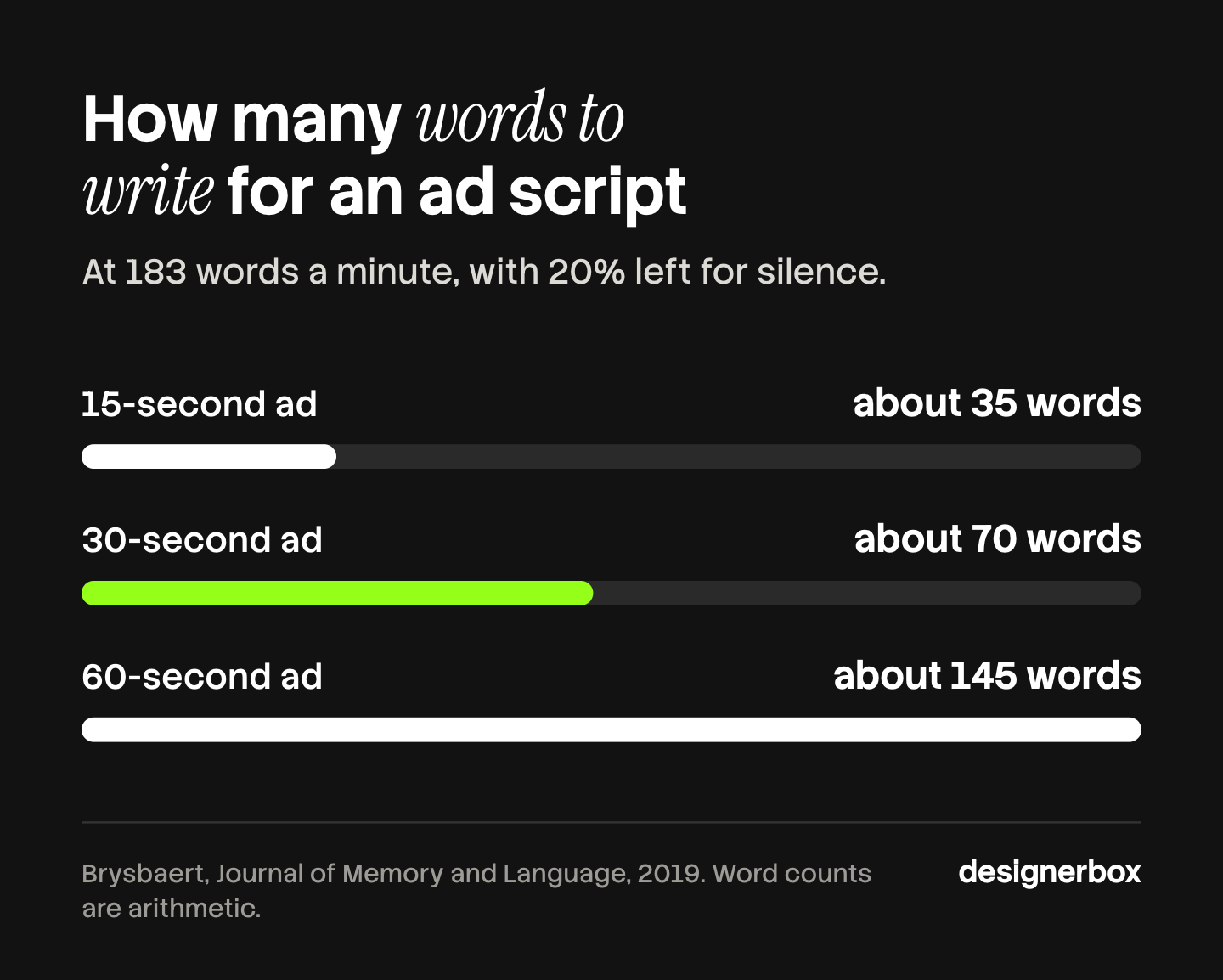
| Ad length | Ceiling at 183 words a minute | Words to write (20% for silence) | Parts that fit |
|---|---|---|---|
| 15 seconds | About 45 | About 35 | Opening, one proof, call to action |
| 30 seconds | About 90 | About 70 | Opening, problem, product, proof, call to action |
| 60 seconds | About 183 | About 145 | Opening, problem, three product points, proof, call to action |
The ceiling is arithmetic from the reading rate. The 20% cut is our working rule, not a platform rule. A script can sit well under it: several examples below do, because the picture does the work.
Platforms give two notes on length. TikTok’s video advertising guide says “21–34 seconds performs best” for in-feed ads (ads.tiktok.com, read September 2026). Meta’s guidance is to make videos “15 seconds or less and get your main message across in the first 3 seconds” (facebook.com, October 2026). So write the 30-second script first, then cut a 15-second version from it.
Ad script examples for 15 seconds
A 15-second ad script has room for one idea: an opening, one proof and the call to action. Both examples stay near 35 words.
1. Product demo, 15 seconds
An insulated bottle. The picture carries the proof, so the voice stays short.
| Seconds | Voice | On screen | Words |
|---|---|---|---|
| 0 to 3 | ”Ice at nine. Still ice at five.” | Bottle opens, ice inside, a clock in the corner | 7 |
| 3 to 9 | ”The steel wall is double, so the cold stays in and the outside stays dry.” | Cut view of the wall, then a dry hand on the bottle | 15 |
| 9 to 13 | ”The lid locks with one turn.” | Close-up of the lid turning | 6 |
| 13 to 15 | ”Find it at the link below.” | Product name and the link | 6 |
Total: 34 words.
2. Offer, 15 seconds
A coffee subscription, shown to people who visited the page and left.
| Seconds | Voice | On screen | Words |
|---|---|---|---|
| 0 to 3 | ”Your coffee runs out every third week.” | An empty bag, folded flat | 7 |
| 3 to 10 | ”This plan sends a fresh bag before that happens. You pick the roast and the day.” | The plan screen: roast, day, address | 16 |
| 10 to 13 | ”Skip or cancel from your account.” | The skip button, pressed | 6 |
| 13 to 15 | ”The first bag ships this week.” | Offer line and the link | 6 |
Total: 35 words.
Ad script examples for 30 seconds
A 30-second ad script fits a problem, the product, one filmed proof and the call to action. These four use between 55 and 70 words, so each leaves seconds for a silent product shot.

3. Problem and solution, 30 seconds
A cordless vacuum. The result is filmed, so nobody has to promise it.
| Seconds | Voice | On screen | Words |
|---|---|---|---|
| 0 to 3 | ”Crumbs under the sofa. No outlet in reach.” | Low shot under a sofa | 8 |
| 3 to 9 | ”A corded vacuum stops where the cable stops. So the corners wait until the weekend.” | A cable pulled tight | 15 |
| 9 to 19 | ”This one runs on a battery. The head lies flat, so it slides under low furniture. The bin opens with one button.” | Three short shots, one per sentence | 22 |
| 19 to 26 | ”Watch the strip of floor behind it. One pass, and the rice is gone.” | One slow pass over spilled rice | 14 |
| 26 to 30 | ”See the full specs at the link.” | Product name and the link | 7 |
Total: 66 words.
4. Comparison, 30 seconds
Cling film and a reusable wax wrap, side by side on one counter.
| Seconds | Voice | On screen | Words |
|---|---|---|---|
| 0 to 3 | ”Cling film on the left. A wax wrap on the right.” | Both on one counter, two bowls | 11 |
| 3 to 11 | ”The film is used once and thrown away. It also sticks to itself before it sticks to the bowl.” | Film tangled in the hand | 19 |
| 11 to 21 | ”The wrap is cotton with a wax coat. Warm it in your hands and it holds the shape of the bowl.” | Hands pressing the wrap onto a bowl | 21 |
| 21 to 26 | ”Rinse it in cool water and use it again.” | The wrap under a tap | 9 |
| 26 to 30 | ”Three sizes in one pack. Link below.” | The pack and the link | 7 |
Total: 67 words.
5. Founder or maker, 30 seconds
A candle maker. The real founder reads this one. A generated presenter must not play the founder.
| Seconds | Voice | On screen | Words |
|---|---|---|---|
| 0 to 3 | ”We pour every candle in a room this size.” | The founder in the workshop | 9 |
| 3 to 11 | ”It started with one problem. Most candles tunnel, and half the wax is wasted.” | A tunneled candle, cut in half | 14 |
| 11 to 21 | ”So we use a wider cotton wick and a soy blend. The first burn melts the top from edge to edge.” | A lit candle with an even pool of wax | 21 |
| 21 to 27 | ”Each lid lists the pour date and the batch.” | Close-up of the lid | 9 |
| 27 to 30 | ”Pick a scent at the link.” | Three candles and the link | 6 |
Total: 59 words.
6. Software or service, 30 seconds
An invoicing app. The screen recording is the demo.
| Seconds | Voice | On screen | Words |
|---|---|---|---|
| 0 to 3 | ”Month end. Twelve invoices are still drafts.” | A list of twelve drafts | 7 |
| 3 to 10 | ”Each one needs a client, a rate and a tax line. That is an afternoon.” | One draft filled by hand, fast cuts | 15 |
| 10 to 20 | ”This app builds them from your tracked hours. You check the list, press send, and each client gets a payment link.” | The list, the send button, an email arriving | 21 |
| 20 to 26 | ”Paid invoices turn green on one screen.” | Rows turning green | 7 |
| 26 to 30 | ”Start the trial from the link.” | Logo and the link | 6 |
Total: 56 words.
Ad script examples for 60 seconds
A 60-second ad script is for a product that needs explaining. It holds three product points, and each point gets its own shot. Both examples stay well under the 145-word mark, because long shots carry part of the time.
7. Explainer, 60 seconds
A standing desk. Every number is spelled the way the voice says it.
| Seconds | Voice | On screen | Words |
|---|---|---|---|
| 0 to 4 | ”This desk goes from sitting to standing in nine seconds.” | The desk rising, a timer on screen | 10 |
| 4 to 14 | ”Most people buy a standing desk and stop using the lever after a month. The reason is small. Changing height takes effort.” | A hand crank, turned slowly | 22 |
| 14 to 28 | ”Here, one button holds three heights. Press one for sitting, two for standing, three for the height your partner uses. The motor is quiet enough for a call.” | The three buttons, then a video call at the desk | 28 |
| 28 to 42 | ”The top is one piece, one hundred forty centimeters wide. Two monitors and a laptop fit side by side. A tray under the top hides the cables.” | Top view, then the cable tray | 27 |
| 42 to 52 | ”The frame comes in two boxes. Assembly needs the one tool that is in the box.” | Two boxes, one hex key | 16 |
| 52 to 60 | ”Choose the top color and the frame color at the link below.” | Color options and the link | 12 |
Total: 115 words.
8. Three details, 60 seconds
A travel backpack. A list gives the viewer a reason to stay for the next item.
| Seconds | Voice | On screen | Words |
|---|---|---|---|
| 0 to 4 | ”Three details that make this backpack easier to travel with.” | The backpack on a bed, closed | 10 |
| 4 to 18 | ”One. The back panel opens flat like a suitcase. You pack it on the bed and you see everything at once.” | The panel opening flat | 21 |
| 18 to 32 | ”Two. The laptop sleeve has its own zip on the side. At airport security, the laptop comes out and the bag stays closed.” | The side zip, a laptop sliding out | 23 |
| 32 to 46 | ”Three. The straps tuck behind a flap. The bag then goes in an overhead bin with nothing to catch.” | Straps tucked, bag lifted into a bin | 19 |
| 46 to 54 | ”It holds twenty-eight liters, and the listing gives its size in centimeters.” | Size line on screen | 12 |
| 54 to 60 | ”See the three colors at the link.” | Three colors and the link | 7 |
Total: 92 words.
None of the eight scripts claims a personal result. Each line describes the product or shows it. That is deliberate: it means a hired actor, a voice-over or a generated presenter can read any of them, except the founder script, which belongs to the founder.
How do you write an ad script for an AI voice?
Write it for the ear. A generated voice or presenter reads the text exactly as written, so the script has to carry the pace, the pauses and the pronunciation. Seven rules cover most of it.
- Keep sentences short. One idea per sentence, under about 15 words. A long sentence has no place to breathe.
- Use the full stop as the pause. Two short sentences read slower and clearer than one long sentence with commas.
- Write numbers as words. “One hundred forty centimeters”, not digits and a unit sign. Do the same for prices, dates and model names.
- Spell out or avoid abbreviations. A voice engine may read letters as a word. Google’s text-to-speech documentation describes markup for exactly these cases: “pauses, and audio formatting for acronyms, dates, times, abbreviations” (cloud.google.com, October 2026).
- Avoid hard sound pairs. A row of words that start with the same sound is hard for a person and for lip sync. Read the line aloud once and change what catches.
- Say the opening line and show it. The first line goes in the voice and on the screen. The three layers of an opening are covered in video hooks.
- Time it. Read the script aloud with a timer before any video is made. If you run over, cut words, not seconds.
Then split the script by clip length. Many video models make short clips. Google lists the duration of a Veo 3.1 clip as “4”, “6” or “8” seconds (ai.google.dev, read September 2026). At 3 words a second, an 8-second clip holds about 20 spoken words with room to spare. So a 30-second script becomes four or five parts, and each part must end on a full sentence. Where the voice comes from, and how long one read can run, is covered in AI voiceover for UGC ads. Lip sync has its own limits, in AI lip sync for video ads.

What can an ad script not say?
An ad script cannot state a result the brand cannot prove, present an actor or a generated presenter as a real customer, or break the ad rules of the platform it runs on. This section is general information, not legal advice.
Claims need proof first. The FTC’s policy is that advertisers must “have a reasonable basis for advertising claims before they are disseminated” (ftc.gov, October 2026). “Nine seconds” in the desk script is a claim. The brand needs the test behind it before the ad runs.
An endorsement needs a real user. The FTC’s Endorsement Guides say endorsements “must reflect the honest opinions, findings, beliefs, or experience of the endorser”, and that the endorser “must have been a bona fide user” of the product (ecfr.gov, 16 CFR 255.1, October 2026). The FTC’s rule on testimonials bans one that misrepresents that the person exists or “used or otherwise had experience with the product” (ecfr.gov, 16 CFR 465.2, October 2026). So “I have used this every day since March” is not a line for a generated presenter. How that applies to creator-style ads is in AI UGC ads and the FTC rule.
Disclosures go in the voice and on the screen. FTC guidance says: “if the representation is made through both visual and audible means, the disclosure should be made both visually and audibly” (ftc.gov, October 2026).
Platforms add their own lines. The table shows three that reject scripts often.
| Rule | What it says | A line that breaks it |
|---|---|---|
| Meta, personal attributes | ”ads must not contain content that asserts or implies personal attributes.” Meta allows “you” and “your” without an attribute | Meta’s own examples: “Do you have diabetes?”, “Ready to upgrade your skin to look younger?” |
| TikTok, exaggerated results | Ads “must not promise or exaggerate results concerning a product’s effect” | TikTok’s own example: “Get slim legs right away.” |
| TikTok, absolute terms | TikTok does “not allow ad content to feature absolute terms about a product in relation to time, region, or brand” | TikTok’s own example: “Number 1 song on TikTok” |
Sources: transparency.meta.com and ads.tiktok.com (last updated April 2026), both read October 2026. In the United Kingdom, the CAP Code’s rule 3.1 says marketing “must not materially mislead or be likely to do so” (asa.org.uk, October 2026).
One opening line from the examples shows the difference. “Your coffee runs out every third week” speaks to the viewer about a habit. It does not assert a health condition, an age or another personal attribute.
How do you turn one ad script into several ads?
Keep the body and change what the viewer meets first. One 30-second script with three openings and two lengths gives six ads. A script breakdown then lists the shot, text and audio each version needs.
- Write three openings. One that shows the result, one that names the problem, one that compares.
- Cut the 15-second version. Keep the opening, one proof and the call to action.
- Make the Stories cut. Meta says Instagram Stories plays video ads under 16 seconds in full, so keep that cut under 16 (facebook.com/business/ads-guide, September 2026).
- Name each file by opening and length. The report then shows which opening won.
- Read the result. Hook rate shows which opening stopped the most viewers.
Scripts read by a presenter, on brand
Anyone can make an AI picture. Making hundreds that still look like your brand is the hard part. A script with three openings and two lengths already asks for six videos, and each one needs the same product, the same colors and the same claims.
DesignerBox is AI creative production for brands and agencies. Scale your images, ads and video with AI and keep your brand on every piece: build the workflow once with your brand rules, run it on every product, see the cost before each run, and keep everything from the first product photo to the finished ad in one place. AI video ads start from your product photos. A talking avatar with lip sync reads your script, and text to speech offers 20 voices. The presenter video app runs that job from a short form: you paste the script and press Run.
You set the brand once, with its colors, logos and rules, and the workflow reads it on every run. The video editor is a real timeline, with several tracks, transitions, animated text and audio. You join each opening to the same body there and cut the shorter version.
The full workflow from the first product photo to the finished ad, in one subscription.
Here are the limits. DesignerBox does not write the claims for you, and it does not check them: the proof stays with the brand. It does not publish ads into TikTok or Meta. You download the results, or send them with a webhook or an S3 step. AI video and the video editor start on the Premium plan, and an 8-second clip costs 40 to 560 credits, depending on the model. Uploading your own photos and the commercial license start on the Pro plan. The free plan cannot make video. Plans and credits are on the pricing page.
A free plan for your first run
There is a free plan, and it runs on sample products. Start from a template and see the cost before you run it. Get started free.
FAQ
What is an example of an ad script?
A 15-second example: “Ice at nine. Still ice at five. The steel wall is double, so the cold stays in and the outside stays dry. The lid locks with one turn. Find it at the link below.” That is 34 words, with one picture planned for each line.
How many words is a 30-second ad script?
About 90 words is the ceiling, at an average of 183 words a minute read aloud. Write about 70, so a product shot can run with no voice over it. A 15-second script holds about 35 to 45 words, and a 60-second script about 145 to 183.
How do you write a video ad script?
Start with the length, then the word count. Write one opening line, a body that shows the product, one proof the viewer can see and one call to action. Give every line a second column for what is on screen. Read it aloud with a timer, then cut words until it fits.
Can AI write an ad script?
An AI chat can draft one from a product page, and the draft needs the same checks as any script: word count, numbers written as words, and claims the brand can prove. The brand stays responsible for what the ad says, whoever wrote the line.
What should an ad script avoid?
Results the brand cannot prove, a presenter who claims an experience they did not have, lines that assert a personal attribute of the viewer on Meta, and exaggerated or absolute claims on TikTok. This is general information, not legal advice.
How is an ad script different from a UGC script?
An ad script covers any video ad, read by an actor, a voice or a presenter. A UGC script is written for a creator who films the product in their own space, and it travels with a creator brief. The word counts per second are the same.
Sources
- Brysbaert, M., “How many words do we read per minute? A review and meta-analysis of reading rate”, Journal of Memory and Language 109, 2019: doi.org/10.1016/j.jml.2019.104047, read September 2026
- TikTok for Business, Video advertising guide: ads.tiktok.com/business/en/guides/video-advertising-guide, read September 2026
- Meta, Creative best practices to drive action: facebook.com, accessed 4 October 2026
- Meta Ads Guide, Instagram Stories video ads: facebook.com/business/ads-guide/update/video/instagram-story, read September 2026
- Google Cloud, Speech Synthesis Markup Language (SSML): cloud.google.com/text-to-speech/docs/ssml, accessed 4 October 2026
- Google, Gemini API, Generate videos with Veo 3.1: ai.google.dev/gemini-api/docs/veo, read September 2026
- FTC, Policy Statement Regarding Advertising Substantiation: ftc.gov, accessed 4 October 2026
- 16 CFR Part 255, Guides Concerning the Use of Endorsements and Testimonials in Advertising: ecfr.gov, accessed 4 October 2026
- 16 CFR Part 465, Rule on the Use of Consumer Reviews and Testimonials: ecfr.gov, accessed 4 October 2026
- FTC, Endorsement Guides: What People Are Asking: ftc.gov, accessed 4 October 2026
- Meta Advertising Standards, Personal attributes: transparency.meta.com, accessed 4 October 2026
- TikTok Ads Help Center, Misleading and false content, last updated April 2026: ads.tiktok.com, accessed 4 October 2026
- ASA and CAP, CAP Code section 3, Misleading advertising: asa.org.uk, accessed 4 October 2026
- DesignerBox plan gates and the video cost range: DesignerBox pricing page (designerbox.ai/pricing), October 2026
FTC, Meta, TikTok and CAP wording verified from their own pages on 4 October 2026. The reading rate, the TikTok length guide, the Stories rule and the Veo clip lengths were verified in September 2026. Word counts are arithmetic from the cited reading rate. The eight scripts are examples for products that do not exist. This is general information, not legal advice.