


Transcreation is the rewriting of a marketing message for a new language and culture, so that it has the same effect and not the same words. A translator keeps the meaning of each sentence. A transcreator keeps the goal of the ad and writes new copy to reach it. Brands use it for slogans, headlines, humor and video openings, where a literal translation fails.
A campaign that worked in one market now has to run in six, or in twenty-two. The body copy translates in a day. The headline does not: the pun is gone, the German line is twice as long, and the French version needs a legal check. The video is worse. The voice no longer fits the seconds, and the text on screen runs off the frame.
This guide explains what transcreation is, how it differs from translation and localization, and how to choose a level for each part of an ad. It then covers video: text length, voice length, and what AI dubbing does and does not do. It is for brands and agencies that run one campaign in many markets. AI dubbing for video ads covers the dubbing step on its own.
Key Takeaways
- Transcreation keeps the effect, not the words. The American Translators Association describes it as “creating brand new messaging that is culturally appropriate”.
- Three levels cover every ad. Translate the facts, localize the details, transcreate the lines that persuade.
- Most of an ad does not need it. Specs, sizes and legal lines translate. The headline, the slogan and the video opening are where a rewrite pays.
- Short text grows the most. IBM’s figures, published by the W3C, put expansion at 200 to 300% for text of up to 10 characters.
- Law can force a rewrite. France requires French in advertising. The EU allows only authorized health claims.
- AI dubbing translates. It does not transcreate. Meta says advertisers cannot edit its automatic text translations.
- The brief is the tool. A transcreator needs the goal, the audience, the claims and the limits, not only the source text.
What is transcreation?
Transcreation is creative adaptation of a message from one language and culture to another. The word joins “translation” and “creation”. The American Translators Association defines it as “the process of creatively adapting a message’s intended meaning from one language to another and creating brand new messaging that is culturally appropriate”, and adds that it “is often used for literary, marketing and advertising content” (atanet.org, October 2026).
The UK’s Institute of Translation and Interpreting describes the work itself: “taking a persuasive text in one language and producing an equivalent persuasive text in another language by employing translation and copywriting skills on the basis of a client brief” (iti.org.uk, October 2026). Two things in that sentence matter. The transcreator is a copywriter as well as a translator. And the work starts from a brief, not only from the source text.
The translation industry treats it as a separate service. ISO 17100, the standard for translation services, does not define transcreation. It lists it in an annex of “value added services”, next to the core translation process.
Transcreation vs translation vs localization
Translation changes the language. Localization changes the details that differ by market. Transcreation changes the message itself. Most campaigns use all three, each on a different part of the ad.
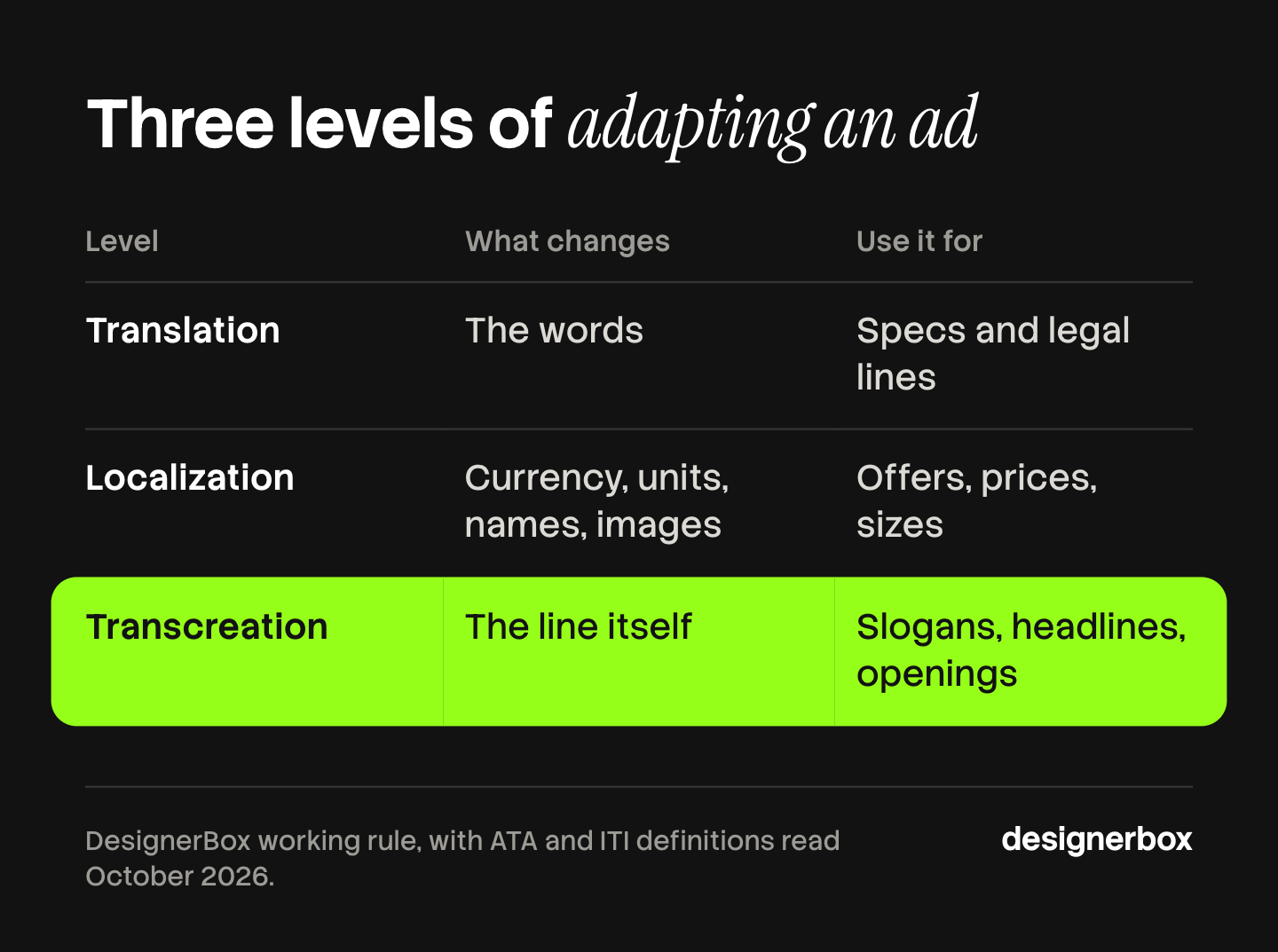
| Level | What changes | What stays | Use it for | Example |
|---|---|---|---|---|
| Translation | The words | Meaning, sentence by sentence | Specs, sizes, ingredients, legal lines, instructions | ”Machine washable at 30 degrees” |
| Localization | Words plus market details: currency, units, dates, names, images | The message and the layout | Offers, prices, sizes, product pictures, names on screen | Size 8 in the US, size 38 in Germany |
| Transcreation | The line itself: idea, wordplay, tone | The goal and the brand | Slogans, headlines, video openings, humor | A pun replaced by a different line that sells the same benefit |
Two well-known campaigns show the two upper levels. Coca-Cola’s “Share a Coke” began in Australia by “swapping out Coke branding on bottles and cans with the 150 most popular monikers in Australia” (coca-colacompany.com, October 2026). The idea stayed the same in each country, and the names changed. That is localization.
The second case is “Got Milk?”. When the California milk board planned to reach Spanish-speaking households, a consultant “pointed out a problem. In Spanish, the question takes on a considerably different meaning: ‘Are you lactating?’” (bloomberg.com, August 2000). The problem was found before an ad ran. A literal translation was not an option, so the line had to be written again. That is transcreation.
When does an ad need transcreation?
An ad needs transcreation when the line works through language or culture, and not through information. Four signs show it.
- Wordplay. A pun, a rhyme or a double meaning almost never survives translation.
- A cultural reference. A holiday, a sport, a TV show or a habit that the new market does not share.
- Humor or tone. What reads as friendly in one market reads as rude or flat in another.
- A short line with a big job. Slogans, headlines and the first line of a video carry the whole ad.
The rest of the ad usually does not need it. A product description, a size table and a returns line carry information. Translate them, check them and move on. Spending a copywriter’s time on a care label is waste. Sending a slogan through automatic translation is risk.

Demand is not in doubt. In a CSA Research survey of 8,709 consumers in 29 countries, “76% of online shoppers prefer to buy products with information in their native language” and “40% will never buy from websites in other languages” (csa-research.com, July 2020). The question is which level each line needs.
Which rules force an ad to change by market?
Some changes are not a creative choice. The law of the market sets them. Three examples show the kinds of rule. This section is general information, not legal advice.
Language laws. In France, the law on the use of the French language applies to “toute publicité écrite, parlée ou audiovisuelle”, which means any written, spoken or audiovisual advertising. Where a foreign-language version appears next to the French, the French must be “aussi lisible, audible ou intelligible”, as legible, audible or intelligible (legifrance.gouv.fr, Loi 94-665, articles 2 and 4, October 2026). In Quebec, the Charter of the French Language says commercial advertising “must be in French” and may be in another language too “provided that French is markedly predominant” (legisquebec.gouv.qc.ca, section 58, October 2026).
Claims. In the EU, health claims on food “shall be prohibited” unless they are authorized and on the list of authorized claims (eur-lex.europa.eu, Regulation 1924/2006, article 10, October 2026). A claim that ran in a US ad may have no legal version in the EU at all. The line is then cut or replaced, not translated.
AI disclosure. Under the EU AI Act, a deep fake is AI-generated or manipulated content that “resembles existing persons, objects, places, entities or events and would falsely appear to a person to be authentic or truthful”. Deployers “shall disclose that the content has been artificially generated or manipulated” (eur-lex.europa.eu, articles 3(60) and 50(4), October 2026). Article 50 has applied since 2 August 2026. The texts we read do not say whether a lip-synced dub of a real presenter counts. Ask counsel before an AI-dubbed presenter runs in the EU. New York’s synthetic performer law takes a different line: it does not apply when AI is used only to translate a human performer’s words (nysenate.gov, October 2026).
The wider set of label rules is in AI disclosure in advertising.
Why does a translated video ad not fit the same seconds?
Because text and speech both change length, and a video has fixed seconds and a fixed frame. The words on screen grow, and the voice has to fit the same shot.
Text on screen. The W3C publishes IBM’s average expansion rates for text translated from English into European languages (w3.org, October 2026). Short text grows the most.
| English text length | Expected length after translation |
|---|---|
| Up to 10 characters | 200 to 300% |
| 11 to 20 characters | 180 to 200% |
| 21 to 30 characters | 160 to 180% |
| 31 to 50 characters | 140 to 160% |
| Over 70 characters | 130% |
A video caption or a button is short text. “Shop now” has 8 characters, so plan for a line two to three times as long. The frame also has safe zones, so the longer line cannot move into the edges. How a layout survives that is covered in how to localize ads without rebuilding them.
The voice. Languages differ in how many syllables a speaker says per second. A study of 17 languages found that they still “encode similar average information rates” of about 39 bits per second (Coupé and others, Science Advances, 2019). In plain words: a language that needs more syllables is spoken faster. A dubbed line can fit the same seconds, but only if the new script is written for speech and timed, and not converted word by word. Read every dubbed line against the picture before it ships. The steps for one category are in video localization for fashion ads.
Where do AI dubbing and automatic translation fit?
They fit the first two levels. Automatic tools translate and, in part, localize. They do not write a new line for a new culture. Each ad platform now has its own tool, and each states its limits.
| Platform | What its own page says | What else it states |
|---|---|---|
| Meta ads | ”Text translations use AI to translate the primary and headline text in an ad to the user’s preferred language.” Voice translations “translate and dub your video’s original voiceover to another language" | "You can’t edit the translated text” |
| TikTok Symphony | ”AI Dubbing gives creators and marketers the control to translate their content into 10+ languages and dialects" | "Symphony content is automatically labeled as AI-generated” |
| YouTube | ”Auto dubbing is available in 27 languages” | Lip sync is “experimental” and “available to select channels” |
| Google Ads | An AI campaign localization tool, in beta, translates campaigns “with English (US) as the original source language” | For app campaigns, “Google Ads won’t translate your ads” |
Sources: facebook.com/business/help, newsroom.tiktok.com and its Symphony update, blog.youtube (May 2026), support.google.com/youtube and support.google.com/google-ads, all read October 2026.
The Meta limit is the one to plan around. If the advertiser cannot edit the translated text, the advertiser cannot fix a headline that fails in one market. So use automatic translation for lines that carry information. Write the persuading lines yourself, per market, and upload them as their own ads.
How do you choose a level for each part of an ad?
Sort the ad into parts, then give each part the lowest level that works. The table is our working rule.
| Part of the ad | Level | Who does it |
|---|---|---|
| Legal line, ingredients, specs | Translation, then a legal check in the market | Translator and counsel |
| Price, currency, units, sizes, dates | Localization | Market team |
| Product picture, model, setting | Localization, where the market differs | Brand team |
| Body copy | Translation with a native edit | Translator and editor |
| Headline, slogan, video opening | Transcreation | Copywriter in the market |
| Call to action | Localization, checked for length | Market team |
Then count the files, because volume is the real cost. One concept in 6 markets, 4 formats and 2 lengths is 48 files. The arithmetic is 6 times 4 times 2, and it is an illustration, not a benchmark. Only the headline and the opening line in each market need a writer. The other parts are production: the same layout, rebuilt with new text.
What goes in a transcreation brief?
A transcreation brief gives the writer the goal and the limits, so the new line can differ from the source and still be right. A source text alone produces a translation.
| Field | What to write |
|---|---|
| Goal | What the viewer should do after the ad |
| Audience | Who they are in this market, and what they already use |
| Source line | The original, with a plain note on why it works |
| Must keep | The brand name, the product name, the benefit |
| Must not say | Claims with no proof in this market, banned words |
| Tone | Two or three ads from this market that sound right |
| Length | Characters for text on screen, seconds for the voice |
| Legal check | Who reviews claims and language rules in the market |
| Back translation | A literal English version of each option, with the writer’s reasons |
| Options | Three lines per slot, so the brand can choose |
The back translation is what lets a brand team approve a line in a language it does not read. The writer gives the new line, what it says word for word, and why it fits. A campaign-level template for the fields above the market level is in the creative brief template.

One campaign in every market, on brand
Anyone can make an AI picture. Making hundreds that still look like your brand is the hard part. Markets multiply the problem: 48 files have to carry one look, and only a few lines in each one differ.
DesignerBox is AI creative production for brands and agencies. Scale your images, ads and video with AI and keep your brand on every piece: build the workflow once with your brand rules, run it on every product, see the cost before each run, and keep everything from the first product photo to the finished ad in one place. The ad localizer rebuilds one static ad in another language and redraws the layout, so the longer line still fits. It is one of the jobs on the resizing and translating at volume page. The ads resizer makes one ad in the sizes the ad platforms need.
You set the brand once, with its fonts, logos, colors and rules, and the workflow reads it on every run. A saved workflow runs the same way on the next market. A page for brand teams shows how one team keeps that standard across campaigns.
The full workflow from the first product photo to the finished ad, in one subscription.
Here are the limits. DesignerBox does not transcreate. A copywriter in the market writes the headline and the opening line, and you give that line to the workflow. The ad localizer works on static ads and does not dub a video. DesignerBox does not check claims or language law, and it does not publish ads into a channel: you download the results, or send them with a webhook or an S3 step. Uploading your own photos and the commercial license start on the Pro plan. Team features, shared brand kits and white label are on the Ultra plan, and every plan below Ultra is one seat. Plans and credits are on the pricing page.
A free plan for your first run
There is a free plan, and it runs on sample products. Start from a template and see the cost before you run it. Get started free.
FAQ
What is transcreation in simple terms?
Transcreation is rewriting a marketing message for another language and culture so it has the same effect. The writer keeps the goal and the brand, and may change the words, the image and the idea. It is used for slogans, headlines and ads.
What is the difference between transcreation and translation?
Translation keeps the meaning of each sentence in a new language. Transcreation keeps the goal of the message and writes new copy to reach it. A translator works from the source text. A transcreator works from a brief and writes like a copywriter.
What is the difference between transcreation and localization?
Localization adapts details to a market: currency, units, dates, names and images. The message stays the same. Transcreation changes the message itself when the original line does not work in the new culture.
When should a brand use transcreation?
For lines that persuade through language or culture: slogans, headlines, humor and the opening of a video. Product specs, size tables and legal lines need translation and a check. Prices, units and dates need localization.
Can AI do transcreation?
AI tools translate text and dub voices, and the ad platforms offer both. They do not replace a writer who knows the market. Meta says advertisers cannot edit its automatic text translations, so a line that fails in one market stays as it is. Write the persuading lines yourself.
What is a back translation?
A back translation is a literal version of the new line in the source language. The transcreator supplies it with a short reason for each option. It lets a brand team approve copy in a language it does not read.
Sources
- American Translators Association, Guide to Buying Translation Services: atanet.org, accessed 4 October 2026
- Institute of Translation and Interpreting, Transcreation explained: iti.org.uk, accessed 4 October 2026
- ISO 17100:2015, Translation services, Annex F, list of value added services: iso.org, accessed 4 October 2026
- CSA Research, “Can’t Read, Won’t Buy” press release, 7 July 2020: csa-research.com, accessed 4 October 2026
- The Coca-Cola Company, How a campaign got its start Down Under: coca-colacompany.com, accessed 4 October 2026
- Bloomberg, “Got Spanish?”, 13 August 2000: bloomberg.com, accessed 4 October 2026
- W3C Internationalization, Text size in translation: w3.org, accessed 4 October 2026
- Coupé, Oh, Dediu and Pellegrino, “Different languages, similar encoding efficiency”, Science Advances, 2019: pmc.ncbi.nlm.nih.gov, accessed 4 October 2026
- France, Loi 94-665 relative à l’emploi de la langue française: legifrance.gouv.fr, accessed 4 October 2026
- Quebec, Charter of the French Language, section 58: legisquebec.gouv.qc.ca, accessed 4 October 2026
- Regulation (EC) No 1924/2006 on nutrition and health claims made on foods: eur-lex.europa.eu, accessed 4 October 2026
- Regulation (EU) 2024/1689, the AI Act, articles 3(60) and 50(4): eur-lex.europa.eu, accessed 4 October 2026
- European Commission, FAQ on transparency obligations under Article 50: digital-strategy.ec.europa.eu, accessed 4 October 2026
- New York General Business Law section 396-b: nysenate.gov, read September 2026
- Meta Business Help Center, About translations for ads: facebook.com/business/help, accessed 4 October 2026
- TikTok Newsroom, Announcing Symphony Avatars, and TikTok Symphony updates: newsroom.tiktok.com, accessed 4 October 2026
- YouTube, Auto dubbing explained, 15 May 2026: blog.youtube, and YouTube Help: support.google.com/youtube, accessed 4 October 2026
- Google Ads Help, AI campaign localization tool: support.google.com/google-ads, accessed 4 October 2026
- DesignerBox plan gates: DesignerBox pricing page (designerbox.ai/pricing), October 2026
Definitions, laws and platform features verified from the sources above on 4 October 2026. The ISO 17100 annex was read in a copy of the standard, because the ISO text is behind a paywall. The file count is arithmetic. This is general information, not legal advice.