

The right Midjourney alternatives depend on the job. Ideogram and GPT Image lead with text inside the image. Nano Banana and FLUX edit a real product photo from references. OpenAI, Google and Black Forest Labs each offer an API. FLUX.2 klein and Stable Diffusion 3.5 have open weights you can run yourself. DesignerBox makes brand-consistent sets across many products. For art direction, Midjourney is still a fair first choice.
A poster with a headline, a product photo that must stay exact and a script that makes 500 images are three different jobs. So this guide sorts Midjourney competitors by job. Each claim comes from the vendor’s own documentation, read in October 2026.
A note on bias: DesignerBox makes AI creative production software, so it is one of the eight options. This guide prints no vendor prices.
Key Takeaways
- Midjourney is built for art direction. Its docs describe a model line focused on aesthetics, with Style Reference, Moodboards and Personalization.
- Midjourney does not provide an API. Its guidelines say so, with a few rare exceptions, and its terms forbid automated tools.
- Five jobs lead to other options. Text in the image, exact product edits, an API, open weights and brand-consistent sets.
- A new picture is not a product photo. If the image must show your real product, start from your own photo.
What Midjourney does well
Midjourney is an image and video service built around art direction. Its current default model is V8.2, which became the default on 24 July 2026. Midjourney’s docs describe V8.2 as an update focused on aesthetics, image quality and Personalization (docs.midjourney.com, October 2026).
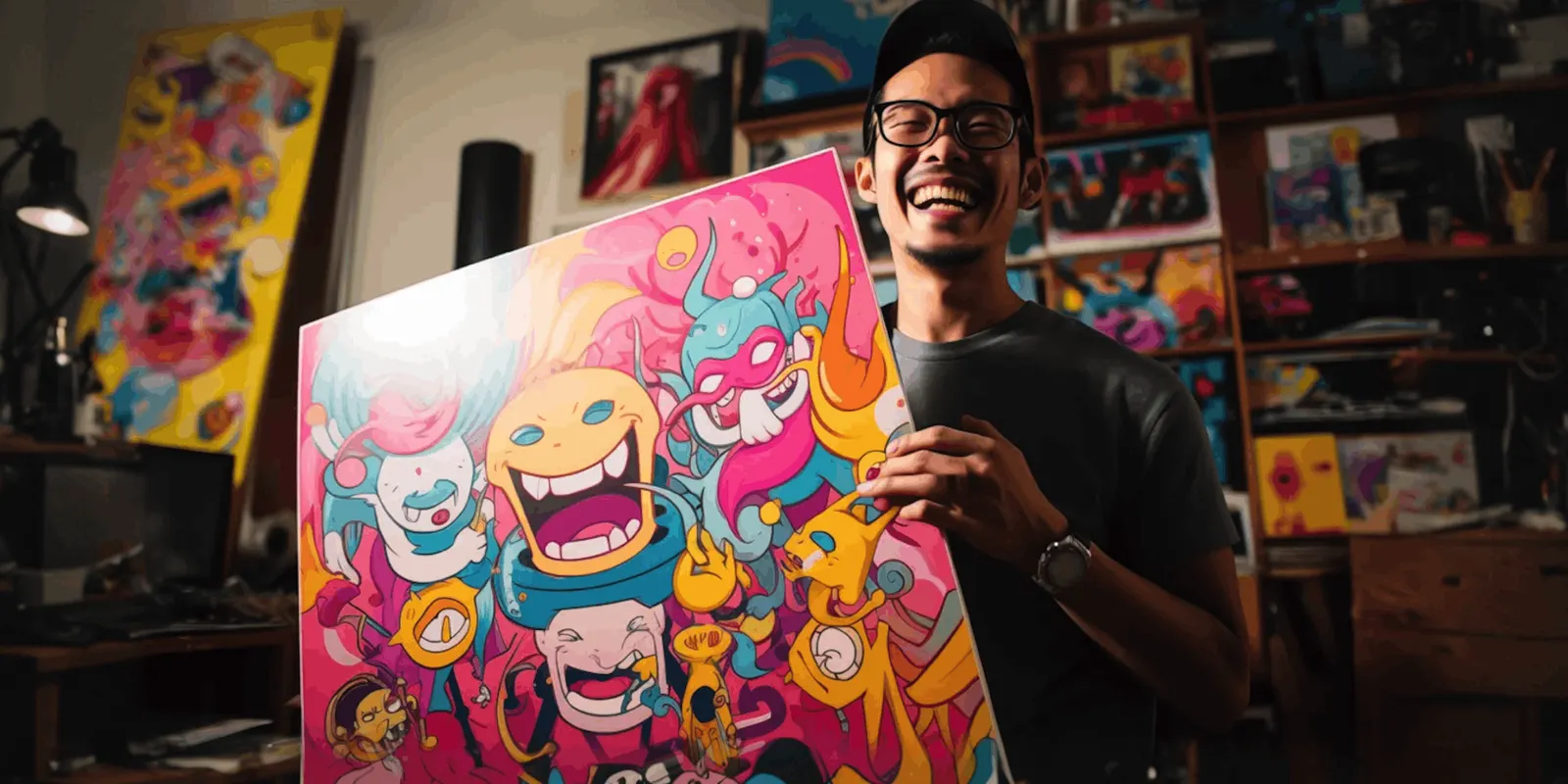
Three features carry that focus:
- Style Reference applies the look of an image you supply to a new prompt.
- Moodboards and Personalization teach the model your taste over time.
- Niji models are a separate series for anime and illustration styles, developed with Spellbrush.
Midjourney also has an Editor on its website. The docs say it edits both Midjourney images and your own uploaded images, with inpainting, Pan, Zoom Out and layers.
Leonardo AI alternatives covers the other platforms built for that kind of work.
What Midjourney’s docs say about scope
Five statements in Midjourney’s documentation explain why people look for an alternative. Each one is a choice about what the service is for.
| Topic | What Midjourney’s docs say | Read on |
|---|---|---|
| API | ”With a few rare exceptions that are explicitly granted, Midjourney does not provide an API” | Community Guidelines |
| Automation | ”You may not use automated tools to access, interact with, or generate Assets through the Services” | Terms of Service |
| Seats | ”Only one user may use the Services per registered account” | Terms of Service |
| Privacy | ”By default, Your Content is publicly viewable and remixable” | Terms of Service |
| Free trial | ”No free trial is currently available in Discord or the midjourney.com website” | Free Trials |
All five rows were read on docs.midjourney.com in October 2026.
Two more notes matter for product work. The docs page for Omni Reference, which places an object or a person from a reference image, says: “intricate details like specific freckles or logos on clothing may not perfectly match your reference.” The docs page for text says words appear when you put them in double quotation marks, and that shorter words in the Latin alphabet work best.
Midjourney alternatives by the job
Each row names a job that Midjourney’s own docs place outside its main aim, and the options whose vendors lead with that job.
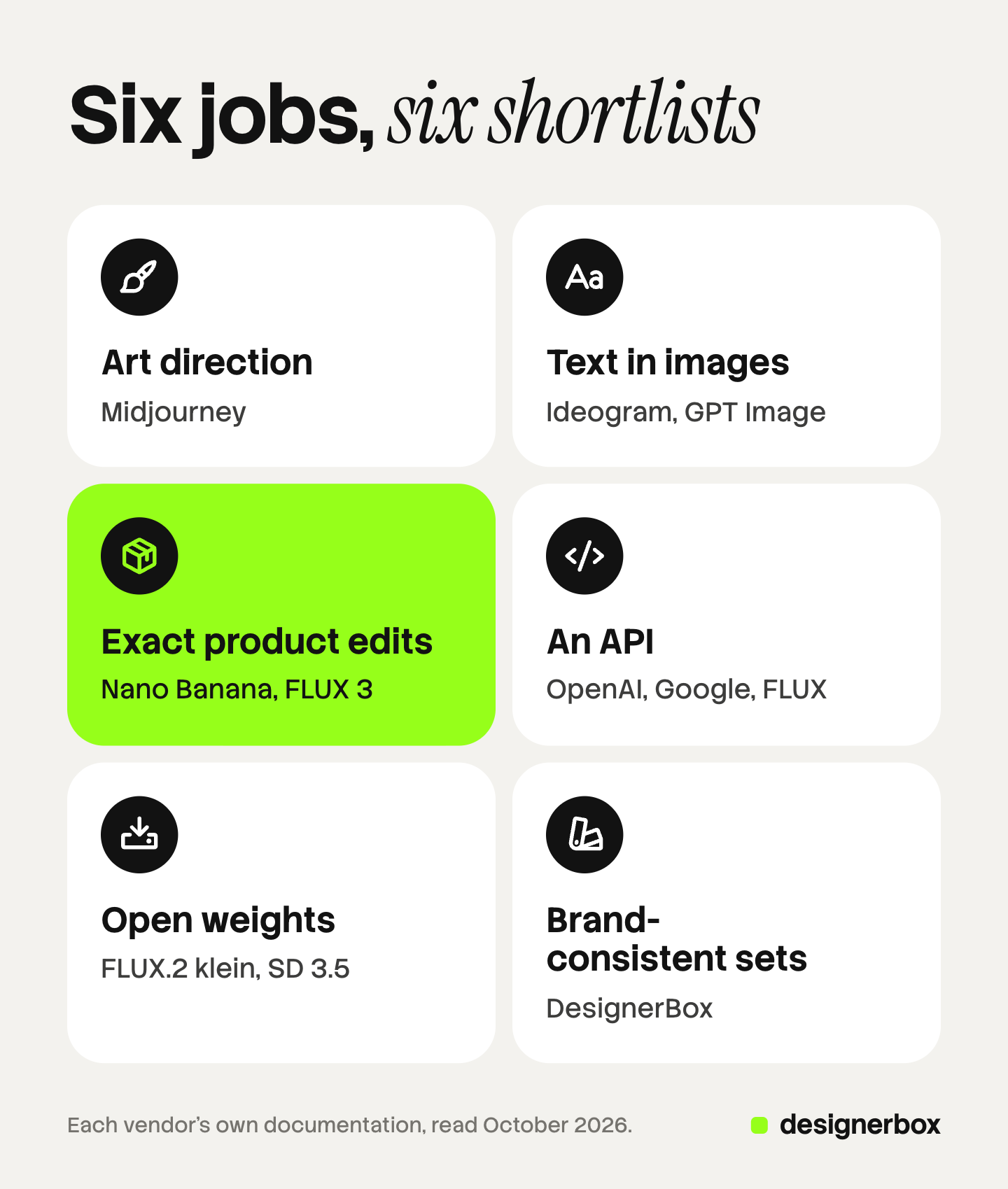
| The job | Options that lead with it | What the vendor says |
|---|---|---|
| Text inside the image | Ideogram, GPT Image, Nano Banana | Typography and legible text are named features |
| Exact edits to a product photo | Nano Banana, FLUX 3 Image, GPT Image | Edits from reference images and written instructions |
| An API for automation | OpenAI, Google, Black Forest Labs, Ideogram | A documented image API |
| Open weights you run yourself | FLUX.2 klein, Stable Diffusion 3.5, ComfyUI | Weights or software you can download |
| Brand-consistent sets across many products | DesignerBox | A saved workflow that reads the brand rules on every run |
A vendor’s statement tells you what the product is built for. Test with a real brief to see how yours comes out.
Text inside the image
Posters, packaging mockups and ad images need words that read correctly. Three options name this as a feature.
Ideogram. Ideogram’s API documentation describes its 4.5 and 4.0 models as “known for prompt fidelity and crisp typography”. (docs.ideogram.ai and developer.ideogram.ai, October 2026).
Nano Banana. Google lists “advanced text rendering” for its Gemini 3 image models. The docs say they can make “legible, stylized text for infographics, menus, diagrams, and marketing assets” (ai.google.dev, October 2026).
GPT Image. OpenAI’s image guide is the most careful of the three. Under limitations it says text rendering is “significantly improved”, and that the model “can still struggle with precise text placement and clarity” (developers.openai.com, October 2026).
That last quote is a useful rule for every model. Check each word in the result against the brief. AI image prompts for advertising explains when to put the text in the prompt and when to add it later.
Recraft belongs next to this job. Its site says it can make images directly in vector format, so a logo stays editable (recraft.ai, October 2026).
Exact edits to a product photo
An art director wants a new picture. A product team wants the same bottle, with the same label, in a new scene.

Three model vendors document editing from your own images.
Nano Banana. Google’s docs say the Gemini 3 image models can mix up to 14 reference images in one request. Google describes Nano Banana Pro with the words “accurate brand consistency”, and Nano Banana 2 as “excelling at multiple reference image processing and consistency”. Every image carries a SynthID watermark (ai.google.dev, October 2026). Nano Banana 2 vs Nano Banana Pro compares the two for product shots.
FLUX 3 Image. Black Forest Labs says FLUX 3 Image can “edit specific details, and combine up to ten references”. Its docs also describe bounding boxes. You recolor, move, replace or remove one element while the rest of the image stays unchanged (docs.bfl.ai, October 2026).
GPT Image. OpenAI’s API has an edits endpoint and mask editing. The guide names two models and says to choose the Sunburst model “for workflows where editing precision matters most”. It also lists a limit: the model “may occasionally struggle to maintain visual consistency for recurring characters or brand elements across multiple generations” (developers.openai.com, October 2026).
No vendor statement replaces a check. Compare every result with the real photo: label text, color, shape and scale.
An API for automation
Some teams want a script to read a product list and call an image API once per row. Midjourney’s guidelines rule this out (docs.midjourney.com, October 2026).
Four vendors document an API: OpenAI, Google, Black Forest Labs and Ideogram. Google’s Gemini API serves the four Nano Banana models, and Black Forest Labs also lists an official MCP server.
An API is a developer job. Someone has to write the calling code, handle errors and store the files. Image generation API explains the three ways to call one.
Open weights you can run yourself
Some teams must keep every image on their own hardware. That needs weights you can download.
FLUX.2 klein. Black Forest Labs says the klein 4B model is fully open under Apache 2.0 and runs on consumer GPUs with about 13GB of VRAM. The klein 9B model uses the FLUX Non-Commercial License (docs.bfl.ai, October 2026). For commercial self-hosting of its larger models, the company sells weight licenses in tiers (bfl.ai, October 2026).
Stable Diffusion 3.5. The Stability AI Community License allows research, non-commercial and commercial use for people and organizations under 1 million US dollars of annual revenue. Above that, an Enterprise license applies (stability.ai, October 2026).
ComfyUI. ComfyUI is the interface many teams put around those weights. Comfy lists a desktop app, a cloud version and more than 60,000 nodes (comfy.org, October 2026).
The cost of this route is time. You manage the hardware, the updates and the license terms.
Is there a free Midjourney alternative?
Yes, in three forms.
- Open weights. FLUX.2 klein 4B is under Apache 2.0, and Stable Diffusion 3.5 is free under the Community License below the revenue line. You pay for the hardware.
- Free credits. Ideogram’s docs say sign-ins with Google, Apple or Microsoft get free weekly credits (docs.ideogram.ai, October 2026).
- Free plans on wider platforms. Higgsfield AI alternatives lists what each free plan covers.
Midjourney’s own docs say no free trial is currently available in Discord or on its website (docs.midjourney.com, October 2026).
Midjourney commercial use
Midjourney’s terms say you own all assets you create “to the fullest extent possible under applicable law”, with some exceptions (docs.midjourney.com, October 2026).
- The company rule. Midjourney’s plan page says a company with more than 1 million US dollars in gross revenue per year must buy the Pro or Mega plan.
- The license you give. The terms grant Midjourney a perpetual, worldwide, royalty-free license to the content you input and the assets you make.
- Public by default. Images can appear on the Explore page. Stealth mode is only available on the Pro and Mega plans.
Ownership under a vendor’s terms and copyright under the law are separate questions. Commercial use of AI images covers both. This is general information, not legal advice.
How to pick a Midjourney alternative
- Name the job. Use the table above. An open model and a text model do not compete.
- Decide who runs it. A designer needs an app. A developer needs an API. A catalog team needs a saved workflow.
- Read the terms for your plan. Check ownership, privacy and the company revenue rule.
- Test with one real brief. Count the tries until a result is usable, and compare it with the source.
Brand-consistent sets across many products
DesignerBox is AI creative production for brands and agencies. Midjourney makes a new image from a prompt. DesignerBox starts from your own product photo and makes the product set and the ads around it.
Anyone can make an AI picture. Making hundreds that still look like your brand is the hard part. In DesignerBox you set the brand once: logos, fonts, colors and rules. You build a workflow once, and the workflow reads the brand rules on every run. Batch runs that workflow over a sheet of products, so row one and row two hundred get the same light and framing. You keep or discard each row.
The image editor makes one edit after another, and the picture keeps its detail and resolution. The workflow picks the image model for each step, and the models page shows which ones. You see the cost of a run before you press Run. The full workflow from the first product photo to the finished ad, in one subscription.
Here are the limits. DesignerBox is not a place for concept art or style exploration. Midjourney is the better choice there. DesignerBox does not have a public API. It does not send results to a store or an ad account. You download the results, or send them with a webhook or an S3 step. Every plan below Ultra is one seat.
Uploading your own photos and the commercial license start on the Pro plan. AI video, virtual try-on, upscaling, the image editor and the video editor start on the Premium plan. Plans and credits are on the pricing page. The compare page sets DesignerBox next to other products.
A free plan for your first run
There is a free plan, and it runs on sample products. Start from a template and see how a saved workflow treats a product. Get started free
FAQ
What is the best alternative to Midjourney?
It depends on the job. Ideogram leads with text in images. Nano Banana and FLUX 3 Image document edits from reference images. OpenAI, Google and Black Forest Labs offer an API. FLUX.2 klein and Stable Diffusion 3.5 have open weights. DesignerBox fits brand-consistent sets made from your own product photos.
Is there a free Midjourney alternative?
Partly. FLUX.2 klein 4B is open under Apache 2.0, and Stable Diffusion 3.5 is free under the Community License below 1 million US dollars of revenue. Ideogram gives free weekly credits to some sign-ins. Midjourney’s docs say no free trial is available on its website or in Discord (vendor pages, October 2026).
Does Midjourney have an API?
No general one. Midjourney’s Community Guidelines say that, with a few rare exceptions that are explicitly granted, it does not provide an API. Its terms also forbid automated tools (docs.midjourney.com, October 2026). OpenAI, Google, Black Forest Labs and Ideogram each document an image API.
Can I use Midjourney images commercially?
Midjourney’s terms say you own the assets you create to the fullest extent possible under applicable law, with some exceptions. A company with more than 1 million US dollars in yearly gross revenue must be on the Pro or Mega plan (docs.midjourney.com, October 2026). This is general information, not legal advice.
Can DesignerBox replace Midjourney?
Only for product work. DesignerBox makes product sets and ads from your own product photo, and the cost is shown before the run. It does not make concept art, and it has no public API.
Sources
- Midjourney, Version page: V8.2 default since 24 July 2026, Niji models and the feature chart (docs.midjourney.com, October 2026)
- Midjourney, Community Guidelines: the API statement (docs.midjourney.com, October 2026)
- Midjourney, Terms of Service, version effective 27 May 2026: automated tools, one user per account, ownership, the license granted to Midjourney, public by default and Stealth (docs.midjourney.com, October 2026)
- Midjourney, Comparing Midjourney Plans and Using Images and Videos Commercially: the company revenue rule and ownership after cancellation (docs.midjourney.com, October 2026)
- Midjourney, Free Trials, Keeping Your Creations Private, Editor, Omni Reference and Text Generation pages (docs.midjourney.com, October 2026)
- Google, Gemini API image generation: the Nano Banana models, text rendering, reference images and SynthID: ai.google.dev, October 2026
- OpenAI, image generation guide: models, edits endpoint, mask editing and limitations: developers.openai.com, October 2026
- Black Forest Labs, FLUX 3 Image overview: editing and up to ten references: docs.bfl.ai, October 2026
- Black Forest Labs, FLUX.2 overview: klein licenses and hardware: docs.bfl.ai, October 2026
- Black Forest Labs, open weights licensing: bfl.ai, October 2026
- Stability AI, license page: the Community License revenue line: stability.ai, October 2026
- Ideogram documentation and API overview: models, typography statement, access and free weekly credits (docs.ideogram.ai and developer.ideogram.ai, October 2026)
- Recraft, vector output (recraft.ai, October 2026)
- Comfy, ComfyUI desktop, cloud and node count (comfy.org, October 2026)
- DesignerBox plans and feature gating: DesignerBox pricing page (designerbox.ai/pricing), October 2026
Vendor features and terms checked against each company’s own pages as of October 2026. This is general information, not legal advice. Individual results vary.