To keep a character consistent in AI video, anchor every clip to the same reference image instead of describing the character in words. Reuse one identity image across generations, keep the description line identical, hold motion and lighting modest, and chain the last frame of each clip into the next. The model you pick sets how strong that anchor holds.
You generate a presenter for a product video. The first clip looks right. The second clip, same prompt, gives you a face that is close but wrong: the jaw is heavier, the hair parts the other way, the person is a sibling of the one you approved. Cut them together and the drift is obvious. Nobody watching believes it is the same person.
This is the single hardest thing to get right in AI video, and it is fixable. This guide covers why a character drifts between clips, the one rule that stops it, which models in the DesignerBox catalogue hold a face and how, what each approach costs in credits, and the specific failures that still happen. It is written for marketing teams, agencies, and brands producing character-driven or presenter-led video, not evaluating whether to.
Key Takeaways
- Consistency is a reference problem, not a prompt problem. A text description of a face is reinvented on every clip. A reference image is reused. The fix is a picture, not better adjectives. If the character recurs across a whole campaign rather than one video, build it as an AI brand character first.
- Anchor every clip to the same image. One identity image, fed into every generation, is what keeps the face from resetting between shots.
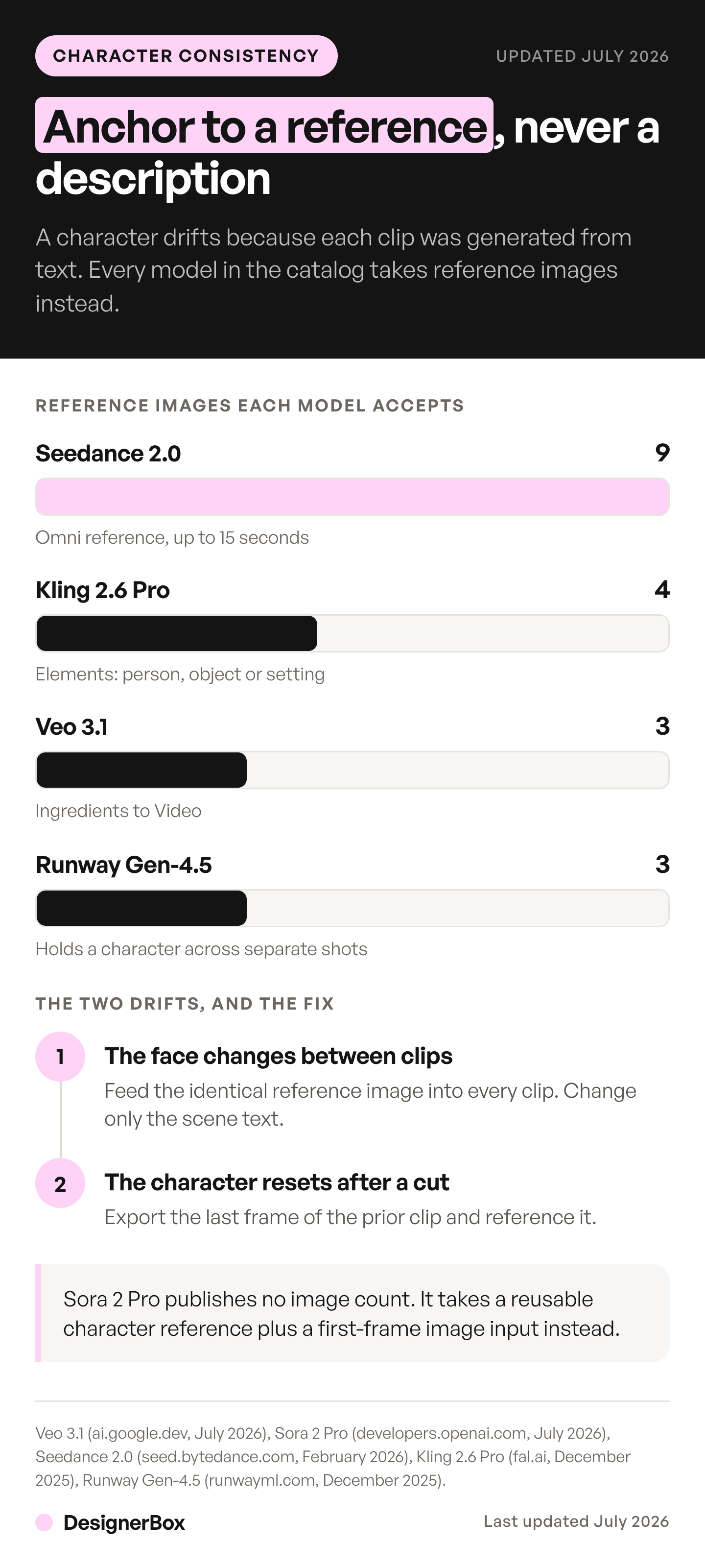
- The models hold a character through named features. Veo 3.1 uses Ingredients to Video, Runway Gen-4.5 uses References, Kling 2.6 Pro uses Elements, Seedance 2.0 uses omni reference. Same idea, different limits.
- Chain the frames for a sequence. Export the last frame of one clip and use it as the reference for the next. The character carries forward instead of resetting after a cut.
- Keep motion and light modest. Aggressive camera moves and jumping colour temperature give the model more room to drift. Introduce big motion across several clips, not one.
- Building the reference is cheap. The video is not. An image edit is 5 credits and a 9-image avatar set is 25. A Veo 3 clip with audio at 8 seconds is 6,400. Iterate the reference cheaply, then spend once on the anchored take.
- Expect strong, not perfect. The newest reference features moved this from experimental to production-ready. They did not make it flawless. Check every shipping clip.
Why a character drifts between clips
An AI video model does not move a photo. It redraws every frame from scratch, 24 or more times a second, and each redraw is a fresh guess at what the character looks like. Give it only a text description and it guesses slightly differently each time. Over a five-second clip that is 120 chances to drift, and the drift compounds the longer the sequence runs.
This is a known, measured problem, not a quirk of one tool. The EntityBench benchmark found that “cross-shot entity consistency degrades sharply with recurrence distance” in current systems, meaning the further apart two appearances of a character are, the more they diverge (arXiv, 2026). Text-to-video models generate each shot independently, with no persistent identity for a recurring subject, so small variations accumulate into visible identity drift.
The reason a prompt alone cannot fix it: words are lossy. “A woman in her thirties, brown hair, green jacket” describes a million faces. The model picks a different one from that space every time you run it. You cannot write a face precisely enough to pin it. You have to show the model the face.
The one rule: anchor to a reference, not a description
Every reliable consistency workflow reduces to the same move. Stop describing the character and start feeding the model a fixed image of them on every clip. The reference is the anchor. The prompt only controls what the anchored character does and where.
That splits the work into four moves.
Build one reference, then reuse it
Generate or shoot a single clean image of the character: front-facing, even lighting, neutral expression. This is the identity every clip inherits. For a character that needs to hold across angles, build a small set instead of one frame. In DesignerBox, a Kontext Multi generation combines multiple references into one consistent character and style, and a 9-image avatar set gives you the same face from several angles to draw on. Spend your iteration here, on the cheap image step, not later on the expensive video step.
Lock the identity line in the prompt
Write the character description once and paste it identically into every clip. Change only the scene, the action, and the camera. The instant you rewrite “brown hair” as “chestnut hair” between clips, you have told the model to pick a new face. Keep the identity half of the prompt frozen and let the environment half move. Where that identity line sits in the prompt depends on the model, because the five providers document five different prompt structures.
Keep motion and framing restrained
Fast camera moves and dramatic action force the model to redraw more, and more redraw is more drift. Shorten the clip, slow the move, and keep the character at a similar distance from camera across shots. When a shot genuinely needs big motion, build it across several linked clips rather than asking one generation to do everything.
Chain frames for a sequence
For narrative video where clips run back to back, export the final frame of each clip and feed it as the reference or start frame for the next. The character carries forward with its exact appearance from the previous shot, so the identity does not reset at the cut. This is the difference between a sequence that reads as one person and a montage of near-copies.
Which models hold a character, and how
Every current video model in the catalogue supports reference anchoring, but the feature has a different name and a different limit on each. These are catalogue models on one DesignerBox subscription, so you can pick the anchor that fits the shot rather than the one your single tool happens to ship. Specs verified against each provider’s documentation on the dates shown. For the wider view, the same six models are scored on planability, where reference count is one of four axes. Anchors get chosen once, at the planning stage, so locking a character before you generate the frames is where this decision belongs.
| Model | Provider | How you anchor a character | Best for |
|---|---|---|---|
| Veo 3.1 | Ingredients to Video: up to 3 reference images of a person, character, or product (ai.google.dev, July 2026) | Narrative shots where the face and the audio both have to match | |
| Veo 3.1 Fast | Same reference input, tuned for quick drafts | Blocking a sequence before you commit credits | |
| Sora 2 Pro | OpenAI | Reusable character reference plus a first-frame image input (developers.openai.com, July 2026) | Scene-led clips with synced audio |
| Seedance 2.0 | ByteDance | Omni reference: up to 9 images anchoring one subject, up to 15 seconds (seed.bytedance.com, Feb 2026) | Longer takes that hold a single character |
| Kling 2.6 Pro | Kuaishou | Elements: up to 4 reference images for a person, object, or setting (fal.ai, Dec 2025) | A character who speaks a line, with lip sync |
| Runway Gen-4.5 | Runway | References: up to 3 images to hold a character across separate shots (runwayml.com, Dec 2025) | The same character reappearing across a sequence |
Two honest notes from the providers themselves. Google frames Ingredients to Video as keeping “your characters looking the same even as the setting changes” (blog.google, January 2026), which is the exact job here. Read that phrasing carefully, because it also marks the boundary of the technique: holding the person is a different problem from holding the location across shots, and a sequence needs both to read as one shoot, with physics failures forming a third category that neither anchor touches. ByteDance, launching Seedance 2.0, conceded “room for optimization regarding multi-subject consistency” (seed.bytedance.com, February 2026), which is your warning that two characters in one shot is still the hard case. For a fuller breakdown of which video model suits which job, see our guide to picking an AI model for product video.
Reference anchoring also raises a rights question the technique itself does not answer. If your “character” is a real person’s face, holding it consistent across a campaign is a likeness use that needs their consent, and a standard model release often does not cover it. We cover that line in detail in how AI head swap works and what commercial use requires.
What each approach costs in credits
The economics reward the reference-first workflow directly, because the cheap part and the expensive part are on opposite ends of it.
Building the anchor is inexpensive. An image generate or edit is 5 credits. A 9-image avatar set, enough to hold a character across angles, is 25 credits. You can iterate a reference twenty times for the cost of a few seconds of finished video.
The video is where credits go. Video is priced as credits per second times duration, and it is by far the most expensive operation in the product.
| Example clip | Credits |
|---|---|
| Seedance Pro Fast, 720p, 5 seconds | 150 |
| Kling Standard, 720p, 5 seconds | 225 |
| Sora 2, 720p, 8 seconds | 1,600 |
| Veo 3 with audio, 8 seconds | 6,400 |
Read the bottom row against a plan. Premium includes 2,500 credits a month. One 8-second Veo 3 clip with audio costs 6,400, more than two months of that allocation on a single take. So the sequence is: lock the reference on the cheap image step, block the shot on Veo 3.1 Fast or Seedance Pro Fast to confirm the character holds through the motion, then spend the flagship credits once on the take you ship.
AI video needs the Premium plan or higher, and the commercial licence starts at Pro. The reference-image step that anchors all of this starts on the free plan, so you can prove a character holds before you pick a tier. The full per-second math is in our breakdown of what AI video costs, and the plans are on the pricing page.
Where characters still drift, and the fix
Even with a reference in place, a few failures recur. Each has a specific cause and a specific fix, and none of them is “write a better prompt.”
| What you see | Why it happens | The fix |
|---|---|---|
| The face changes shape between two clips | Each clip was generated from the text description, not a shared image | Feed the identical reference image into every clip. Change only the scene text. |
| The character resets after a scene cut | The new clip had no visual anchor from the previous shot | Export the last frame of the prior clip and use it as the reference for the next. |
| Features smear when the camera moves fast | Aggressive motion gives the model more frames to redraw and drift through | Shorten the clip and slow the move. Spread big motion across several linked clips. |
| The character ages or restyles between shots | Lighting direction and colour temperature jumped between generations | Keep the light and colour the same, and describe them the same way every time. |
| Two characters blend traits in one shot | The model merged two identities with no separation | Anchor each with its own reference, name them distinctly, and generate them in separate passes when you can. |
The last row is the current frontier. Single-character consistency is production-ready with the reference features above. Two or more recurring characters in the same frame is where even the newest models still slip, which the Seedance launch note admits outright. When a shot needs two consistent characters, isolate them: generate each against its own reference, then composite, rather than asking one generation to hold both.
Where DesignerBox fits
Character consistency breaks down into a chain: build a reference, hold it across clips, keep the assets together, and rerun the whole thing for the next campaign. DesignerBox is built around that chain rather than one step of it.
Every top video model sits on one subscription, so you choose the anchor feature that fits the shot instead of forcing every character through a single tool. Kontext Multi builds the reference on the image side. One workspace and one library keep the reference frame and every clip in the same place, so the character sheet is not scattered across drives and tool exports, which is where consistency usually dies.
And a saved workflow reruns the same character setup for the next product, drop, or client, so the presenter you locked once comes back the same. This is the video-length version of the same argument in our piece on why AI brand assets drift and how to stop it. See the Video Studio for where images, video, and avatars share one canvas, or the full model catalogue to compare the anchor features shot by shot.
The honest limit: the reference workflow makes a character strongly consistent, not perfectly so. Treat every shipping clip as something to check against your reference, not something to trust unseen.
On the stills side, best AI image model for consistent characters runs the same face through each model, and character LoRA training locks one identity across a whole campaign.
FAQ
Why do AI video models struggle with character consistency?
Because a video model regenerates every frame from scratch rather than moving a fixed image. Without a shared visual anchor, it re-guesses the character on each frame and each clip, and the small differences compound. Research on the problem finds that consistency “degrades sharply with recurrence distance,” meaning the further apart two shots of a character are, the more they drift (arXiv, 2026).
Do all AI video models support reference images?
Most current ones do, under different names. Veo 3.1 has Ingredients to Video, Runway Gen-4.5 has References, Kling 2.6 Pro has Elements, and Seedance 2.0 has omni reference. They all let you anchor a subject to one or more images, but the number of references and the strength of the hold differ by model, so verify the current limits before you rely on one.
How many reference images do I need?
One clean, front-facing image is enough to hold a single look. To keep a character consistent across angles and expressions, use a small set: Veo 3.1 accepts up to 3 subject images (cloud.google.com, July 2026), and a DesignerBox avatar gives you 9 images of the same face to draw from. Runway’s 3-reference feature runs on its image model rather than on Gen-4.5, and Kling publishes no reference cap for 2.6. The per-model breakdown is in AI character reference images.
Can I keep the same character across multiple clips?
Yes. Feed every clip the same reference image, keep the identity description identical, and for back-to-back sequences export the last frame of each clip to anchor the next. That frame chaining is what carries the exact appearance forward instead of letting it reset at the cut.
Can I keep a brand presenter or avatar consistent across a campaign?
Yes, and it is the strongest use of the technique. Build the presenter once as a reference or a 9-image avatar set for 25 credits, then reuse that anchor on every clip and save it as a workflow. The same face comes back for the next video without rebuilding it.
Can I keep two characters consistent in the same video?
This is the hard case. Current models hold one anchored character well but still blend traits when two recurring characters share a frame, which ByteDance acknowledged at the Seedance 2.0 launch. The workaround is to anchor each character with its own reference, name them distinctly, and generate them in separate passes where the shot allows. The full method, and what each model documents about character counts, is in the guide to putting two characters in one AI image.
Is perfect character consistency possible yet?
No. The newest reference features moved character consistency from experimental to production-ready, but not to flawless. Expect a strong hold with occasional drift, especially on long takes, fast motion, and multi-character shots. Check every clip you plan to ship against your reference.
Sources
- Cross-shot entity consistency degrading with recurrence distance, from the EntityBench benchmark: (arXiv, 2026)
- Veo 3.1 Ingredients to Video and its limit of three reference images: (ai.google.dev, July 2026)
- Google’s own framing of Ingredients to Video keeping characters the same as the setting changes: (blog.google, January 2026)
- Sora 2 Pro reusable character reference and first-frame image input: (developers.openai.com, July 2026)
- Seedance 2.0 omni reference limits, 15-second clip length, and ByteDance’s multi-subject consistency caveat: (seed.bytedance.com, February 2026)
- Kling 2.6 Pro Elements and its limit of four reference images: (fal.ai, December 2025)
- Runway Gen-4.5 References and its limit of three images: (runwayml.com, December 2025)
- DesignerBox credit costs, plan allocations and feature gating verified against live product configuration, July 2026
Model reference and consistency features verified from provider documentation (Google, OpenAI, ByteDance, Kuaishou, Runway) and the EntityBench benchmark as of July 2026. This category moves monthly; re-verify a model’s features before you rely on them. Individual results vary.