
The main Hailuo AI alternatives are Kling 3.0, Google Veo 3.1, Seedance 2.0 and 2.5, Runway Gen-4.5, Luma Ray3.2, Wan 3.0, LTX-2.5 and Vidu Q3. They differ most on three things: how long one clip runs, whether sound comes with the picture, and whether you can run the model yourself. Check Hailuo’s own new model first, because MiniMax H3 changed the comparison.
Hailuo 2.3 made clips of 6 or 10 seconds, and MiniMax’s pages state no native audio for it. MiniMax now lists Hailuo 2.3 and Hailuo 02 as legacy models, and its current model makes clips of up to 15 seconds with audio.
So the first question is why you want to leave. This guide sorts the alternatives by that reason. It is written for brands and agencies that make product and ad video every week. It prints no app prices, and every model fact links to the vendor’s own page.
Key Takeaways
- Hailuo changed. MiniMax H3 is the current model. Hailuo 2.3 and Hailuo 02 are listed as legacy models in MiniMax’s API docs.
- H3 closes two old gaps. It makes clips of 4 to 15 seconds and generates stereo audio with the picture.
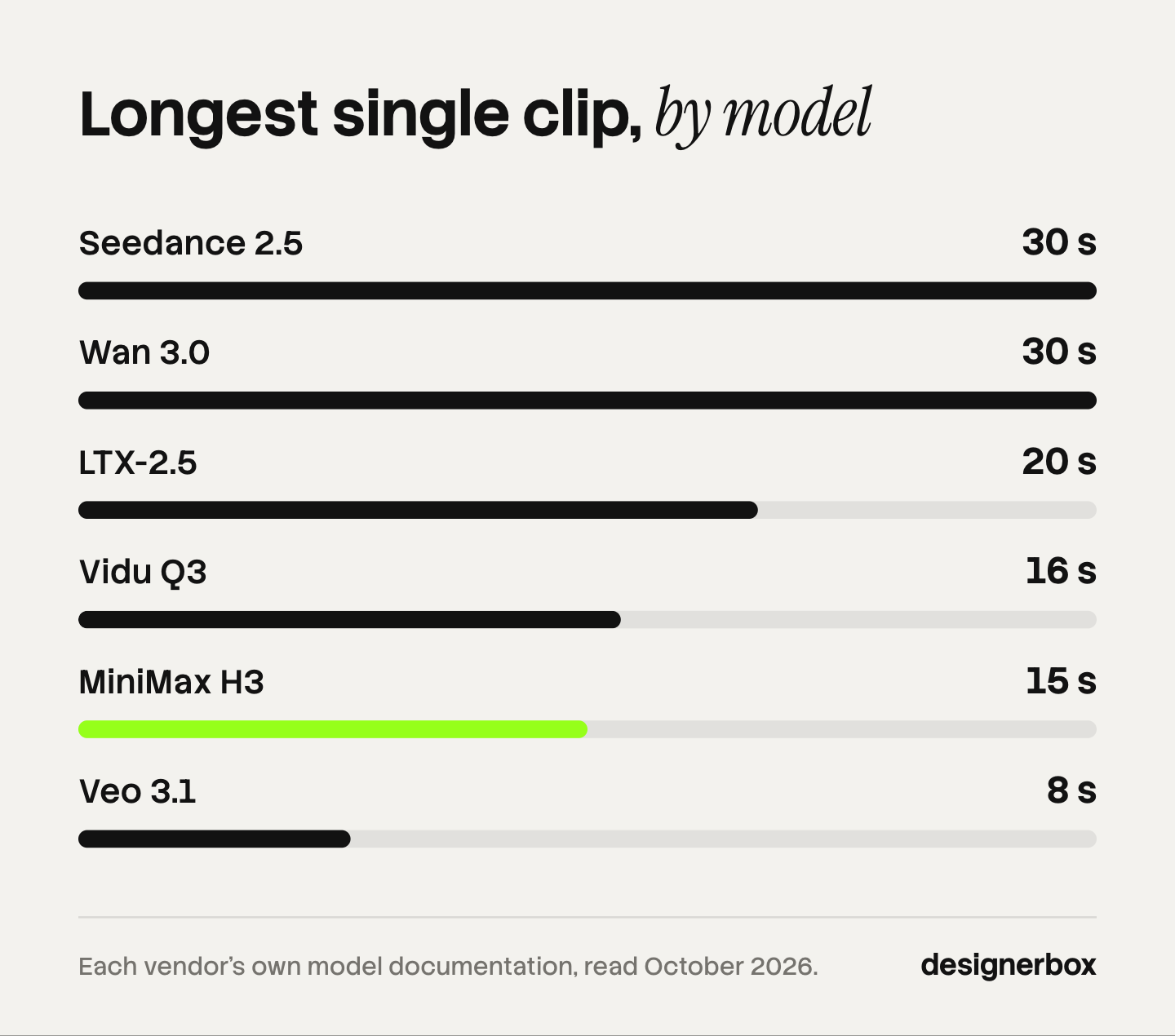
- Clip length now reaches 30 seconds. Seedance 2.5 and Wan 3.0 both list single clips of up to 30 seconds.
- Veo 3.1 has a date on it. Google lists 22 October 2026 as the earliest shutdown date for the Veo 3.1 preview models in the Gemini API.
- Two alternatives have open weights. LTX-2.5 and MiniMax H3 can run on your own hardware, under each vendor’s license.
- One app can host many models. Runway’s API lists MiniMax H3, Seedance 2.5, Wan 3.0 and Veo 3.1 next to its own models.
- The model is one step. For a brand, the harder part is the same look on every product and a review step that catches the bad clips.
What is Hailuo AI?
Hailuo AI is the video app from MiniMax, a Chinese AI company. MiniMax listed on the Main Board of the Hong Kong Stock Exchange on 9 January 2026 (HKEX filing, October 2026). The same models are sold to developers through the MiniMax API.
The model most people mean by “Hailuo” is Hailuo 2.3, which MiniMax launched on 28 October 2025. On the same day it renamed the Hailuo Video Agent to the Media Agent (MiniMax news, October 2026). Hailuo 2.3 makes text-to-video and image-to-video clips at 1080p for 6 seconds, or at 768p for 6 or 10 seconds. Hailuo 2.3 Fast takes an image only.
Today those models sit under “Legacy Models” in MiniMax’s API docs. The current video models are MiniMax H3 and H3 Max (MiniMax API docs, October 2026).
What changed with MiniMax H3?
MiniMax H3 makes clips of 4 to 15 seconds at 768P or 2K, at 24 frames a second. It covers text-to-video, image-to-video, first and last frame, and multimodal reference (MiniMax API docs, October 2026).

Three changes matter for anyone who left Hailuo, or plans to:
- Sound. H3 generates 32 kHz stereo audio with the video.
- References. One request takes up to 9 images, 3 videos and 3 audio clips, with 12 files at most.
- Open weights. MiniMax released H3 as an open-weight model under its own community license (MiniMax H3 announcement, October 2026).
One detail differs between pages. The API docs list 4 to 15 seconds, and the Hailuo app page lists 5 to 15 seconds. Test the length you need in the place you plan to use it.
If your reason to leave was short clips or silent clips, test H3 before you move. If your reason is below, read on.
Why do teams look for a Hailuo AI alternative?
Most reasons fall into five groups. Each one points to a different shortlist.
| Your reason | What to check | Shortlist |
|---|---|---|
| You need longer single clips | Seconds per generation | Seedance 2.5, Wan 3.0, LTX-2.5 |
| You need speech and sound | Native audio and languages | Veo 3.1, Kling 3.0, Vidu Q3 |
| You need tight control of the frame | Start and end frames, references | Kling 3.0, Veo 3.1, Seedance 2.0 |
| You need files for a film pipeline | HDR and export formats | Luma Ray3.2, Runway Gen-4.5 |
| You need to run the model yourself | Open weights and license | LTX-2.5, MiniMax H3 |
A sixth reason is common for brands: the clips are fine, and the process around them is the problem. That is a workflow question, and the DesignerBox section below covers it.
The 8 best Hailuo AI alternatives in 2026
Each entry starts with what the model does well. The facts come from the vendor’s own documentation.
1. Kling 3.0
Kling VIDEO 3.0 comes from Kuaishou. It covers text-to-video, image-to-video, start and end frames, native audio and multi-shot generation, with clips of 3 to 15 seconds (Kling 3.0 user guide, October 2026). Its audio covers Chinese, English, Japanese, Korean and Spanish.
Kling announced Kling 4.0 with generations of 3 to 30 seconds, and says it is scheduled to launch in October 2026 (Kling blog, October 2026). Plan on 3.0 until 4.0 is in the API docs.
Best for multi-shot scenes with dialogue in one generation.
2. Google Veo 3.1
Veo 3.1 generates video with native audio at 720p, 1080p or 4K, in clips of 4, 6 or 8 seconds. It accepts up to 3 reference images of a person, a character or a product, and it supports a last frame and video extension (Gemini API docs, October 2026).
Check the dates before you build on it. Google lists 22 October 2026 as the earliest shutdown date for the Veo 3.1 preview models in the Gemini API, and names Gemini Omni Flash as the replacement (Gemini API deprecations, October 2026). Veo alternatives covers where to go next.
Best for short clips where speech and sound have to match the picture.
3. Seedance 2.0 and 2.5
Seedance comes from ByteDance. Seedance 2.0 makes clips of 4 to 15 seconds and generates audio and video together. Seedance 2.5, released on 31 July 2026, makes single clips of 4 to 30 seconds and takes up to 50 image, video and audio references (BytePlus, October 2026).
Seedance 2.0 has a rule that matters for brand work: you cannot upload real human faces directly. Seedance alternatives explains the rule and the options.
Best for long single takes and scenes built from many references.
4. Runway Gen-4.5
Gen-4.5 reached the Runway API on 10 February 2026, with text-to-video and image-to-video in clips of 2 to 10 seconds. Runway delivers ProRes, PNG sequences and 10-bit files, and its Aleph 2.0 model edits existing clips of up to 30 seconds at 1080p (Runway API docs, October 2026).
Runway’s API also lists other vendors’ models, including MiniMax H3, Seedance 2.5, Wan 3.0 and Veo 3.1. So moving to Runway does not mean leaving MiniMax’s model behind. Runway alternatives compares the field around it.
Best for teams that edit generated footage and need professional file formats.
5. Luma Ray3.2
Ray3.2 is Luma’s current video model. It outputs 1080p in every mode, with text-to-video and image-to-video clips of 5 or 10 seconds. HDR is native 16-bit, with EXR export, and Modify Video handles clips of up to 20 seconds at 1080p (Luma, October 2026).
Best for footage that goes into a color-managed film or post-production pipeline.
6. Wan 3.0
Wan comes from Alibaba. Wan 3.0, released on 6 August 2026, covers text-to-video, first and last frame and reference-to-video at 480P, 720P or 1080P, in clips of 2 to 30 seconds. It does multi-shot video with dialogue, music and sound effects (Alibaba Cloud Model Studio, October 2026).
Open weights apply to the older versions. Wan 2.1 and Wan 2.2 are on GitHub under Apache 2.0, and Wan 3.0 is a hosted model. The Wan 2.5 API guide covers the developer side.
Best for long multi-shot clips with sound in a single request.
7. LTX-2.5
LTX-2.5 comes from Lightricks. It is an open-weight model that outputs 1080p, 1440p and native 4K at 24 to 50 frames a second, in clips of up to 20 seconds, with audio generated jointly (LTX, October 2026).
Open weights mean your team can run it on its own hardware. Read the license before commercial use, and count the engineering time.
Best for teams with engineers who want the model inside their own infrastructure.
8. Vidu Q3
Vidu Q3 generates clips of up to 16 seconds with dialogue, voiceover, sound effects and music in one pass. Its output languages are English, Japanese and Chinese, and its reference-to-video models run from 3 to 16 seconds (Vidu, October 2026).
Best for reference-led clips with speech in one of its three languages.
A note on Sora
Some older lists still name Sora. OpenAI removed Sora 2 and Sora 2 Pro from its API on 24 September 2026 and named no replacement (OpenAI API deprecations, October 2026). Sora alternatives covers what teams moved to.
Hailuo AI alternatives compared
Every cell comes from the vendor’s own page, read on the date in the Sources.
| Model | Maker | Single clip length | Native audio | Weights |
|---|---|---|---|---|
| MiniMax H3 | MiniMax | 4 to 15 seconds | Yes | Open, community license |
| Hailuo 2.3 (legacy) | MiniMax | 6 or 10 seconds | Not stated | Hosted |
| Kling 3.0 | Kuaishou | 3 to 15 seconds | Yes | Hosted |
| Veo 3.1 | 4, 6 or 8 seconds | Yes | Hosted | |
| Seedance 2.0 | ByteDance | 4 to 15 seconds | Yes | Hosted |
| Seedance 2.5 | ByteDance | 4 to 30 seconds | Not checked | Hosted |
| Runway Gen-4.5 | Runway | 2 to 10 seconds | No audio parameter in the API | Hosted |
| Luma Ray3.2 | Luma | 5 or 10 seconds | Not checked | Hosted |
| Wan 3.0 | Alibaba | 2 to 30 seconds | Yes | Hosted. 2.1 and 2.2 are open |
| LTX-2.5 | Lightricks | Up to 20 seconds | Yes | Open |
| Vidu Q3 | Vidu | Up to 16 seconds | Yes | Hosted |
“Not checked” means this guide did not confirm the fact on the vendor’s own page. “Not stated” means the vendor’s page does not say.
How to choose a video model
A spec table does not tell you how a model handles your product. Run a short test before you commit.
- Write down the reason. Length, sound, control, file format or self-hosting. Use the table above.
- Test with your own product photo. Use the same image and the same prompt in each model.
- Check the product first. Look at the logo, the label text and the shape in every frame.
- Count the retries. Note how many clips you made to get one you would publish. The most reliable AI video generator explains why this number matters.
- Check the dates. Models are retired fast. Read the vendor’s deprecation page before you build a process on one.
- Check where it runs. A model may be in an app you already pay for.
Cost follows from the retry count more than from the list rate. What AI video generation costs shows the arithmetic, and image-to-video for ecommerce covers the product-photo route.
DesignerBox fit and limits
Anyone can make an AI picture. Making hundreds that still look like your brand is the hard part. The same holds for video. One good clip from a model is a test. A brand needs the same clip style for every product, every week.
DesignerBox is AI creative production for brands and agencies. A model is one step in a workflow, and the workflow picks the model for each step. You set the brand once, and the workflow reads it on every run. A saved workflow takes a product photo, makes the product images, turns one into a clip and assembles the ad in the video editor, which is a real timeline with several tracks, transitions, animated text and audio. Batch runs one workflow over a sheet of up to 200 products, so row one and row two hundred get the same standard. Three critic steps score the results, and best-of-N keeps the best one. You see the cost before each run. An 8-second clip costs 40 to 560 credits, depending on the model. The full workflow from the first product photo to the finished ad, in one subscription.
The limits matter for a Hailuo user. The DesignerBox models page lists Veo 3.1, Seedance 2.0, Kling 2.6 Pro and Runway Gen-4.5 among its video models. MiniMax models are not on that page. If you want to explore one model after another, or run open weights yourself, a model app or your own hardware is the better choice. DesignerBox does not publish to a store or a social account. You download the results, or send them with a webhook or an S3 step. It does not have a public API. It has 68 tools over MCP, so an AI chat such as Claude, ChatGPT or Cursor can run it.
Uploading your own photos and the commercial license start on the Pro plan. AI video, the image editor and the video editor start on the Premium plan. There is a free plan. It runs on sample products, and it cannot make video. For an agency, team features are on the Ultra plan, and every plan below Ultra is one seat. Plans are on the pricing page, and the AI video ads page shows the video side.
The first job is one product video, built once. Start from a template, add your brand and your products, and run it. See the templates.
FAQ
What is the best alternative to Hailuo AI?
It depends on your reason. Kling 3.0 and Veo 3.1 fit clips with speech. Seedance 2.5 and Wan 3.0 fit long single clips of up to 30 seconds. LTX-2.5 fits teams that want open weights. Test MiniMax H3 first, because it replaced Hailuo 2.3 with longer clips and audio.
Is MiniMax Hailuo 2.3 still available?
MiniMax still documents Hailuo 2.3, Hailuo 2.3 Fast and Hailuo 02, and lists them under legacy models. The current models are MiniMax H3 and H3 Max (MiniMax API docs, October 2026).
Does Hailuo AI generate audio?
MiniMax H3 does. It generates 32 kHz stereo audio with the video (MiniMax H3 announcement, October 2026). MiniMax’s pages for Hailuo 2.3 do not state native audio.
Which Hailuo alternative makes the longest clips?
Seedance 2.5 and Wan 3.0 both list single clips of up to 30 seconds. LTX-2.5 lists up to 20 seconds and Vidu Q3 up to 16. Kling 3.0 and MiniMax H3 reach 15 seconds, and Veo 3.1 makes 8-second clips that it can extend.
Is there an open-source Hailuo alternative?
LTX-2.5 has open weights, and so does MiniMax H3 under its community license. Wan 2.1 and Wan 2.2 are open under Apache 2.0, and Wan 3.0 is hosted. Read each license before commercial use.
Is Hailuo AI free?
MiniMax says daily free trial credits may be offered during launch periods (Hailuo, October 2026). This guide found no statement of a permanent free tier, so check the app before you plan work on it.
Can DesignerBox replace Hailuo AI?
Only for a different job. DesignerBox runs a saved workflow from a product photo to a finished ad, and you see the cost before each run. It does not offer MiniMax models, and it is not a place to test one model after another.
Sources
- MiniMax current and legacy video models, H3 specs and Hailuo 2.3 specs: MiniMax API docs, models, October 2026
- MiniMax H3 audio, reference inputs and open weights: MiniMax H3 announcement, October 2026
- Hailuo 2.3 launch date and the Media Agent: MiniMax news, October 2026
- Hailuo app clip lengths for H3 and free trial credits: Hailuo, October 2026
- MiniMax listing on the Hong Kong Stock Exchange: HKEX filing, October 2026
- Kling VIDEO 3.0 features, clip length and audio languages: Kling 3.0 user guide, October 2026
- Kling 4.0 announcement: Kling blog, October 2026
- Veo 3.1 resolutions, durations, reference images and extension: Gemini API docs, Veo, October 2026
- Veo 3.1 preview shutdown date and replacement: Gemini API deprecations, October 2026
- Seedance 2.0 and 2.5 clip lengths, audio and references: BytePlus and BytePlus ModelArk, October 2026
- Runway Gen-4.5, Aleph 2.0, file formats and third-party models: Runway API docs and Runway API changelog, October 2026
- Luma Ray3.2 resolution, clip lengths, HDR and Modify Video: Luma, October 2026
- Wan 3.0 release, clip length, resolutions and multi-shot audio: Alibaba Cloud Model Studio, October 2026
- Wan 2.2 open weights and license: Wan 2.2 on GitHub, October 2026
- LTX-2.5 open weights, resolutions, frame rates, clip length and audio: LTX, October 2026
- Vidu Q3 clip length, audio and languages: Vidu and Vidu API docs, October 2026
- Sora 2 and Sora 2 Pro removal from the API: OpenAI API deprecations, October 2026
- DesignerBox models, plan gates, batch and MCP tools: (DesignerBox models, pricing and product pages, October 2026)
Model facts verified from each vendor’s own documentation as of October 2026. Individual results vary.