


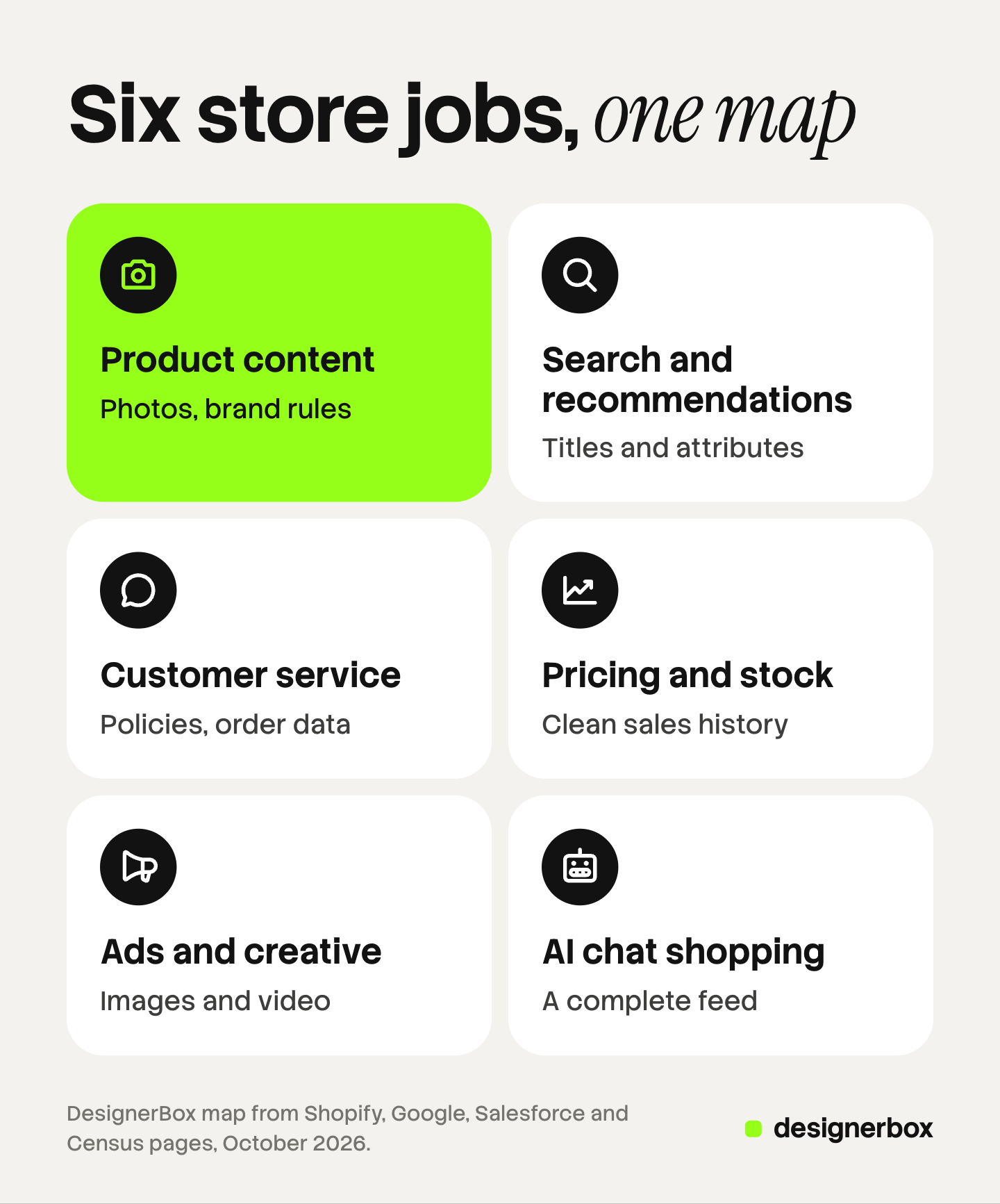
AI in ecommerce does six jobs in an online store in 2026. It makes product content, runs search and recommendations, answers customers, forecasts prices and stock, builds ads, and sells through AI chat. Each job needs something from you first: source photos, clean product data, written policies or sales history. A small team should start with the job whose input it already owns.
This guide is a map of AI for ecommerce, sorted by job. Each job gets its input and one dated source where a real one exists. It is written for a brand with 20 to 500 products, and for the agency that runs several stores.
Key Takeaways
- Online is a large share of retail. Ecommerce was 17.1 percent of total US retail sales in the second quarter of 2026 (census.gov, October 2026).
- AI in ecommerce is six jobs, and each has its own input: photos, product data, policies or sales history.
- Service is the best-measured job. Service teams estimate that AI handles 30 percent of cases today and expect 50 percent by 2027 (salesforce.com, October 2026). That is vendor data.
- AI chat is a small channel that grows fast. Traffic from generative AI tools to US retail sites rose 693.4 percent in the 2025 holiday season (news.adobe.com, October 2026).
- AI does not fix wrong product data, bad source photos or review time.
- Start where you own the input and can check the result first. For most small teams that is product content.
What is AI in ecommerce?
AI in ecommerce is the use of machine learning and generative models to do repeat work in an online store. Older systems predict: which product to show, how much stock to order. Newer generative models make things: an image, a description, a reply to a customer.
Much of it is already in your store. Shopify says its storefront search results “are built on an AI-powered search infrastructure”. Predictive search and typo tolerance are on by default for every merchant with an online store (help.shopify.com, October 2026). So the useful question is which job to feed with better input first.
How far has AI in ecommerce spread?
The US Census Bureau put retail ecommerce sales at $340.2 billion for the second quarter of 2026, seasonally adjusted. That is 12.2 percent more than a year before, and 17.1 percent of total retail sales (census.gov, October 2026).
Two vendor data sets show how much of that AI touches. Salesforce reported that AI and AI agents influenced 20 percent of all retail sales in the 2025 holiday season. It valued that at 262 billion dollars worldwide (salesforce.com, October 2026). Adobe Digital Insights counted 257.8 billion dollars of US online spending in the same season. Retail traffic from generative AI tools rose 693.4 percent (news.adobe.com, October 2026).
Read both with care. Each company sells software in this field, and Adobe wrote that “the base of users remains modest”. We found no published share for a store of your size.
AI in ecommerce by job
This table is the map. Each row is one job, with its input and a first step for a small team.
| Job | What AI does | What it needs from you | Where to start |
|---|---|---|---|
| Product content | Makes product images, video and copy from a source photo and product facts | Sharp source photos, a fact list per product, brand rules | One product type, one shot list, a review step |
| Search and recommendations | Matches shopper words to products and suggests related items | Clear titles, complete attributes, correct stock status | Fix titles and attributes on your top sellers |
| Customer service | Drafts or sends answers to common questions | Written policies, order data, a handoff rule | Order status and returns questions only |
| Pricing and inventory forecasting | Predicts demand and suggests prices or reorder dates | A year or more of clean sales history, lead times, costs | Reorder suggestions that a person approves |
| Ads and creative | Picks audiences and placements, and builds ad variants | Product images and video in every format, a product feed | One campaign with a full set of creative |
| Shopping through AI chat | Answers shopping questions and shows products inside a chat | A complete, accurate product feed and matching images | Fill every feed field for your top sellers |
Four of the six rows depend on product data or product pictures. AI in a store works on what the store gives it.
Product content: images, video and copy
This is the generative job. An image model takes a source photo and makes the other pictures a listing needs. A language model writes the title, the description and the attributes from a fact list.
Platforms now include some of it. Shopify lists product description text and a suggested product category among the AI features in its admin. It tells merchants to “review changes before you apply them” (help.shopify.com, October 2026).
It needs a sharp source photo, a list of true facts per product, and brand rules for light, framing and color. A team that skips the rules gets pictures that look like five different shops. Our guide to generative AI in ecommerce covers which products to do first.
Search and recommendations
This is the oldest AI job in a store. Search models match what a shopper types to your products. Recommendation models pick the related items under a product.
On Shopify, related product recommendations “are automatically generated for each product in your store”. The same page says they adjust to changes in your products and to customer activity (help.shopify.com, October 2026).
The input is your product data. A search model cannot match “linen shirt” to a product titled with a style code. Write titles in shopper words, complete the attributes, and keep stock status correct. The reference on product attributes lists the fields.
Customer service
Here AI drafts or sends answers to the questions that repeat, such as order status and returns. It is the job with the clearest adoption data.
In Salesforce’s State of Service report, service teams estimated that AI handles 30 percent of cases today. They expect 50 percent by 2027. The figures come from a survey of 6,500 service professionals in 2025 (salesforce.com, October 2026). The sample covers all industries, so a five-person store should not expect the same share.
It needs written policies, order data and a rule for when a person takes the conversation. A model can only repeat a returns rule that exists in writing. Keep complaints and exceptions with a person.
Pricing and inventory forecasting
A forecasting model reads past sales and suggests when to reorder and how much. A pricing model suggests price changes from demand and stock.
This job has the weakest public evidence for small stores. We found analyst predictions about large companies, and could not open the original pages in October 2026. This guide prints none.
The input is history. A forecast needs a year or more of clean sales data to see a season, plus supplier lead times. If you start here, start with reorder suggestions that a person approves.
Ads and creative
Ad platforms now run the buying with AI. The model picks the audience, the placement and the bid. It cannot pick creative you never gave it.
The platforms make some of it. Google Ads says its automatically generated images “will be based on either the text assets in your campaign or your landing page”. The advertiser decides which ones to add (support.google.com, October 2026). So your landing page and product pictures decide what the platform can build.
This job needs each product as a still and a short video, in each format the campaign takes. Our guide to ecommerce advertising lists what each of five channels automates. The guide to ecommerce creative production covers the cost that repeats on every asset.
Shopping through AI chat
This is the newest job, often called agentic commerce. A shopper asks an AI chat for a product, and the chat answers with products, prices and pictures.
Salesforce reported that the share of traffic from AI search channels doubled in the 2025 holiday season. Shoppers who arrived from those channels converted nine times more often than shoppers from social media (salesforce.com, October 2026). Shopify lets a merchant sell in AI channels such as ChatGPT, Google AI Mode and Gemini, Microsoft Copilot and Meta (help.shopify.com, October 2026).
An AI chat needs a complete product feed, with images that match the data. Our guide to agentic commerce gives 12 catalog checks from the published specs. The guide to ChatGPT shopping covers how a product gets shown there.
What AI in ecommerce does not fix
Three things stay with you, whatever the model.

Wrong product data. A model repeats what it reads. If the fact list says cotton and the shirt is a blend, every description and chat answer says cotton.
Bad source photos. An image model keeps what is in the photo. A blurred label stays blurred, or the model invents a new one. Shoot the source well once, and check each result against the real product.
Review time. Every job above produces more pictures, more copy and more replies. Somebody has to read them. A team that plans the AI and forgets the review has only moved the work.
Small catalogs have a fourth limit. A model that forecasts or personalizes has little to learn from a few hundred orders.
Where should a small team start?
Ask three things about each row of the map: whether you own the input today, whether you can check the result before a shopper sees it, and whether the job repeats every week.

Product content passes all three for most small brands. You have the photos, you see every picture before it goes live, and new products keep arriving.
Search and recommendations come second, because the platform already runs the model. Your work is the titles and attributes. That same data feeds AI chat, so the work counts twice. Service comes third, limited to order status and returns. Leave forecasting and pricing until you have a full year of sales.
An agency runs the same order for each client, and keeps each client’s brand rules and product facts separate.
AI tools for ecommerce, by category
AI tools for ecommerce follow the map, with one category per job: content tools, search and merchandising tools, service tools, planning tools, ad tools and feed tools. Store and ad platforms include basic versions of some of them.
Pick the category by the job you chose above, then pick a product. Our guide to AI ecommerce automation tools names tools for each job. It also sorts the jobs by how much checking each one needs.
Creative on brand, at volume
DesignerBox covers one job on this map: the creative. It makes images, ads and video for brands and agencies. It does not run search, answer customers, forecast stock or set prices. It does not write product descriptions or feed data either. It makes the pictures that the copy and the data have to agree with.
Anyone can make an AI picture. Making hundreds that still look like your brand is the hard part.
You set the brand once and build a workflow once. The workflow reads the brand on every run, so the next product gets the same light and framing. Batch runs one workflow over a sheet of up to 200 rows. Row one and row two hundred follow the same rules.
The full workflow from the first product photo to the finished ad, in one subscription. The cost is shown before the run. For video, an 8-second clip costs 40 to 560 credits, depending on the model.
Know the limits before you plan. DesignerBox does not publish to a store or an ad account, and it does not send a product feed. You download the results, or send them with a webhook or an S3 step. Every plan below Ultra is one seat. The free plan runs on sample products.
Uploading your own photos and the commercial license start on the Pro plan. AI video, virtual try-on, upscaling, the image editor and the video editor start on the Premium plan. Plans and credits are on the pricing page.
FAQ
How is AI used in ecommerce?
AI does six jobs in an online store: product content, search and recommendations, customer service, pricing and stock forecasts, ads, and shopping inside AI chat. Some of it is built into the store platform and is on by default. The rest comes from tools a team adds one job at a time.
What are examples of AI in ecommerce?
A search box that understands a spelling mistake is one. Related products under a listing are another. So is a product scene made from one source photo, or a chat reply about a late order. A product shown inside an AI chat is the newest example.
Which AI tools for ecommerce should a small store pick first?
Pick by job, then by tool. Most small stores start with a content tool, because they own the photos and can check every result. Next, use the search features the platform already includes. Add a service tool after you have written your policies.
Will AI replace ecommerce teams?
The sources in this guide do not show that. Salesforce’s survey reports AI handling 30 percent of service cases, which leaves most cases with people. Every job on the map also adds review work.
Does AI in ecommerce work for a small catalog?
Generative jobs work from the first product, because they need a photo and facts. Predictive jobs need history. A forecast has little to learn from a few hundred orders, so that job pays later.
Does DesignerBox cover all six jobs?
No. DesignerBox covers the creative: images, ads and video that follow your brand rules, for one product or a whole sheet. The cost is shown before the run. Search, service, forecasting, pricing and product copy need other tools.
Sources
- U.S. Census Bureau, Quarterly Retail E-Commerce Sales, 2nd Quarter 2026 (census.gov, accessed October 2026)
- Adobe Digital Insights, 2025 holiday shopping season results (news.adobe.com, January 2026, accessed October 2026)
- Salesforce, State of Service report, seventh edition (salesforce.com, November 2025, accessed October 2026)
- Salesforce, 2025 holiday shopping data (salesforce.com, January 2026, accessed October 2026)
- Shopify Help Center, Storefront search (help.shopify.com, accessed October 2026)
- Shopify Help Center, Customize product recommendations (help.shopify.com, accessed October 2026)
- Shopify Help Center, AI-powered tools (help.shopify.com, accessed October 2026)
- Shopify Help Center, Agentic storefronts (help.shopify.com, accessed October 2026)
- Google Ads Help, About generated images in Google Ads (support.google.com, accessed October 2026)
- DesignerBox plan gating (DesignerBox pricing page, designerbox.ai/pricing, October 2026)
Figures verified from the U.S. Census Bureau, Adobe Digital Insights, Salesforce, Shopify and Google pages as of October 2026. The Salesforce and Adobe figures are vendor data. Platform features change often, so check each help page before you plan. Individual results vary.