


Agentic commerce optimization is the work of making your products easy for AI shopping systems to find, describe and send a buyer to. In October 2026 the platforms handle the protocols and most of the checkout. Four jobs stay with the store: one accurate record per variant, one true image per variant, a product page a machine can read, and a way to measure the visits.
Most advice on this topic starts with the protocols. A store with five people then reads about feeds, carts and payment tokens, and decides the work is too technical to start. That is the wrong conclusion. The technical layer changed twice in a year, and the platforms absorbed both changes.
This guide is for brands with 20 to 500 products and the agencies that produce for them. It shows what is live today, who does which job, and the order to do your four in.
Key Takeaways
- AI visits now convert. Adobe reports that AI traffic to US retail sites converted 42% better than other traffic in March 2026. A year earlier it converted 38% worse.
- Checkout moved back to the store. OpenAI ended Instant Checkout in March 2026. A ChatGPT shopper now pays on the merchant’s own site.
- The platform owns the protocol. Shopify sends eligible products to ChatGPT, Microsoft Copilot, AI Mode in Google Search and the Gemini app by default.
- Four jobs stay with you. The variant record, the variant image, the readable product page and the measurement.
- The product page is the weak point. Adobe scored US retail product pages at 66% readable by machines, the lowest of the page types it lists.
- Google Analytics already has the channel. The default “AI Assistant” channel counts visits from ChatGPT, Gemini, Copilot and similar sources.
What is agentic commerce optimization?
Agentic commerce optimization is the practice of preparing a catalog so that AI shopping systems can read it, compare it and hand a buyer to checkout. Agentic commerce is the wider term: shopping where an AI system searches, compares and sometimes builds a cart for a person. Optimization is the seller’s side of it. It covers product data, images, product pages and tracking.
The reason to do it is in the traffic. Adobe measured traffic from AI sources to US retail sites up 393% year over year in the first three months of 2026. In March 2026 that traffic converted 42% better than non-AI traffic. In March 2025 it converted 38% worse (business.adobe.com, read October 2026). Adobe bases this on more than 1 trillion visits to US retail sites.
Shopify reports the same direction from its own stores. It says AI-referred orders grew 13 times year over year in the first quarter of 2026 (shopify.com, read October 2026). Both figures are the companies’ own data, and both describe growth from a small base.
What is live in October 2026?
Three surfaces matter for most stores. Each one gets product data a different way, and each one sends the shopper to pay in a different place.
| Surface | Where product data comes from | Where the shopper pays |
|---|---|---|
| ChatGPT | Shopify Catalog, a direct product feed, or public product pages | On the merchant’s own store, in an in-app browser |
| Microsoft Copilot | Shopify Catalog | In Copilot for eligible merchants, or on the store |
| AI Mode in Google Search and the Gemini app | Merchant Center feeds | In Google for eligible merchants, or on the store |
Shopify describes the three rows this way in its own guide, and says each store can turn direct checkout on or off per channel for Copilot and Google (shopify.com, read October 2026). Google’s developer page says its checkout uses your existing Merchant Center feeds and that you stay the merchant of record (developers.google.com, read October 2026). Google says the Universal Commerce Protocol “already enables direct checkout for hundreds of thousands of brands and retailers across Google” (blog.google, 16 September 2026). New merchants apply through an interest form (support.google.com, read October 2026).

The ChatGPT row is the one that changed. OpenAI launched Instant Checkout in the autumn of 2025, so that a shopper could pay inside the chat. In March 2026 it confirmed the end of that feature. An OpenAI spokesperson said the company was prioritizing search and product discovery, and that “Instant Checkout is moving to Apps” (cnbc.com, 20 March 2026). A Forrester analyst told CNBC that about 30 Shopify merchants were available through Instant Checkout the month before.
How a store gets into ChatGPT in detail is in the guide to ChatGPT shopping for sellers.
Which jobs belong to the platform, and which to the store?
The split is simple once the checkout news is clear. The platform does the parts that are the same for every store. Your store does the parts that only it knows.
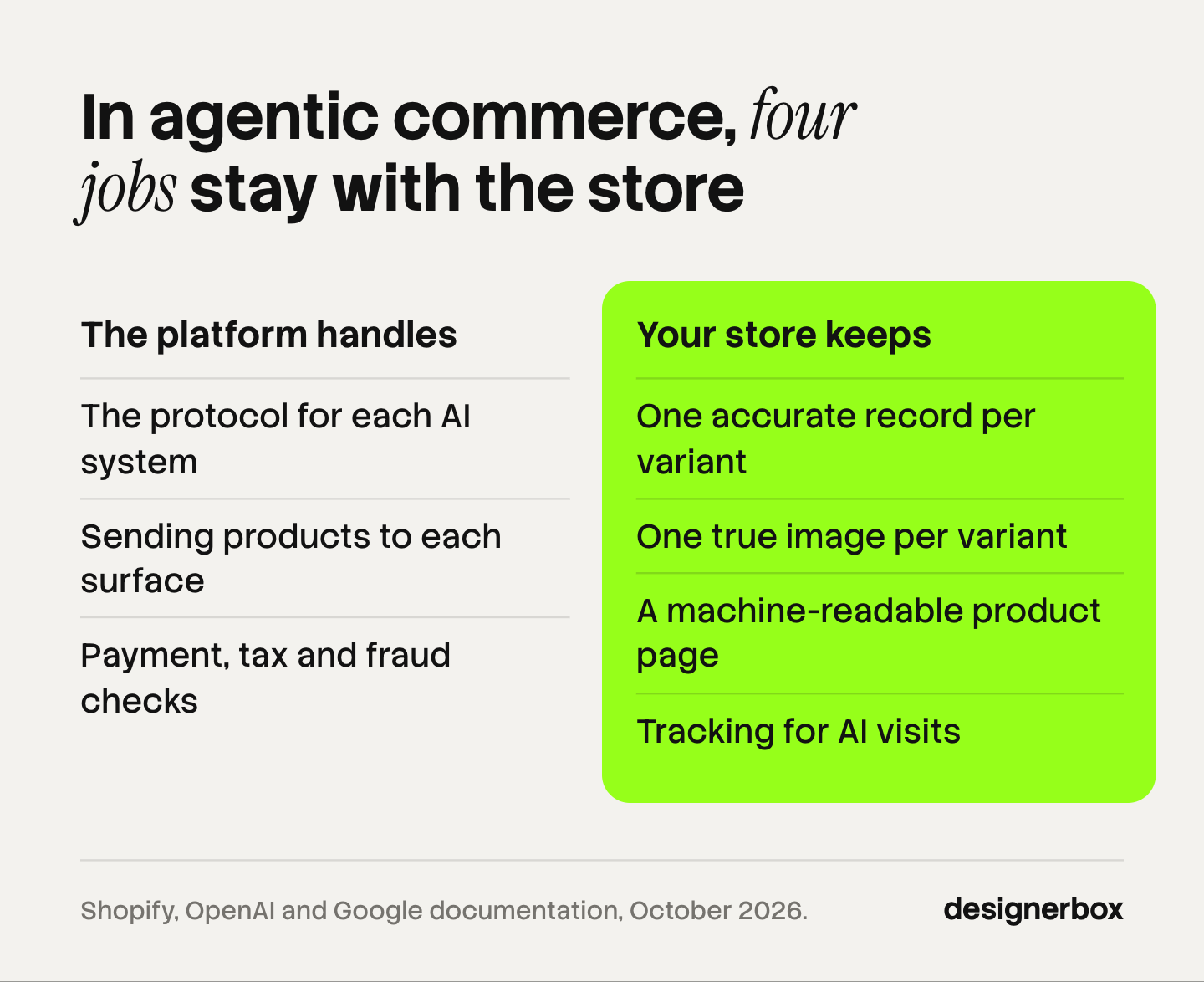
| Job | Who does it | Why |
|---|---|---|
| Speak the protocol to each AI system | Platform | It changes often, and it is the same for every store |
| Send products to each surface | Platform or feed provider | Shopify Catalog does this by default for eligible stores |
| Take payment, tax and fraud checks | Platform | It runs through the checkout you already use |
| Keep one accurate record per variant | Store | Only you know the material, the size and the stock |
| Supply one true image per variant | Store | Only you have the product |
| Keep the product page readable by machines | Store | It is your site and your theme |
| Measure visits and orders from AI sources | Store | It is your analytics account |
Shopify states the platform half plainly. It says Agentic Storefronts give merchants access to ChatGPT, Microsoft Copilot, AI Mode in Google Search and the Gemini app, managed from the Shopify admin, with products discoverable by default (shopify.com, 24 March 2026). The Universal Commerce Protocol, which Shopify and Google developed together, is the standard under the Copilot and Google checkouts.
If your store is not on Shopify, the same split holds. Your Merchant Center feed reaches Google’s surfaces. OpenAI takes a direct product feed, and its guide says feed onboarding is currently available to approved partners, with an application form (developers.openai.com, read October 2026).
Job 1: one accurate record per variant
A shopping system compares rows of data. A row with a missing material or a stale price loses the comparison, or is left out.
OpenAI’s feed reference asks for one row per purchasable item or variant, with nine required fields. It says each variant row carries its own price, availability, URL and images (developers.openai.com, read October 2026). The same reference says not to fill a field with placeholder text such as “n/a”.
Three checks cover most of the damage:
- The title names the variant. “Trail running shoes, black, size 10” can be compared. “Trail shoe” cannot.
- The attributes are written down. Material, color, size and dimensions sit in their own fields, in the same words on every product.
- Price and stock match everywhere. The feed, the product page and the checkout show the same number.
The definition, the protocols and 12 catalog checks are in the guide to agentic commerce. How the description field differs per channel is in how to write a product description.
Job 2: one true image per variant
The image rule is the one most catalogs fail. OpenAI defines the required image field as the main product image, showing this variant. It defines the color field as the selected color, consistent with the product image. Its best practices add that product-level images should be used only when they apply across every variant.

So a sweater in four colors needs four main images. The rule is set out field by field in product images for AI shopping agents. A store that shot the navy one and reused it for all four has three rows where the color field and the picture disagree.
Count it before you plan it. A catalog of 120 products with four colors each has 480 variants, and so 480 main images. That is plain arithmetic for one example store, not a benchmark.
Google’s rules apply to the same files:
- Size. Merchant Center will require at least 500 x 500 pixels for all products from 31 January 2027, and recommends 1,500 x 1,500 or more.
- AI label. Images made with generative AI must keep metadata that marks them as AI-generated (support.google.com, read October 2026).
- No placeholders. A logo or a “photo pending” graphic is not accepted as a product image.
A generated image may change the background. It may not change the product. The checks for that are in the guide to AI product photo accuracy, and the method for holding one look across a catalog is in consistent product images. This is general information, not legal advice, and each platform’s policy page is the rule.
Job 3: a product page a machine can read
A feed covers the products you send. Everything else is read from your pages, and the pages are where stores are weakest.
Adobe ran its own AI visibility checker across US retail sites. A score of 50% means half of a page’s content is not readable by machines. Home pages averaged 75%. Product pages averaged 66%, the lowest of the page types Adobe lists. Adobe sells a product in this area, so read the score as a vendor’s measurement.
Three things decide whether a product page can be read:
- The crawler is allowed in. OpenAI says a site that opts out of OAI-SearchBot is not shown in ChatGPT search answers. A change to robots.txt takes about 24 hours to apply (developers.openai.com, read October 2026).
- The product data is in the markup. Google’s merchant listing markup requires a name, an image and an offer with a price. Image URLs must be crawlable (developers.google.com, read October 2026).
- The details are on the page as text. Shopify’s help page recommends specifications, sizing guides, material and care information, and images with descriptive alt text (help.shopify.com, read October 2026).
A size chart inside an image fails the third point. So does a material that appears only in a lifestyle photo caption. On Shopify, the nine fields of a product listing are covered in order in Shopify product page optimization.
Job 4: a way to measure AI visits
You cannot see inside an AI answer. You can see what arrives at your store.
Google Analytics has a default channel named AI Assistant. Google describes it as the channel for users who arrive from sources such as ChatGPT, Gemini, Deepseek, Copilot or Grok. It excludes Google’s own AI Overviews and AI Mode, which stay inside search (support.google.com, read October 2026).
Use it for three numbers per month: sessions, conversion rate and the landing pages. The landing pages tell you which products AI systems send people to. Compare that list with the products you want to sell.
Two more signals cost nothing:
- Order attribution. Shopify says orders from ChatGPT arrive in the admin with ChatGPT referral attribution.
- Feed tagging. OpenAI’s best practices suggest adding a tracking parameter to the product URL in a feed, so feed clicks can be told apart.
Asking a chat a few questions about your category is a spot check. It is not a ranking, because the answer changes with the wording and the person.
When does a custom integration make sense?
Rarely, for a small store. The first year of agentic checkout is the evidence.
Instant Checkout launched and ended inside about six months. Stores that waited lost nothing. Their products still appear in ChatGPT, and the shopper pays on their site. OpenAI’s standard feed upload currently targets the US, and checkout needs a separately enabled integration. Google’s checkout takes new merchants through an interest form.
A direct build is worth a look only when all of these are true:
- Your platform does not offer the connection.
- The expected sales justify a developer who maintains it.
- Your price, stock and tax data are already accurate in real time.
- One named person owns the changes to the spec.
If one is false, the four jobs above are the better use of the month.
The order of work
- Week 1. Open the AI Assistant channel in your analytics and note the baseline. Check robots.txt for OAI-SearchBot.
- Weeks 2 and 3. Take 25 products across your best sellers and your slow ones. Check every variant for title, attributes, price, stock and its own image.
- Week 4. Turn each repeated fault into a rule: a title pattern, a required attribute, an image standard.
- After that. Apply the rules to the whole catalog, and to every new product on the day it is added.
The fourth step is where the time goes, and most of it goes on images.
Variant images at catalog scale
Anyone can make an AI picture. Making hundreds that still look like your brand is the hard part. DesignerBox is AI creative production for brands and agencies. It covers Job 2, the image for every variant, and nothing else on the list above.
- You build the image job once. A workflow holds your light, framing and background, and your brand profile holds the rules. The workflow reads them on every run.
- Batch runs it over the sheet. Batch runs one workflow over a sheet of up to 200 rows. You keep or discard each row, and re-run one row on its own.
- Review is built in. Critic steps score the results of a run, and best-of-N keeps the best one. You still compare each image with the real product.
- It continues past the listing. The full workflow from the first product photo to the finished ad, in one subscription.
The cost is shown before each run. Uploading your own photos and the commercial license start on the Pro plan. Plans and credits are on the pricing page.
The limits are clear. DesignerBox does not build or send a product feed, and it does not edit your product data or your product pages. It does not publish images to your store: you download the results, or send them with a webhook or an S3 step. Every plan below Ultra is one seat. The page on AI product photography shows the image job itself.
A free plan for your first run
There is a free plan, and it runs on sample products. Start from a template and see the cost before you run it.
FAQ
What is agentic commerce optimization?
Agentic commerce optimization is the work of preparing a catalog so AI shopping systems can find, compare and recommend its products. For a store, it means one accurate record per variant, one true image per variant, a product page that machines can read, and tracking for visits from AI sources. The platform handles the protocols.
What are agentic storefronts?
Agentic Storefronts is Shopify’s name for selling through AI channels from the Shopify admin. Shopify says it gives merchants access to ChatGPT, Microsoft Copilot, AI Mode in Google Search and the Gemini app. Eligible products are discoverable by default through Shopify Catalog, and the store stays the merchant of record.
What is the Universal Commerce Protocol?
The Universal Commerce Protocol is an open standard that Shopify and Google developed together. It defines how an AI system creates a cart and completes a checkout with a merchant. Google uses it for buying in AI Mode and Gemini, with your Merchant Center feeds. Most stores use it through their platform and never implement it directly.
Do I need a developer for agentic commerce readiness?
Not for the four jobs in this guide. Auditing titles, attributes, images and tracking is catalog work. A developer helps with product markup on a custom theme, and is needed for a custom feed or a direct protocol integration. Most small stores do not need the last two.
Can shoppers still buy inside ChatGPT?
OpenAI ended Instant Checkout in March 2026 and said it was moving to apps inside ChatGPT. Shopify says a ChatGPT shopper now completes the purchase on the merchant’s own store through an in-app browser. Check OpenAI’s current pages before you plan around this, because it changed twice in a year.
How do I track agentic shopping traffic?
Google Analytics has a default channel named AI Assistant, which counts visits from sources such as ChatGPT, Gemini and Copilot. It does not include Google’s AI Overviews or AI Mode. On Shopify, orders from ChatGPT carry a referral attribution in the admin.
Does DesignerBox make my store ready for AI shopping?
It covers one of the four jobs: the image for each variant, at the same standard across the catalog. The cost is shown before the run. It does not build a feed or edit product data, and you download the results yourself.
Sources
- Adobe, AI traffic to US retail sites and the AI visibility scores: business.adobe.com, read October 2026
- Shopify, how agentic commerce works: shopify.com, read October 2026
- Shopify, product data management guide: shopify.com, read October 2026
- Shopify News, Agentic Storefronts announcement: shopify.com, 24 March 2026
- Shopify Help Center, optimizing your store for AI: help.shopify.com, read October 2026
- OpenAI, product feed reference: developers.openai.com, read October 2026
- OpenAI, commerce get started guide and best practices: developers.openai.com, read October 2026
- OpenAI, crawlers overview: developers.openai.com, read October 2026
- Google, Universal Commerce Protocol guide: developers.google.com, read October 2026
- Google, agentic commerce updates for the holiday season: blog.google, 16 September 2026
- Google Merchant Center Help, about the Universal Commerce Protocol: support.google.com, read October 2026
- Google Search Central, merchant listing structured data: developers.google.com, read October 2026
- Google Merchant Center Help, image link attribute: support.google.com, read October 2026
- Google Analytics Help, default channel group: support.google.com, read October 2026
- CNBC, OpenAI ends Instant Checkout: cnbc.com, 20 March 2026
- DesignerBox pricing, October 2026
Platform facts verified from Adobe, Shopify, OpenAI and Google pages as of October 2026. The Adobe and Shopify growth figures are each company’s own data. The variant count is an example. Individual results vary.