


Creative operations is the operating model around creative work. It covers how a request enters the team, how the queue is ordered, who makes each decision, how fast each kind of work is promised, how review runs and what the team measures. Creative ops does not make the ad or the picture. It decides how the people who make them work together.
This guide gives a model that a team of 3 to 15 people can copy. It has one intake form, three request tiers, a list of decision owners, example service levels, one escalation rule and five metrics with a formula for each.
It is written for a performance or creative agency, and for an in-house brand team. In-house teams are now common. In 2023, 82% of members of the Association of National Advertisers had an in-house agency, up from 42% in 2008 (ANA, read October 2026).
Key Takeaways
- Creative operations has six parts. Intake, queue, roles, service levels, review and measurement. A small team can write all six on two pages.
- Sort every request into one of three tiers. Reusable, adapted or bespoke. The tier sets the owner, the promised time and the number of review rounds.
- Give each decision one owner. The creative lead owns the look, the product owner owns the facts, and the brand reviewer owns the rules.
- Set your own service levels. The numbers in this guide are an example to adapt, and your own delivery record should replace them.
- Measure five things. Cycle time, first-pass approval rate, revision rounds, reuse rate and cost per accepted asset.
- AI moves the constraint. Production time drops, so intake and review decide how fast work ships.
What is creative operations?
Creative operations, or creative ops, is the set of rules a creative team works by. They cover intake, the queue, roles, service levels, review and measurement.
Creative ops is wider than project management. A project manager keeps one project on time. Creative operations sets the rules that every project follows, so the tenth request runs like the first.
Creative workflow management is one part of it. A creative workflow is the path one job follows from request to delivery. Workflow management keeps that path the same each time. Our guide to the seven stages of an agency workflow covers the path itself. This guide covers the rules around it.
Few teams have these rules on paper. In a May 2026 survey of more than 200 marketing leaders by the software vendor Typeface, 20% said their workflows were standardized and documented. Another 18% said the workflows existed only in the heads of team members (Typeface, The AI Speed Paradox, read October 2026).
The six parts of a creative operations model
A small team needs six parts. Each part is one short written rule.
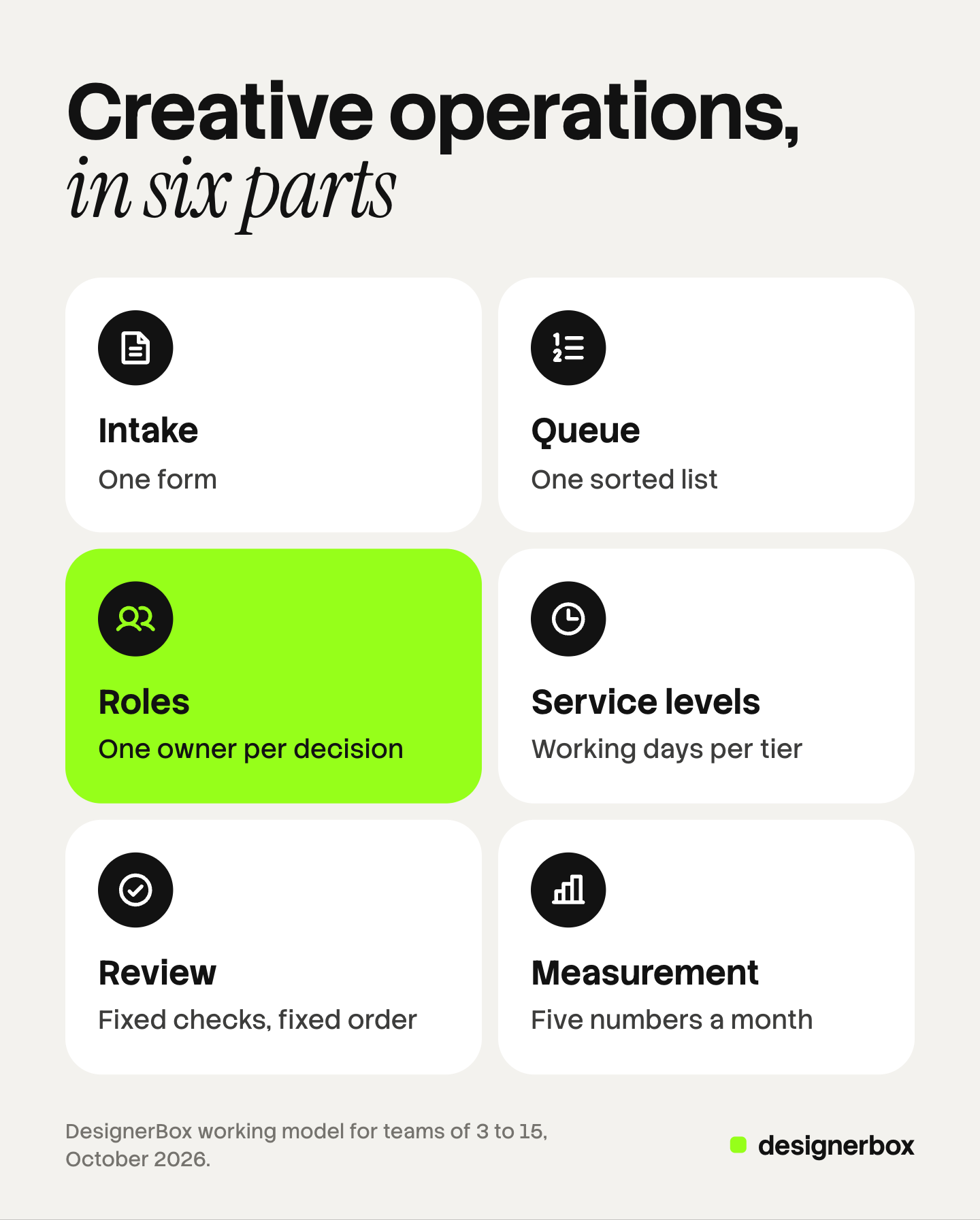
| Part | The question it answers | What a small team writes |
|---|---|---|
| Intake | How does work arrive? | One form, and no requests by chat |
| Queue | In what order is work done? | One list, sorted by tier and date |
| Roles | Who decides what? | One owner for each decision |
| Service levels | How long does each kind take? | Working days per tier |
| Review | Who approves, and how many rounds? | Fixed checks in a fixed order |
| Measurement | Is the team getting better? | Five numbers, read each month |
One intake form and one queue
Every request enters through one form. A request sent by chat or said in a meeting does not exist until it is on the form.
The form needs a small set of fields: the requester, the request type, the brand, the product, the purpose, the approver and the date. Our creative request form with 12 fields gives a template to copy, so this guide does not repeat it.
The form feeds one queue. One person orders it, and that person is the same every week.
Two rules keep the queue honest:
- The clock starts at a complete form. An incomplete form returns to the requester, and no time counts against the team.
- Nothing skips the queue without the escalation rule. A senior person who walks to a designer’s desk still completes the form.
Three request tiers: reusable, adapted and bespoke
Sort each request into one of three tiers when it arrives. The tier decides who does the work, how long it takes and how many review rounds it gets.
| Tier | What it is | Example | Who does it |
|---|---|---|---|
| Reusable | A job the team has done before, with only the product and the copy changed | The weekly promotion ad in four sizes | Anyone trained on the template |
| Adapted | An approved job with one or two changes to the look or the format | Last season’s product scene with a new background | A designer |
| Bespoke | New work with no approved starting point | A campaign concept or a launch film | The creative lead and a designer |
The test for the reusable tier is simple. Read the last five requests of one type. If only the product and the copy changed, that type is reusable.
Tiering protects the bespoke work. Without tiers, a new campaign concept and a resize wait in the same line.
Count one month of requests before you decide. The share of reusable work is your starting reuse rate, which is the fourth metric below.
Who owns which decision
Slow review usually has one cause. Two people believe they own the same decision, or nobody does. Give each decision one named owner.
| Decision | Owner | What this person checks |
|---|---|---|
| Is the request complete, and which tier is it? | Queue owner | The form and the tier test |
| Does the product look and read correctly? | Product owner | Variant, color, pack contents, claims and price |
| Does it follow the brand rules? | Brand reviewer | Logo, colors, type, tone and layout |
| Is the idea and the craft good enough? | Creative lead | Concept, composition and finish |
| Does it meet the goal? | Requester | The purpose on the form, and nothing else |
In a small team, one person can hold two roles. Each decision still has one name beside it.

Run the checks in a fixed order. Product facts come first, because a wrong product cannot be saved by good design. Brand rules come second. Our guide to brand compliance as a review standard covers the checks and the rejection reasons in detail.
Example service levels and one escalation rule
A service level is a promise the team makes to its requesters. The table below is an example for a team of about eight people. The numbers are an example to adapt. They are not an industry standard, and nobody measured them across teams.
| Tier | First result | Review rounds included | Each review returned within |
|---|---|---|---|
| Reusable | 1 working day | 1 | 1 working day |
| Adapted | 3 working days | 2 | 1 working day |
| Bespoke | 10 working days, or the date in the brief | 2 | 2 working days |
Set your own numbers from your own record. Take the last 30 finished requests in each tier. Use the time in which most of them were delivered, and promise that.
Service levels bind both sides. The reviewer’s time is in the table too.
The escalation rule is one sentence. Write it at the top of the form:
A rush request needs a yes from the queue owner, and the requester names the request that moves down to make room.
A rush costs something, so the person who asks for it chooses what waits.
Five creative operations metrics with formulas
Five numbers show whether the model works. Read them once a month, and split each one by tier.
| Metric | Formula | What it shows |
|---|---|---|
| Cycle time | Delivery date minus the date of the complete form, in working days. Report the median for each tier | Whether you keep your service levels |
| First-pass approval rate | Assets approved in the first review, divided by assets submitted, times 100 | Whether the form and the brief are clear |
| Revision rounds | Total review rounds, divided by approved assets | Where opinions differ |
| Reuse rate | Requests finished from a saved template or workflow, divided by all finished requests, times 100 | How much work is repeat work |
| Cost per accepted asset | People cost plus tool cost plus outside cost for the month, divided by accepted assets | Your real unit cost |
Here is an illustrative month, with invented numbers. A team finishes 120 requests, and 84 of them came from a saved template. The reuse rate is 84 divided by 120, or 70%. The team submits 150 assets, and 105 pass the first review. The first-pass approval rate is 70%. Reviewers ran 195 rounds for 150 approved assets, so revision rounds are 1.3. The month cost $9,000 in total, so the cost per accepted asset is $60.
Measurement is the part teams skip. In a 2025 survey by the staffing firm Cella, 42% of marketing and creative professionals said they struggle to define performance KPIs, and 28% hold regular project retrospectives (Cella by Randstad Digital, 2025 Cella Intelligence Report press release, read October 2026). Five numbers and one monthly meeting cover both gaps.
For the cost side in more depth, our guide to the four repeat costs in ecommerce creative production shows how a low approval rate multiplies unit cost.
What does a creative operations manager own?
A creative operations manager owns the model, and does not own the creative work. In practice this person owns five things: the intake form, the queue order, the service levels, the monthly metrics and the list of tools.
The manager does not approve the work. The three decision owners still do that.
A team of three does not need this as a job title. One person takes the duties for a few hours a week. The role becomes a full job when the queue owner spends more time ordering work than doing it. In a vendor survey of 1,008 creative professionals, 88% of organizations with a dedicated creative operations role rated themselves as effective (Monotype with Extensis, September 2025, read October 2026). That number is self-rated, so treat it as weak evidence.
What AI changes in creative operations
AI shortens production. It does not shorten intake or review. So the constraint moves to the two ends of the process.

The evidence for the first half is independent. In a preregistered experiment with 453 professionals, published in Science, access to an AI chat tool cut the average time for a writing task by 40% (Noy and Zhang, Science, July 2023, read October 2026). Quality rose by 18% in the same experiment. The tasks were writing tasks, so the exact number does not transfer to design.
The evidence for the second half comes from vendor surveys, so name the vendor when you repeat it. In the Typeface survey, 88% of marketing leaders said their teams can make content quickly, and the problem is approval. In the same survey, 44% said a campaign needs 20 or more people, against 10% a year before (Typeface, read October 2026).
In the Monotype survey, 57% of creative teams said they spend more than a quarter of their time on non-creative tasks, such as font and asset management, compliance checks and workflow bottlenecks (Monotype with Extensis, September 2025).
Three changes to the model follow:
- Move effort to intake. A fast tool makes a wrong request faster. A complete form matters more when production takes minutes.
- Plan review time as work. If a tool returns 40 results in an hour, someone needs an hour to judge them. Put that hour in the service level.
- Grow the reusable tier on purpose. Each adapted job that the team approves can become a saved template or an AI creative workflow. The reuse rate should rise each quarter.
Our guide to scaling creative production without hiring shows the same shift from the agency side, with volume benchmarks for each client size.
Where this model stops
The model has three limits.
- Service levels fail without the requester. If requesters do not return feedback on time, the team’s promise breaks. Get their agreement before you publish the table.
- Too many rules slow a small team. A team of three needs the form, the tiers and two metrics. Add the rest when the queue passes about 20 open requests.
- The numbers need three months. Read the trend, never one month.
Creative operations in DesignerBox
DesignerBox is AI creative production for brands and agencies. It makes images, ads and video, and a product photo is one of several inputs. DesignerBox covers the production part of this model. The intake queue, the service levels and the metrics stay in your own form and your own sheet.
Anyone can make an AI picture. Making hundreds that still look like your brand is the hard part. That is where the three tiers map to the product:
- Reusable work becomes an app. In DesignerBox, an app is a workflow with a form. A colleague completes the form and presses Run, so the request and the job are one step.
- Adapted work starts from a saved workflow. A designer makes a copy, changes one step and runs it. Batch runs the same workflow over a sheet, from row one to row two hundred.
- Bespoke work stays with your creative lead. The image editor and the video editor are there for finishing it.
Two parts of review are built in. The workflow reads your brand rules before every run, so the brand reviewer checks fewer basic errors. DesignerBox can send a client a page of pictures. The client opens the link with no account, chooses the pictures and sends the choice back. The cost is shown before the run, so cost per accepted asset is easier to count.
The full workflow from the first product photo to the finished ad, in one subscription.
The limits are plain. A person still judges every result. DesignerBox does not send results to an ad account or a store for you. You download the results, or send them with a webhook or an S3 step. Every plan below Ultra is one seat, so a team where several people run the form needs the Ultra plan.
Uploading your own photos and the commercial license start on the Pro plan. AI video, virtual try-on, upscaling, the image editor and the video editor start on the Premium plan. Plans and credits are on the pricing page.
Start with your largest reusable request type. If you run this for client brands, see DesignerBox for agencies.
FAQ
What is creative operations in simple terms?
Creative operations is the set of rules a creative team works by. The rules cover how requests arrive, the order of the queue, who decides what, how long each kind of work takes, how review runs and what the team measures. The short name is creative ops.
What is the difference between creative operations and project management?
Project management keeps one project on time and on budget. Creative operations sets the rules that every project follows: the intake form, the tiers, the decision owners and the service levels. A project manager works inside the model that creative operations defines.
What does a creative operations manager do?
A creative operations manager owns the intake form, the queue order, the service levels, the monthly metrics and the tool list. This person does not approve creative work. In a team under about ten people, the creative lead often holds these duties part time.
What is creative workflow management?
Creative workflow management keeps the path of each job the same, from request to delivery. It is one part of creative operations. The workflow is the path. Creative operations also covers the queue, the roles, the service levels and the metrics around that path.
Which creative operations metrics should a small team track first?
Start with two: cycle time and first-pass approval rate. Cycle time shows whether you keep your promises. First-pass approval rate shows whether requests are clear. Add revision rounds, reuse rate and cost per accepted asset after three months of data.
Sources
- 82% of ANA members with an in-house agency in 2023, up from 78% in 2018, 58% in 2013 and 42% in 2008: Association of National Advertisers, The Continued Rise of the In-House Agency: 2023 Edition, published May 2023, read October 2026
- A 40% drop in average task time and an 18% rise in quality, from a preregistered experiment with 453 college-educated professionals on writing tasks: Noy and Zhang, Experimental evidence on the productivity effects of generative artificial intelligence, Science 381(6654), 14 July 2023, abstract read October 2026
- 20% with standardized and documented workflows, 18% with workflows only in the heads of team members, 88% who can make content quickly and wait for approval, and 44% needing 20 or more people against 10% in 2025, from a May 2026 survey of more than 200 marketing leaders at vice-president level and above: (Typeface, The AI Speed Paradox, typeface.ai, read October 2026). A vendor survey
- 57% of creative teams spending more than a quarter of their time on non-creative tasks, and 88% of organizations with a dedicated creative operations role rating themselves as effective, from 1,008 creative professionals in the United States, the United Kingdom and Germany, surveyed April 2025: (Monotype with Extensis, Scaling Creative Operations press release, monotype.com, 17 September 2025, read October 2026). A vendor survey
- 42% who struggle to define performance KPIs and 28% who hold regular project retrospectives, from hundreds of marketing and creative professionals: (Cella by Randstad Digital, 2025 Cella Intelligence Report press release, 8 May 2025, read October 2026). A staffing firm’s survey
- DesignerBox apps page (designerbox.ai/product/apps), October 2026
- DesignerBox brand page (designerbox.ai/product/brand), October 2026
- The DesignerBox app, Reviews and Batch pages, read October 2026
- DesignerBox pricing page (designerbox.ai/pricing), October 2026
The six parts, the three tiers, the service levels and the worked month are a working method with illustrative numbers. They are not a measured benchmark. Survey figures were read on each publisher’s own page or press release in October 2026. DesignerBox facts were checked against designerbox.ai and the app in October 2026. Individual results vary.