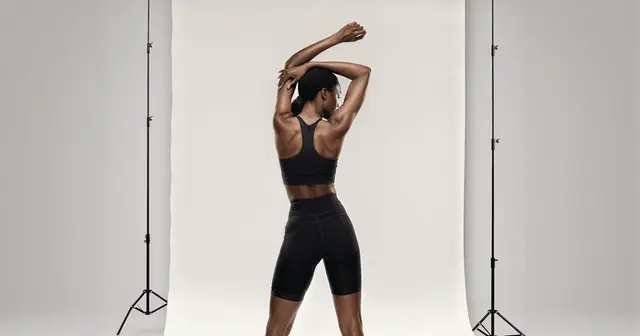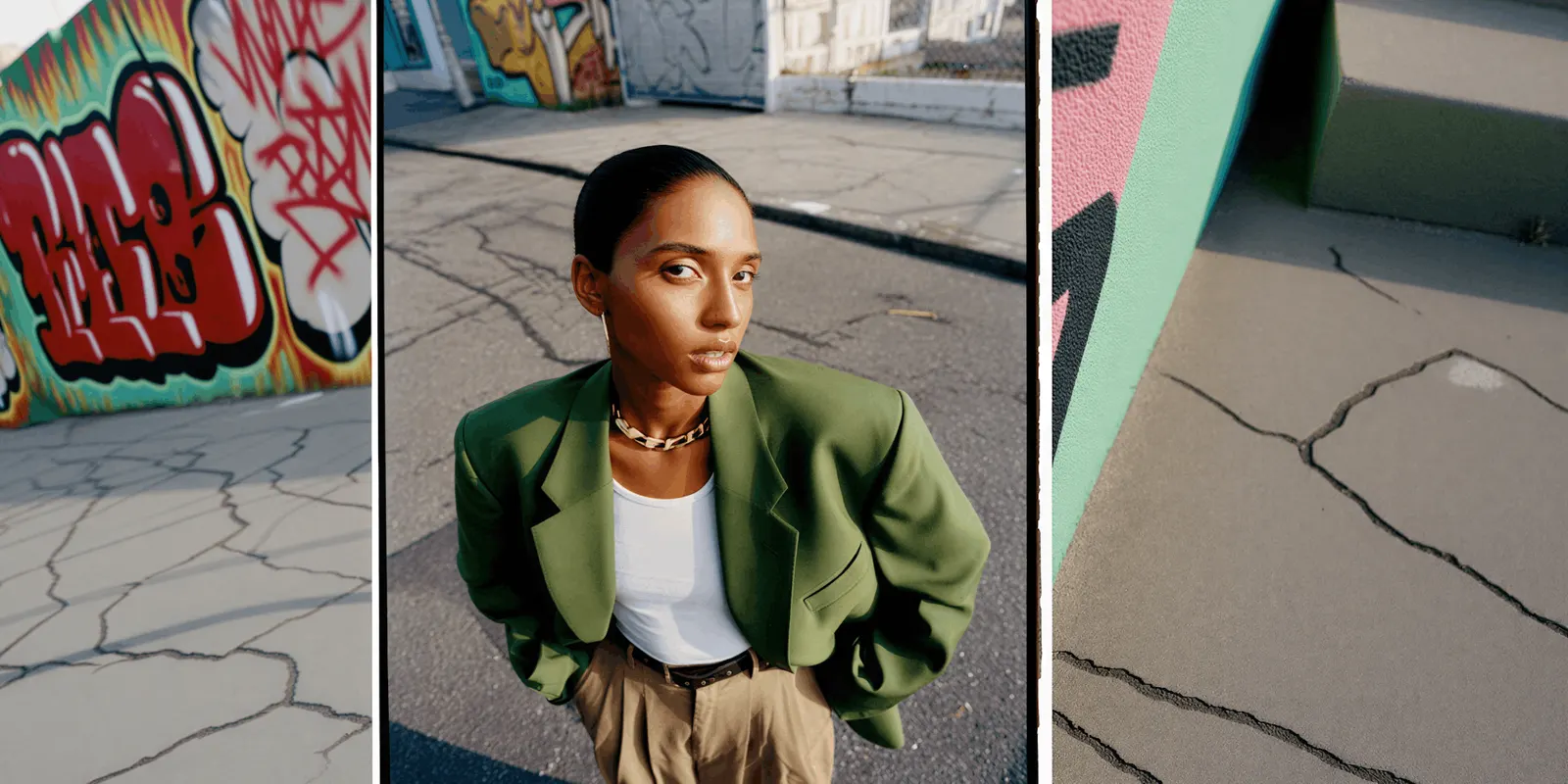
Jacket photography is the image set that sells an outer garment: a front on a body, a back, a hardware detail, a lining or interior frame, and a laydown. Outerwear is the only apparel category Amazon files under two different crop rules at once, and the hem decides which one applies. It is also the category where the picture itself carries a claim about fill, fur or insulation that a regulator can read.
Most jacket guides open with lighting. Diffuse the key, rake the leather, stop down, keep the background clean. That advice is correct and it is not what costs a listing. Brands follow it, shoot a beautiful bomber at waist crop, and then discover the parka in the same drop needed a full-length frame and a different setup.
This guide takes the other route. Which Amazon rule your jacket falls under and why it changes per SKU, the two frames outerwear listings skip most, what the Federal Trade Commission says about a picture of a down garment, how the four fabric families behave under a camera, and which frames survive a generative pass.
Key Takeaways
- A jacket sits in two Amazon crop classes at once. Outerwear falling below the knee is a full-length shot. Outerwear above the knee is a top-body shot. The hem sets the frame, not the product type (Amazon Seller Imaging Guide, Clothing and Accessories, Spring 2021, accessed August 2026).
- Sort the drop by hem length before anyone books a day. A mixed outerwear capsule needs more setups than a mixed tee capsule, and that is a budget line, not a styling preference.
- The ghost mannequin is banned from the Amazon main image and legitimate in every alternate slot. For a structured jacket that is the shot that shows shoulder and collar roll without a model.
- The picture is part of the claim. The FTC reads an ad “in context, words, phrases and pictures”, and treats an implied claim the same as an express one (ftc.gov, accessed August 2026).
- Unqualified “down” carries a number. FTC guidance says mass production should yield down content above 70% for a product labelled down, and a stated percentage may deviate by no more than 5% (ftc.gov, accessed August 2026).
- The back frame is the fit frame. Seat length, yoke and centre-back seam decide whether a jacket reads tailored or boxy, and apparel returns sit in a commonly reported 20% to 40% band with fit named as the leading cause.
- Generated backgrounds have a measured upside on apparel. A live catalogue test lifted click-through roughly 15% over baseline, in a range of 4% to 40% (RecSys ‘24, arXiv:2408.12392).
- Hardware is where generation fails first. Zip teeth, two-way pulls, snap plackets and woven labels come back as approximations. Count the pockets in every output before it ships.
What is jacket photography?
Jacket photography is product photography for a structured outer garment: blazers, bombers, bikers, overcoats, parkas, shells, denim and puffers. It differs from the rest of apparel in three ways that change the shoot.
The garment has internal structure. A shoulder pad, a canvas, a collar roll and a button stance exist whether or not anything is wearing the jacket, so an empty jacket still holds a shape that a tee never does. That is why off-figure outerwear shots read better than off-figure knitwear.
The garment has function. A jacket claims warmth, weather resistance, pocket count and closure type. Those are the things a shopper is buying and they are all visible decisions in a frame.
The garment layers. It sits over something, which means the frame has to show the fit with the intended layer underneath, or the sleeve and chest read tighter than the size chart says.
Why Amazon files a jacket in two crop classes
Amazon prescribes the crop by where the garment falls on the body, not by product type. Read the outerwear rows and the logic is immediate.
| Crop | Garment falls | Outerwear this covers |
|---|---|---|
| Full length | At or below the knee | Overcoats, long parkas, trench coats, robes, longline puffers |
| Top body | Below fingertips, above the knee | Bombers, bikers, blazers, shackets, cropped puffers, shells |
Both rows name jackets and outerwear explicitly. The same brand, in the same drop, sends two different frames depending on where the hem lands.
Two consequences follow, and both are budget items rather than styling notes.
You cannot shoot the whole capsule at one focal length and crop later. Framing a full-length coat and then cropping in for the bomber throws away resolution on the tighter shot, which matters because clothing images have a 1,600 pixel minimum height before Amazon switches on zoom.
A mixed outerwear drop needs its shot list sorted by hem before anyone books a studio. Eight SKUs split five short and three long is two setups, not one. The parent rule set for every other garment category sits in the clothing photography shot list Amazon already wrote.
The jacket shot list, sorted by hem
Amazon asks for a minimum of five and a maximum of seven images per listing, with a clear front and back plus additional angles. Here is that mapped onto outerwear.
| Shot | Slot | On or off figure | What it proves |
|---|---|---|---|
| Front, closed | MAIN | On-figure | Silhouette, button stance, length |
| Back | PT01 | On-figure | Seat length, yoke, centre-back seam |
| Front, open | PT02 | On-figure | Lining, inner pockets, how it wears layered |
| Hardware detail | PT03 | Either | Zip type, snaps, buckles, storm flap |
| Ghost mannequin | PT04 | Off-figure | Shoulder and collar roll with nobody in it |
| Laydown | FL01 | Off-figure | Full colourway and true proportion |
Five of those six carry no rule beyond image quality. One of them, the main, carries a published rule sheet. That imbalance is the most useful thing to know about an apparel shoot, because it tells you where to spend.
The main image needs a pure white background at RGB 255, 255, 255, the product filling at least 85% of the frame, no props, no visible or ghost mannequins, and a model shown from the nose down. Everything else is open. The styled frame has no restrictions at all, which is where brand voice belongs.
The picture is a claim about the fill
This is the part outerwear guides leave out, and it applies to no other apparel category as hard.
The FTC does not treat imagery as decoration. Its guidance on feather and down states that the Commission “examines the ad in context, words, phrases and pictures, to determine what it conveys to consumers”, and that advertisers “must have proof to back up all express and implied claims that a reasonable consumer would take from an ad”. The worked example in that document is a picture: the claim “nature’s best insulation” beside an image of a goose implies goose down (ftc.gov, accessed August 2026).
Three numbers from the same guidance are worth writing on the brief:
- A product may not be called “pure down”, “all down” or “100% down” unless that is true.
- An unqualified “down” label should reflect content above 70%, because that is what mass production techniques yield.
- A stated percentage may deviate by no more than 5%, and a producer “may not shoot for the tolerance”.
Now apply that to a generated image. A puffer rendered with baffles the real garment does not have, a hood rendered with fur trim that is not on the SKU, or a shell rendered with a laminated sheen the fabric does not carry, is an implied claim about the product. The label is not the fix. If the image flatters the garment beyond what arrives in the box, the answer is a different image.
The disclosure question is separate and it moved this month. Article 50 of the EU AI Act became applicable on 2 August 2026, and the Commission’s July 2026 guidelines put a photorealistic AI-generated person inside the deep fake definition while leaving background replacement, colour correction and rescaling outside it. The full breakdown, including which assets in a drop trigger a label, is in labelling AI-generated fashion images.
How the four fabric families behave
Outerwear is four capture problems wearing the same word. Brief them separately.
Leather and coated finishes. Grain is a specular property, so it only appears where light rakes across it. Overhead soft light flattens a biker jacket into a shape with no surface. Use a directional key with visible falloff and let one side of the sleeve go darker than the other. The failure mode to watch is the opposite of underexposure: a blown highlight on a shoulder deletes the grain entirely and the jacket reads as vinyl.
Wool and melton. Nap has direction. A wool overcoat photographed with the nap running away from the light looks flat and slightly dusty, and the same coat turned around looks rich. Shoot a test frame both ways before committing the setup. Wool also holds a crease differently from twill, which is a drape claim, and drape is the thing that carries a coat. The gauge and stitch problems that apply to sweaters under the coat are worked through in knitwear photography.
Technical shell. Ripstop, laminates and DWR finishes reflect. A shell will pick up a colour cast from anything in the room, including the model’s skin and any coloured surface behind camera. Flag it. A shell that photographs slightly green is a colour accuracy problem, and colour accuracy is a returns problem.
Down and quilting. Baffle geometry is a product identifier. Box-wall versus sewn-through changes both the look and the warmth claim, and a shopper comparing two puffers is reading exactly that. Light it so the baffle edges hold a shadow line, because flat light collapses a quilted panel into a printed pattern.
The two frames outerwear listings skip most
The back. Seat length, yoke width and centre-back seam decide whether a jacket reads tailored or boxy, and a shopper cannot infer any of it from a front frame. Amazon reserves PT01 for the back for exactly this reason. Apparel carries one of the highest return rates in ecommerce, commonly reported in a 20% to 40% band depending on subcategory, and fit is consistently named the leading cause. A back frame is returns work.
The open front. A jacket is bought partly on its interior: lining, inner pocket, storm flap, drawcord. A closed front hides every one of them. This is also the frame that shows how the jacket wears over a layer, which resolves the sizing question a structured garment always raises.
The off-figure equivalent of both is the ghost mannequin, and it is the outerwear technique that gains the most from a structured garment. It is prohibited in the Amazon main image and allowed everywhere else, and the channels that take the opposite position are covered in where a ghost mannequin shot is allowed to run. On DesignerBox the same effect runs from a photo of the garment on a form through ghost mannequin.
Where AI holds up on jackets, and where it breaks
The split follows the constraint map above, and it is sharper for outerwear than for soft apparel.
Where it holds up. Scene and background swaps for the styled frame. Additional colourways of a jacket already photographed, which for outerwear is often the same shell in four colours. Crops and aspect ratios for a paid social calendar. Angle coverage from one source photo, which Photo Angles generates as front, side, three-quarter, back, top-down and low angle. There is measured upside here: a live catalogue test on mostly-apparel inventory lifted click-through roughly 15% over baseline with generated backgrounds, in a range of 4% to 40% (RecSys ‘24, arXiv:2408.12392).
Where it breaks. Hardware first, and it fails quietly. Zip teeth render as a plausible texture rather than the actual tooth pitch. A two-way zip comes back one-way. Snap plackets lose a snap. Woven labels and embossed logos garble into near-text. On a $400 biker the hardware is the price signal, so a wrong pull tab is not cosmetic.
Second, quilting. Baffle count and stitch spacing drift between generations, and on a puffer that pattern is the product.
Third, pile direction on shearling and fur trim, which reverses or feathers in ways that read as a different material.
The working rule is the same one that applies across apparel: generation moves the alternates first and the main image last. Photograph, or verify frame by frame, the shot that carries the 85% rule. And check the output against the real garment with a literal count. Pockets, zips, snaps, baffles.
Two DesignerBox surfaces are built for this. Everything starts from your actual product photo rather than a text prompt, so the output is your jacket. Material swap changes a finish while holding the shape, which is the safe version of a colourway variant. And when a jacket has to appear worn, Model Studio puts the real garment on a model rather than inventing one. Keeping that model identical across a whole capsule is its own problem, worked through in consistent AI fashion images.
On model choice, DesignerBox runs the same fashion brief through its catalogue and publishes the result: Nano Banana Pro for natural skin and pose, FLUX 2 Flex for the truest fabric and texture. For outerwear, fabric fidelity is usually the deciding axis.
What an outerwear drop costs to shoot
Run the arithmetic on the shot list, not on a day rate, because the shot list is what scales.
An 8-SKU outerwear capsule at six shots per SKU is 48 images, across at least two setups because of the hem split. Published day rates for ecommerce fashion photographers commonly sit in a $1,000 to $3,500 band, rising above $3,000 in New York and Los Angeles, with studio rental quoted from roughly $300 to $1,500 a day (jointellos.com, larsmillermedia.com and wearview.co, August 2026). Model, styling and retouching sit on top, and the second colourway of the same shell costs close to the first.
Generated images invert the unit. On DesignerBox, generating or editing an image costs 5 credits. Basic is $15 a month for 500 credits, which is 100 images, and the 48-image capsule above fits inside it with room for the reshoots. Plan detail is on the pricing page.
The number that compounds is the second colourway, not the first shoot. Once the garment is photographed, additional colourways, crops and scene variants come off that file. For a category that ships the same shell in six colours every season, that is where the arithmetic moves.
Two limits stated plainly. Video is priced per second of output and is the most expensive operation on the platform, so budget it apart from stills. Team collaboration and shared brand kits are on the Ultra plan at $200 a month.
How to produce a jacket set with DesignerBox
- Photograph the main image properly. One clean front frame of the real jacket, correct crop for its hem, white background. This is the file everything else derives from.
- Sort the drop by hem. Long coats to full length, short jackets to top body, before anything is generated or booked.
- Generate the angle coverage. Photo Studio takes the single source photo out to the back, three-quarter and detail frames.
- Add the off-figure frames. Ghost mannequin for structure, laydown for colourway.
- Put it on a model where the fit story needs one. Outfit to Image works from the garment, so the jacket in the frame is the jacket in the box.
- Run the count check. Pockets, zips, snaps, baffles, labels, against the real garment, on every output.
- Rerun it next drop. The whole sequence saves as a repeatable pass, and the bulk catalog processor applies it across a folder of SKUs with marketplace naming on the way out.
Channel specs beyond Amazon, including Shopify, Etsy and TikTok Shop, are collected in the channel-by-channel image spec.
FAQ
How do you photograph a jacket for ecommerce?
Shoot six frames: a front on a body for the main image, a back, an open front showing the lining, a hardware detail, a ghost mannequin for structure, and a flat laydown for the colourway. Frame the main image to Amazon’s crop class for that garment’s hem, on pure white, with the product filling at least 85% of the frame.
What crop does Amazon require for a jacket?
It depends on the hem. Amazon’s Clothing and Accessories imaging guide puts outerwear falling below the knee in the full-length class and outerwear above the knee in the top-body class. A long parka and a bomber from the same brand take different frames.
Should a jacket be photographed on a model or a mannequin?
On a model for the main image if you are selling adult apparel on Amazon, since the guide directs adult apparel to be imaged on-figure and shows the model from the nose down. Use a ghost mannequin in the alternate slots, where it is allowed and where a structured jacket benefits most from it.
Can you use a ghost mannequin for a jacket main image on Amazon?
No. Ghost mannequins and visible mannequins are both listed under the main image prohibitions. They remain legitimate in the variant slots, which is where most outerwear brands should be using them.
How many photos does a jacket listing need?
Amazon asks for a minimum of five and a maximum of seven per listing, including a clear front and back plus additional angles. Six is the practical number for outerwear, because the open-front frame carries the lining and the layering story.
How do you photograph a leather jacket without losing the grain?
Light it directionally rather than flat. Grain is specular, so it only shows where light rakes across the surface. Watch the shoulder highlight, because a blown highlight deletes grain and makes leather read as vinyl.
Do you need a back shot for a jacket?
Yes, and it is the frame most listings skip. Seat length, yoke and centre-back seam decide whether the jacket reads tailored or boxy. Amazon reserves the first variant slot for the back for this reason.
Can AI generate jacket photos that keep the real hardware?
Not reliably, and hardware is the first thing to check. Zip tooth pitch, two-way pulls, snap counts and woven labels are where generation drifts. Generate the styled and colourway frames, verify the hardware detail frame against the garment, and count pockets, zips and baffles on every output before it ships.
Does a picture of a down jacket count as a claim?
Yes. The FTC examines an ad in context, including pictures, and treats implied claims the same as express ones. An image showing baffles, fur trim or an insulation finish the garment does not have is a claim you would need to substantiate.
Sources
- Amazon Seller Imaging Guide, Clothing and Accessories, Spring 2021 edition, m.media-amazon.com, accessed August 2026. Crop classes for full length, top body and waist down, main image requirements and prohibitions, image counts and file naming, and the 1,600 pixel zoom threshold. The guide carries a Spring 2021 stamp and is marked informational, so confirm the current style guide for your subcategory before a launch.
- Federal Trade Commission, “Down…But Not Out: Advertising and Labeling of Feather Down”, ftc.gov, accessed August 2026. Express and implied claims, the reading of ads in context including pictures, the 70% threshold for unqualified down, the 5% percentage tolerance, and the pure, all and 100% down restriction.
- European Commission, Guidelines on the implementation of the transparency obligations under Article 50, adopted 20 July 2026, and the Article 50 applicability date of 2 August 2026, via European Commission FAQ, August 2026.
- Kumar et al., generated product image experiment, RecSys ‘24, arXiv:2408.12392. Click-through lift from generated backgrounds on a mostly-apparel catalogue.
- Published photographer and studio rate ranges: jointellos.com, larsmillermedia.com and wearview.co, August 2026. These are published ranges rather than a survey, and vary by market.
- Apparel return rate band and fit as the leading cause: commonly reported industry figures, August 2026.
- DesignerBox plan allocations, credit costs and feature gating, product brief, August 2026.
Amazon requirements verified from the Seller Imaging Guide for Clothing and Accessories, and FTC positions from ftc.gov, as of August 2026. Marketplace specs and disclosure rules change; check the current guide for every channel you list on before briefing a drop. This is not legal advice. Individual results vary.
Ready to shoot the drop before the samples land? Turn one jacket photo into the full outerwear set.