


Perplexity shopping is the product search inside the Perplexity answer engine. A shopper asks a question, and Perplexity answers with product cards that show the item, its specs and its reviews. Products reach it in three ways: the web crawler, the Perplexity Merchant Program, or a PayPal catalog connection. Some products carry an Instant Buy button, so the shopper pays inside the answer.
Perplexity launched the feature in November 2024 and relaunched it in November 2025 with PayPal behind the checkout. This guide is for brands with 20 to 500 products. It covers how Perplexity shopping works for a seller as of October 2026, read from Perplexity’s own pages, and it says where Perplexity publishes no detail.
Key Takeaways
- Three routes in. The PerplexityBot crawler, the Merchant Program, or a PayPal store sync connection through your commerce platform.
- Checkout is called Instant Buy. The 2024 name was Buy with Pro. Instant Buy is for users in the United States, except those on Perplexity’s two enterprise plans.
- The retailer is the merchant of record. The order and the payment go to the merchant.
- Product cards are not ads. Perplexity says advertisers cannot pay to list products.
- No feed specification is public. Perplexity publishes no field list, no image size and no ranking formula.
What is Perplexity shopping?
Perplexity shopping is the part of Perplexity that answers buying questions with products. Perplexity describes “product cards focused on what matters for your specific questions, alongside the specs and reviews” (perplexity.ai, 25 November 2025).

Perplexity’s own example is a winter jacket for a person who takes a ferry to work in San Francisco. The answer is meant to match that commute. Perplexity also says it remembers past searches and uses them to shape later results.
The product has had two launches:
- November 2024. Perplexity launched product cards, a visual search called Snap to Shop, and a checkout called Buy with Pro for Pro subscribers in the US (perplexity.ai, 18 November 2024).
- November 2025. Perplexity launched a new shopping experience, “available for free to all US Perplexity users”, with PayPal powering the checkout.
Two limits matter for a seller. Shopping and Instant Buy are for users in the United States. And the Help Center says Instant Buy does not apply to users on Perplexity’s two enterprise plans (perplexity.ai, October 2026).
How does a product get into Perplexity shopping?
Perplexity’s pages describe three routes.
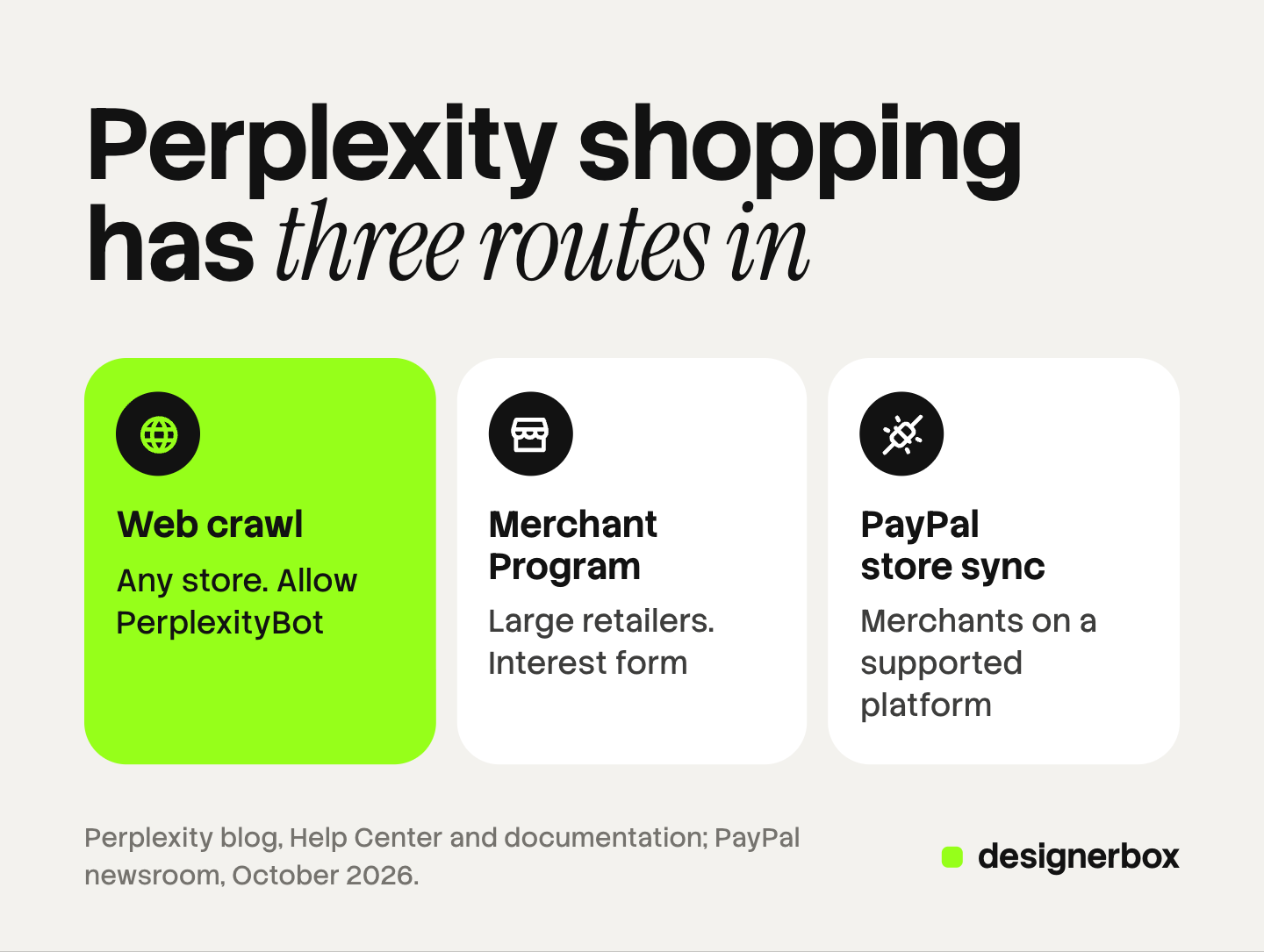
| Route | Who can use it | What you do |
|---|---|---|
| Web crawl | Any store | Allow PerplexityBot in your robots.txt file |
| Merchant Program | Large retailers, by Perplexity’s own wording | Fill in the interest form and wait for a reply |
| PayPal store sync | PayPal merchants on a supported platform | Enroll through PayPal or your commerce platform |
Route 1: the web crawl
Perplexity’s crawler is called PerplexityBot. Perplexity’s documentation says the crawler exists to “surface and link websites in search results on Perplexity”, and it recommends allowing PerplexityBot in your robots.txt file (docs.perplexity.ai, October 2026). A change to that file can take up to 24 hours to apply.
This route needs no agreement. It needs a product page a crawler can read, with the price, the stock and the specifications in text.
Route 2: the Merchant Program
The Perplexity Merchant Program is the direct route. Perplexity launched it in November 2024 so that large retailers could share product specs with it. A later section covers it.
Route 3: a PayPal store sync connection
PayPal calls its catalog service store sync. PayPal says store sync “makes merchant product catalogs instantly discoverable within Perplexity’s results”. A second service, which PayPal calls agent ready, lets the merchant accept payment there with its existing PayPal setup (newsroom.paypal-corp.com, 25 November 2025).
Store sync works through partner platforms. PayPal named Wix, Cymbio, Commerce (BigCommerce and Feedonomics) and Shopware when it announced the service (newsroom.paypal-corp.com, 28 October 2025). Perplexity’s Help Center names the same group. It says Instant Buy products come from select merchants, including Wayfair and Abercrombie & Fitch, and from thousands of merchants on BigCommerce, Shopware and Wix (perplexity.ai, October 2026).
PayPal adds one caution: integrations through store sync may vary by provider. Check availability with your commerce platform.
What about Shopify?
Perplexity’s 2024 post said product discovery was “powered by platform integrations including Shopify”. That was announced in November 2024.
Shopify’s current help page for agentic storefronts names ChatGPT, Google AI Mode and Gemini, Microsoft Copilot and Meta as its AI channels (help.shopify.com, October 2026). It does not name Perplexity. A Shopify store should not assume a managed connection to Perplexity exists today. The crawl route still applies.
How does Perplexity Instant Buy work?
Instant Buy is the checkout inside Perplexity. The Help Center describes three steps:
- The shopper searches. Perplexity answers with product cards.
- The shopper clicks Instant Buy. They enter shipping and payment details once, and Perplexity saves them.
- The order goes to the merchant. Perplexity says the order and the payment are sent directly to the merchant for fulfillment.
The retailer is the merchant of record. Perplexity wrote that retailers “have full visibility into who their customer is, can process returns, build loyalty, and own the post-purchase relationship”. PayPal’s announcement says the same, and adds that retailers are paid directly.
So support stays with you. The Help Center tells shoppers to contact the brand or the retailer about availability, shipping and delivery. Perplexity Support does not answer product questions.
Not every product has the button. Perplexity says: “We only support Instant Buy with merchants who are compatible with our agentic checkout experience.” The 2024 post said that a product with no in-answer checkout sends the shopper to the merchant’s website. Plan for both outcomes.
Perplexity’s pages name no merchant fee for Instant Buy. Ask PayPal or your platform before you enroll.
What is the Perplexity Merchant Program?
The Perplexity Merchant Program lets a retailer share product data with Perplexity directly. Perplexity says the program is free for merchants, and that it is separate from its advertising products.
The 2024 post lists four benefits: a better chance of being a recommended product, payment integration for the one-click checkout, free API access, and a dashboard of search and shopping trends.
To join, a retailer fills in an interest form. On 7 October 2026 the form was live and asked for four things: a contact name, a contact email, the merchant URL and the shopping vertical.
Read the wording with care. Perplexity addresses the program to “large retailers”, and it publishes no size threshold. A brand with 200 products can fill in the form, but Perplexity makes no promise of a place. For a smaller store, the crawl and a PayPal connection are the routes described in public.
Which products does Perplexity recommend?
Perplexity publishes a short answer and no formula. The Help Center says: “Just as our answer engine ranks sources based on authority and relevance, we rank product listings using similar criteria.”
It names three more things:
- The question. Perplexity says the more specific the shopper is, the more exactly it can match products.
- The shopper. Past searches, interactions and saved preferences refine the results over time.
- Product detail. Perplexity says it is “more likely to recommend merchants who provide deeper product details such as availability, reviews, pricing, and specifications”.
Listings are not for sale. The Help Center says the algorithm determines all product listings “based on relevance and ratings”, and that advertisers cannot pay to list their products.
Product detail is the point a seller controls. A shopper who asks for a waterproof jacket can only be matched to a product whose record says waterproof. The guide to agentic commerce optimization sorts this work into the jobs a platform handles and the jobs the store keeps.
What product images does Perplexity ask for?
Perplexity publishes no image requirement. Its pages name no minimum size, no file format, no background rule and no number of images.

Three things are on the record:
- Cards are visual. Perplexity’s 2024 post describes product cards with key details “in a simple, visual format”.
- Shoppers can search with a photo. Snap to Shop is a visual search tool. It shows relevant products when the shopper takes a photo of an item. It was announced in November 2024.
- The image comes from your record. Perplexity reads the catalog your platform syncs, or the product page its crawler finds. It shows the image it finds there.
So the working standard comes from the platforms that do publish one. Google will require at least 500 x 500 pixels for every product from 31 January 2027, and OpenAI asks for a main image that shows the exact variant. Both rules are explained in the guide to product images for AI shopping agents.
One example shows the count. A store has 60 products in three colors each, so it needs 180 main images. This is arithmetic for one invented store. The sizes per sales channel are in the guide to ecommerce product photography.
Perplexity vs ChatGPT shopping vs Google
Every cell below comes from the platform’s own page, read in October 2026.
| Perplexity | ChatGPT | Google AI Mode and Gemini | |
|---|---|---|---|
| Source of product data | Web crawl, the Merchant Program, PayPal store sync | Public product pages, the Shopify or Etsy catalog, a direct feed for approved partners | Merchant Center product feeds |
| Checkout | Instant Buy inside the answer for compatible merchants | On the merchant’s own site or app | A checkout button for select merchants |
| Merchant of record | The retailer | The merchant, in its own checkout | The merchant |
| Feed specification | None published | Published | Published |
| Image rule | None published | A main image for each variant | At least 500 x 500 pixels from 31 January 2027 |
| Where it is live | United States | United States | Checkout: eligible products in the US, Canada and Australia |
OpenAI’s merchant page says purchases “are completed on merchant-owned websites or apps” (chatgpt.com, October 2026). Its developer guide says feed onboarding is “currently available to approved partners” (developers.openai.com, October 2026). The seller view is in the guide to ChatGPT shopping.
Google says its checkout uses your existing Merchant Center shopping feeds and that you remain the merchant of record (developers.google.com, October 2026). Its help page says the checkout is available for select merchants at this time (support.google.com, October 2026). The image floor is on Google’s image link page (support.google.com, October 2026). The protocols behind both are in the guide to agentic commerce.
What Perplexity does not document
On 7 October 2026, Perplexity’s blog, Help Center and developer documentation did not state any of the following:
- A feed specification. No field list, file format or update schedule.
- An image rule. No size, format or count.
- A ranking formula. Only authority, relevance, ratings, personal history and product detail are named.
- Merchant Program criteria. No size threshold and no review time.
- A merchant fee for Instant Buy.
- The current state of the Shopify integration.
- Countries beyond the US.
Several third-party guides describe a Perplexity feed format and an approval time in days. No Perplexity page read for this guide confirms those claims. Treat them as unverified.
A seller checklist for Perplexity shopping
- Check the crawler. Confirm that your robots.txt file allows PerplexityBot.
- Write the detail down. Availability, price, specifications and reviews belong on the product page as text.
- Match each image to its variant. One main image per color, in the same framing. Planning that volume is covered in the guide to bulk product images.
- Ask your platform about store sync. Wix, BigCommerce and Shopware are the platforms Perplexity names.
- Apply to the Merchant Program. Expect it to favor large retailers.
- Search for your own products. Ask Perplexity a shopper’s question and note what the card shows.
Catalog images for every shopping surface
Anyone can make an AI picture. Making hundreds that still look like your brand is the hard part. DesignerBox is AI creative production for brands and agencies. For a brand with 20 to 500 products, it covers the image part of this job: the same shot for every product, and one main image per color.
- You build the set once. A workflow holds the steps for the main image and the extra views. A saved workflow runs the same way on the next product. The page on AI product photography shows the shots.
- You set the brand once. Light, framing and rules live in your brand. The workflow reads them on every run.
- The catalog runs from a sheet. Batch runs one workflow over a sheet of up to 200 rows. Row one and row two hundred get the same standard. You keep or discard each row, and re-run one row on its own.
- You check each result. Compare every image with the real item before it goes into a catalog.
The cost is shown before the run. The full workflow from the first product photo to the finished ad, in one subscription.
Uploading your own photos and the commercial license start on the Pro plan. AI video, virtual try-on, upscaling, the image editor and the video editor start on the Premium plan. Plans and credits are on the pricing page.
The limits are clear. DesignerBox makes the images. It does not send finished work to Perplexity, PayPal, Shopify or any product feed. You download the results, or send them with a webhook or an S3 step. Titles, prices and stock stay in your commerce platform. Every plan below Ultra is one seat. The free plan runs on sample products. The page for ecommerce brands shows the catalog work in one place.
FAQ
How do I sell on Perplexity?
There are three routes. Allow the PerplexityBot crawler to read your product pages. Fill in the interest form for the Perplexity Merchant Program, which Perplexity addresses to large retailers. Or enroll in PayPal store sync through a supported commerce platform, which PayPal says makes a catalog discoverable in Perplexity’s results.
What is Perplexity Instant Buy?
Instant Buy is the checkout inside Perplexity. The shopper clicks Instant Buy on a product card and enters shipping and payment details once. Perplexity sends the order and the payment to the merchant. It works only with compatible merchants, for users in the United States.
Who is the merchant of record on Perplexity?
The retailer. Perplexity says that, through its partnership with PayPal, retailers stay at the center of the transaction as the merchant of record. PayPal’s announcement says retailers are paid directly.
Are Perplexity product listings ads?
No. Perplexity’s Help Center says its algorithm determines all product listings based on relevance and ratings. It says advertisers cannot pay to list their products there.
What image size does Perplexity shopping need?
Perplexity publishes no image size. A practical standard is the one Google publishes: at least 500 x 500 pixels from 31 January 2027, with 1,500 pixels square or more recommended.
Sources
- Perplexity, Shopping that puts you first: perplexity.ai, 25 November 2025, read 7 October 2026
- Perplexity, Shop like a Pro: perplexity.ai, 18 November 2024, read 7 October 2026
- Perplexity Help Center, What is Instant Buy?: perplexity.ai, last modified 3 September 2026, read 7 October 2026
- Perplexity Help Center, Instant Buy + Buy with PayPal: perplexity.ai, last modified 14 September 2026, read 7 October 2026
- Perplexity documentation, Perplexity crawlers: docs.perplexity.ai, read 7 October 2026
- Perplexity Merchant Program interest form, linked from the 2024 post, checked 7 October 2026
- PayPal Newsroom, PayPal and Perplexity Launch Instant Buy: newsroom.paypal-corp.com, 25 November 2025
- PayPal Newsroom, PayPal Launches Agentic Commerce Services: newsroom.paypal-corp.com, 28 October 2025
- Shopify Help Center, Agentic storefronts: help.shopify.com, read 7 October 2026
- OpenAI, merchant page for shopping in ChatGPT: chatgpt.com, read 7 October 2026
- OpenAI developer documentation, get started with product feeds: developers.openai.com, read 7 October 2026
- Google for Developers, Universal Commerce Protocol guide: developers.google.com, read 7 October 2026
- Google Merchant Center Help, About the Universal Commerce Protocol: support.google.com, read 7 October 2026
- Google Merchant Center Help, Image link: support.google.com, read 7 October 2026
- DesignerBox pricing, October 2026
Perplexity shopping facts verified from Perplexity’s blog, Help Center and documentation and from PayPal’s newsroom as of 7 October 2026. Perplexity changes this product often, so check its pages before you act. The image count is an example. Individual results vary.