
White label content is content that one company makes and another company sells under its own name. For a creative studio, white label creative means finished image and video sets: product shots, angles, lifestyle scenes and short clips. The studio sells them under its own brand, or an agency sells them under the agency’s brand. The seller’s brand is the only brand on the files.
A brand sends 40 new products on Monday. Each one needs a hero on white, three angles, a lifestyle scene and a marketplace crop. The brand wants three things: product 40 looks like product 1, the invoice matches the quote, and it can use the files in paid ads without a rights problem.
This guide is for creative studios and operators who buy the tools and sell the result. It covers the two white label models, what goes into a finished set, how to price a set for margin, who owns AI-made images, and what the client contract should say. DesignerBox for creative studios shows how one studio set runs as a saved workflow.
Key Takeaways
-
Studios sell white label creative in two ways. Direct to brands under the studio’s name, or through agencies under the agency’s name.
-
Sell the set, not the hours. Price one finished set per product, from your cost and a target margin.
-
At a 60% margin, every $1 of cost needs $2.50 of price. Tool cost, review time and a revision reserve are the three cost lines.
-
“You own the output” is a contract term. The US Copyright Office says copyright does not extend to purely AI-generated material.
-
Exclusivity is a promise you write down. Where copyright may not exist, the contract carries the rights the client pays for.
-
Real faces need consent, and AI people may need a label. New York and the EU both have rules in force in 2026.
What is white label content?
White label content is any content that one company makes and another company sells under its own brand. The producer stays invisible. In marketing, the content can be blog posts, social posts, images or video. The seller sets the price, owns the client relationship and is responsible for the result.
The term comes from products. Wikipedia defines a white-label product as one “produced by one company (the producer) that other companies (the marketers) rebrand to make it appear as if they had made it” (wikipedia.org, September 2026).
This guide covers the visual side of white label content. White label creative is images and video made to a written spec and delivered as finished sets. A white label agency is a company that does this work for other agencies, which resell it under their own names.
How does white label creative work for a studio?
A studio can sell white label creative in two ways. In the direct model, the studio sells finished sets to brands under the studio’s own name. In the partner model, the studio works for agencies. Each agency sells the sets to its clients under the agency’s name, and the studio never appears. In this model, your sets fill the produce stage of the agency’s creative workflow.
| Direct model | Partner model | |
|---|---|---|
| Your client | The brand | The agency |
| Name on the files | Your studio | The agency |
| Who talks to the brand | You | The agency only |
| Your price | The full price per set | A trade price per set |
| Your main risk | Revision rounds with the brand | Volume stops when the agency loses a client |
In the partner model, do not put your studio name on the files, the file names or any message the end client sees. Do not remove the AI marks a tool adds to its results. Article 50(2) of the EU AI Act requires AI tool providers to mark their output “in a machine-readable format” so it is “detectable as artificially generated or manipulated” (ai-act-service-desk.ec.europa.eu, September 2026). Keep the marks on the files, whoever sells them.
Your buyer compares you with other options. The four ways brands outsource design explains what a freelancer, a subscription, an agency and an in-house hire each buy. The queue math of an unlimited design service shows why a fixed set is easier to compare.
What goes into a finished set?
A finished set is the same group of files for every product, made to a written spec. For a product listing, that is usually a hero on white, three or four angles, one or two lifestyle scenes, a marketplace crop and sometimes a short clip. The spec fixes the sizes, the background, the light and the file types.
| Item | What the spec fixes | Why the client cares |
|---|---|---|
| Hero on white | Background, crop, how much of the frame the product fills | Marketplace main-image rules |
| Angles | Which views, the same light on each | Buyers check the back and the side |
| Lifestyle scene | Setting, props, a person or no person | Paid ads and social posts |
| Marketplace crop | The size for each channel | Each channel has its own sizes |
| Short clip | Length, format, sound or no sound | Listing video and ads |
| Files | Format, file names, color profile | The client’s upload process |
The spec is the product you sell. Write it once per client and attach it to every quote. When a client asks for “a few extra shots”, the spec shows that the request is a new item with its own price. To count the images a catalog needs before you quote, see the catalog photoshoot guide. For ad work, creative assets by type and count shows how many files one campaign takes.

Your client will compare the set with a photo studio quote. How ecommerce photography services price a shoot shows that comparison, and what drives the cost of a product photo editing service covers the retouching line.
How do you price white label creative?
Price white label creative per finished set, and do not quote hours. Add three costs for one set: the tool cost, the review and fix time, and a reserve for revisions. Then divide the total by one minus your target margin. At a 60% margin, a set that costs you $20 sells for $50.
Price per set = (tool cost + review time x hourly cost + revision reserve) ÷ (1 minus target margin)
- Tool cost. Count what one set uses in credits or subscription share, including the runs you discarded.
- Review and fix time. The median US wage for graphic designers was $30.27 an hour in May 2025 (bls.gov, September 2026). That is the wage alone, before tax, software and unbilled hours. Thirty minutes of review per set costs you at least $15 at that rate.
- Revision reserve. Clients return some sets for changes. Add a share of the other two costs, for example 10%, and correct it after a month.
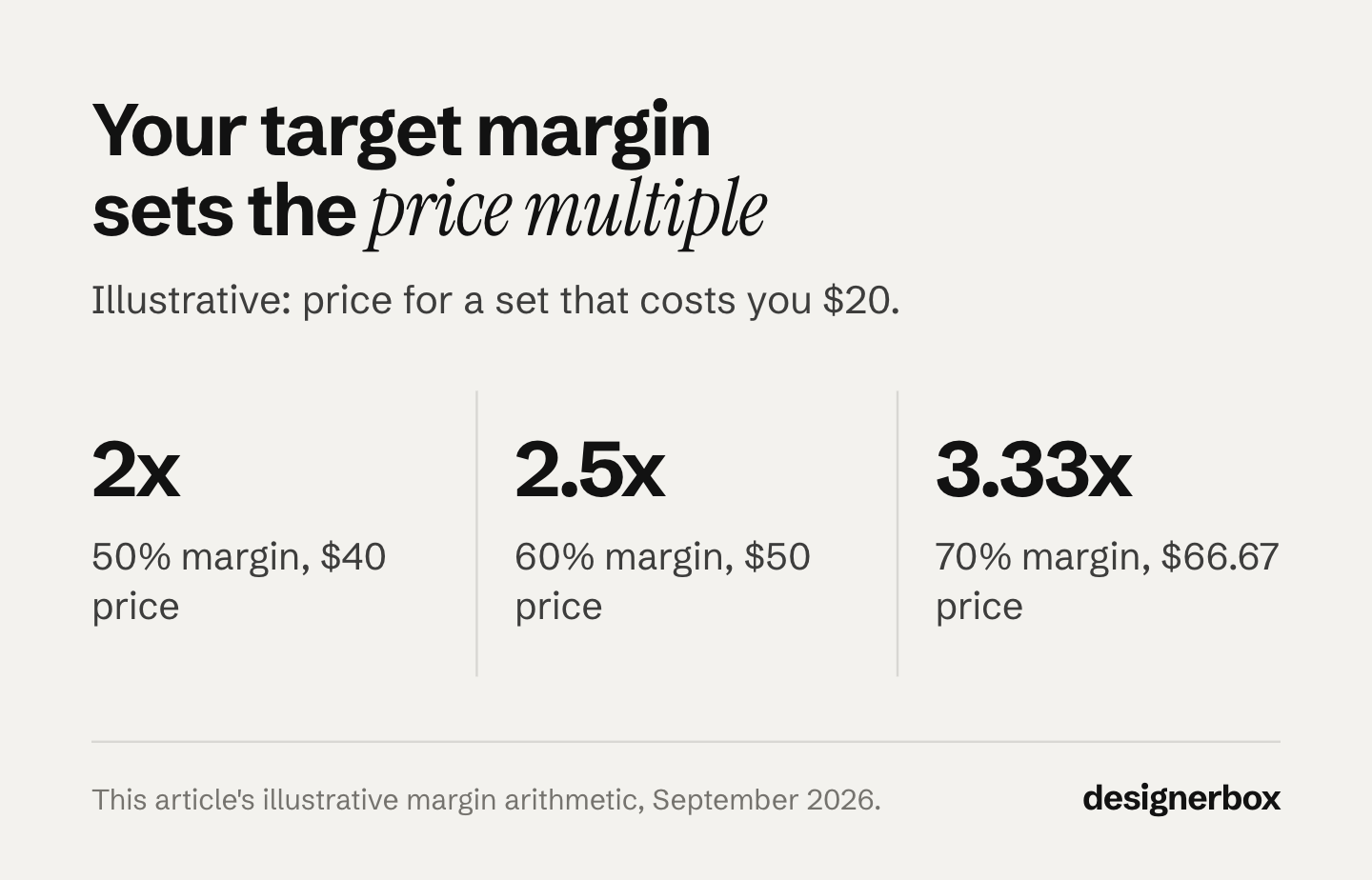
The margin you want sets the multiple. This table is illustrative, for a set that costs you $20.
| Target margin | Price as a multiple of cost | Price for a $20 set |
|---|---|---|
| 40% | 1.67x | $33.33 |
| 50% | 2x | $40 |
| 60% | 2.5x | $50 |
| 70% | 3.33x | $66.67 |
Some clients ask for a lower price because AI is faster. In Productive’s 2025 survey of more than 180 agencies, “almost one in three agencies was asked for an ‘AI discount’”, and “only 13% have actually lowered prices” (productive.io, read September 2026). With a set price, faster production widens your margin and your invoice stays the same. Agency creative pricing compares four pricing models in detail.
In the partner model, agree three things in writing: the trade price per set, the monthly volume, and the new price if the volume drops.
Who owns AI images you sell to a client?
The answer has two layers. The tool’s terms decide what the vendor claims. Copyright law decides whether a right exists at all. In the US, copyright needs a human author, so the purely AI-generated parts of an image may have no copyright. The contract then carries what the client pays for. Run four checks before you sell an AI-made set.
This is general information, not legal advice. The rules differ by country, so ask your own lawyer before you sign a large client.
Check 1: the tool terms
Read the terms of every tool in your chain. Google says it “won’t claim ownership” over content you generate with the Gemini API (ai.google.dev, terms updated April 2026, read September 2026). Black Forest Labs says: “We claim no ownership rights in and to Your Content” (bfl.ai, terms updated August 2026, read September 2026).
Also check whether the vendor keeps a license to use what you upload and create, and whether commercial use needs a paid plan. A client’s unreleased product is confidential, so name every tool that will process it.
Check 2: copyright
The US Copyright Office published its report on AI and copyrightability on 29 January 2025. It says: “Copyright does not extend to purely AI-generated material, or material where there is insufficient human control over the expressive elements.” It also says that “prompts do not alone provide sufficient control” (copyright.gov, read September 2026).
So a tool’s “you own it” is a promise in a contract. It cannot create a copyright that the law does not give. Your human work still counts. The report says human authors are entitled to copyright in “the creative selection, coordination, or arrangement of material in the outputs, or creative modifications of the outputs”. Keep your working files as a record.
UK law has a separate rule. Section 9(3) of the Copyright, Designs and Patents Act 1988 names “the person by whom the arrangements necessary for the creation of the work are undertaken” as the author of a computer-generated work (legislation.gov.uk, September 2026). For the traditional side of the question, image licensing after a shoot explains media, term, territory and exclusivity.
Check 3: the people in the frame
A real person’s face needs consent. New York Civil Rights Law section 50 makes it a misdemeanor to use a living person’s “name, portrait, picture, likeness, or voice” for advertising without “the written consent of such person” (nysenate.gov, September 2026). California Civil Code 3344 requires “prior consent” and sets damages of at least $750 (leginfo.legislature.ca.gov, September 2026). From 1 January 2027 the same law names digital replicas: California signed SB 1111 on 30 September 2026, and it says a person’s voice or likeness includes a digital replica (California SB 1111, accessed October 2026).
In New York, models must also give “separate and explicit written consent” for their digital replica, naming “the scope, purpose, rate of pay, and length of time” of use (dol.ny.gov, September 2026).
Check 4: AI labels
An invented AI person can still need a label. New York’s synthetic performer law has applied since 9 June 2026. It requires whoever “produces or creates an advertisement” to disclose a synthetic performer in the ad, “where such person has actual knowledge” (nysenate.gov, September 2026). A synthetic performer is a digital asset that looks like a human performer who is “not recognizable as any identifiable natural performer”.
In the EU, Article 50 of the AI Act has applied since 2 August 2026. Article 50(4) says deployers of an AI system that makes a deep fake image, audio or video “shall disclose that the content has been artificially generated or manipulated” (ai-act-service-desk.ec.europa.eu, September 2026). A realistic invented person can be in scope. Decide in the contract who adds each label.
What should a white label contract say?
A white label contract names the set, the revision rounds, how the client accepts the work, and which rights move to the client. It also covers the files the client sends you, consent for any real person, who labels AI content, and confidentiality. In the partner model, add the terms that keep your studio away from the agency’s clients.

Two US rules decide how rights move. The Copyright Office says a commissioned work is a “work made for hire” only in nine listed categories, and only if a written agreement signed by both parties says so (copyright.gov Circular 30, revised August 2024, read September 2026). A transfer of copyright ownership “is not valid” unless it is “in writing and signed” by the owner (law.cornell.edu, 17 U.S.C. 204, September 2026). If a set does not fit one of the nine categories, the work-for-hire label does not apply. A signed written assignment moves the rights that exist.
| Clause | What it says | Why it matters |
|---|---|---|
| Scope | The set per product: items, sizes, file types, delivery time | Every extra request becomes a priced item |
| Revisions and acceptance | How many rounds, the price of an extra round, and the days the client has to approve | Revision rounds decide your margin |
| Rights | An assignment of the rights that exist, plus a license for the rest | Copyright may not cover the AI-made parts |
| Exclusivity | You do not reuse the client’s product images or brand files for anyone else | A promise protects the client where copyright cannot |
| Client inputs | The client confirms it has the rights to the photos, logos and fonts it sends | Every set starts from their files |
| People | Real faces only with written consent; AI people only where the client agrees | Likeness laws in New York and California |
| AI and labels | You list which parts are AI-made, and the contract names who adds labels | New York’s synthetic performer law and EU Article 50 |
| Confidentiality | Unreleased products stay private, and you name the tools that process them | Tool terms may give the vendor a license |
Partner contracts need three more lines. You do not contact the agency’s clients directly. Your name stays off every file and every message. The agency approves each set before its client sees it.
Finished sets as a workflow
Anyone can make an AI picture. Making hundreds that still look like your brand is the hard part. For a studio, the brand belongs to the client, and every client has a different one.
DesignerBox is AI creative production for brands and agencies. Scale your images, ads and video with AI and keep your brand on every piece: build the workflow once with your brand rules, run it on every product, see the cost before each run, and keep everything from the first product photo to the finished ad in one place.
You save the set as a workflow for each client, with that client’s brand rules: logos, fonts, palette, light and framing. A junior runs it through an app, which is a workflow with a form. They add the product photo and press Run. Batch runs one workflow over a whole sheet of products. You keep or discard per row, and re-run one row on its own. Three critic steps score the results, and best-of-N keeps the best one. You still review every set before the client sees it.
The full workflow from the first product photo to the finished ad, in one subscription. Every paid plan removes the DesignerBox mark from your results, and the Ultra plan adds white label options. Studios with many client brands can apply to the agency partner program. DesignerBox agrees a partner price for your client brands and monthly volume in writing, after a call. DesignerBox for creative studios shows the full studio setup.
Here are the limits. Your client does not see work in progress inside DesignerBox. You download the results, or send them with a webhook or an S3 step. Uploading your own photos and the commercial license start on the Pro plan. AI video starts on the Premium plan. Team features, shared brand kits and white label are on the Ultra plan, and every plan below Ultra is one seat. Plans and credits are on the pricing page.
A demo for your studio
Book a 30-minute demo shaped around your studio. Bring one client product and the set you sell for it. Book a demo.
FAQ
What does white label content mean?
White label content is content that one company makes and another company sells under its own name. It can be written content, such as blog posts, or visual content, such as product images and video.
What is a white label agency?
A white label agency does work that other agencies sell to their clients under their own names. A creative studio becomes one when it produces image and video sets for agencies at a trade price. The agency adds its markup and keeps the client relationship.
Who owns the copyright in AI images made for a client?
In the US, copyright needs a human author. The US Copyright Office says copyright does not extend to purely AI-generated material. Human changes and the creative selection and arrangement of a set can be protected. The contract should assign the rights that exist and add a written promise of exclusivity.
How much should a studio charge for a white label image set?
Charge per finished set. Add the tool cost, the review time and a revision reserve, then divide by one minus your target margin. At a 60% margin, the price is 2.5 times your cost. In DesignerBox, the cost of a run is shown before you run it, so you can quote a set before you make it.
Do I have to tell clients that I use AI?
Tell them, and put it in the contract. Your client may have to label AI content in its ads. New York’s synthetic performer law requires the ad to disclose a synthetic performer when its maker knows about it. Article 50 of the EU AI Act requires deployers to disclose deep fakes. The client can only label what it knows about.
Sources
- Wikipedia, White-label product: en.wikipedia.org/wiki/White-label_product, accessed September 2026
- US Copyright Office, Copyright and Artificial Intelligence, Part 2: Copyrightability, 29 January 2025: copyright.gov, accessed September 2026
- US Copyright Office, Circular 30, Works Made for Hire, revised August 2024: copyright.gov/circs/circ30.pdf, accessed September 2026
- 17 U.S.C. 204, Execution of transfers of copyright ownership, via Cornell LII: law.cornell.edu/uscode/text/17/204, accessed September 2026
- Copyright, Designs and Patents Act 1988, section 9: legislation.gov.uk, accessed September 2026
- Google, Gemini API Additional Terms of Service, last updated 28 April 2026: ai.google.dev/gemini-api/terms, accessed September 2026
- Black Forest Labs, Terms of Service, last updated 1 August 2026: bfl.ai/legal/terms-of-service, accessed September 2026
- New York Civil Rights Law section 50: nysenate.gov/legislation/laws/CVR/50, accessed September 2026
- California Civil Code section 3344: leginfo.legislature.ca.gov, accessed September 2026
- California SB 1111, signed 30 September 2026 (Chapter 862), which adds digital replicas to Civil Code section 3344: leginfo.legislature.ca.gov, accessed October 2026
- New York State Department of Labor, Fashion Workers Act FAQs: dol.ny.gov, accessed September 2026
- New York General Business Law section 396-b, synthetic performers: nysenate.gov/legislation/laws/GBS/396-B, accessed September 2026
- New York State, Governor’s announcement that the synthetic performer law is in effect, 9 June 2026: governor.ny.gov, accessed September 2026
- EU AI Act, Article 50, via the AI Act Service Desk: ai-act-service-desk.ec.europa.eu, accessed September 2026
- European Commission, Transparency obligations under Article 50 of the AI Act, FAQ, last updated 24 July 2026: digital-strategy.ec.europa.eu, accessed September 2026
- US Bureau of Labor Statistics, Occupational Outlook Handbook, Graphic Designers, May 2025 wage data: bls.gov, accessed September 2026
- Productive, Agencies in the AI Era: Between Hype and Reality, survey of 180+ agencies, 2025: productive.io, accessed September 2026
- DesignerBox agency partner page (designerbox.ai/agency-partners), September 2026: paid-plan mark removal, white label options on Ultra, partner pricing
- DesignerBox pricing page (designerbox.ai/pricing), September 2026: plan gates
Copyright, likeness and disclosure rules verified from the US Copyright Office, New York State, the California Legislature, the European Commission and legislation.gov.uk as of September 2026. California SB 1111 was read on 2 October 2026. Individual results vary.