


AI advertising tools are software that uses machine learning or generative AI for one job in an ad campaign: research, copy, creative, buying and bidding, or measurement. The ad platforms already include a free tool for most of those jobs. Meta, Google, TikTok and Amazon build them into the ad account. A paid tool is worth it where a platform tool stops at the edge of its own platform.
An AI ad generator covers one job out of five. The tools you already have cover more of them. A team that buys media on Meta and Google has a bidding model, a copy writer, an image generator and an ad library in those two accounts today.
This guide sorts AI advertising tools by job across the whole ad stack. Each section starts with the free tool inside the ad platform and what its own documentation says it does. Then it names the kind of paid tool that takes over, and when.
Key Takeaways
- Sort AI ad tools by job. There are five: research, copy, creative, buying and bidding, and measurement. A tool that is strong at one says little about the other four.
- The ad platforms cover all five. Meta, Google, TikTok and Amazon include AI for each job inside the ad account, with no separate subscription.
- Bidding is the job you cannot skip. Google Smart Bidding sets a bid in every auction, and it needs conversion tracking before it runs (support.google.com, October 2026).
- Creative is the job where your choice of tool changes the result. The platforms buy the media the same way for every advertiser. They do not hold your brand rules.
- Each platform tool works in one platform. A paid tool is worth it when the same work has to run across several ad accounts, several products or several clients.
- Measurement has free, open-source options. Google publishes Meridian and Meta publishes Robyn. Both are marketing mix models you run on your own data.
What are AI advertising tools?
AI advertising tools are products that apply machine learning or generative AI to a single stage of an ad campaign. Some find and study competitor ads. Some write copy or make images and video. Some set bids and move budget in each auction. Some estimate which ads caused a sale. Most products do one or two of these jobs well, so the useful question is which job you need done.

Two kinds of AI sit under that definition. Predictive models score an auction, a person or a placement, and they run bidding and delivery. Generative models make text, images and video. AI in advertising explains the four layers these models work on and who controls each layer.
Start any shortlist with one line per job: what you do by hand today, and how many hours it takes each week. The job with the most hours is the first one to hand to a tool.
AI advertising tools by job
The table lists the free tool inside the ad platform for each job, and the kind of paid tool that takes over. Every platform tool below was checked on the platform’s own help or product page on 1 October 2026.
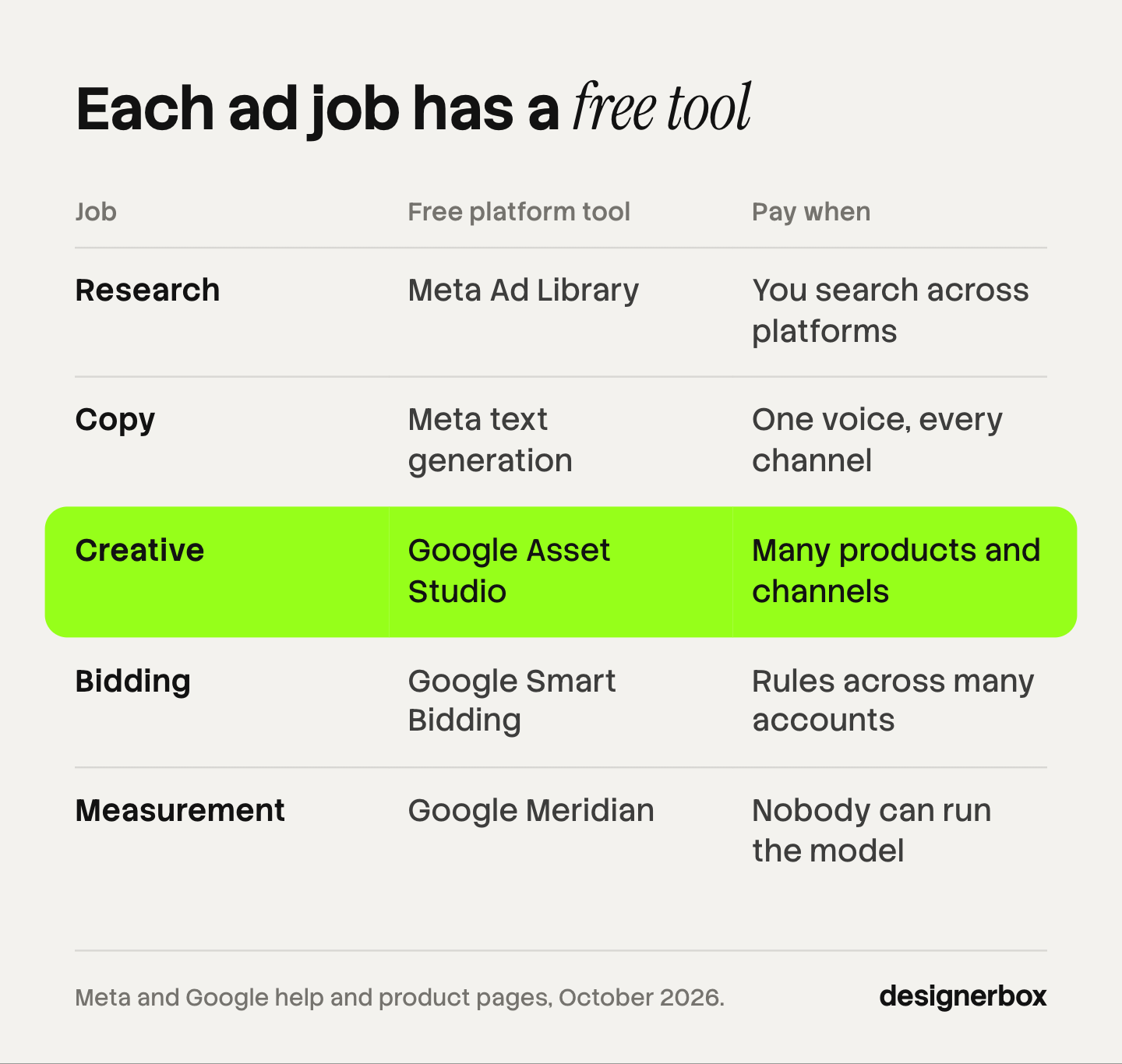
| Job | Free tools inside the ad platforms | A paid tool takes over when |
|---|---|---|
| Research | Meta Ad Library, Google Ads Transparency Center, TikTok Top Ads | You need saved boards, alerts or a search across platforms |
| Copy | Meta text generation, Google text customization, Ask Advisor in Google Ads | You need one brand voice across every channel |
| Creative | Meta Advantage+ creative, Google Asset Studio, TikTok Symphony Creative Studio, Amazon Video Generator | The same ad set has to run for many products and several channels |
| Buying and bidding | Google Performance Max and Smart Bidding, Meta Advantage+ sales campaigns, TikTok Smart+ | You manage many accounts and need rules, pacing and alerts across them |
| Measurement | Google Analytics attribution, Google Meridian, Meta Robyn | You need one view of every channel without building the model yourself |
Two things stand out. The platforms cover every row. And every platform tool works on that platform’s inventory and that platform’s data only. The paid column exists because of that second point.
Research: ad libraries and trend tools
Research is the job with the least AI in it and the most free data. Three platforms publish a searchable ad library.
Meta Ad Library. Meta says the library “contains all active ads that are shown across Meta technologies” and that anyone can view and search it (facebook.com, October 2026). For an ordinary commercial ad you see the creative and the copy. You do not see spend or results.
Google Ads Transparency Center. Google describes it as a searchable repository of advertisers and the ads they have served on Google platforms such as Search, Display, Gmail and YouTube. You can filter by date and by targeted location (support.google.com, October 2026).
TikTok Top Ads. The Creative Center page shows high-performing auction ads on TikTok. You filter by region, objective, ad language and ad format, and you sort by reach or by click-through rate (ads.tiktok.com, October 2026).
Paid research tools add storage and search on top of those libraries. Foreplay lists a swipe file, an ad search engine and competitor tracking among its products (foreplay.co, October 2026). Ad spy tools compares the free libraries and the paid databases in detail, and it explains why run length is the only public proxy for performance.
Ad copy: text tools inside the ad account
Copy is where a free tool is closest to the paid one, because the ad account already knows your landing page and your past ads.
Meta text generation. Meta’s help page says the feature “can generate up to 5 variations of primary text and headline”. It is available for single image, video and carousel ads (facebook.com, October 2026).
Google text customization. In Performance Max, Google AI writes headlines and descriptions from your landing page content, your domain and your current ads. It is a campaign-level setting (support.google.com, October 2026).
Ask Advisor in Google Ads. Google describes it as a conversational experience built with Gemini. It answers questions about your account and suggests new text and image creatives. It carries a Beta badge (support.google.com, October 2026).
A general AI chat such as ChatGPT or Claude also drafts ad copy from a brief. The limit is the same for all of these: each one writes from what it can see. The Meta tool sees your Meta ad. The chat sees your prompt.
Paid copy tools aim at brand voice across channels. Jasper describes itself as AI agents for marketing work, with a feature that applies brand guidelines to each piece of copy across a team (jasper.ai, October 2026). That fits a team whose copy has to read the same in ads, email and on the site.
Image and video creative: the platform generators
All four ad platforms now make ad images or video from a product image, at no separate fee.
- Google Asset Studio generates product imagery from one or two product images, edits images from a text prompt and builds video. Google says it now includes the Nano Banana Pro image model, and that projects made from a prompt are kept for 55 days (support.google.com, October 2026).
- Meta Advantage+ creative generates image variations from a product image or a full image, for single image ads (facebook.com, October 2026).
- TikTok Symphony Creative Studio makes video, static images and avatar videos. TikTok’s help page calls it “this free creation tool” (ads.tiktok.com, October 2026).
- Amazon Video Generator turns one product image or video into up to six 15-second video ads, at no additional cost. Advertisers open it inside the Amazon Ads console (advertising.amazon.com, October 2026).
Paid creative generators are a category of their own. AdCreative.ai, for one, lists ad creatives, ad copy, creative scoring and a compliance checker on its site (adcreative.ai, October 2026). This guide keeps the creative job short on purpose. The best AI ad generator covers the platform generators and their documented limits, and the three jobs worth paying for. Ad creative for ecommerce sorts the generators by the input each one starts from.
Buying and bidding: Performance Max, Advantage+ and Smart+
This is the job where the AI already runs, whether you chose a tool or not.

Google Smart Bidding and Performance Max. Smart Bidding uses Google AI to set a bid for conversions or conversion value in every auction, which Google calls auction-time bidding. Performance Max reaches all Google Ads inventory from one campaign, including YouTube, Display, Search, Discover, Gmail and Maps (support.google.com, October 2026). Smart Bidding needs conversion tracking. Google recommends judging results over a period with at least 30 conversions, or 50 for Target ROAS.
Meta Advantage+ sales campaigns. Meta describes these as its most advanced AI marketing tool, one that sets audience, placements and budget automatically (facebook.com, October 2026). On placements, Meta reports that ad sets with Advantage+ placements delivered an 11.7% lower cost per action on average than ad sets with manual placements. That figure comes from Meta’s own experiment (facebook.com, October 2026).
TikTok Smart+. You give Smart+ your performance goal, your creative assets, and a target geography and language. TikTok automates targeting, optimization and creative. It also tries to move budget to the best-performing creative and to pause weak ones (ads.tiktok.com, October 2026).
What you still control is the input: the conversion data, the budget, the exclusions and the creative. Facebook ads automation lists what Meta automates and what stays with you. Dynamic creative optimization explains how the platforms assemble an ad from the assets you supply. Ecommerce advertising across five channels shows what each channel automates for a store.
Paid tools in this job work across accounts. Optmyzr lists a rule engine, budget pacing and alerts for Google, Microsoft, Amazon, Meta, LinkedIn and TikTok ads (optmyzr.com, October 2026). Smartly calls itself an AI advertising platform and groups its product into creative, media and intelligence (smartly.io, October 2026). An agency with thirty client accounts needs that layer. A brand with one Meta account and one Google account often does not.
Measurement and attribution
Each ad platform reports on its own ads. The tools below help you compare channels.
Google Analytics attribution. Google Analytics offers three attribution models. The data-driven model uses machine learning on converting and non-converting paths to share credit between click interactions (support.google.com, October 2026).
Google Meridian. Meridian is an open-source marketing mix model built by Google. It estimates the return on each channel and includes budget optimization and scenario planning (developers.google.com, October 2026).
Meta Robyn. Meta describes Robyn as “an experimental, AI/ML-powered and open sourced Marketing Mix Modeling (MMM) package from Meta Marketing Science” (facebookexperimental.github.io, October 2026).
Both open-source models are free, and both need someone who can prepare the data and read the result. Paid measurement tools sell that work as a product. Northbeam lists multi-touch attribution, incrementality and media mix modeling in one suite (northbeam.io, October 2026).
Which AI tools for advertising should you pay for?
Pay for a tool when the free one fails on one of three tests. Agencies sort the same tools into the four layers of an AI ad agency stack.
- More than one platform. A platform tool stops at that platform. If the same copy, creative or budget rule has to run on Meta, Google and TikTok, you repeat the work three times or you buy a tool that holds it in one place.
- More than one product or client. A platform generator starts again for each ad. Forty products, or twenty client accounts, need a saved build that runs the same way each time. Creative automation covers that step.
- A brand standard the platform does not hold. The platforms optimize for a click or a sale. They do not check your logo, your product label or your tone.
Then count the subscriptions. One paid tool per job makes five monthly bills and five places to enter the brand. AI tool stack cost shows how to price that stack per product. For the creative tools, AI ad generator pricing explains credits, seats and per-video billing.
If none of the three tests fails, stay with the free tools. That is a sound answer for a single-platform advertiser with good product photos. For the work outside ads, AI digital marketing covers where AI pays and how to start.
Creative production in DesignerBox
DesignerBox does one of the five jobs: creative. It is AI creative production for brands and agencies, and it does not buy media, set bids or measure results.
Anyone can make an AI picture. Making hundreds that still look like your brand is the hard part. In DesignerBox you build a workflow once with your brand, your products and your rules. The workflow reads the brand profile on every run. You publish it as an app, and a colleague runs it through a form. Batch runs it over a whole sheet of products. The AI ad generator page shows the ad workflows, and the workflows page shows how one is built.
The steps that matter for ads are live today. Winning-ad variations make new versions of an ad that already works. The ad localizer rebuilds one ad in another language and redraws the layout. The ads resizer makes each placement size. Competitor ad research runs as a workflow step. The full workflow from the first product photo to the finished ad, in one subscription.
You see the cost of a run before you press Run.
The limits, stated plainly. Publishing to an ad account is not built: you download the results, or send them with a webhook or an S3 step. Uploading your own photos and the commercial license start on the Pro plan. AI video starts on the Premium plan. Team features are on the Ultra plan, and every plan below Ultra is one seat, which matters for an agency. Plans are on the pricing page.
A free plan for your first run
There is a free plan, and it runs on sample products. Start from a template and see the cost before you run it. Get started free
FAQ
What are AI advertising tools?
AI advertising tools are software that uses machine learning or generative AI for one job in an ad campaign. The five jobs are research, copy, creative, buying and bidding, and measurement. The ad platforms include a tool for each job, and paid tools add work across platforms, products and clients.
What is the best AI advertising tool?
There is no single best one, because the tools do different jobs. For bidding, the best tool is the one inside the platform where you buy media, such as Google Smart Bidding. For creative, start with the platform generator and pay when the same ad set has to run for many products and channels.
Are there free AI tools for ads?
Yes. Meta, Google, TikTok and Amazon include AI tools in the ad account with no separate subscription. TikTok’s help page calls Symphony Creative Studio a free creation tool, and Amazon offers Video Generator at no additional cost (ads.tiktok.com and advertising.amazon.com, October 2026). Google Meridian and Meta Robyn are free, open-source measurement models.
Which AI ad tools does Google Ads include?
Google Ads includes Smart Bidding, Performance Max, Asset Studio for images and video, text customization for headlines and descriptions, and Ask Advisor, which is in beta. The Ads Transparency Center is a separate, public ad library. Google’s help pages describe each one (support.google.com, October 2026).
Can AI run an ad campaign on its own?
Partly. Performance Max, Advantage+ sales campaigns and Smart+ automate targeting, placements, bids and budget once you set a goal. You still supply the conversion data, the budget, the exclusions and the creative. Google also notes that you stay responsible for the accuracy of dynamically generated assets (support.google.com, October 2026).
How many AI ad tools does a small team need?
Often none beyond the ad accounts. A team on one or two platforms can cover all five jobs with the built-in tools. Add a paid tool for the one job that takes the most hours each week, and check that it works across every platform you buy on.
Does DesignerBox replace the ad platform tools?
No. DesignerBox makes the creative, and the ad platforms still buy the media and set the bids. The cost of a run is shown before the run. You download the results and upload them to each ad account.
Sources
- Google Smart Bidding: auction-time bidding, the conversion tracking requirement and the 30 and 50 conversion guidance: support.google.com, October 2026
- Google Performance Max: inventory, text customization and advertiser responsibility for generated assets: support.google.com, October 2026
- Google Asset Studio: features, the Nano Banana Pro image model and the 55-day project history: support.google.com, October 2026
- Google Ask Advisor (beta): support.google.com, October 2026
- Google Ads Transparency Center: support.google.com, October 2026
- Google Analytics attribution models: support.google.com, October 2026
- Google Meridian introduction: developers.google.com, October 2026
- Meta Advantage+ creative: text generation and image generation: facebook.com, October 2026
- Meta Advantage+ sales campaigns: facebook.com, October 2026
- Meta Advantage+ placements and the 11.7% figure from Meta’s own experiment: facebook.com, October 2026
- Meta Ad Library: facebook.com, October 2026
- Meta Robyn: facebookexperimental.github.io, October 2026
- TikTok Symphony Creative Studio (last updated June 2026): ads.tiktok.com, October 2026
- TikTok Smart+ campaigns: ads.tiktok.com, October 2026
- TikTok Creative Center Top Ads: ads.tiktok.com, October 2026
- Amazon Ads Video Generator for Sponsored Brands video campaigns: advertising.amazon.com, October 2026
- Vendor product pages for Foreplay, Jasper, AdCreative.ai, Optmyzr, Smartly and Northbeam (foreplay.co, jasper.ai, adcreative.ai, optmyzr.com, smartly.io, northbeam.io), October 2026
- DesignerBox plans and feature gating: DesignerBox pricing page (designerbox.ai/pricing), October 2026
Platform and vendor features checked against each company’s own pages as of October 2026. Individual results vary.