Changing clothes in a photo with AI means replacing the garment a person is wearing while keeping their face, body, pose, and background from the original shot. You mask the clothing, give the model a new garment to render, then regenerate. The technical part takes about a minute. What decides whether the result ships is whether the new garment is your actual product, not an AI approximation of one.
That last sentence is the whole article. Consumer “AI clothes changer” tools are built to try a different look for fun, and for that they are fine. A brand editing an on-model photo has a harder bar: the garment on the model has to be the exact garment the customer receives, down to the trim, the print scale, and the colourway. Miss that and the edit is not a photo, it is a claim you cannot honour.
Here is the version you have already lived. The on-model set for the drop is shot and approved. Then merchandising adds the black colourway that was not on the call sheet, or a retailer wants the jacket shown over a different base layer, or the same look has to run again next season in a new fabric. The photograph exists. The garment in it is now wrong, and the next studio day is eight weeks out.
This guide is written for fashion and ecommerce teams editing images that go on a live storefront. It covers what the edit does, the three different jobs people file under “changing clothes,” how to do it so it survives a PDP zoom, what it costs, and the rights layer that decides whether a photo of a real person can ship after you have altered it.
Key Takeaways
- Changing clothes in a photo keeps the person and swaps the garment. It is the mirror image of an AI head swap, which keeps the garment and swaps the person.
- The result is only sellable if the new garment is your real product. A garment invented from a text prompt looks plausible and misrepresents what ships. Anchor the edit to your actual product photo.
- Region-locked editing is documented but approximate. Black Forest Labs states FLUX.1 Kontext makes “targeted modifications of specific elements in an image without affecting the rest” (bfl.ai, July 2026). Budget for iterations and check at full resolution, not thumbnail.
- Free consumer tiers cap resolution and watermark. Magic Hour’s free plan outputs 576px with a watermark (magichour.ai, July 2026). A PDP needs full-resolution, watermark-free files.
- A real model’s image is not yours to alter freely. California’s AB 2602 (effective 1 January 2025) treats an appearance whose “fundamental character” has been “materially altered” as a digital replica needing specific consent (leginfo.legislature.ca.gov via firm analysis, July 2026).
- EU disclosure may apply from 2 August 2026. AI Act Article 50 requires deployers to disclose manipulated image content that constitutes a deep fake (artificialintelligenceact.eu, July 2026). Altering a real person’s photo is the case to plan for.
- In DesignerBox an image edit costs 5 credits. The editing tools and try-on that do this work sit on Premium at $75 a month with 2,500 credits, and the commercial licence to run the output starts at Pro.
What “change clothes in a photo with AI” means
Changing clothes in a photo with AI is a targeted image edit. The model identifies the clothing region in an existing photo, holds the face, skin, hands, pose, and background steady, and renders a new garment into the space the old one occupied. The output is a single photograph of the same person wearing something different.
Two things vary between tools, and they matter more than the button labels. The first is how the new garment is defined: described in words, or supplied as your own product image. The second is how well the person and the lighting survive the edit. A good result reads as one photograph. A weak one reads as a person standing behind a cut-out.
Three edits people call “changing clothes”
“Change the clothes” arrives as one request and splits into three different jobs. Naming which one you have saves a week of the wrong work.
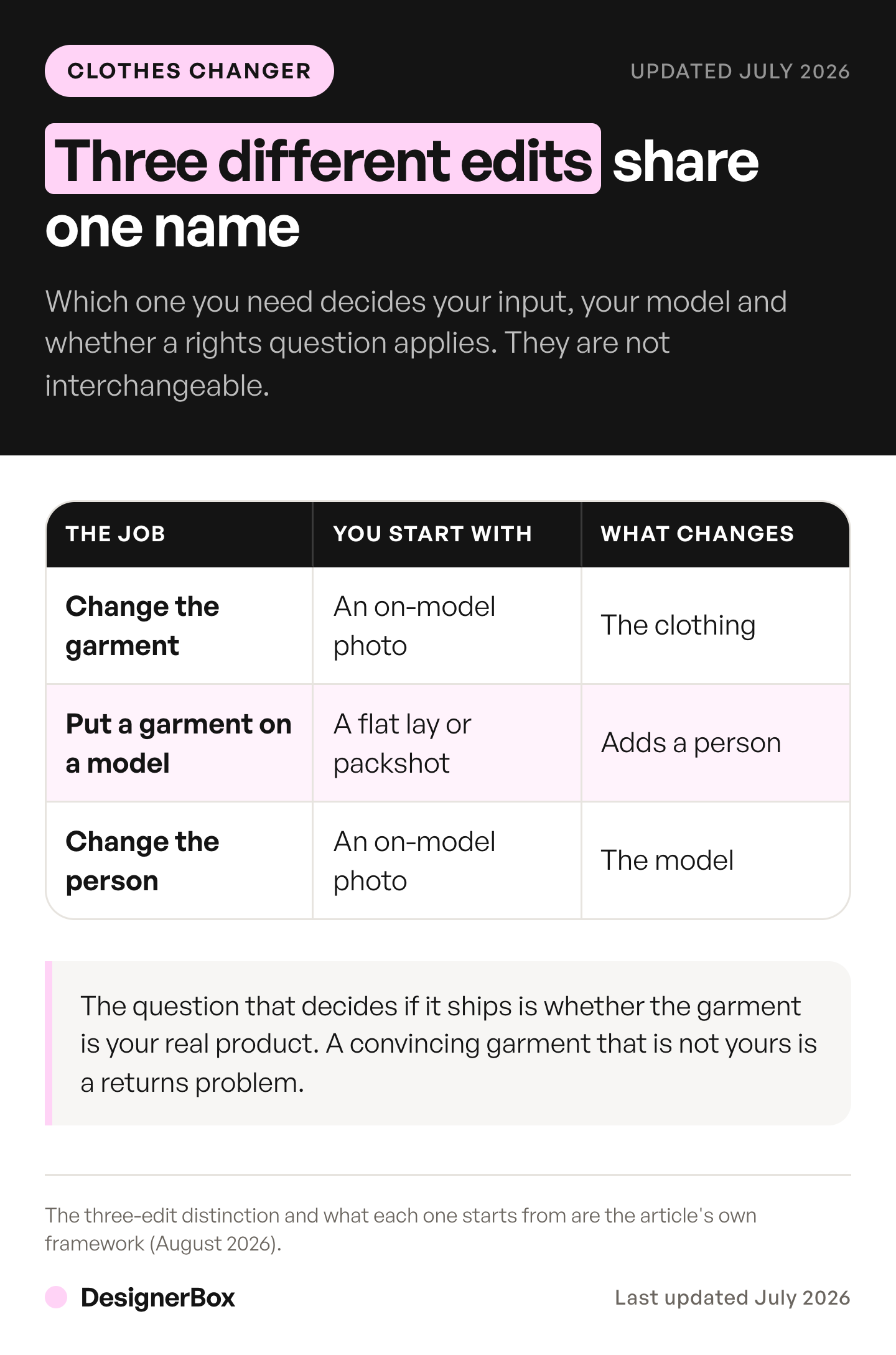
| The job | What you start with | What stays | What changes |
|---|---|---|---|
| Change the garment | An on-model photo | The person, pose, background | The clothing |
| Put a garment on a model | A flat lay or packshot | The garment | Adds a person |
| Change the person | An on-model photo | The garment, pose | The model |
This article is the first row. If you have a flat garment shot and no body yet, that is the second job, covered in putting clothes on a model with AI. If the garment is right and the model has to change, that is the third job, covered in changing the model in a product photo. The three read as one problem and behave as three, because the rights and the failure points move each time.
The row that catches teams out is the second one. When the garment in your reference is not on a body yet, you are not editing an existing photo, you are generating a new one, and the on-model generators split on whether they anchor to your real garment or reinvent it. We compared the on-model generators on exactly that question.
The question that decides if it ships: is the garment your real product?
Every clothes-changing tool does one of two things, and the difference is the difference between a usable asset and a liability.
Prompt-described garment. You type “red satin slip dress” and the model invents one. It will look convincing. It will not be your dress. The neckline, the strap width, the hem, the sheen, and the exact red are the model’s guess. On a moodboard that is fine. On a product detail page it is a photograph of a garment your customer will never receive.
Reference-anchored garment. You give the tool an image of your actual product, and it renders that garment onto the person. The output is the real thing: your print at the right scale, your trim, your colourway. This is the only version that belongs on a storefront, in a catalogue, or in a paid ad, because it is the only one that is true.
DesignerBox is built around the second approach. Every asset derives from your real product photo rather than a text description, which is why the output is your product and not a lookalike. The outfit to image app and virtual try-on both work from your garment image, so the person changes clothes into the thing you sell.
The test is simple. Put the edited photo next to the real garment on a table. If a customer would notice a difference when the parcel arrives, the edit is not done.
How to change clothes in a photo with AI, step by step
If reference-anchored editing is the right call, this sequence produces the fewest retries. Steps 1 and 3 are the ones people skip, and they are the ones that decide the result.
- Start from the highest-resolution source you have. Edits compound. Beginning with a web-sized JPEG means the join between the new garment and the body is soft before you touch it.
- Supply the new garment as an image, not a description. A flat lay or packshot of the real product. This is what keeps the edit honest.
- Write the instruction as preservation, not replacement. Name what must not change: the face, the pose, the hands, the light direction, the background. Telling the model what to keep does more work than telling it what to swap.
- Mask the clothing region if the tool allows it. Constraining the edit to the garment area protects the parts of the photo that were already right.
- Generate, then check the seams at full resolution. The garment edge against the arms and neck fails first, the same way a hairline fails first in a head swap. Zoom to PDP size, not thumbnail size.
- Check the drape and the fit against the real product. A generated garment can hang in a way the real fabric never would. Fabric texture, seam lines, and how the cloth falls are where fidelity is won or lost.
- Log what you edited and from what. If disclosure is required later, you need a record of which images were altered and which are straight photography.
Step 5 is worth labouring. Most clothes-changing output looks correct at thumbnail size and wrong at the size a shopper inspects. The same resolution and accuracy discipline that governs any generated product image applies harder here, because the garment is the thing being sold.
Which models hold a garment, and where they break
Editing one region of a photo while holding the rest is a documented capability, not luck. Reading what the providers claim tells you where to set expectations.
Black Forest Labs documents FLUX.1 Kontext as able to “make targeted modifications of specific elements in an image without affecting the rest,” and to “preserve unique elements of an image, such as a reference character or object in a picture, across multiple scenes and environments” (bfl.ai, July 2026). That preservation is exactly what a garment change needs: the person is the element that must survive untouched.
Google documents Nano Banana Pro, its Gemini 3 Pro Image model, with localized editing and output at “1k, 2k or 4k resolution” (deepmind.google, July 2026). The high-resolution output is the part that matters for a PDP file, where a 576px consumer export will not do.
Read the marketing copy carefully, though. Phrases like “preserves everything you did not touch” describe the intent, not a guarantee. In practice, region-locked editing is approximate across every major provider. The garment boundary, the hands near the fabric, and any reflective surface are where the artefacts show up first. Plan for two or three passes rather than a clean first result, and judge every one at full size.
DesignerBox includes 13 image and video models on one subscription, so the model can be picked per shot rather than per tool. Kontext Multi is the catalog entry for reference-conditioned consistency, and Nano Banana Pro covers the high-resolution editing modes. Switching between them does not mean switching tools or bills.
What changing clothes in a photo with AI costs
The consumer clothes-changer tools price on credits and gate resolution by tier. Prices below are the vendor’s own, in USD, at the monthly-billed rate, checked July 2026.
| Tool | Built for | Free tier | Paid entry |
|---|---|---|---|
| Magic Hour AI Clothes Changer | Fast consumer garment swaps | 400 credits + 100/day, 576px, watermarked | Creator $15/mo, 10,000 credits, 1024px (magichour.ai, July 2026) |
| FASHN AI | On-model and try-on for fashion | 10 free credits on signup | Basic $19/mo, 200 credits (fashn.ai, July 2026) |
| Pixelcut | General image editing | Free plan | Pro $10/mo (pixelcut.ai, July 2026) |
Two things to read off that table. Magic Hour’s free tier is genuinely free but outputs 576px with a watermark, which is below PDP resolution, so the free plan is a preview rather than a production tool. Pixelcut is inexpensive but its pricing page does not list garment replacement or virtual try-on as of July 2026, so it fits background and general editing rather than this job. FASHN AI documents on-model and try-on directly, and if it heads your shortlist, what else to weigh it against prices five options from each vendor’s own page.
In DesignerBox the accounting is per credit, not per tool. An image edit, including a garment change, costs 5 credits. The editing tools and try-on that do this work sit on the Premium tier at $75 a month, which includes 2,500 credits, so a garment change runs 500 edits into the monthly allocation.
The commercial licence you need to run the output as paid media or on a live PDP starts at the Pro tier at $35 a month. The full ladder, Free at 112 credits through Ultra, is on the pricing page, and the catalogue-scale case lives in Model Studio.
The rights layer when there is a real person in the shot
This is the section the consumer tutorials skip, and for a brand it is the one that decides whether the edited photo can ship.
Changing the garment on a stock or generated model who is not a real, identifiable person carries no likeness question. Changing the garment on a photograph of a real model you hired does. Their image is licensed to you under the terms of the original shoot, and altering what they appear to be wearing can exceed those terms.
Altering a real appearance can create a digital replica. California’s AB 2602, effective 1 January 2025, treats a “computer-generated, highly realistic” representation of a real person as a digital replica when “the fundamental character of the performance or appearance has been materially altered,” and voids contract terms that permit such use unless the intended uses are described with specificity (leginfo.legislature.ca.gov via firm analysis, July 2026). Whether a garment swap crosses that line is a judgment about how much you changed, and it is a judgment a brand should make before publishing, not after a complaint.
Right-of-publicity law still governs the base case. Using an identifiable person’s image commercially, beyond what their release granted, is the ordinary right-of-publicity question that predates AI. A model release is a private contract, and most were written before AI editing existed, so they rarely address it. Tennessee’s ELVIS Act, effective 1 July 2024, goes further and can attach liability to tools whose primary function is producing an unauthorised likeness (law-firm analysis, July 2026). Treat AI modification as a term to negotiate into the release, not an assumption.
The clean way around all of this is to not have a real person’s likeness in the output at all. Generating the on-model image from your garment onto a model who resembles nobody in particular sidesteps the entire question, because there is no identifiable individual to license.
What the platforms require when the edited image runs
Disclosure is separate from consent. Clearing one does not clear the other, and the rules differ by market.
EU AI Act Article 50 applies from 2 August 2026. Deployers of an AI system that manipulates image content constituting a deep fake “shall disclose that the content has been artificially generated or manipulated,” and providers of the AI system must mark outputs in a machine-readable format (artificialintelligenceact.eu, July 2026). A garment swap on a real, identifiable model is manipulation of a person’s image, so it is the case to plan disclosure around. The machine-readable marking duty falls on the tool vendor; the disclosure duty falls on you.
The two big ad platforms are not symmetric, and a lot of published advice gets this wrong. Meta applies an “AI info” label automatically to ads created or significantly edited with generative AI, and does not apply it to minor edits such as resizing or colour correction. Its mandatory advertiser self-disclosure is scoped to ads about social issues, elections, or politics, not ordinary commercial product ads (meta.com, July 2026). Google requires AI disclosure on ads in jurisdictions with AI-content laws, naming the EU, India, and New York, plus separate rules for election ads, rather than a blanket global mandate (support.google.com, July 2026).
Be skeptical of blog posts claiming either platform now forces every advertiser to tick an AI box worldwide. That framing appears on marketing sites, not on Meta’s or Google’s own policy pages. Verify platform policy against the platform before each campaign, including against this article.
What this does not solve
Honest limits, because the technique is oversold.
Changing the garment does not fix a bad source photograph. The pose, the lighting, and the camera angle come from the original, and a new garment on an awkward pose is an awkward pose. It does not reliably survive a PDP zoom on the first pass, which is why the full-resolution check is a step and not a suggestion.
It does not grant rights you did not have over the person in the image. And it does not hold one garment consistent across a whole range on its own; keeping a product identical across forty edited shots is a brand consistency problem solved by reference conditioning and saved workflows, not by repeating a one-off edit.
Whatever route produces the image, it still has to earn its slot in the PDP gallery. A truthful garment on a clean on-model shot does that. An invented one undermines it the first time a return cites “not as pictured.”
The fashion factory feature runs this across a full drop rather than one photo at a time.
FAQ
How do you change clothes in a photo with AI?
You open the photo in an AI editing tool, mask or select the clothing, supply the new garment as an image of your real product or describe it, and regenerate. The model holds the face, pose, and background while rendering the new garment. For anything that goes on a storefront, use a reference image of the actual product rather than a text description, and check the result at full resolution before it ships.
Is there a free AI clothes changer?
Yes, several tools offer free tiers. Magic Hour’s free plan changes clothes at 576px with a watermark and daily credits (magichour.ai, July 2026), which works as a preview but is below the resolution a product page needs. DesignerBox starts free with 112 credits and no credit card, where an image edit costs 5 credits. Free tiers are for testing the workflow; production files need full resolution and no watermark.
Can I change the clothes on a real model’s photo and use it in ads?
Only with rights that cover the alteration. A standard model release rarely addresses AI modification, and altering a real appearance can create a digital replica under laws like California’s AB 2602 (leginfo.legislature.ca.gov via firm analysis, July 2026). Generating the on-model image on a model who is not a real identifiable person avoids the likeness question. If a real person stays in the frame, get written consent for the AI edit before running it.
Will the AI change my garment into something that is not my actual product?
If you describe the garment in words, yes, the model invents its own version. The neckline, colour, and print will be the model’s guess rather than your product. To keep it accurate, supply your real product photo as a reference so the tool renders the actual garment. This is the difference between a moodboard image and a photo you can put on a product page.
Do I have to disclose that a product image was AI-edited?
In the EU, plan for it from 2 August 2026. AI Act Article 50 requires deployers to disclose image content that has been artificially generated or manipulated where it constitutes a deep fake, and altering a real person’s photo is the case that triggers it (artificialintelligenceact.eu, July 2026). Ad-platform rules are separate and vary by market, so verify current advertising policy before a campaign ships.
What is the difference between changing clothes and a head swap?
They are opposites. Changing clothes keeps the person and swaps the garment. An AI head swap keeps the garment and swaps the person. Pick garment change when the model is right and the product has to update, such as a new colourway on an approved shot. Pick a head swap when the garment is right and the person has to change.
Which DesignerBox plan do I need to change clothes in a photo?
The editing tools and try-on that do this work sit on the Premium tier at $75 a month, which includes 2,500 credits, with each image edit costing 5 credits. The commercial licence you need to run the edited image as paid media or on a live PDP starts at the Pro tier at $35 a month. Basic at $15 does not include the try-on and editing tools this workflow uses.
Sources
All accessed July 2026.
- FLUX.1 Kontext’s targeted region editing and reference preservation across scenes: (bfl.ai, July 2026)
- Nano Banana Pro’s localized editing and 1k, 2k and 4k output: (deepmind.google, July 2026)
- Magic Hour free-tier resolution and watermark, and Creator plan pricing and credits: (magichour.ai, July 2026)
- FASHN AI signup credits, Basic plan pricing, and its documented on-model and try-on coverage: (fashn.ai, July 2026)
- Pixelcut plan pricing and its published feature list: (pixelcut.ai, July 2026)
- California AB 2602’s digital replica definition and its specificity requirement for consent, effective 1 January 2025: (leginfo.legislature.ca.gov via firm analysis, July 2026)
- Tennessee’s ELVIS Act, effective 1 July 2024, and its liability reach over tools producing unauthorised likenesses: (law-firm analysis, July 2026)
- EU AI Act Article 50 disclosure and machine-readable marking duties, applying from 2 August 2026: (artificialintelligenceact.eu, July 2026)
- Meta’s automatic AI info label and the scope of its mandatory advertiser self-disclosure: (meta.com, July 2026)
- Google’s AI disclosure requirements by jurisdiction and its separate election ad rules: (support.google.com, July 2026)
- DesignerBox pricing, credit costs, plan allocations and feature gating verified against live product configuration, July 2026
Tool pricing, model editing capability, and policy claims verified from magichour.ai, fashn.ai, pixelcut.ai, bfl.ai, deepmind.google, artificialintelligenceact.eu, leginfo.legislature.ca.gov, meta.com and support.google.com as of July 2026. This is not legal advice; likeness and disclosure law varies by jurisdiction and is changing quickly, so verify current requirements for your markets before publishing. DesignerBox pricing, credits, and feature gating verified against live product configuration, July 2026. Individual results vary.