
A PDP gallery converts when each image answers the next question a shopper has. Lead with the hero on a white background, then an in-scale shot, then a detail close-up, then the product in use, then one frame per variant. Shoppers swipe through in sequence and stop when a frame tells them nothing new. Order the set to the questions, not to your shot list.
Most catalogues get the count right and the order wrong. Eight images per SKU, all of them front-on, three of them near-identical, and the one shot that answers the actual objection sits at position seven where nobody reaches it.
Baymard Institute’s product page research puts numbers on the cost of that. Across 334 benchmarked US and European ecommerce sites, 82% have severe UX issues on their product pages, and only 48% of desktop sites reach a “decent” or “good” rating (baymard.com, July 2026). Images are where a lot of that lands.
This covers the sequence that works, what each position has to answer, and how to produce the whole set from one photo of the real product.
Key Takeaways
- 56% of users inspect the images first when they land on a product page, before the copy, the price, or the reviews (baymard.com, July 2026). The gallery is the page.
- Order beats volume. Users swipe the carousel in sequence rather than jumping to the image they want, and fatigue sets in before they reach the end (baymard.com, July 2026). A useful shot at position seven is a shot nobody sees.
- The hero is a compliance asset, not a creative one. Amazon requires the main image on a pure white background with the product filling at least 85% of the frame (sellercentral.amazon.com, July 2026).
- 42% of shoppers try to judge size from the images, and 37% of sites provide no in-scale shot at all (baymard.com, July 2026). Position two is the cheapest conversion fix in the gallery.
- Six images answers most catalogues. Hero, scale, detail, in use, alternate angle, variant. Each one answers a different question.
- One source photo produces the whole set. In DesignerBox an image costs 5 credits, so a six-image PDP set is 30 credits per SKU.
- Edits keep full resolution. Retouch, relight, re-angle, and swap backgrounds, and each pass holds detail, which matters when marketplaces gate zoom behind a pixel floor.
The gallery sequence
| Position | Shot | What it answers | Source |
|---|---|---|---|
| 1 | Hero on pure white | What exactly am I buying? | Your product photo, background removed |
| 2 | In scale | How big is it really? | Same photo, placed beside a familiar reference |
| 3 | Detail close-up | What is it made of? | Same photo, cropped and relit |
| 4 | In use | Does this fit my life? | Same photo, dropped into a styled scene |
| 5 | Alternate angle | What does the back look like? | Same photo, re-angled |
| 6 | Variant | Which one do I want? | Same photo, per colourway |
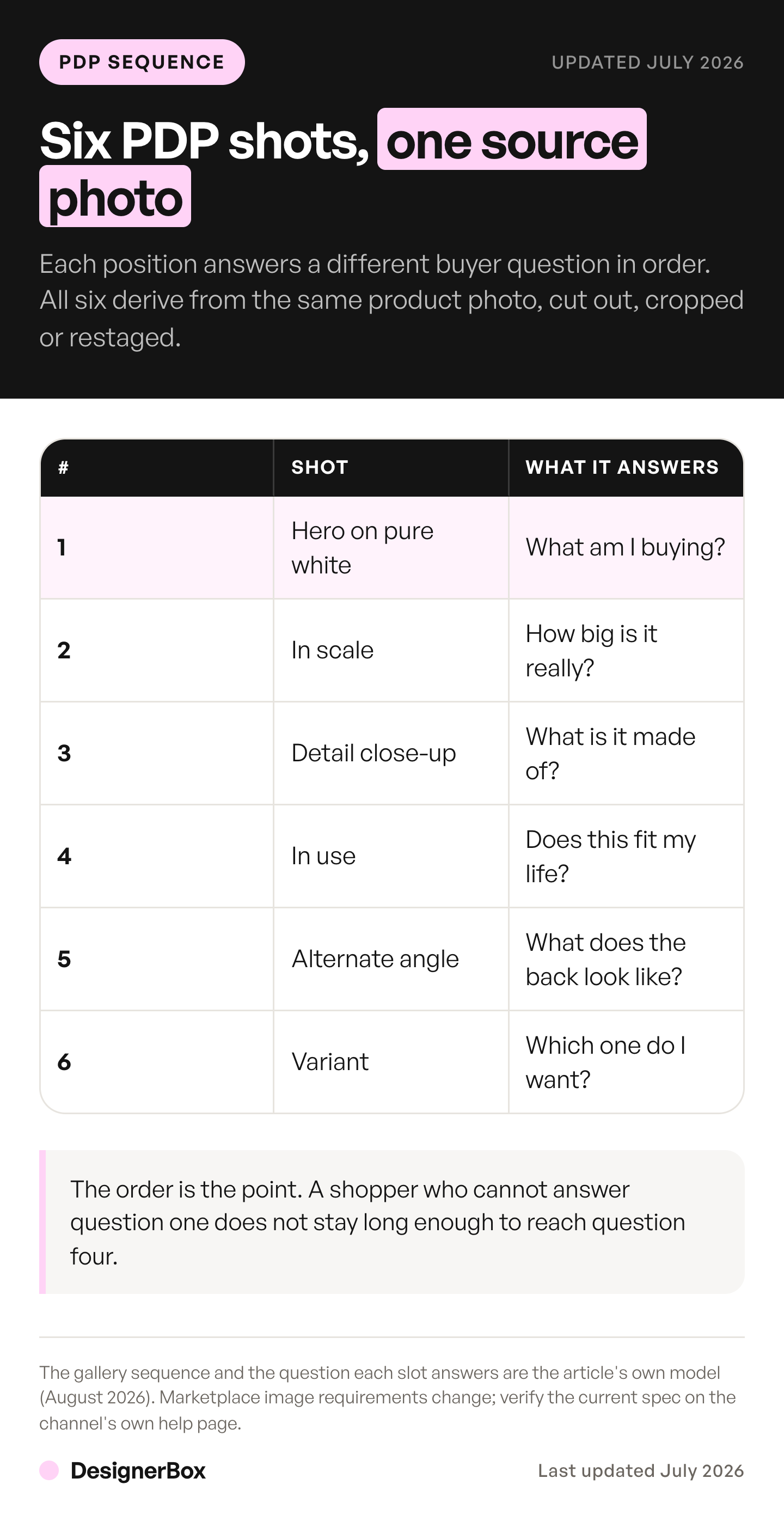
Read the middle column top to bottom. It is a conversation, and each answer earns the next swipe.
Why does the order of PDP images matter for conversion?
Order matters because shoppers consume the gallery as a sequence, not as a grid. Baymard’s testing found users swipe or tap through the carousel rather than navigating straight to the image they want, and that fatigue sets in before all the images have been explored (baymard.com, July 2026). Every frame that repeats the last one spends a swipe and returns nothing.
That is the whole mechanic. A gallery is a queue of answers, and you control the running order.
Two failure modes follow from it. The first is redundancy: three front-on shots at slightly different crops, which burns positions two and three on a question already answered at position one. The second is burial: the in-scale shot or the variant frame parked at position seven, behind the fatigue wall. Categories sold on volume feel this hardest, and proving capacity on a backpack listing works through which frames have to sit near the front.
Both are ordering problems. Neither is fixed by shooting more.
The truncation problem compounds it. When galleries show only five or six thumbnails by default without signposting the rest, users assume the visible thumbnails are all the images there are (baymard.com, July 2026). On mobile it is worse: 76% of mobile sites do not use thumbnails to represent additional product images at all (baymard.com, July 2026). Your first five or six frames are frequently the entire gallery as far as the shopper is concerned.
So the first six positions carry the page. Spend them on six different questions.
What should the first PDP image be?

The hero, on a pure white background, with the product filling the frame. Amazon requires the main image to show only the product for sale on a white background, with the product occupying at least 85% of the image, and recommends the longest side exceed 1,000 pixels so zoom activates (sellercentral.amazon.com, July 2026). Baymard notes the plain cut-out shot carries the highest signal-to-noise ratio of any product image type (baymard.com, July 2026). Getting to that cut-out is its own job, and the edge cases that break it are worth knowing before you batch a catalogue.
Treat position one as infrastructure. It is the frame that appears in search results, in the cart, in the category grid, and in the marketplace listing, so it has one job: identify the product without ambiguity. On Shopify the reuse is documented behaviour, and which surfaces share image one sets the framing that has to work at every size.
This is also where creative ambition does the most damage. A lifestyle hero looks better in a design review and performs worse everywhere the thumbnail is 80 pixels wide. Save the atmosphere for position four, and if that frame is styled to read as a customer photo, check the shot list and rules for UGC-style images before it ships.
The resolution floor is worth checking, because 25% of ecommerce sites do not have product images with sufficient resolution or zoom (baymard.com, July 2026). If your hero came out of a resize pipeline that cost you pixels, zoom quietly switches off and you never get told. Where that has already happened across a back catalogue, restoring low resolution product images covers what can be recovered and what has to be reshot.
What should come second, and why is scale so often missing?
An in-scale shot: the product next to something of known size, held in a hand, or worn. 42% of users will try to gauge a product’s overall scale and size from its images, and 37% of sites provide no in-scale image at all (baymard.com, July 2026). That gap is the most reliable easy win in the sequence.
Scale goes at position two because it is the question that follows “what is it” fastest. A shopper who cannot size your product either guesses wrong and returns it, or does not buy. That second outcome is expensive in apparel, where returns run at 23.4% of online orders and quietly cut the return on your ad spend, which we work through in how to increase ROAS for fashion ecommerce.
Before you try to prove any of this order with a split test on your own store, check the sessions you have to spend on it. Most catalogues cannot reach the volume a readable result needs, and the traffic math behind ecommerce image testing sets out what each level of lift costs.
Position three is the detail close-up. It closes the tactile gap, which is the one thing a screen cannot do on its own: the weave, the grain, the stitching, the finish. Baymard’s image-type research treats textural close-ups as a distinct category precisely because they answer a question no wide shot answers.
Position four is the product in use. For apparel, accessories, and cosmetics, Baymard’s research is direct that human-model images are essential, because length, fit, and tightness are close to impossible to judge otherwise (baymard.com, July 2026).
Then variants. One frame per colourway, per finish, per size where size changes the look. A variant the shopper cannot see is a variant they will not choose.
How many images does a product page need?
Six covers most catalogues, because six is how many distinct questions a typical product raises. Baymard identifies seven product image types across its research, and the point is coverage rather than volume: one image per question beats four images of the same answer. Add frames only when a variant or a genuine second use case earns one.
The count follows the questions. If your product has four colourways, you need nine or ten frames, and the four variant shots are load-bearing. If it has one, six is plenty.
On a marketplace the platform answers the question for you. Amazon’s detail page displays seven frames whatever you upload, and the slot counts and main-image rules across the five major platforms set the ceiling before your shot list does.
What the count should never follow is a shot list built around what was easy to capture on the day. That is how galleries end up with three front-on angles and no scale reference.
The harder question is not how many images a page needs but which SKUs should get the full set, because most catalogues answer that by sales forecast and quietly starve everything below the top sellers.
Whatever the gallery does not answer falls to the text underneath it, which is why the description should be written against the image set rather than from a blank page.
One exception worth knowing if you sell on Amazon and plan to add video. Amazon states the product must have fewer than six images for a shoppable video to appear in the main media block (sell.amazon.com, July 2026), so the sixth image and the video compete for the same slot. Amazon’s four video slots and what each one accepts covers the trade.
Can every PDP image come from one product photo?

Yes, and that is the part that changes the economics. Every asset builds from your actual product photo rather than a text prompt, so the object in frame is your object, with your logo placement, your stitching, your colourway. Nothing comes out looking generic AI.
Any tool that generates product stills can fill these positions, and the Photoroom alternatives worth comparing covers what each one charges to do it. The mapping below is how DesignerBox does it. Background Remover cuts the hero for position one. Photo Angles produces the alternate angles for position five. Spotlight relights a flat capture to studio standard for the detail crop. Styled Scene Generator drops the product into the in-use scene at position four. Flat Lay Studio handles catalogue compositions.
Resolution survives the trip. You can retouch, relight, change angles, and swap backgrounds, and each pass keeps the detail and resolution, which is what keeps you above the marketplace zoom floor after four edits. The gallery is the honest test of whether that holds.
The constraint stays honest: you need one accurate photo of the real product first. That does not go away, and it is the same constraint that governs what a product photoshoot costs in the first place. What goes away is the second trip to the studio for the colourway you added in March.
Teams already working in Figma can build the same set inside the layout rather than round-tripping through a folder of exports.
There is also a one-run route. A preset that returns the whole six-shot set from a single upload skips the app-by-app mapping above, and what an AI photo template locks in explains what stays fixed between SKUs when you take it.
What does a full PDP image set cost per SKU?
Generating or editing an image in DesignerBox costs 5 credits. A six-image PDP set is 30 credits per SKU. That makes the catalogue arithmetic simple.
| Plan | Price/mo | Credits/mo | Images | Full 6-image SKUs |
|---|---|---|---|---|
| Free | $0 | 112 | 22 | 3 |
| Basic | $15 | 500 | 100 | 16 |
| Pro | $35 | 1,000 | 200 | 33 |
| Premium | $75 | 2,500 | 500 | 83 |
| Ultra | $200 | 8,000 | 1,600 | 266 |
A 20-SKU catalogue needs 600 credits for a full first pass, so Pro covers it with room for revisions. A 100-SKU catalogue needs 3,000 credits, which puts it on Ultra for a single-month rebuild, or on Premium spread across two months.
Two gating facts worth knowing before you plan around this. Importing your own photos and using custom prompts start at Pro, which matters because importing your product photo is the entire premise. The commercial licence also starts at Pro. If the images are going on a live PDP, Pro is the floor.
The comparison that matters is not against your first shoot. It is against the eleventh small one: a two-colourway top-up is a studio minimum, a shipping run, and a week of calendar. It is also 60 credits.
For catalogues past a few dozen SKUs, the bulk catalog processor workflow and the catalog batch processor skill run the same pass without per-SKU setup.
FAQ
What order should product images be in on a PDP?
Hero on pure white, in-scale shot, detail close-up, product in use, alternate angle, then one frame per variant. The order tracks the questions a shopper asks in sequence: what is it, how big is it, what is it made of, does it fit my life, what does the back look like, which one do I pick.
How many images should a product detail page have?
Six covers most products, because six distinct questions is what a typical product raises. Baymard identifies seven product image types across its research, and coverage beats volume: one image per question outperforms four versions of the same answer (baymard.com, July 2026). Add frames for genuine variants, not for extra angles of the same view.
Why does the first product image have to be on a white background?
Because it is the frame every surface reuses at thumbnail size, and marketplaces enforce it. Amazon requires the main image to show only the product on a white background, filling at least 85% of the frame (sellercentral.amazon.com, July 2026). A lifestyle hero reviews well and performs poorly at 80 pixels wide.
Do shoppers look at product images before the description?
Yes. Around 56% of users inspect the images first when they arrive on a product page (baymard.com, July 2026). On mobile they swipe the gallery in sequence rather than jumping to a specific frame, and fatigue sets in before the carousel ends, which is why the running order carries more weight than the total count.
What is the most commonly missing PDP image?
The in-scale shot. 42% of users try to gauge a product’s size from its images, and 37% of sites provide no in-scale image at all (baymard.com, July 2026). Adding one at position two is usually the cheapest gallery fix available, and it reduces the size-related returns that follow a wrong guess.
Do AI-generated PDP images lose resolution after editing?
No. In DesignerBox you can retouch, relight, change angles, and swap backgrounds, and each pass keeps the detail and resolution. That matters for PDPs specifically, because marketplaces gate zoom behind a pixel floor, and zoom switching off silently is a failure you are never notified about.
What does a six-image PDP set cost to generate?
30 credits per SKU, since an image is 5 credits. Basic at $15 a month includes 500 credits, which is 16 full sets. Pro at $35 includes 1,000 credits, or 33 sets, and Pro is also where importing your own photos and the commercial licence begin, so it is the practical floor for live listings.
Sources
All accessed July 2026.
- Product page UX benchmarks across 334 sites, the 56% images-first figure, carousel sequence and fatigue behaviour, the 42% scale-judgement and 37% no-in-scale-shot figures, thumbnail truncation and the 76% mobile figure, the 25% insufficient resolution or zoom figure, the signal-to-noise ranking of cut-out shots, human-model images for apparel, and the seven product image types: (baymard.com, July 2026)
- Amazon main image requirements: product only on a pure white background, filling at least 85% of the frame, and a longest side over 1,000 pixels for zoom (sellercentral.amazon.com, July 2026)
- Amazon’s fewer-than-six-images condition for a shoppable video in the main media block: (sell.amazon.com, July 2026)
- DesignerBox credit costs, plan allocations and feature gating verified against live product configuration, July 2026
Product page and image gallery statistics verified from Baymard Institute research at baymard.com, and image specifications from Amazon Seller Central guidelines at sellercentral.amazon.com, as of July 2026. DesignerBox credit costs, plan allocations, and feature gating verified against live product configuration, July 2026. Individual results vary.