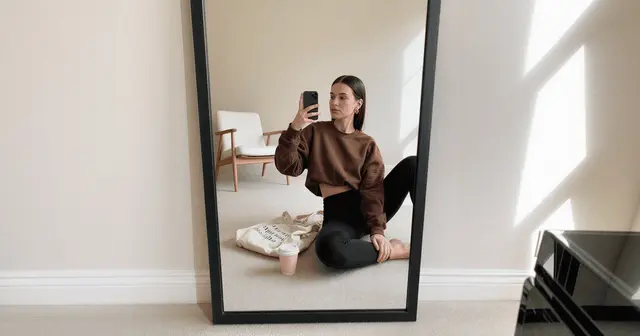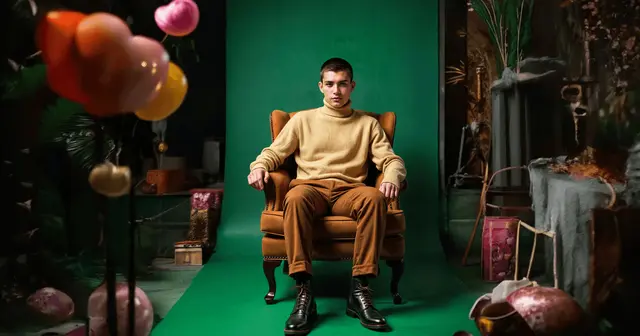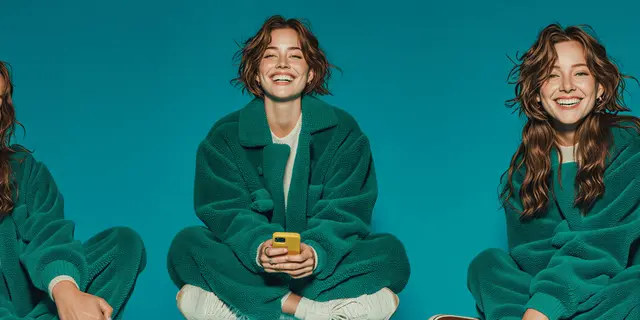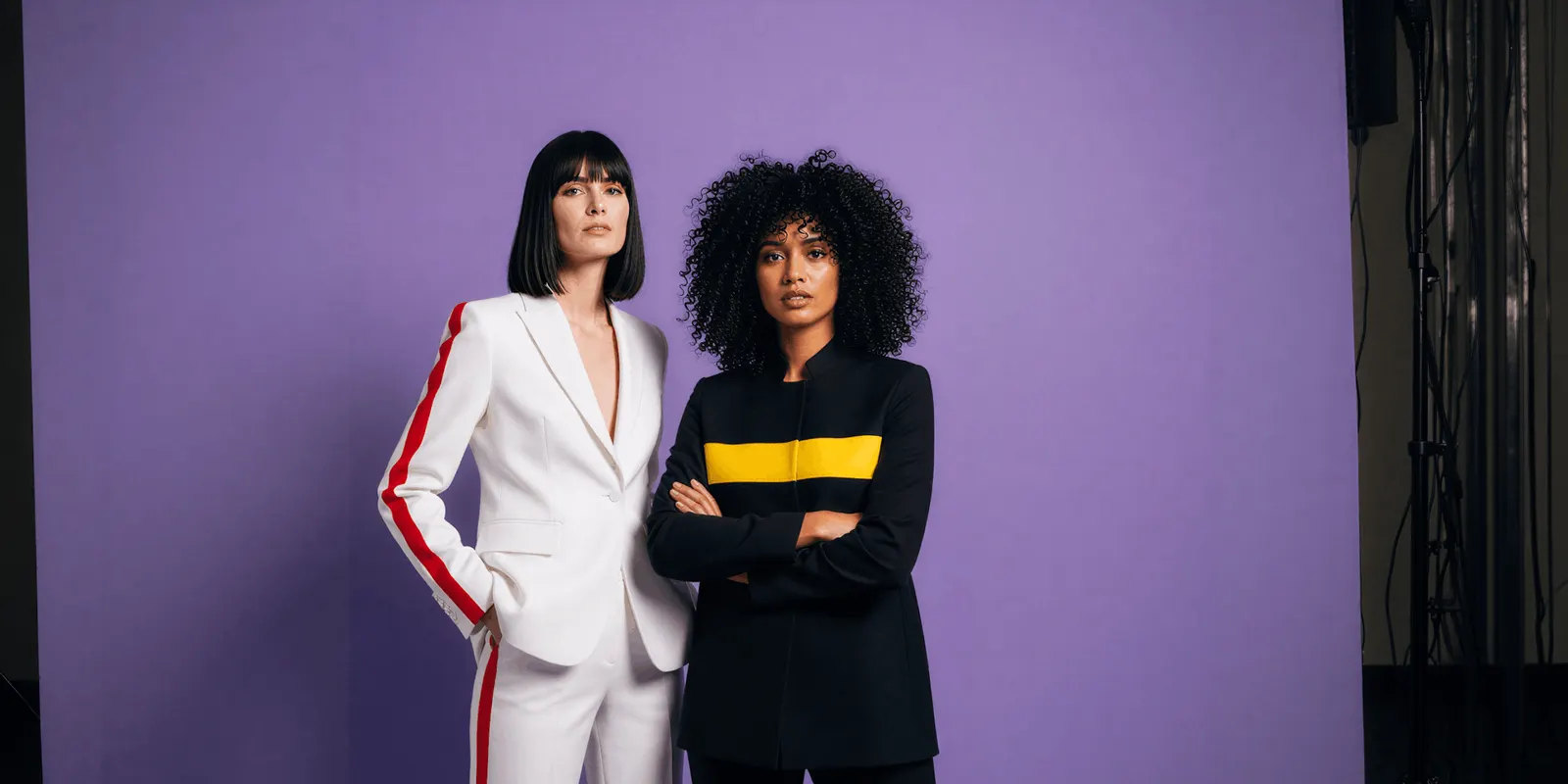
An AI head swap replaces a person’s whole head in a photo, hair and head shape included, while the body, garment, and background stay put. For a brand, the technique is the easy part. The binding constraint is rights: using a real person’s likeness in a commercial image needs their consent, and the model release from your original shoot probably does not grant it.
That second sentence is where most head swap guides stop and most brand problems start.
Here is the version you have already lived. The autumn shoot is done, the images are approved, and then someone asks whether the same set can run in a market where the cast reads wrong. Or the model’s contract term expires in March and the images are still on live PDPs. Or a retailer wants the range on a different body type and the next studio day is eight weeks out. The photograph exists. The person in it is the problem.
This covers what a head swap does, when a brand genuinely needs one, how to do it, and the rights and disclosure layer that decides whether the output can ship. It is written for fashion and ecommerce teams putting images on a live storefront, not for anyone making a meme.
Key Takeaways
- Head swap replaces the entire head including hair and silhouette. Face swap replaces facial features only and keeps the original hair. Pick head swap when the hairstyle or head shape is part of what has to change.
- For commercial use, regenerating the shot on-model usually beats swapping a head in. A swap inherits the pose, lighting, and rights problems of the source photo. A regeneration does not.
- A standard model release rarely covers AI modification. New York’s Fashion Workers Act requires separate written approval for a digital replica and explicitly excludes routine retouching from that definition (dol.ny.gov, July 2026).
- TikTok and Meta are not symmetric. TikTok requires an AIGC label on significantly AI-edited ad media. Meta’s mandatory disclosure applies to political and social issue ads, and labels commercial ads rather than requiring self-disclosure.
- California Civil Code 3344 requires prior consent to knowingly use another person’s likeness for advertising, with statutory damages starting at $750 (leginfo.legislature.ca.gov, July 2026).
- EU AI Act Article 50 transparency obligations apply from 2 August 2026, requiring deployers to disclose image content that is artificially generated or manipulated (artificialintelligenceact.eu, July 2026).
- The model providers already require consent. Google prohibits “using someone’s image without their consent” (support.google.com, July 2026), and Black Forest Labs prohibits content “invasive of privacy or publicity rights” (bfl.ai, July 2026).
- The providers also document where this breaks. Google states that masked editing and blending multiple images “may sometimes produce unnatural results” (deepmind.google, July 2026).
What is an AI head swap?
An AI head swap replaces one person’s entire head in a photograph with another, including hair, head shape, and often part of the neck, while keeping the body, clothing, pose, and background from the original image. The model matches lighting direction, skin tone, and viewing angle at the join so the edit reads as one photograph rather than two.
The distinction that matters commercially is what the new head is. Swapping in a second real person carries that person’s likeness rights into your image. Generating a head that resembles nobody in particular does not, though it still carries a disclosure obligation in some markets.
Head swap vs face swap: which one you need
Both edits replace part of a person. They differ in how much.
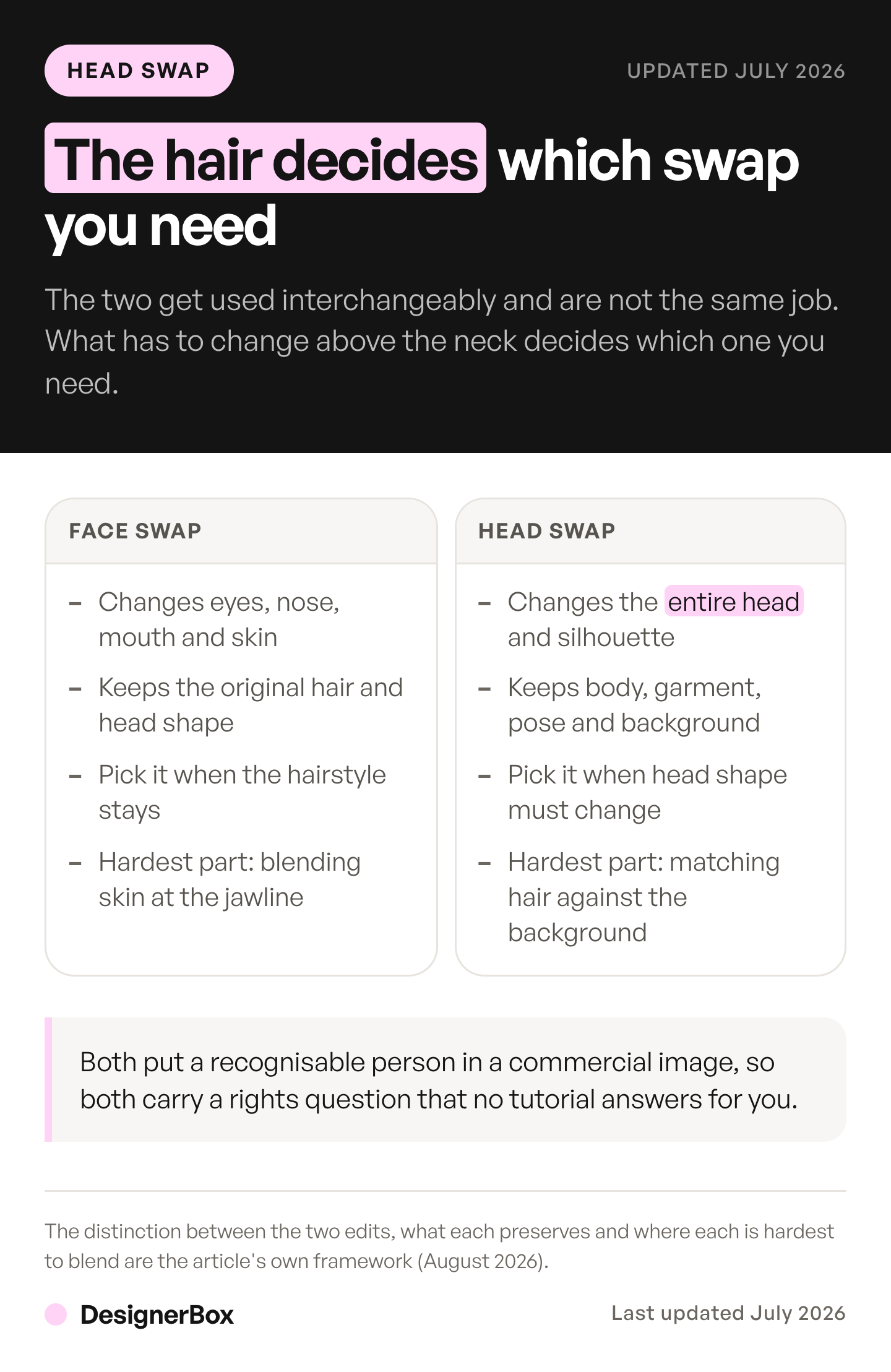
| Face swap | Head swap | |
|---|---|---|
| What changes | Eyes, nose, mouth, skin | Entire head, hair, silhouette, often neck |
| What stays | Original hair and head shape | Body, garment, pose, background |
| Best for | Keeping the existing hairstyle | Hairstyle or head shape must change |
| Harder because | Blending skin tone at the jawline | Matching hair against the background edge |
The practical test is the hairline. If the original hairstyle works for the new image, a face swap is the smaller and more reliable edit. If the hair is wrong, a face swap will leave a person wearing someone else’s hair, and it reads immediately as wrong in close crops.
Head swap is the larger edit and the harder one, because hair has thousands of soft edges against the background. That is also where the artefacts show up first.
When a brand needs this, and when it does not
Most brand requests that arrive phrased as “can we swap the head” are better solved another way. Worth separating the three cases.
Cases where a head swap is genuinely the right tool:
- The photograph is irreplaceable. A campaign hero shot, an on-location image, a set you cannot rebuild.
- The garment fit and drape in the original are the asset, and regenerating risks losing them.
- You need one specific change to an approved image late in a cycle.
Cases where regenerating on-model is better:
- You have flat lays or packshots and no on-model imagery yet. Nothing to swap into.
- You need the same garment across several model appearances. Swapping heads one at a time compounds artefacts; generating from the garment does not.
- The original model’s usage term is expiring. A swap built on their pose and body may still be a derivative of their performance.
Cases where the answer is a reshoot or a licence:
- The person whose head you want to swap in has not consented.
- The image is going into paid media in a market with strict likeness law and you have no written grant.
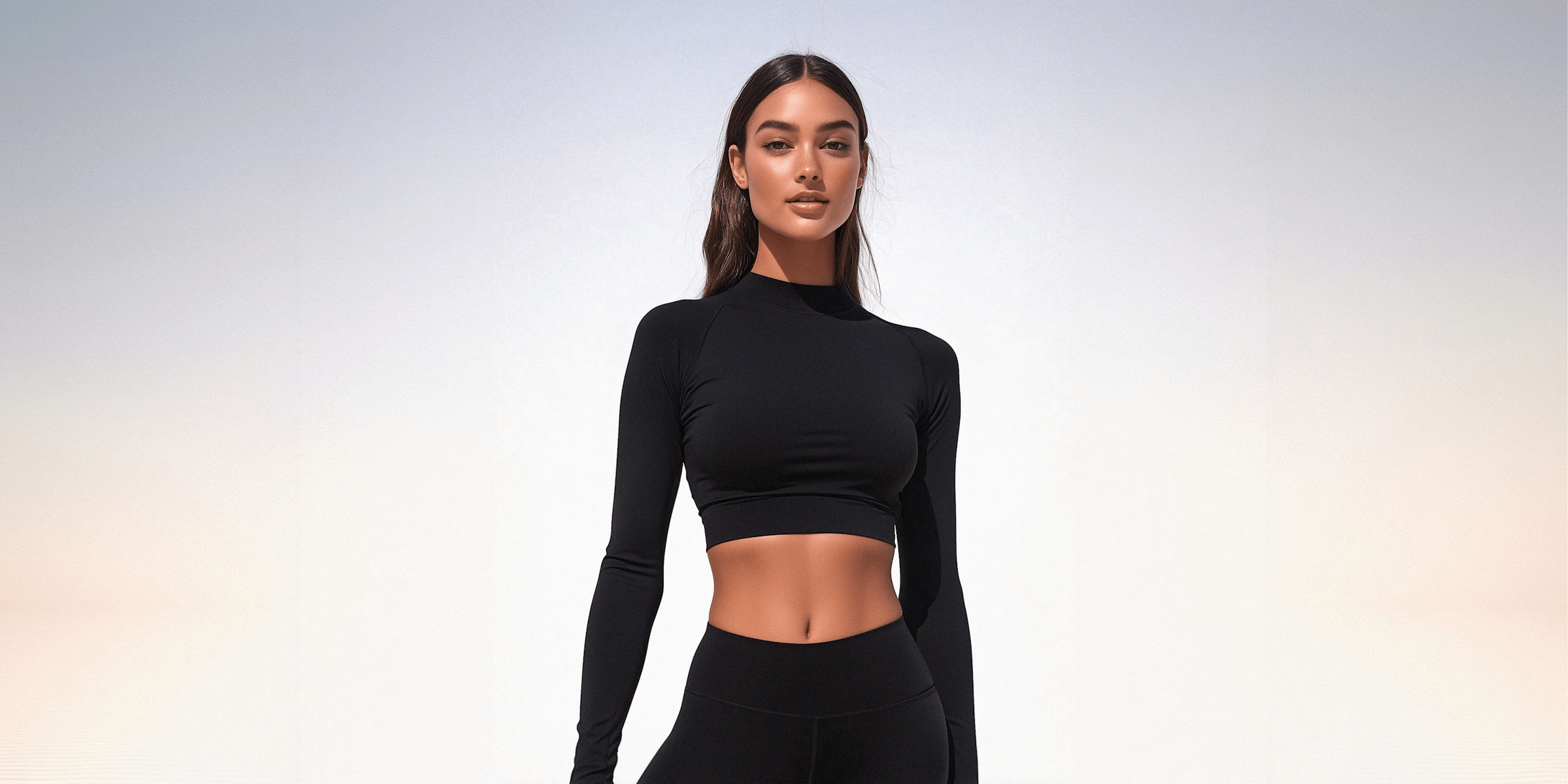
That middle column is the one teams underuse. If you have the garment, generating a fresh on-model image sidesteps the entire rights question, because there is no real person’s likeness in the output to license. DesignerBox’s outfit to image app and virtual try-on both work this way, and the wider tool set is compared in our guide to AI fashion model generators.
How to swap the model in a product photo, step by step
If a swap is the right call, the sequence below produces the fewest retries. Steps 1 and 2 are the ones people skip, and they are the ones that decide the result.
- Confirm the rights before you generate. Written consent from the person whose likeness is going in, and a check that your source photo’s release permits modification. If either is missing, stop here.
- Match the source images on angle and light. A front-facing head will not sit on a three-quarter body. Match the direction the light falls from, and the height of the camera relative to the face.
- Work from the highest resolution you have. Edits compound. Starting from a web-sized JPEG means the join is soft before you begin.
- Write the edit as a preservation instruction, not a replacement one. Google’s own prompting guidance for this pattern is to “change only the [specific element] to [new element/description]. Keep everything else in the image exactly the same, preserving the original style, lighting, and composition” (ai.google.dev, July 2026). Naming what must not change does more work than naming what must.
- Check the hairline, the neck join, and the ears at full resolution. These fail first. Ears are the reliable tell, because they sit at the boundary and are easy to get subtly wrong.
- Check the hands and any reflective surface. Skin tone that matches at the face but not at the hands is the second most common miss.
- Log what you generated and from what. If disclosure is required later, you need a record of which images were modified.
Step 5 is worth labouring. Most head swap output looks correct at thumbnail size and wrong at PDP zoom, which is the size that matters. The same resolution and accuracy discipline that applies to any generated product image applies harder here.
Holding a face across moving frames is the harder version of this same problem. If the shot is video rather than a still, see how to keep a character consistent in AI video.
Which models hold a face, and where they break
Identity preservation across an edit is a documented capability, not a happy accident. Worth reading what the providers claim.
Google documents Nano Banana Pro as “a sophisticated reasoning-driven engine for professional-grade image editing and generation” and states it can blend “up to 14 images and maintaining the consistency and resemblance of up to 5 people,” with 2K and 4K output (ai.google.dev and blog.google, July 2026). Google also documents localized editing that lets you “select, refine and transform any part of an image.”
Black Forest Labs documents FLUX.1 Kontext as built to “preserve unique elements of an image, such as a reference character or object in a picture, across multiple scenes and environments” and to “make targeted modifications of specific elements in an image without affecting the rest” (bfl.ai, July 2026). Their docs add that Kontext “excels at character consistency, even after multiple edits.”
OpenAI documents GPT Image 2 edits with mask support, and is candid about the limit: “Masking with GPT Image is entirely prompt-based. The model uses the mask as guidance, but may not follow its exact shape with complete precision” (developers.openai.com, July 2026).
The honest counterweight comes from Google, on its own product page: advanced features “like masked editing, major lighting changes (like day to night), or blending multiple images may sometimes produce unnatural results” (deepmind.google, July 2026).
Read those together and the picture is consistent. Region-locked editing is approximate across every major provider, by their own documentation. Budget for iterations rather than expecting a first-pass result, and check output at full size.
DesignerBox includes 13 image and video models on one subscription, so the model can be picked per shot rather than per subscription. Nano Banana Pro covers the editing modes, and Kontext Multi is the catalog entry for reference-conditioned consistency work.
The rights layer nobody puts in the tutorial
This is the section the consumer guides omit, and it is the one that decides whether the image ships.
A likeness in an advert needs consent. California Civil Code 3344 covers “any person who knowingly uses another’s name, voice, signature, photograph, or likeness, in any manner, on or in products, merchandise, or goods, or for purposes of advertising or selling” without prior consent, with statutory damages starting at $750 (leginfo.legislature.ca.gov, July 2026). New York, Tennessee, and a growing list of other states run comparable statutes. This is not new law reaching for AI. It is ordinary right-of-publicity law, and a generated image is still a use.
California has since legislated digital replicas directly. AB 2602, effective 1 January 2025, restricts contract terms permitting digital replica use without informed consent. AB 1836, effective 1 January 2026, restricts digital replicas of deceased personalities without estate permission, with damages the greater of $10,000 or actual damages (leginfo.legislature.ca.gov and firm analyses, July 2026).
Your existing model release probably does not cover this, and one state now says so in statute. New York’s Fashion Workers Act, effective 19 June 2025, requires clear written approval to create or use a model’s digital replica, and that approval “must be separate from the representation agreement,” detailing scope, purpose, rate of pay, and duration. It draws the line explicitly, excluding “routine photographic edits such as color correction, minor retouching, or other standard post-production modifications” from the definition of a digital replica (dol.ny.gov, July 2026). Retouching is covered by an ordinary release. Replacing someone’s head is not.
The exposure compounds when the face is meant to recur. A one-off swap needs consent for one image; a reusable AI brand character needs a release that names synthetic generation, a term, and a territory.
Consent requirements also differ by state in a way that catches people out. New York Civil Rights Law 50 requires consent to be obtained in writing. California’s 3344 says only “prior consent” and does not specify writing (nysenate.gov and leginfo.legislature.ca.gov, July 2026). Get it in writing regardless, because you will need to evidence it.
Licensed stock does not solve it either. Getty’s end user licence states plainly that “Getty Images does not represent or warrant that consent has been obtained for such uses with respect to model-released content” (gettyimages.com, July 2026). A model release attached to a stock photo is not a grant to synthesise that person’s likeness.
The model providers require consent too, independently of the law. Google’s policy prohibits “using someone’s image without their consent” (support.google.com, July 2026). Black Forest Labs’ terms prohibit content “invasive of privacy or publicity rights (including, but not limited to, uploading images of individuals via the Services without their consent)” (bfl.ai, July 2026).
One nuance that gets misreported: none of the major providers ban face or head swapping as a technique. They regulate the outcome, which is impersonation, privacy violation, and unauthorised use of likeness. Swapping in a model you hold rights to is a different act from swapping in someone you do not, and the policies are written to reach the second.
What the platforms require when the ad ships
Disclosure is a separate obligation from consent. Clearing one does not clear the other.
EU AI Act Article 50 takes effect on 2 August 2026. Deployers of an AI system that generates or manipulates image content constituting a deep fake “shall disclose that the content has been artificially generated or manipulated.” Content forming part of an “evidently artistic, creative, satirical, fictional or analogous work” gets a lighter obligation, limited to disclosing that generated content exists in a way that does not hamper enjoyment of the work (artificialintelligenceact.eu, July 2026). A commercial product image is not an artistic work under that carve-out, so brands should not plan around it.
The two big ad platforms are not symmetric, and a lot of published advice says otherwise.
TikTok requires the AIGC label or a clear disclaimer, caption, watermark, or sticker on significantly edited or AI-generated media in ads, and defines “significantly modified by AI” to include showing someone doing something they did not do. It does not allow content using the likeness of a public figure without permission, particularly in misleading contexts (ads.tiktok.com, July 2026).
Meta applies an “AI info” label to ads created or significantly edited with its generative AI features, and does not apply it to minor edits such as resizing or colour correction. Its mandatory advertiser self-disclosure duty is scoped to ads about social issues, elections, or politics, not to ordinary commercial product ads (meta.com, July 2026).
Be careful what you read on this. A cluster of marketing blogs claims Meta made AI disclosure mandatory for all advertisers globally, quoting rejection-rate percentages and rule counts that appear on no Meta property and that Meta’s own help pages contradict. Verify platform policy against the platform, and re-check it before each campaign, including against this article.
Google also embeds SynthID, an imperceptible digital watermark, in all media generated by its tools (blog.google, July 2026). Assume generated imagery is detectable, and plan disclosure as a normal production step rather than a risk to manage.
What this does not solve
Honest limits, because the technique is oversold.
A head swap does not fix a bad source photograph. Pose, lighting, and garment fit come from the original, and a new head on an awkward pose is an awkward pose. It does not reliably survive a PDP zoom on the first pass.
It does not give you rights you did not have. And it does not produce a consistent model across a range, because each swap is an independent edit; holding one identity across forty SKUs is a brand consistency problem solved by reference conditioning and saved workflows, not by repeating a swap. Holding one look across a whole drop takes four separate locks: model identity, lighting, framing, and garment fidelity.
Against a reshoot, the economics still favour generation. Shopify puts model photoshoots at $100 to $500 or more per product (shopify.com, July 2026), and the full picture is in our breakdown of product photoshoot cost. Whichever route produces the image, it still has to earn its place in the PDP gallery.
For teams doing this at catalogue scale, the relevant surface is Model Studio. Try-on and AI video sit on the Premium tier at $75 a month with 2,500 credits, an image edit costs 5 credits, and the commercial licence you need to run output as paid media starts at Pro. DesignerBox also has a free plan, so you can see how the output holds on your own photo before you pick a tier. Full tiers are on the pricing page.
The character swap feature runs this directly, and best AI image model for portraits and headshots compares the models on faces. For headshots specifically, the AI headshot prompts library and the headshot studio agent cover the repeatable version.
FAQ
What is an AI head swap?
An AI head swap replaces a person’s entire head in a photograph, including hair, head shape, and often part of the neck, while keeping the body, garment, pose, and background from the original image. The model matches lighting, skin tone, and viewing angle at the join. It differs from a face swap, which replaces only facial features and keeps the original hair.
What is the difference between a head swap and a face swap?
A face swap replaces the eyes, nose, mouth, and skin while keeping the original hair and head shape. A head swap replaces the whole head including hair and silhouette. Use the hairline as the test: if the original hairstyle suits the new image, a face swap is the smaller and more reliable edit. If the hair has to change, only a head swap will look right in close crops.
Can I use an AI head swap in a commercial advert?
Only with rights to the likeness in the output. California Civil Code 3344 requires prior consent to knowingly use a person’s likeness for advertising, with statutory damages starting at $750 (leginfo.legislature.ca.gov, July 2026), and other states run comparable statutes. Model provider policies require consent as well. Generating a model who is not a real identifiable person avoids the likeness question, though disclosure obligations can still apply.
Does my model release cover AI modification of the photos?
Usually not. New York’s Fashion Workers Act, effective 19 June 2025, requires clear written approval for a model’s digital replica that is separate from the representation agreement, and excludes “routine photographic edits such as color correction, minor retouching” from that definition (dol.ny.gov, July 2026). Getty’s licence goes further and disclaims any warranty that consent was obtained for such uses on model-released content (gettyimages.com, July 2026). Treat AI modification as a separately negotiated term.
Do I have to disclose that a product image was AI-edited?
In the EU, yes, from 2 August 2026. AI Act Article 50 requires deployers to disclose image content that has been artificially generated or manipulated, and the carve-out for artistic and creative works does not cover commercial product imagery (artificialintelligenceact.eu, July 2026). Platform rules are separate and change frequently, so verify current advertising policy before a campaign ships.
Why does my head swap look wrong at full resolution?
Because region-locked editing is approximate across every major provider, by their own documentation. Google states that masked editing and blending multiple images “may sometimes produce unnatural results” (deepmind.google, July 2026), and OpenAI notes that its masking “may not follow its exact shape with complete precision” (developers.openai.com, July 2026). Check the hairline, neck join, and ears at full size, and start from the highest resolution source you have.
Should I swap the head or regenerate the shot on-model?
Regenerate, in most cases. A swap inherits the pose, lighting, and likeness rights of the source photograph, while generating an on-model image from your garment carries none of those. Swapping is the better answer when the original photograph is irreplaceable, such as a campaign hero or an on-location set, or when garment fit and drape in the original are the asset.
Which plan do I need for on-model work in DesignerBox?
Try-on clothes and AI video require Premium at $75 a month, which includes 2,500 credits, with image generation and editing at 5 credits each. The commercial licence needed to run output as paid media or on a live PDP starts at the Pro tier. Basic at $15 and Pro at $35 do not include try-on.
Sources
All accessed July 2026.
- California Civil Code 3344 prior-consent requirement and $750 statutory damages, plus AB 2602 and AB 1836 on digital replicas: (leginfo.legislature.ca.gov, July 2026)
- New York’s Fashion Workers Act, separate written approval for a digital replica and the routine-retouching exclusion: (dol.ny.gov, July 2026)
- New York Civil Rights Law 50 requiring consent in writing: (nysenate.gov, July 2026)
- EU AI Act Article 50 deployer disclosure duty and the artistic-work carve-out, applying from 2 August 2026: (artificialintelligenceact.eu, July 2026)
- Getty’s end user licence disclaiming any warranty that consent was obtained for such uses on model-released content: (gettyimages.com, July 2026)
- TikTok’s AIGC labelling rule for significantly AI-edited ad media and its public-figure likeness rule: (ads.tiktok.com, July 2026)
- Meta’s “AI info” label scope and its mandatory self-disclosure duty limited to social issue, election and political ads: (meta.com, July 2026)
- Nano Banana Pro editing capability, 14-image blending, 5-person consistency, and the prompt pattern for preservation instructions: (ai.google.dev, July 2026)
- Nano Banana Pro output resolutions and SynthID watermarking on Google-generated media: (blog.google, July 2026)
- Google’s caveat that masked editing, major lighting changes and multi-image blending may produce unnatural results: (deepmind.google, July 2026)
- Google’s policy prohibiting use of someone’s image without their consent: (support.google.com, July 2026)
- FLUX.1 Kontext character and element consistency across edits, and Black Forest Labs’ terms on privacy and publicity rights: (bfl.ai, July 2026)
- GPT Image 2 mask support and its prompt-based, imprecise mask behaviour: (developers.openai.com, July 2026)
- Model photoshoot cost of $100 to $500 or more per product: (shopify.com, July 2026)
- DesignerBox pricing, credit costs, plan allocations and feature gating verified against live product configuration, July 2026
Legal, policy, and model capability claims verified from leginfo.legislature.ca.gov, nysenate.gov, dol.ny.gov, artificialintelligenceact.eu, gettyimages.com, ads.tiktok.com, meta.com, support.google.com, blog.google, deepmind.google, ai.google.dev, bfl.ai and developers.openai.com as of July 2026. This is not legal advice; likeness and disclosure law varies by jurisdiction and is changing quickly, so verify current requirements for your markets before publishing. DesignerBox pricing, credits, and feature gating verified against live product configuration, July 2026. Individual results vary.