


Good product description examples share one shape. The first line names the product and its defining attribute. The next line answers the question shoppers ask most. Then come the facts, the care or use, and one honest limit. Each claim has an image that proves it. This guide gives eight examples in that shape, then one template you can fill in.
Every example below is illustrative. We wrote each one for this guide, for a generic product that no real brand sells. The measurements are sample values. Replace them with the facts of your own product before you use the structure.
Key Takeaways
- A useful example has three parts you can check: the shopper question it answers, the fact it states, and the image that proves the fact.
- Write for a scan. In a 1997 Nielsen Norman Group study, 79 percent of test users always scanned a new page, and 16 percent read word by word (nngroup.com, October 2026).
- State one limit in every description. “Runs small” and “charger not included” answer a question before the order.
- One template with six slots covers all eight examples.
- A product feed needs a second version. Google asks for the most important details in the first 160 to 500 characters (support.google.com, October 2026).
What makes a product description example worth copying?
A product description example is worth copying when you can take its structure and leave its words. Each example below opens with a bold name line and keeps every sentence to one fact, because shoppers scan. Each one comes with three notes:
- Answers: the shopper question the copy resolves.
- States: the fact that carries the weight.
- Image must show: the frames the gallery needs so the copy is true.
A description that says “lightly textured” beside a glossy photo loses trust. Our guide to what to show in a product page gallery covers the order of those frames.
Product description examples for clothing
Clothing descriptions carry the fit question. A photo shows the shape. It cannot tell the shopper which size to order.

1. A linen shirt
Relaxed linen shirt, long sleeve. 100% linen, 160 gsm. Loose through the body with a straight hem. Runs small: between two sizes, choose the larger one. Chest and length for each size are in the chart below. Machine wash cold. Linen creases with wear. Imported.
- Answers: “Which size do I order?”
- States: fiber, fabric weight and origin. FTC guidance on the Textile Act says product descriptions in internet advertising must state that a textile product was made in the U.S.A., imported or both (ftc.gov, October 2026).
- Image must show: the shirt on a model, front and back, with the model’s height and size in the caption. Add a close crop of the weave.
Product description examples for furniture and kitchen tools
Home products carry the scale question: does it fit the room and the hand.
2. An armchair
Oak-frame armchair with a wool-blend seat. 29 in wide, 31 in deep, 30 in high. Seat height 17 in. Arrives in one box. Attach the four legs with the included key in about ten minutes. Holds up to 300 lb. Spot clean only.
- Answers: “Will it fit, and do I have to build it?”
- States: the dimensions, the weight limit and the assembly time. Time the assembly yourself first.
- Image must show: a dimension diagram, a room scene with a person seated for scale, and a fabric close crop in true color.
3. A pepper mill
Beech pepper mill, 7 in tall. Ceramic grinding core. Turn the top knob to move from fine to coarse. Lift the top to refill. Holds about 1.4 oz of peppercorns. Wipe with a dry cloth. Keep it away from the dishwasher. For pepper only, never for salt.
- Answers: “How do I use it and clean it?”
- States: the limit, “for pepper only”.
- Image must show: the mill in a hand for scale, the top removed for refilling, and fine and coarse pepper side by side.
Product description examples for skincare, supplements and food
These categories carry the claims question. A safe description says what the product is and how to use it.
4. A face moisturizer
Daily face moisturizer, fragrance free, 1.7 fl oz. A light cream with glycerin and squalane. Leaves a matte finish. Use morning and night after cleansing. Pump bottle. The full ingredient list is below. Patch test first if your skin reacts easily.
- Answers: “How does it feel, and what is in it?”
- States: texture, finish and key ingredients, with no claim to treat anything. The FDA says certain claims may cause a product to be considered a drug, even if it is marketed as a cosmetic (fda.gov, October 2026).
- Image must show: a swatch of the cream on skin, the bottle in a hand, and a readable crop of the ingredient panel.
5. A magnesium supplement
Magnesium glycinate capsules, 120 count. One serving is two capsules and provides 200 mg of magnesium. Sixty servings per bottle. Vegetarian capsule. No added colors or flavors. Take with food. The Supplement Facts panel is in image three.
- Answers: “How much is in a serving, and how long does a bottle last?”
- States: dose, count and servings, with no health claim. The FTC says claims about health benefits require competent and reliable scientific evidence (ftc.gov, October 2026).
- Image must show: the Supplement Facts panel at a readable size, one capsule in a palm, and the bottle with the count on the label.
6. A bag of granola
Maple pecan granola, 12 oz bag. Rolled oats, pecans, maple syrup, sunflower oil, sea salt. Baked into large clusters. Contains tree nuts. Made in a kitchen that also handles peanuts and wheat. About eleven servings per bag. Resealable.
- Answers: “What is in it, and can I eat it?”
- States: every ingredient and the allergens.
- Image must show: the ingredient label at a readable size, a bowl that shows the cluster size, and the bag in a hand.
Product description examples for jewelry and tech accessories
Small products carry two questions: size and compatibility.

7. A pendant necklace
Sterling silver pendant necklace, 18 in chain. The disc pendant is 0.5 in across. The chain adjusts from 16 to 18 in. Lobster clasp. Sits at the collarbone on most necks. Sterling silver tarnishes over time. Polish it with the cloth in the box.
- Answers: “How big is the pendant, and where does it sit?”
- States: metal, pendant size, chain range, and that silver tarnishes.
- Image must show: the necklace on a neck, the pendant beside a ruler, and a close crop of the clasp.
8. A charging cable
USB-C to USB-C cable, 6 ft, braided. Charges at up to 100 W with a 100 W charger. Transfers data at up to 480 Mbps. It carries no video signal to a monitor. Works with phones, tablets and laptops that have a USB-C port. Charger not included.
- Answers: “Will it work with my device?”
- States: two limits, no video and no charger.
- Image must show: both connector ends in a close crop, the cable beside a laptop for length, and one frame of what is in the box.
A product description template you can fill in
All eight examples use the same six slots. The table uses the linen shirt as the worked case.
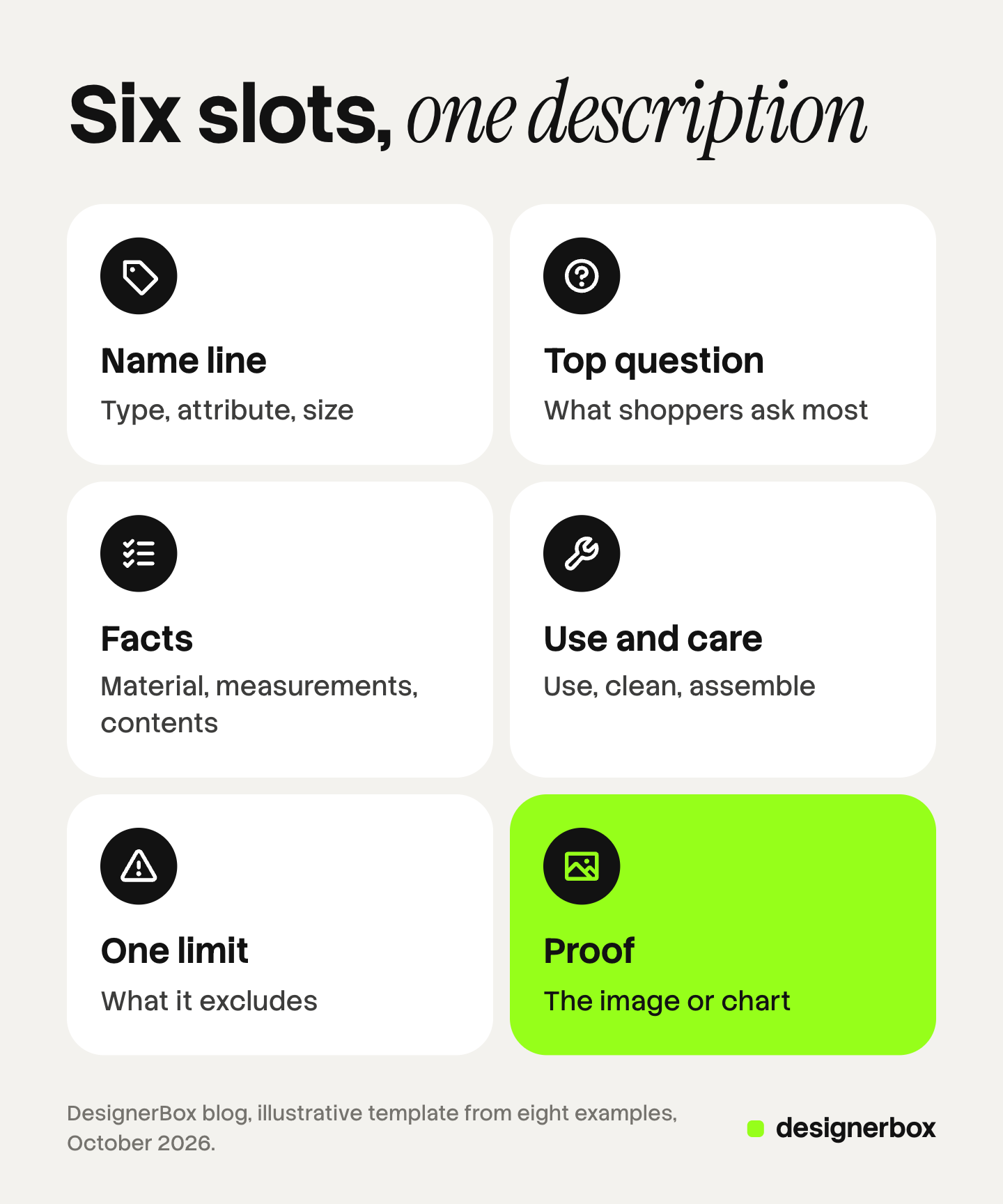
| Slot | What goes in it | From the linen shirt |
|---|---|---|
| 1. Name line | Product type, defining attribute, size or count | Relaxed linen shirt, long sleeve |
| 2. Top question | The answer to what shoppers ask most | Runs small, choose the larger size |
| 3. Facts | Material, measurements, contents, compatibility | 100% linen, 160 gsm |
| 4. Use and care | How to use, clean or assemble it | Machine wash cold |
| 5. One limit | What it does not do or include | Linen creases with wear |
| 6. Proof | The image or chart that shows the facts | Size chart, on-model photo |
The fill-in version:
[Product type], [defining attribute], [size or count]. [Answer to the top question]. [Material and measurements]. [How to use or care for it]. [One honest limit]. [Where the proof is].
Two rules keep the template honest in product description writing. Find the top question in your own support messages, reviews and return reasons. Fill slot 6 last: if no image proves a claim, add the image or cut the claim.
The structure of the page version, with labeled highlights, is covered in how to write a product description.
Claims that need proof before they print
Some words carry a rule in a real listing. These are United States rules, read on each regulator’s own pages. This is general information, not legal advice.
| Claim in the copy | What the regulator says | Source |
|---|---|---|
| ”Made in USA” | The product should be “all or virtually all” made in the U.S. The Labeling Rule covers labels in catalogs and online | FTC, October 2026 |
| ”Eco-friendly”, “green” | Marketers should not make broad, unqualified claims. Name the specific benefit | FTC Green Guides summary, October 2026 |
| A structure or function claim on a supplement label | The label must carry a disclaimer that FDA has not evaluated the claim | FDA, October 2026 |
If you cannot show the document behind a claim, cut the claim.
Product description SEO in one section
Product description SEO starts with the name line. Write the product the way a shopper types it: “relaxed linen shirt”, “USB-C cable 6 ft”.
Google’s guidance sets three limits. Google Search does not use the keywords meta tag. Repeating the same words is tiring for users, and keyword stuffing is against Google’s spam policies (developers.google.com, October 2026). Google also asks for unique content, so write your own text instead of copying the supplier’s.
Add a keyword only when it is true of the product. On Shopify, one description field serves every variant, as the guide to Shopify product descriptions explains. The fields around the description, such as the title and alt text, are covered in Shopify product page optimization.
How does the same example change for a feed or a marketplace?
A product feed wants plain facts at the front. Here is the linen shirt, rewritten for the Google Merchant Center description:
Relaxed linen shirt with long sleeves in 100% linen, 160 gsm. Loose cut through the body, straight hem. Runs small. Machine wash cold. Imported.
The bold label is gone. The pointer to “the chart below” is gone, because a feed has no page below it.
Google’s rules for this field, read on 7 October 2026 (support.google.com):
- List the most important details in the first 160 to 500 characters. The limit is 5,000.
- Leave out promotional text such as price, sale dates, shipping and your company’s name.
- Avoid all caps and symbols used to draw attention.
- A description created with generative AI goes in the structured description attribute.
A marketplace listing is a third version, usually bullets with one claim each. The guide linked above holds the rules for each surface. The image side is in what each marketplace shows in its listing images, and the data that AI shopping systems read is in the agentic commerce checklist.
The image set behind each description
Every example above ends with the frames the image must show, three per product. Across 200 products that is 600 frames, and each one has to agree with a line of copy.
DesignerBox makes images, ads and video. It does not write product descriptions, titles or feed data. Its part is the picture side.
Anyone can make an AI picture. Making hundreds that still look like your brand is the hard part. You set your brand rules once: the light, the background, the framing, the colors. You save the shot list as a workflow. The workflow reads the brand rules on every run.
Batch runs one workflow over a sheet of products, up to 200 rows. Row one and row two hundred get the same frames in the same style. The cost is shown before the run. You download the results, or send them with a webhook or an S3 step.
DesignerBox does not send finished work to a store, a marketplace or a feed. An AI image can change a detail, so check each result against the real product with the list in what to verify in an AI product photo. Label panels, such as Supplement Facts, should come from a photo of the real label.
Uploading your own photos and the commercial license start on the Pro plan. AI video, virtual try-on, upscaling, the image editor and the video editor start on the Premium plan. Plans and credits are on the pricing page.
The full workflow from the first product photo to the finished ad, in one subscription. There is a free plan, and it runs on sample products. Get started free.
FAQ
What is a good example of a product description?
A good example names the product in the first line, answers the most common shopper question, states facts a shopper can check, and states one limit. For a linen shirt that is the fiber, the note “runs small”, the care line and the origin.
Can I copy these product description examples?
Copy the structure and replace every fact. The examples describe generic products with sample values. Google’s SEO Starter Guide asks for unique content that you create yourself (developers.google.com, October 2026).
How long should a product description be?
The eight examples here run from about 35 to 50 words, and each one covers the six slots. A technical product with many compatible models needs more facts, in the same order.
Does DesignerBox write product descriptions?
No. DesignerBox makes images, ads and video. It produces the image set that a description has to agree with, with the same brand rules on every product.
What is a product description template?
A product description template is a fixed order of slots that every product in a catalog fills in. The one in this guide has six. A missing fact appears as an empty slot.
Sources
- Nielsen Norman Group, How Users Read on the Web (nngroup.com, October 2026)
- Google Merchant Center Help, description and structured description attributes (support.google.com, October 2026)
- Google Search Central, SEO Starter Guide (developers.google.com, October 2026)
- Federal Trade Commission, Complying with the Made in USA Standard (ftc.gov, October 2026)
- Federal Trade Commission, Environmental Claims: Summary of the Green Guides (ftc.gov, October 2026)
- Federal Trade Commission, Health Products Compliance Guidance, December 2022 (ftc.gov, October 2026)
- Federal Trade Commission, Threading Your Way Through the Labeling Requirements Under the Textile and Wool Acts (ftc.gov, October 2026)
- U.S. Food and Drug Administration, Structure/Function Claims (fda.gov, October 2026)
- U.S. Food and Drug Administration, Is It a Cosmetic, a Drug, or Both? (fda.gov, October 2026)
- DesignerBox plans and batch (DesignerBox pricing page and batch page, designerbox.ai, October 2026)
The eight product descriptions are illustrative examples written for this guide, with sample values. Regulator and Google guidance was read on 7 October 2026 and can change. The claims section is general information about United States rules, not legal advice.