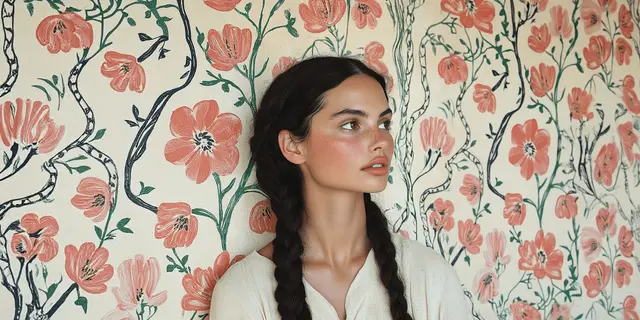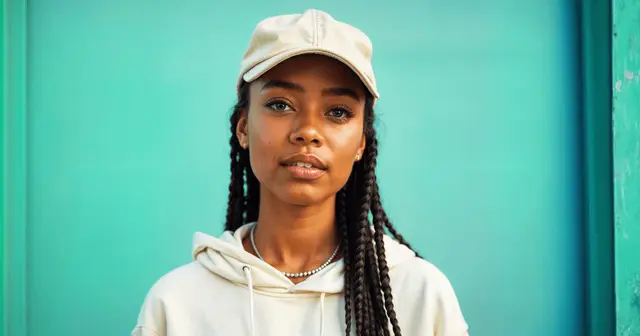
To become a fashion influencer, treat the account as a small business with five working parts. Pick a niche that a stranger can name in one line. Post a repeatable weekly set of outfit posts, flat lays, Reels and carousels. Join an affiliate program so each post can earn. Label paid, gifted and affiliate posts. Tell followers when a picture shows an AI model.
“Post often and be authentic” is not a plan. Three things decide whether the account pays: the formats Instagram accepts, the programs that pay commission, and the rules on labels.
This guide is for a fashion content creator who runs the account alone. Every platform fact was read on the platform’s own page in October 2026. It prints a follower number only where a program publishes one, and it prints no income figure.
Key Takeaways
- A niche is one sentence. A stranger should know who you dress and for what occasion after three posts.
- The weekly set has five post types. Outfit posts, flat lays, Reels, carousels and Stories each do a different job.
- Instagram’s frames are fixed. A feed photo can be as tall as 1080 x 1440 pixels, and a carousel holds up to 20 photos and videos.
- Affiliate and gifted posts need a label. Instagram says a post with an affiliate link or a free product takes the paid partnership label.
- An AI model is a claim about fit. If the garment is on an AI model and you have not worn it, say so in the picture or the first caption line.
- Volume is the hard part. Every product you link needs a picture, and one person cannot shoot every product every week.
A niche a stranger can name
A fashion influencer is a person whose outfit choices other people trust enough to copy. The trust comes from a narrow promise. “Workwear for tall women” is a niche. “Fashion” is a category.
Write the niche as one sentence with three parts: who you dress, for what occasion, and at what budget. If a stranger cannot guess the sentence from your last nine posts, the niche is still too wide.
Body and fit make the strongest first part: petite, tall, plus size, maternity. You can answer fit questions from experience. You do not need to cover all of fashion. You need one group of people who see your post and think “that is my problem”.
The weekly content set
A weekly content set is a short list of post types you repeat every week. The table below is one working example for a creator who posts alone. The mix is our suggestion, and Instagram publishes no required number of posts.
| Post type | What it shows | Job in the week | What you need |
|---|---|---|---|
| Outfit post | You in the full outfit, one clear frame | Shows fit and proportion on a real body | A photo of you in the clothes |
| Flat lay | The pieces of one outfit on a surface | Shows each product clearly, with links | A picture of each product |
| Reel | The outfit in motion, or three ways to wear one piece | Reaches people who do not follow you yet | Short clips, vertical |
| Carousel | A roundup, such as five coats under one budget | Holds several linked products in one post | One picture per product |
| Stories | Try-ons, polls, links to the shop | Answers questions from followers | Quick phone clips |
Two notes on the outfit post. “Outfit of the day” is still the search term followers use, and the hashtag is OOTD. Good OOTD ideas come from the niche sentence: one outfit, one occasion, one reason it works.
The flat lay and the carousel carry most of the links. That matters for the pay section below, and our guide to flat lay photography covers the camera position and light for that shot.
LTK gives new creators a concrete number for pace. Its expectations page says to post shoppable content at least 10 times in the first 30 days. It also says top performing posts include 4 to 8 products from 1 or 2 brands (LTK, October 2026).
For the tools around the posts, CreatorFlow’s creator tools directory lists 190+ tools by job, from link-in-bio and email to scheduling and affiliate platforms. CreatorFlow is built by the same team as DesignerBox (creatorflow.so/creator-tools, October 2026).
Instagram formats and sizes in 2026
Instagram accepts a fixed range of shapes, and it crops a post outside the range.
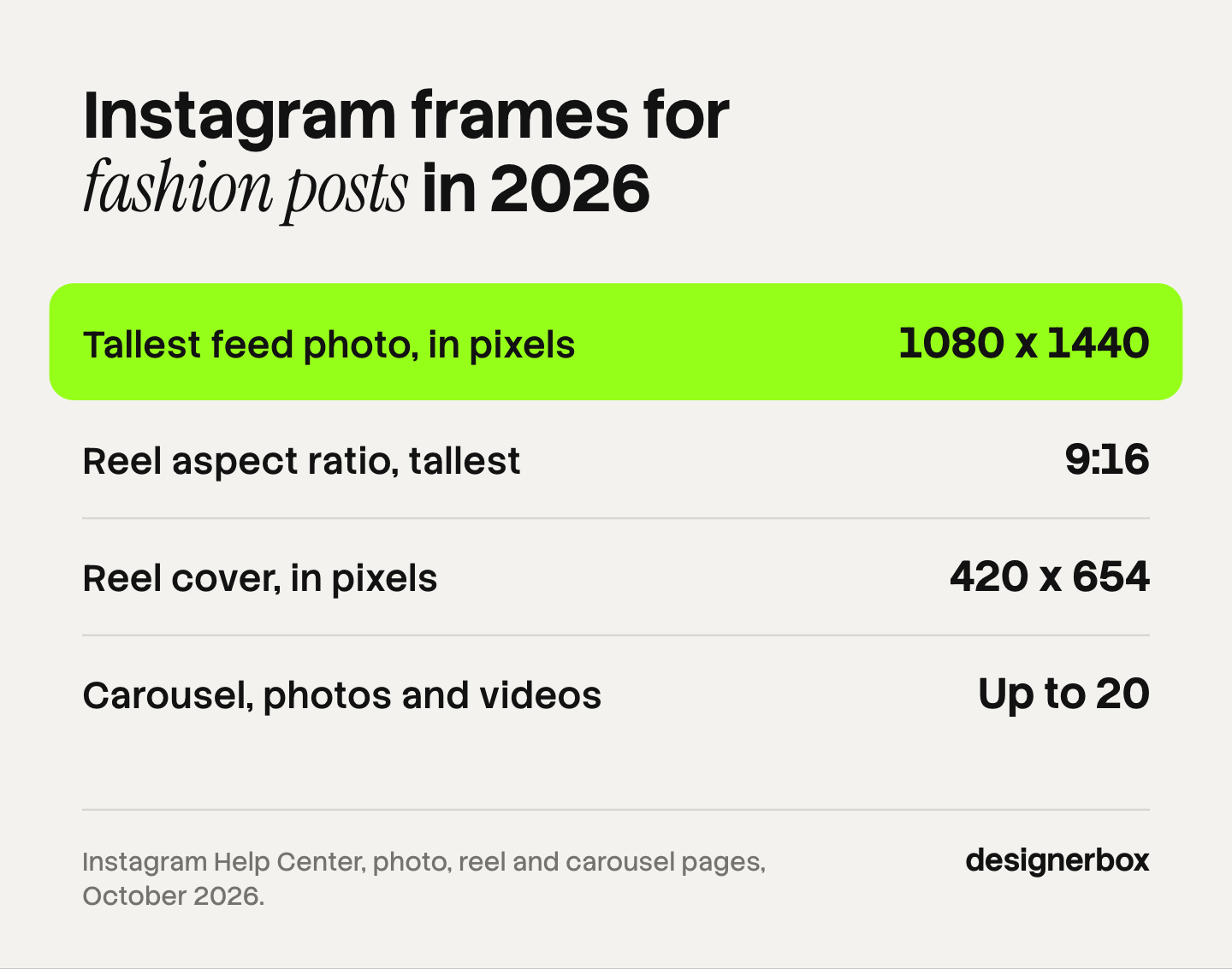
Feed photos. Instagram uploads a photo at up to 1080 pixels wide. It keeps the original resolution when the aspect ratio is between 1.91:1 and 3:4. At 1080 pixels wide, that is a height between 566 and 1440 pixels (Instagram Help Center, October 2026).
Reels. A reel can have an aspect ratio between 1.91:1 and 9:16. Instagram says reels should have a minimum frame rate of 30 frames per second and a minimum resolution of 720 pixels. The recommended cover photo is 420 by 654 pixels (Instagram Help Center, October 2026).
Carousels. One post holds up to 20 photos and videos. The orientation you choose applies to every item, so you cannot mix a square and a portrait. Videos inside a carousel are not reels, and they do not appear in the Reels tab (Instagram Help Center, October 2026).
Shoot outfits at 3:4 so the full body fits, and shoot Reels at 9:16. Our guide to Instagram product photos covers how the same picture looks in the feed and in the profile grid.
How fashion creators are paid
Fashion creators are paid in three ways: affiliate commission, brand deals and gifted product. Most start with affiliate links, because a link can earn before any brand writes to you.
Affiliate links. You join a program, create a link to a product, and earn a commission when a follower buys. Four programs are common in fashion:
- LTK. Creators apply, and LTK asks for more than 5,000 followers on at least one platform. Posts link to exact products in a personal shop.
- ShopMy. Creators apply, and ShopMy’s guide sets a minimum of 1,000 followers (ShopMy guide, October 2026). ShopMy states commissions of 10 to 30% on sales, paid every Friday (ShopMy, October 2026).
- Mavely, now Later. Later says links, commissions and payouts stayed the same, with payouts on the 1st and the 15th (Later, October 2026).
- Amazon Influencer Program. You need a YouTube, Instagram, Facebook or TikTok account. Amazon reviews “the number of followers you have in addition to other engagement metrics” and publishes no minimum (Amazon, October 2026). Our guide to the Amazon Influencer Program covers how it works for creators.
Our comparison of ShopMy and LTK covers how the two differ in scope.
Our guide to Instagram affiliate marketing lists where each link can go.
A post that works brings comments that ask for the link. CreatorFlow, built by the same team as DesignerBox, answers a keyword comment with a DM that holds the link. It works on Reels, posts and Stories (creatorflow.so, October 2026).
Brand deals. A brand pays you a fee for a post. Rates are private, so this guide gives no figure.
Gifted product. A brand sends a free product and hopes you post it. The disclosure rules still apply.
Paid partnership labels and FTC disclosure
Instagram and the FTC each have a rule, and you follow both. This section is general information, not legal advice.
Instagram’s rule. Instagram defines branded content as content that “features or is influenced by a business partner for an exchange of value, such as monetary payment or free gifts” (Instagram Help Center, October 2026). A paid post takes the paid partnership label. A post with a gifted or loaned product takes the label. A post with an affiliate link takes the label, because the link earns commission. A post about your own product line does not (Instagram Help Center, October 2026).
The FTC’s rule. The FTC says to disclose when you have a “financial, employment, personal, or family relationship with a brand”. It adds that free or discounted products count. It says not to place the disclosure only at the end of a post, or anywhere a person must click “more”, and not to mix it into a group of hashtags. It names “#ad” and “#sponsored” as clear terms, and “sp”, “spon” and “collab” as vague ones (FTC, October 2026). For affiliate links, the FTC suggests wording such as “I get commissions for purchases made through links in this post” (FTC, October 2026).
Use the label and write the line. Our guide to AI content rules for LTK creators covers the LTK side, including the rule on using a brand’s own photos.
AI labels and the fit problem
Meta may require an AI label on Facebook, Instagram and Threads when content has photorealistic video or realistic-sounding audio that was digitally created or altered. Meta says this requirement does not apply to images. An image can still receive a label when Meta’s systems detect that AI made or modified it (Meta Help Center, October 2026).
So a still picture of a garment on an AI model may need no label under Meta’s rule. The fit problem remains, for three reasons.
- The FTC. “You can’t talk about your experience with a product you haven’t tried.”
- Instagram. The branded content policy says creators cannot accept anything of value to post content “that does not feature themselves or that they were not involved in creating”.
- LTK. Its Community Guidelines do not allow “AI-generated content that deceives or misrepresents identity, experience, or engagement” (LTK, October 2026).
An AI model has no real waist, height or shoulder width. If you show a garment on an AI model and say nothing, a follower can believe you wore it and that it fits as shown. That can mislead them about fit.
The fix is a plain label, placed where the FTC asks for disclosures:
- Put it on the picture or in the first caption line. Example: “Shown on an AI model. I have not worn this piece.”
- If you own the garment, add your real size and how it fits you.
- Never describe feel, stretch or length unless you held the product.
- Turn on Instagram’s AI label for any AI video.
Our guides to labeling AI-generated fashion images and virtual try-on fit accuracy cover both points in more depth.
The content-volume problem
Every product you link needs a picture. LTK’s own advice is 4 to 8 products a post, and a new creator is asked for 10 posts in 30 days. That is 40 to 80 product pictures in the first month by our arithmetic.
You cannot wear and shoot every one of them, and a retailer’s product photo is usually not yours to post. So each week you choose between three kinds of picture:
- You in the outfit. The strongest post, and the slowest to make. Keep it for products you own.
- A flat lay or product still. Shows the product clearly and makes no claim about fit.
- The garment on a model. Shows drape and proportion. If the model is AI, the label above applies.
For the other jobs in a creator’s week, our guide to AI tools for content creators sorts the tools by job.
Product pictures for a one-person fashion account
DesignerBox is AI creative production for brands, creators and agencies. For a fashion creator, its subject is the product you link: the garment, the shoe, the bag. It does not make pictures of you, and your own outfit posts stay your own photos.
You start from a photo of the real product. A workflow turns it into a flat lay, a product still or an on-model shot on an AI model. Clothing catalog turns one garment into four shots: front, three-quarter, back and a fabric close-up. You set your brand rules once, with your colors, light and crop, and the workflow reads them on every run. You see the cost before each run.
Anyone can make an AI picture. Making hundreds that still look like your brand is the hard part. The full workflow from the first product photo to the finished ad, in one subscription. The AI product photography page shows the product stills, and the fashion page shows garments on AI models.
The limits are these. There is a free plan, and it runs on sample products. Uploading your own photos and the commercial license start on the Pro plan. AI video, virtual try-on, upscaling, the image editor and the video editor start on the Premium plan. Plans and credits are on the pricing page. An on-model result shows a garment on an AI model, so label it as the section above describes. A creator who posts a few times a month may not need this at all.
Start from a template, add your brand and your products, and run it. See the templates.
FAQ
How many followers do you need to become a fashion influencer?
Instagram sets no number for the title. The programs differ. LTK asks for more than 5,000 followers on at least one platform, and ShopMy sets a minimum of 1,000. Amazon says it looks at follower numbers and other engagement metrics, and it names no threshold.
What should a fashion content creator post each week?
A working set has five post types: outfit posts, flat lays, Reels, carousels and Stories. Outfit posts show fit on your body. Flat lays and carousels carry the product links. Reels reach new people, and Stories answer questions.
What size are Instagram posts for outfit photos?
Upload at 1080 pixels wide. Instagram keeps aspect ratios between 1.91:1 and 3:4, so the tallest feed photo is 1080 x 1440 pixels (Instagram Help Center, October 2026).
Do I need the paid partnership label for affiliate links?
Instagram’s guide says yes. It lists a post with an affiliate product link as branded content, because the link earns commission. The FTC also asks for a clear disclosure near the recommendation.
Do I have to label an AI picture on Instagram?
Meta may require a label for photorealistic video and realistic audio made or altered with AI. Meta says the requirement does not apply to images. Still tell followers when a garment is on an AI model, so they do not read the picture as your fit.
Can I show clothes on an AI model instead of wearing them?
You can, with a label. Say in the picture or the first caption line that the model is AI and that you have not worn the piece. Do not describe the fit or the fabric unless you held the product.
Sources
- Instagram Help Center, image resolution of photos you share on Instagram (help.instagram.com, accessed October 2026)
- Instagram Help Center, reel size and aspect ratios (help.instagram.com, accessed October 2026)
- Instagram Help Center, share a post with multiple photos or videos (help.instagram.com, accessed October 2026)
- Instagram Help Center, Branded Content Policies (help.instagram.com, accessed October 2026)
- Instagram Help Center, what is considered branded content (help.instagram.com, accessed October 2026)
- Meta Help Center, how to identify AI content on Meta products (meta.com, accessed October 2026)
- FTC, “Disclosures 101 for Social Media Influencers” (ftc.gov, accessed October 2026)
- FTC, “The FTC’s Endorsement Guides: What People Are Asking” (ftc.gov, accessed October 2026)
- LTK creator application expectations (company.shopltk.com, accessed October 2026)
- LTK Community Guidelines, last updated 18 March 2026 (company.shopltk.com, accessed October 2026)
- ShopMy for creators and ShopMy affiliate links (shopmy.us, accessed October 2026)
- Later, “Mavely is now Later” (later.com, 1 September 2026, accessed October 2026)
- Amazon Influencer Program (affiliate-program.amazon.com, accessed October 2026)
- CreatorFlow comment-to-DM on Reels, posts and Stories (creatorflow.so, accessed 2 October 2026)
- CreatorFlow creator tools directory, 190+ tools in eleven groups (creatorflow.so/creator-tools, accessed 2 October 2026)
- DesignerBox plans and feature gates (DesignerBox pricing, designerbox.ai/pricing, October 2026)
Instagram formats, branded content rules, Meta AI labels, FTC guidance and affiliate program facts verified from each organization’s own pages as of October 2026. Individual results vary.