


Creative strategy is the plan that decides which ads a brand makes, for whom and why, and how each result changes the next ad. For paid social it runs as a weekly loop: research what buyers say, pick distinct angles, brief them, produce them, test them, and read the numbers. Then the winners become a system that runs on the next product.
A brand can spend a month on a shoot and still launch five ads that say the same thing in five colors. Meta’s delivery system now reads those five as one idea. Ad strategy used to mean picking the audience. On Meta and TikTok in 2026, the ads themselves do much of that work, so the plan behind them decides what the budget can reach.
This guide sets out the loop in six steps, with the output, the owner and the rhythm of each one. It covers what Meta publishes about distinct creative, the free research tools, and how to turn one approved ad into a job that repeats. It is written for creative strategists, performance marketers and the agencies that run paid social for brands.
Key Takeaways
- Creative strategy is a loop. Research, angles, brief, production, testing and review repeat every week, and each step hands a named document to the next.
- Meta separates diversification from iteration. Distinct ads for different personas widen reach. New text on the same visual is iteration, and Meta says it should not replace diversification.
- Five distinct ads per ad set. Meta recommends no more than five ads per ad set, with images or videos that are distinct from each other.
- Research starts with the buyer’s words. Reviews, support tickets and the Meta Ad Library give the pains and phrases a brief should use.
- Every ad maps to a hypothesis. Write down what the ad tests before it launches, or the result teaches nothing.
- Creative still drives most of the sales lift. Nielsen named creative the largest driver in a 2017 study of nearly 500 campaigns.
- Winners become templates. The last step saves an approved ad as a job that runs on the next product and the next client.
What is creative strategy?
Creative strategy is the reasoning behind a set of ads: which buyer each ad speaks to, which problem or desire it opens with, which format carries it, and what the result should teach. It sits between research and production. A creative concept is one idea inside it, and a brief is how one idea reaches the people who make it.
Three terms get mixed up, and each has a different owner:
| Term | What it is | Output |
|---|---|---|
| Creative strategy | The plan for which ads to make, for whom and why | Angle list, test plan, learning log |
| Creative concept | One idea every ad in a campaign carries | A one-line concept with its proof |
| Creative brief | The instructions for making one concept | A one-page brief, a script or a shot list |
How a single idea is built is covered in creative concept. This guide covers the plan above it: how many ideas, which ones, and what to do with the results.
In paid social, creative strategy is also called performance creative or ad creative strategy. The work is the same. The difference from brand campaign planning is the rhythm. A brand campaign is planned once a quarter. Paid social creative is planned, tested and replanned every week, because the numbers arrive every day.
Why does creative strategy matter more on Meta now?
Creative strategy matters more on Meta because the delivery system now uses the ads themselves to find buyers. Meta says its retrieval system, Andromeda, “quickly scans tens of millions of ads and selects a few thousand strong candidates so only the most relevant and distinct creatives move forward” (facebook.com/business/news, December 2025).
Three statements from Meta set the rules for a creative plan.
- Distinct ads reach more people. Meta calls creative diversification “the creation of distinct campaign assets tailored to different personas or use cases”. It says diversification and iteration “are two separate concepts”, and that iteration “should not replace true creative diversification”.
- Similar ads count as one. Meta defines creative similarity as ad images that “are visually too alike, even if technically different assets”, and says high similarity “can also drive fatigue”.
- Fewer, more distinct ads per ad set. Meta recommends “no more than five ads per ad set for optimal delivery”, and only “images or videos that are distinct from each other” (facebook.com/business/ads, September 2026).
Meta also names who should do this work: “Agencies have a critical role to play here by aligning creative and performance marketing into a unified workstream.” Its advice, instead of “producing a fixed volume of ad creatives per campaign and refining them”, is to build “a broad portfolio of assets” across text, image and video for several customer personas.
The engineering side explains why. Meta built Andromeda to handle a much larger number of ad creatives, because “the number of ads creatives in Meta’s recommendation systems is expected to grow significantly” (engineering.fb.com, December 2024).
Creative was already the largest lever before this. Nielsen’s 2017 analysis of nearly 500 consumer goods campaigns called creative “the undisputed champ in terms of sales drivers”. It also found the effect of media on sales had grown to 36% from 15% over 11 years (nielsen.com, October 2017). The study is from 2017 and covers traditional and digital media, so read it as direction, not as a figure for social ads today.
The creative strategy loop in six steps
The creative strategy loop has six steps: research, angles, brief, production, testing and review. Each step produces one document that the next step uses, and the loop runs every week. Without the documents, a strategy lives in one person’s head and stops when they are away.
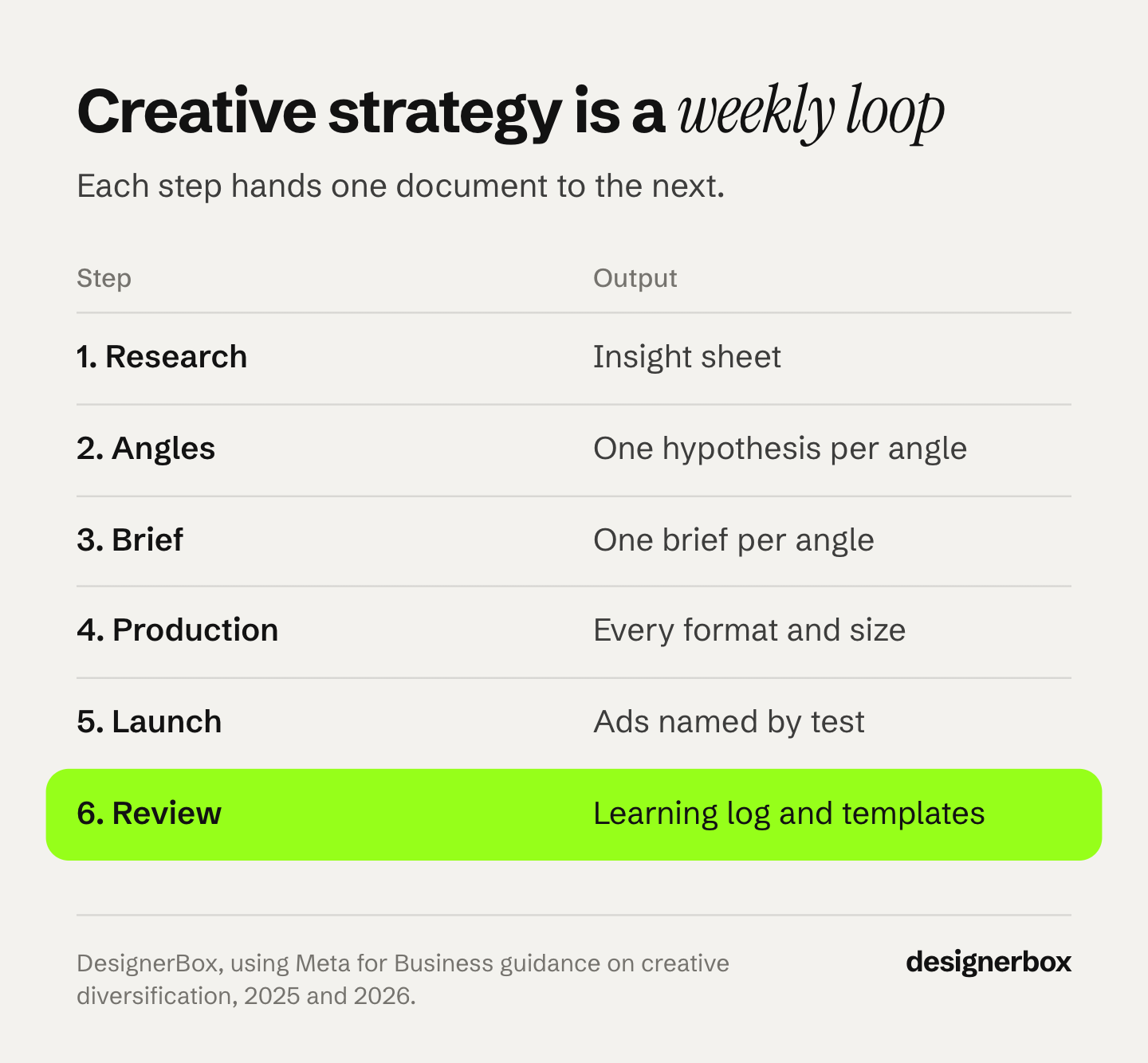
| Step | Output | Owner | Rhythm |
|---|---|---|---|
| 1. Research and insight | Insight sheet: pains, desires, objections, buyer phrases | Creative strategist | Monthly, updated weekly |
| 2. Angles and personas | Angle list, each with a hypothesis | Creative strategist | Weekly |
| 3. Brief | One brief or script per angle | Strategist and copywriter | Weekly |
| 4. Production | Finished ads in every format and size | Designers, editors, creators | Weekly |
| 5. Launch and test | Ads live, named by angle and format | Media buyer | Weekly |
| 6. Review and systematize | Learning log, winners saved as templates | Strategist and media buyer | Weekly review, monthly roll-up |
The rhythm column is a starting point, not a platform rule. A small account may run the loop every two weeks. An agency with many clients runs it per client, on a fixed day.

Step 1: research and insight
Research for creative strategy collects what buyers say in their own words: the pain that made them look, the result they want, the objection that stops them, and the phrases they use. The output is an insight sheet. Every angle, hook and headline later in the loop should trace back to one line on it.
Five sources cover most of it, and four are free:
- Your own reviews. Sort by the three-star and four-star reviews. They name the doubt that almost stopped the sale.
- Support tickets and sales calls. The questions people ask before they buy are the objections the ad should answer.
- Competitor reviews. The complaints about other products are the gaps your ad can fill. Quote the buyer’s words, never a judgment about the competitor.
- The Meta Ad Library. It lets you “search all the ads currently running across Meta technologies”. It also covers ads that ran anywhere in the EU in the past year (facebook.com/ads/library, September 2026).
- TikTok Creative Center. TikTok calls it “a free, public home” for creative resources. Its Top Ads section is “a collection of high-performing creatives from the TikTok platform” (ads.tiktok.com, last updated July 2026).
One caution on ad libraries. A competitor’s ad that has run for months is a signal, but the library does not show you its results. Paid tools and what they add are compared in ad spy tools.
Step 2: angles, personas and hypotheses
An angle is the reason a specific buyer should care: the pain, the result or the objection the ad leads with. A creative strategy needs several distinct angles, each for a different persona or use case, because Meta treats similar ads as one. Every angle gets a written hypothesis before any ad is made.
The difference between the two kinds of new ad decides the plan:
| Creative diversification | Creative iteration | |
|---|---|---|
| What changes | The persona, the angle, the visual and often the format | One element: the hook, the headline, the first frame |
| Example | A Reels ad for students and a creator ad for new parents | The same ad with a new first line |
| What it does | Reaches new buyers | Improves an ad that already works |
| When to use it | Every month, for new concepts | Every week, on the winners |
A hypothesis is one sentence: “Parents who worry about spills will stop for a 3-second spill test, and click more than for the lifestyle shot.” When the result comes back, the sentence is either confirmed or not. Either way, the learning log gets a line.
A useful plan mixes both: a few new diversified concepts each month, and iterations on the winners each week. Ad variants at scale sets out how many a month fits each spend level.
Step 3: the brief
The brief turns one angle into instructions a designer, an editor or a creator can follow. It names the persona, the angle, the hook, the proof, the format and the files to deliver. It also carries the hypothesis, so the maker knows what the ad has to prove.
Each format needs its own brief shape. A static ad brief names the headline, the product shot and the sizes. A video brief adds seconds per beat. A creator brief adds shooting specs, the allowed claims and ad access. The general one-page shape is in the creative brief template, and the creator version, with word counts per second, is in how to write a UGC script.
Step 4: production in every format
Production makes each angle in the formats the plan needs. Most paid social plans use four: a creator-style video, a static image, a product demo, and a mash-up that joins clips from several sources. Each angle should appear in at least two formats, so a result tells you about the angle and not only about the format.
Production is where most teams lose time. One concept in four formats and three sizes is already twelve files, and a new market doubles them. The files also have to look like the same brand. Creative assets lists the file types and why the count grows. Where static still beats video, and when, is covered in static ads vs video.

Step 5: launch and test
Launch puts the new ads live in a structure that can be read. On Meta that means a few distinct ads per ad set, each named by angle, persona and format, so the report shows which idea won. Add new ads together, not one a day, because every new ad restarts the ad set’s learning.
Three rules keep a launch readable:
- Name every ad by what it tests. “Spill-test / parents / UGC / hook B” tells you the answer from the report alone.
- Keep ad sets small and distinct. Meta recommends no more than five ads per ad set. Five near-copies test nothing.
- Give it enough results to read. An ad set needs about 50 optimization events in a week to leave the learning phase. The full math is in ad creative testing. For a sale with a fixed date, Black Friday Facebook ads works the launch dates back from that week of learning.
Step 6: review, iterate and systematize
The weekly review reads each ad’s numbers against the hypothesis, writes one line per ad in the learning log, and decides three things: which ads to keep, which to iterate, and which new concepts to brief. The last part of the step saves each winner as a repeatable job, so the next product gets the same treatment without starting again.
Read the numbers in the order a viewer meets the ad. Hook rate shows whether the opening stopped people, hold rate whether they kept watching, CTR whether they clicked, and conversion rate whether the page did its job. The first weak number is the part to change. A winner that loses ground over weeks may have ad fatigue, and needs a new version rather than a new concept.
A learning log needs five columns: the ad name, the hypothesis, the result, the verdict and the next action. After a quarter it holds the brand’s own rules, such as which hooks work for which persona. That is the part of the strategy a new team member can read on day one.
Systematizing is the step most teams skip. A winning ad is a set of choices: the angle, the layout, the light, the product framing, the text position. Save those choices as a template, and the next product runs through the same template instead of a new brief.
What does a creative strategist do?
A creative strategist owns the reasoning behind a brand’s ads. They run the research, choose the angles, write or approve the briefs, and lead the weekly review with the media buyer. The job sits between the people who make the ads and the people who buy the media, and it exists because each side sees only half of the result.
In a brand team, one strategist often covers one ad account. In an agency, one strategist covers several clients, so the loop has to run the same way for each. That means one insight sheet, one angle list and one learning log per client, on a fixed weekly day. Where the hours go in that kind of agency work is set out in agency workflow.
One system for every client and every product
Anyone can make an AI picture. Making hundreds that still look like your brand is the hard part. A creative strategy asks for distinct angles in several formats every week, for every client, and each file still has to carry the client’s colors, product and rules.
DesignerBox is AI creative production for brands and agencies. Scale your images, ads and video with AI and keep your brand on every piece: build the workflow once with your brand rules, run it on every product, see the cost before each run, and keep everything from the first product photo to the finished ad in one place.
For an agency, that maps onto step 4 and step 6 of the loop. You save a winning ad as a workflow: the brand profile, the layout, the model and the steps. A colleague runs it as an app, with a form, on the next product. Batch runs one workflow over a whole sheet of products, and you review the results in one pass. You keep or discard per row, and re-run one row alone. Each client gets its own brand profile, with voice, logos, fonts, palette and rules, and the workflow reads it on every run. The AI ad generator makes static ads from your product photo, and the ad localizer rebuilds one ad in another language with the layout redrawn.
The full workflow from the first product photo to the finished ad, in one subscription.
Here are the limits. DesignerBox does not do the research, the angles or the review for you: those stay with the strategist. It does not read or publish to your ad accounts. You download the results, or send them with a webhook or an S3 step. Team features, shared brand kits and white label are on the Ultra plan, and every plan below Ultra is one seat. Uploading your own photos and the commercial license start on the Pro plan, and AI video starts on the Premium plan. DesignerBox for agencies shows how the setup works for several clients.
The first job, built once
Start from a template, add your brand and your products, and run it. The cost is shown before the run. See the templates.
FAQ
What is a creative strategy in advertising?
A creative strategy is the plan behind a set of ads: which buyer each ad speaks to, which angle it leads with, which format carries it, and what the result should teach. In paid social it runs as a weekly loop of research, angles, briefs, production, testing and review, and each result shapes the next ads.
What is the difference between creative strategy and a creative brief?
Creative strategy decides which ads to make and why, across a whole account. A creative brief is the instruction for making one of those ads: the persona, the angle, the hook, the format and the files. One strategy produces many briefs, and the review of the results changes the next ones.
What does Meta mean by creative diversification?
Meta calls creative diversification “the creation of distinct campaign assets tailored to different personas or use cases”. It separates this from creative iteration, which changes one element such as the text on the same visual. Meta says iteration can inform new concepts but should not replace diversification.
How many ads should be in one Meta ad set?
Meta recommends no more than five ads per ad set for optimal delivery, and only images or videos that are distinct from each other. Five near-copies of one ad give the system one idea to work with. Five distinct angles give it five.
What does a creative strategist do?
A creative strategist researches buyers, picks the angles, writes or approves the briefs, and runs the weekly review with the media buyer. They keep the learning log that records what each ad tested and what it showed. In an agency, one strategist often runs this loop for several clients.
How often should you review a creative strategy?
Review the ads every week, and the strategy every month. The weekly review decides which ads to keep, iterate or replace. The monthly review checks the insight sheet and the angle list against the learning log, and briefs new concepts where the winners are getting old.
Sources
- Meta for Business, “Demystifying creative diversification”, 16 December 2025: facebook.com/business/news/demystifying-creative-diversification, accessed September 2026
- Meta for Business, ad set structure: facebook.com/business/ads/ad-set-structure, accessed September 2026
- Engineering at Meta, “Meta Andromeda: Supercharging Advantage+ automation with the next-gen personalized ads retrieval engine”, 2 December 2024: engineering.fb.com, accessed September 2026
- Meta Ad Library: facebook.com/ads/library, accessed September 2026
- TikTok Ads Help Center, About Creative Center: ads.tiktok.com/help/article/creative-center, last updated July 2026, accessed September 2026
- Nielsen, “When it comes to advertising effectiveness, what is key?”, 9 October 2017: nielsen.com, accessed September 2026
- DesignerBox for agencies (designerbox.ai/for/agencies), September 2026
Platform guidance verified from Meta, TikTok and Nielsen pages as of September 2026. TikTok’s Creative Center page was re-checked on 2 October 2026. The loop’s rhythm is a starting point, not a platform rule. Individual results vary.