


An AI automation agency is a service company that builds and runs AI systems for other businesses. It sells four service lines: back-office workflow automation, chat and voice agents, content and creative production, and reporting. Clients pay in one of three ways: a monthly retainer, a setup fee plus a retainer, or a fee per result. The agency keeps its margin when the same job runs again for the next client.
This guide has no revenue figures and no promise about what you will earn. It explains what the agency sells, how each service line is priced, and where the margin goes.
Key Takeaways
- An AI automation agency sells four service lines. Back-office workflows, chat and voice agents, content and creative production, and reporting.
- Three pricing models cover most contracts. A retainer, a setup fee plus a retainer, and a fee per result.
- Margin comes from repeat work. A job you build once and run for many clients earns more each time.
- Creative production has a deliverable every week. The client sees new images, ads or video, so the retainer is easy to explain.
- Chat and voice agents carry legal duties. The FCC treats AI voices in calls as artificial voices, and the EU AI Act requires that people know they talk to an AI system.
- Four things come before the first client. One repeatable job, a cost you can state before the work, a review step, and clear rights to the results.
What is an AI automation agency?
An AI automation agency designs, builds and maintains AI systems that do repeated work inside a client’s business. The client pays for a result, such as answered inquiries or finished ads. The agency chooses the software, connects it, and keeps it working.
The term overlaps with two others. An AI consultancy gives advice and leaves the build to the client. An AI ad agency makes and runs advertising with AI at each stage. An AI automation agency is wider than the second and more hands-on than the first.
The four service lines of an AI automation agency
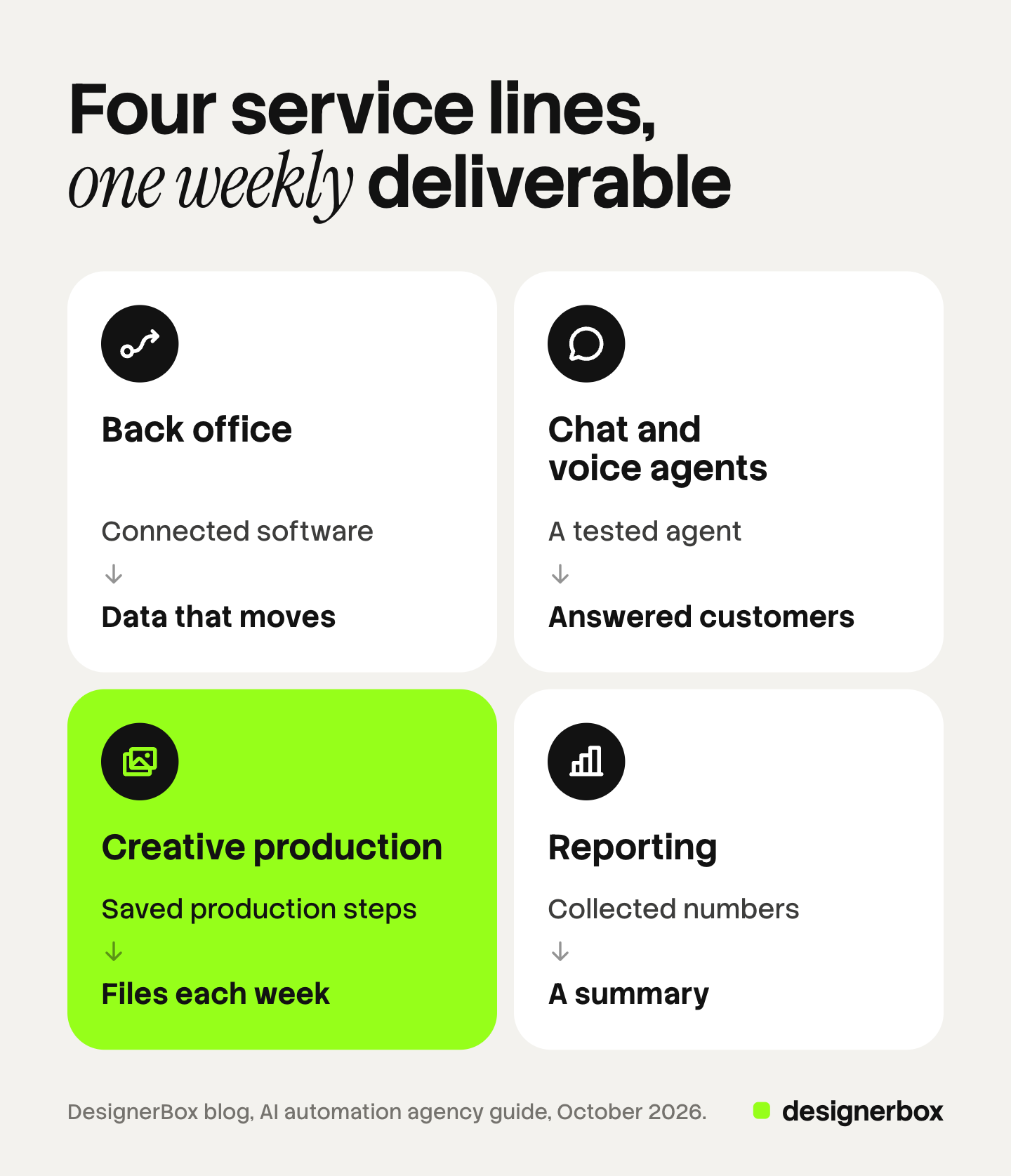
AI automation agency services form four lines. Each line has a different deliverable, and each one fits a different pricing model.
1. Workflow automation and back office
The agency connects the client’s software so that data moves without a person. Typical jobs are lead intake, invoice handling, appointment booking and data entry in a CRM.
Three vendors appear in most of these builds. n8n lets a team “build AI workflows that connect different LLM providers”, and a team can run n8n on its own servers (docs.n8n.io, October 2026). Zapier says it offers automation across more than 9,000 connected software products (zapier.com, October 2026). Make calls each automation a scenario, and its help center has a section on AI agents (help.make.com, October 2026).
2. Chat and voice agents
The agency builds an AI agent that answers customers in a chat window, by text message or on the phone. Typical jobs are answering common questions, qualifying a lead and booking a call.
This line needs the most testing, because the agent speaks for the client’s business. The legal duties are in a section below.
3. Content and creative production
The agency makes images, ads, video and written content for the client on a schedule. The deliverable is a set of files each week or each month.
This line is close to what an AI creative agency sells. The difference is the process. An automation agency builds the production steps once and runs them again for each new brief.
4. Reporting
The agency collects numbers from the client’s systems and sends a summary. Typical jobs are a weekly sales report, an ad performance summary and an alert when a number moves.
Reporting is rarely sold alone. It shows the client what the other three lines did.
| Service line | What the client receives | How often the client sees it | Common pricing model |
|---|---|---|---|
| Workflow automation and back office | A connected system that moves data | Rarely, it runs in the background | Setup fee plus retainer |
| Chat and voice agents | An agent that answers customers | When the client reads the transcripts | Setup fee plus retainer, or per result |
| Content and creative production | Images, ads and video | Every week | Retainer |
| Reporting | A summary of the numbers | Every week or month | Part of a retainer |
How does an AI automation agency price its services?
Three pricing models cover most contracts. This article prints no market rate, because no public survey of these agencies gives one.
Retainer. The client pays a fixed amount each month for a fixed deliverable. A retainer fits creative production and reporting, where the work repeats. State the volume and the revision rounds in the contract.
Setup fee plus retainer. The client pays once for the build and then monthly for maintenance. This model fits back-office automation and chat or voice agents. The setup fee covers design and testing. The retainer covers monitoring, fixes and software.
Fee per result. The client pays for each result, such as a booked appointment or a finished set of ads. The model moves the risk to the agency. Define the result in writing before the first invoice.
Hourly billing is a fourth option, and it works against the agency. When AI makes the work faster, the invoice shrinks. Our guide to agency creative pricing compares four models and shows the margin math.
Where is margin made and lost?
The AI agency business model depends on one thing: how much of each job is repeated. A job you build once and run for ten clients earns more with each client.
Margin is made in three places:
- Reuse. One intake workflow, one ad set or one report template serves many clients in the same industry.
- A narrow offer. An agency that serves one industry learns its software and its questions once.
- A known cost per job. You can only set a price above your cost when you know the cost before you start.
Margin is lost in four places:
- Custom builds. Each new integration is new design and new testing.
- Maintenance nobody priced. Vendors change their software, and someone has to repair the automation.
- Unlimited revisions. A retainer planned for ten hours of work loses its margin at fourteen. That example is illustrative.
- Failed runs. Every discarded result still costs credits or usage fees.
Clients also ask for lower prices. Productive surveyed more than 180 agencies in 2025. It reports that “almost one in three agencies was asked for an ‘AI discount’” and that “only 13% have actually lowered prices” (productive.io, October 2026). A price tied to the deliverable holds better than a price tied to hours.
Why creative production has a visible deliverable each week
Three of the four service lines are hard for a client to see. A back-office automation runs in the background. A chat agent works inside conversations the owner seldom reads. A report describes work that other systems did.
Creative production is different. Each week the client receives new images, new ads or a new video. That makes the retainer easy to explain at renewal.
The line also has a real limit. A client compares every file with their own brand. A set that looks different from last week’s set costs trust.
Some agencies sell this line under their own name. Others supply finished sets that a partner sells, which our guide to white label content explains. An agency that focuses on video can read how an AI video agency handles seats, client separation and rights.
What rules apply to chat and voice agents?
Chat and voice agents are the service line with the clearest legal duties. Two sources matter most for an agency that works in the United States or the European Union. This is general information, not legal advice.

In the United States, the FCC adopted a Declaratory Ruling on 8 February 2024. It “recognizes calls made with AI-generated voices are ‘artificial’ under the Telephone Consumer Protection Act”. The same release says telemarketers must “obtain prior express written consent from consumers before robocalling them” (FCC news release, October 2026). Those rules cover an outbound voice agent that calls consumers.
In the European Union, Article 50 of the AI Act has applied since 2 August 2026. It requires that people “are informed that they are interacting with an AI system”, unless that is obvious from the context (AI Act Service Desk, October 2026). The duty sits with the provider of the system. An agency should still make every agent say what it is in its first message.
Name in the client contract who collects consent and what the agent says first.
What does a small team need before the first client?
A small team needs four things before it takes a first client. None of them is a website or a logo.

1. One repeatable job. Choose one job for one kind of business and build it until it runs the same way each time. Weekly ad creative for a furniture brand is one job. An intake system for a dental office is another.
2. A cost you can state before the work. Count what one run of the job costs you in software, credits and review time. Without that number, a fixed price is a guess. Add the runs you discard, because you pay for those as well.
3. A review step. A person checks every result before the client sees it. For an automation built in a workflow builder, the review can be a pause that waits for approval. Our guide to an AI video workflow in n8n or Make shows where that step goes.
4. Clear rights to the results. Read the terms of each product you use, and confirm that you may deliver its results to a paying client. Then tell the client what copyright covers. The US Copyright Office concludes that AI results “can be protected by copyright only where a human author has determined sufficient expressive elements”, and that this does not include “the mere provision of prompts” (US Copyright Office, October 2026).
Income claims and the FTC
Many guides on how to start an AI agency are sold with income promises. Treat those promises with care.
In September 2024 the FTC announced Operation AI Comply. It brought five law enforcement actions, and several were against companies that claimed consumers could make money with AI. The FTC Chair said the actions “make clear that there is no AI exemption from the laws on the books” (ftc.gov, October 2026).
The same standard applies to an agency’s own promises. Tell a client what you will deliver and when. Do not promise revenue, leads or savings that you cannot show from that client’s own data.
Creative production in DesignerBox
DesignerBox is AI creative production for brands and agencies. Scale your images, ads and video with AI and keep your brand on every piece: build the workflow once with your brand rules, run it on every product, see the cost before each run, and keep everything from the first product photo to the finished ad in one place.
For an AI automation agency, DesignerBox covers one of the four service lines: creative production. It does not automate a back office, and it does not answer calls or chats.
Anyone can make an AI picture. Making hundreds that still look like your brand is the hard part. In DesignerBox you save one workflow for each client, with that client’s logo, colors, fonts and rules. The workflow reads the brand on every run. A product photo is one input, and a brief or a reference picture can be another.
The four things from the list above have a place in the product:
- One repeatable job. A saved workflow runs the same way for the next brief. Batch runs it over a sheet, so row one and row two hundred get the same standard.
- A cost before the work. The cost of a run is shown before the run. An 8-second clip costs 40 to 560 credits, depending on the model.
- A review step. Critic steps score the results, and best-of-N keeps the best one. You keep or discard per row and re-run one row.
- A simpler handover. An app is a workflow with a form. A colleague completes the form and presses Run.
The full workflow from the first product photo to the finished ad, in one subscription.
The limits matter for an agency:
- DesignerBox does not post results to an ad account or a store. You download the results, or send them with a webhook or an S3 step.
- DesignerBox does not have a public API. It runs inside an AI chat such as Claude, ChatGPT or Cursor over MCP.
- Every plan below Ultra is one seat. Team features, shared brand kits and white label are on the Ultra plan.
- Uploading your own photos and the commercial license start on the Pro plan. AI video, virtual try-on, upscaling, the image editor and the video editor start on the Premium plan. Plans and credits are on the pricing page.
Bring one client and the creative set you make for them each week. See DesignerBox for agencies
FAQ
What does an AI automation agency do?
It builds and runs AI systems for other businesses. The work falls into four service lines: back-office workflow automation, chat and voice agents, content and creative production, and reporting.
How much does an AI automation agency charge?
No public survey gives a reliable market rate, so this article prints none. The price depends on the model. A retainer is a fixed monthly amount for a fixed deliverable. A setup fee plus a retainer covers a build and its maintenance. A fee per result charges for each booked call or finished set.
How do you start an AI automation agency?
Start with one repeatable job for one kind of business. Count what one run costs you before you set a price. Add a review step, so a person checks each result. Read the terms of every product you use, and confirm that you may deliver its results to a client.
Is an AI automation agency the same as an AI ad agency?
No. An AI ad agency makes and runs advertising. An AI automation agency also builds back-office systems, chat and voice agents and reports. The two overlap in creative production, where both deliver images, ads and video on a schedule.
Do chat and voice agents need a disclosure?
In many cases, yes. The FCC treats AI-generated voices in calls as artificial voices under the Telephone Consumer Protection Act. Article 50 of the EU AI Act requires that people know they interact with an AI system, unless that is obvious.
Sources
- FTC, “FTC Announces Crackdown on Deceptive AI Claims and Schemes” (25 September 2024): ftc.gov, October 2026
- FCC, “FCC Makes AI-Generated Voices in Robocalls Illegal”, news release (8 February 2024): docs.fcc.gov, October 2026
- EU AI Act, Article 50, transparency obligations: AI Act Service Desk, October 2026
- US Copyright Office, NewsNet 1060 on Part 2 of the report on copyright and AI (29 January 2025): copyright.gov, October 2026
- Productive, “Agencies in the AI Era: Between Hype and Reality”, survey of more than 180 agencies (2025): productive.io, October 2026
- n8n documentation, hosting and AI workflows (docs.n8n.io), October 2026
- Zapier, connected software directory (zapier.com/apps), October 2026
- Make help center, scenarios and AI agents (help.make.com), October 2026
- DesignerBox plans and feature gating: DesignerBox pricing page (designerbox.ai/pricing), October 2026
Vendor features and rules checked against each source’s own pages as of October 2026. This is general information, not legal advice. Individual results vary.