

An AI creative agency is a creative agency that makes concepts, images, video, voice and layouts with AI, and keeps people on the decisions. Two things define it: what stays human, and what the client is allowed to receive. The first is a question of craft. The second is a question of license, because each AI tool sets its own terms for commercial use, ownership and indemnity.
This guide is for the owner of a creative or performance agency with 3 to 15 people on fixed retainers. It has one section for a brand that wants to hire such an agency. It sorts the work by discipline and by license, and it prints no vendor prices. A note on bias: DesignerBox makes AI creative production software.
Key Takeaways
- Two things define the agency. What stays with a person, and what the client may do with the files.
- Six disciplines, one pattern. AI drafts, makes and repeats. A person picks, checks and signs off.
- Tool terms differ. We read seven vendors’ terms on October 4, 2026. Most say you own the result. Two describe an indemnity, for enterprise customers.
- Copyright needs a human author. The US Copyright Office says a prompt alone does not make you the author of an AI result.
- The contract carries the answer. It names the tools, the human work, the license and who answers for a claim.
What is an AI creative agency?
An AI creative agency is a creative shop where AI does the drafting and the repeating, and people do the judging. It sells what any creative agency sells: ideas, images, video, sound and layouts that carry a brand. An AI design agency is the same kind of business with a narrower menu, mostly brand identity, layout and web work.
The work differs from a traditional agency in three ways.
- The first draft is cheap. The limit moves from making to choosing.
- The shoot is optional. Many frames now start from a product photo and a brief.
- Every file has a license history. The agency has to know which tool made each file, and what that tool’s terms allow.
The client still pays for judgment, and the agency still answers for what it delivers. An AI ad agency is a different business: it also buys the media and reports on results. This guide covers the creative shop.
The six disciplines: what AI does and what stays human
AI tools for creative agencies fall into six disciplines. In each one, AI makes options fast, and a person decides which option is right for the brand.
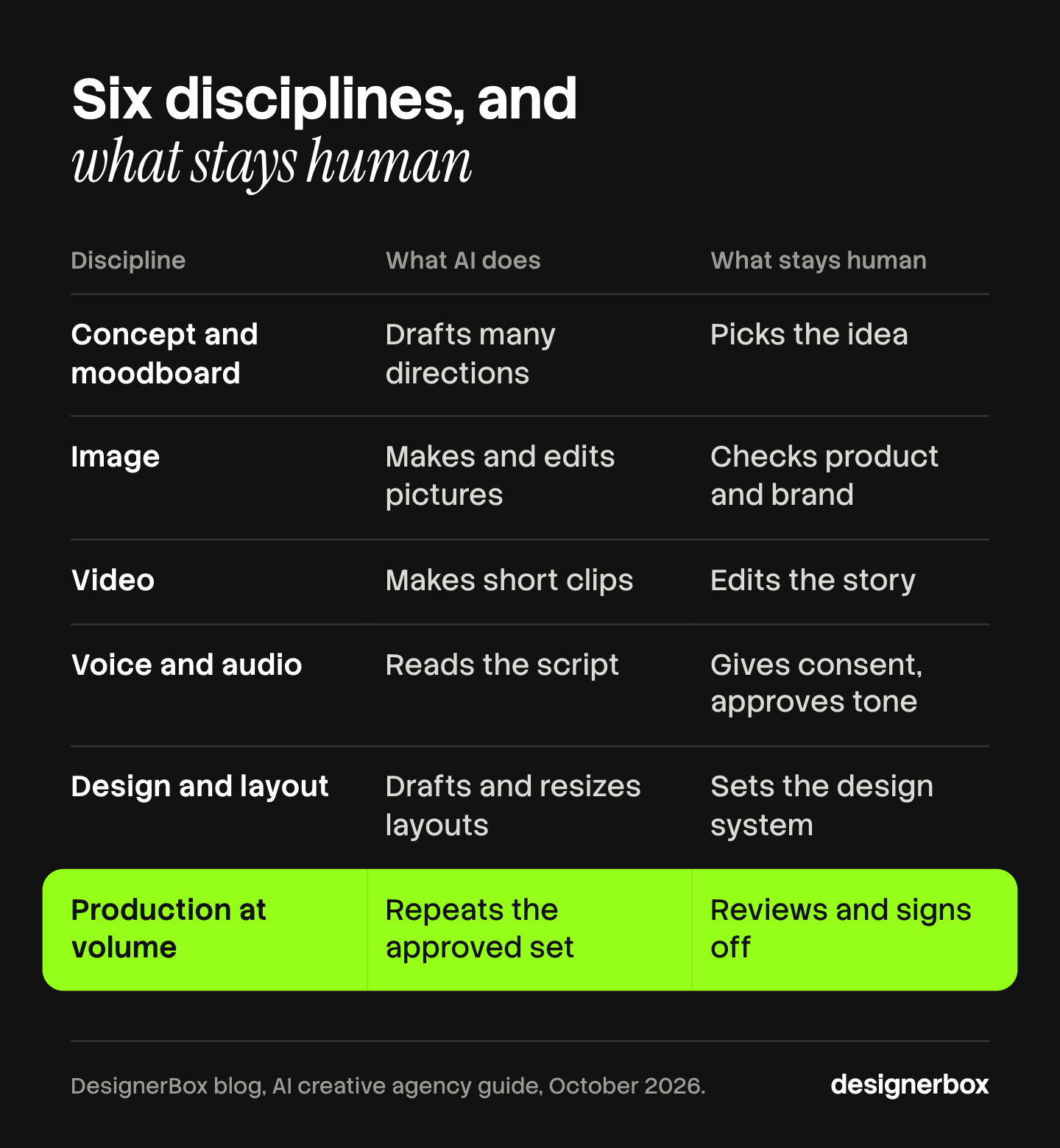
| Discipline | What AI does | What stays human |
|---|---|---|
| Concept and moodboard | Drafts many directions | Picks the idea |
| Image | Makes and edits pictures | Checks product and brand |
| Video | Makes short clips | Edits the story |
| Voice and audio | Reads the script | Gives consent, approves tone |
| Design and layout | Drafts and resizes layouts | Sets the design system |
| Production at volume | Repeats the approved set | Reviews and signs off |
Three rows need a note.

Concept and image. AI turns a brief into many directions, then into product scenes and edits. A person picks the direction and compares each picture with the real product: the logo, the print, the color and the shape. An AI image can change any of them. Our guide to AI creative direction covers how to write the chosen direction down.
Voice and audio. AI reads a script in a chosen voice and in other languages. A real person’s voice needs that person’s consent, and the voice tools write this into their terms.
Production at volume. This is the discipline that repeats. Every client needs the approved set again for each new product, size and language. AI runs the same steps each time, and a person signs off. The creative agency workflow guide covers where approval sits.
Seven common AI tools and what their own terms say
The tools below are common AI tools for creatives, in no ranked order. For each one we opened the vendor’s own terms or help page on October 4, 2026. The two right-hand columns paraphrase those pages closely. Enterprise agreements can differ, and terms change.
| Tool | What an agency uses it for | Commercial use, per the vendor | Ownership and indemnity, per the vendor |
|---|---|---|---|
| Adobe Firefly | Images, graphics and video from text prompts | For features without the beta label, you can use the results in commercial projects | Enterprise customers may purchase an entitlement with contractual IP indemnification for select Firefly results. Copyright in a result depends on local law |
| Midjourney | Concept images and moodboards | A company above a stated yearly revenue level must be on the Pro or Mega plan | You own the assets you create, to the fullest extent possible under applicable law. You indemnify Midjourney |
| Runway | Video and image generation | The general terms do not restrict commercial use of your results | Runway does not claim ownership of your inputs or results, and may use both to train its models. You indemnify Runway |
| Canva’s AI features | Layout and design work, with built-in AI features | You may use your result for any lawful purpose, at your own risk | You own your result, except a result that changes or includes Canva library content, which is licensed. Enterprise customers with 100 or more paid users are indemnified for AI results, subject to the subscription agreement |
| Descript | Audio and video work, with generative features | Check the current terms | You own your input and result, to the extent the law can protect them. You indemnify Descript |
| ElevenLabs | Voice and speech generation | All paid plans include a commercial license, except for beta services. The free plan does not | You keep all rights in your result. You indemnify ElevenLabs |
| Figma’s AI features | Design files and prototypes, with built-in AI features | Check the current terms | The customer keeps all rights in input and result. The customer is responsible for human review and for any clearances |
Two cells say “check the current terms”. On the Descript and Figma pages we opened, we found an ownership line and no separate sentence on commercial use.
Each page and its date is listed under Sources. The Runway terms are at runway.com, last updated September 15, 2026.
Four points in those terms matter to an agency.
- An indemnity is an enterprise term. Adobe ties it to an entitlement that an enterprise customer buys. Canva ties it to enterprise customers of a set size.
- Most terms point the indemnity the other way. In the Midjourney, Runway, Descript and ElevenLabs terms, the user indemnifies the vendor. The agency cannot pass on a protection it never received.
- Privacy is a setting. Midjourney’s terms say your content is publicly viewable by default. Its Stealth mode is part of the Pro and Mega plans.
- A voice needs permission. Descript’s terms prohibit a third party’s unauthorized voice recordings. ElevenLabs’ terms refer to your voice or a voice you are authorized to share.
For the image side in depth, read our guide to AI images and commercial use.
Copyright in AI work, per the US Copyright Office
In the United States, a result that AI made alone has no copyright. The US Copyright Office published Part 2 of its report on copyright and AI on January 29, 2025. It concludes that AI results “can be protected by copyright only where a human author has determined sufficient expressive elements”. That can include a human-made work that is visible in the result, or a human’s creative arrangement or changes, “but not the mere provision of prompts” (US Copyright Office, read October 2026).
For an agency, this splits a deliverable in two. The layout, the copy, the edit and the product photo are human work. A raw AI frame may have no protection. This is general information, not legal advice.
The client contract: ownership, disclosure and labels
A client contract for AI creative work answers four questions in writing.
- Which tools made the files? List them. The client’s legal team may accept some tools and refuse others.
- What does the agency assign? An agency can assign only the rights that exist. Say that the agency assigns its human work, and passes on the rights each tool’s terms give it.
- Who answers for a claim? If no vendor indemnity covers the file, say so. Then agree who carries the risk.
- Who adds a label, and where? Agree this for each channel and market.
On labels, the European Commission says Article 50 of the AI Act “applies as from 2 August 2026”. Under it, a company that publishes a deep fake must disclose that to a person at first exposure at the latest, in a clear and distinguishable way (European Commission FAQ, read October 2026). For EU campaigns with realistic synthetic people or voices, agree who adds that disclosure.

Our guide to white-label creative covers delivery under the agency’s own name.
A checklist for a brand that hires an AI creative agency
A brand can ask these seven questions before it signs. Ask for each answer in writing.
- Which AI tools do you use for each discipline? A clear answer shows a real process.
- Which plan are you on for each tool? The plan can decide commercial use, privacy and indemnity.
- Who approves each file, and against what? Ask for a name and a brand reference.
- What human work goes into each deliverable? This is the part copyright can protect.
- Do our product photos and briefs train any model? Some vendor terms allow training on inputs.
- Whose voices and faces appear, and where is the consent? Ask to see it.
- Who labels AI content for each channel? Agree this before the first campaign.
Pricing for an AI creative agency
An AI creative agency prices the approved set. When a tool cuts a task from a day to an hour, an hourly rate cuts the fee with it.
Four inputs set the price:
- The deliverable. Price a named set: for example, a hero image, four angles and three ad sizes for each product.
- The review. Checking is now the main labor. Count the rounds and the person who does them.
- The license level. A client who needs an indemnified route limits the tools the agency can use. That changes the cost.
- The tool cost. Show it as its own line.
Our guide to agency creative pricing compares four ways to charge by result.
Production at volume in DesignerBox
Anyone can make an AI picture. Making hundreds that still look like your brand is the hard part.
DesignerBox covers the sixth discipline: the approved set, repeated for every product and every client. You build a workflow once with a client’s brand rules. The workflow reads those rules on every run. You can publish the workflow as an app, which is a form a junior completes before pressing Run. A batch runs the workflow over a sheet of up to 200 rows, and you keep or discard each result. The cost is shown before the run. Reviews sends your client a page of pictures. The client opens the link with no account, chooses the pictures they want and sends the choice back to you. Our guide to creative for multiple clients covers one setup for each client.
DesignerBox also has an image editor, and a video editor with a real timeline: several tracks, transitions, animated text and audio. For audio, it has transcription, text to speech with 20 voices, and a talking avatar with lip sync. It also runs over MCP, so an AI chat such as Claude, ChatGPT or Cursor can run the same workflows. The page for agencies covers this job, and our marketing agency tools guide covers the other layers of an agency stack.
The full workflow from the first product photo to the finished ad, in one subscription.
The limits, stated plainly:
- Seats. Every plan below Ultra is one seat. Team features, shared brand kits and white label are on the Ultra plan.
- Voice. DesignerBox does not clone voices, and it is not a voice tool. A dedicated voice tool fits that job.
- Delivery. DesignerBox does not publish to a store or a channel. You download the results, or send them with a webhook or an S3 step.
- API. DesignerBox does not have a public API.
Uploading your own photos and the commercial license start on the Pro plan. AI video, virtual try-on, upscaling, the image editor and the video editor start on the Premium plan. Plans and credits are on the pricing page.
A demo for your agency
See one client’s set built as a workflow, then run on a sheet of products.
FAQ
What is an AI creative agency?
An AI creative agency is a creative agency that uses AI to make concepts, images, video, voice and layouts, and keeps people on the decisions. It is defined by what stays human and by what the client may do with the files under each tool’s license.
How is an AI design agency different from an AI creative agency?
An AI design agency has a narrower menu: mostly brand identity, layout and web work. An AI creative agency also makes campaign images, video and audio. The same license questions apply to both.
Can a client own the copyright in AI work from an agency?
In the US, only in the human parts. The US Copyright Office says prompts alone do not make a person the author of an AI result. The agency can assign its human work and pass on the rights each tool grants.
Do AI tools indemnify an agency for the files they make?
Mostly no. In the terms we read on October 4, 2026, Adobe and Canva describe an indemnity for enterprise customers. In the Midjourney, Runway, Descript and ElevenLabs terms, the user indemnifies the vendor. Check your own plan and agreement.
How does DesignerBox fit an AI creative agency?
It covers production at volume: one workflow for each client’s set, an app for a colleague, and a batch for a sheet of products. Every plan below Ultra is one seat, and DesignerBox does not clone voices.
Sources
- Adobe, Firefly FAQ: commercial use of results from features without the beta label (helpx.adobe.com/firefly, October 2026)
- Adobe, Firefly for business: IP indemnification as an enterprise entitlement for select Firefly results, and copyright interest by local law (business.adobe.com/products/firefly-business, October 2026)
- Midjourney, Terms of Service, effective May 27, 2026: ownership of assets, public by default, Stealth mode, user indemnity; and Comparing Midjourney Plans: the company revenue rule (docs.midjourney.com, October 2026)
- Runway, Terms of Use, last updated September 15, 2026: no ownership claim, no restriction on commercial use, training on inputs and results, user indemnity (runway.com, read October 2026)
- Canva, AI Product Terms: use for any lawful purpose, ownership of results and the library content exception (canva.com/policies/ai-product-terms, October 2026); Canva Enterprise: AI indemnity for enterprise customers with 100 or more paid users (canva.com/enterprise, October 2026)
- Descript, Terms of Service, last updated February 25, 2025: ownership of input and result, user indemnity, unauthorized voice recordings (descript.com/terms, October 2026)
- ElevenLabs, Terms of Service, last updated March 31, 2026: rights in results, user indemnity; and its help page on publishing content: commercial license on paid plans, none on the free plan (elevenlabs.io and help.elevenlabs.io, October 2026)
- Figma, AI Terms, effective June 24, 2026: customer keeps rights in input and result, human review and clearances (figma.com/legal/ai-terms, October 2026)
- US Copyright Office, NewsNet 1060, Part 2 of the report on copyright and artificial intelligence, January 29, 2025 (copyright.gov, read October 2026)
- European Commission, FAQ on the transparency obligations under Article 50 of the AI Act: application from 2 August 2026, disclosure at first exposure (digital-strategy.ec.europa.eu, read October 2026)
- DesignerBox workflows, apps, batch and plan gates: DesignerBox for agencies (designerbox.ai/for/agencies) and DesignerBox pricing (designerbox.ai/pricing), October 2026
Vendor terms, copyright guidance and EU rules verified on the pages listed above on October 4, 2026. Each vendor’s terms are paraphrased from its own page. Terms and laws change, so read the current page and ask your own counsel before you sign.