

An AI ad agency is an advertising agency that uses AI at each stage of the work: research, creative, production and media buying. It sells the same result as any agency, which is ads that perform. The difference is in how the work runs. Software makes the first drafts, the versions and the daily bid changes. People set the strategy, approve the creative and answer to the client.
The term covers two kinds of company. One is a new agency built around AI tools from day one. The other is an existing agency that has moved its production onto AI. Both run a similar software stack, and both carry the same legal duties for the ads they ship.
This guide explains what an AI ad agency does, the four layers of its stack, seven tools sorted by the job they do, how far agency adoption has gone, and the disclosure rules. It prints no vendor prices. A note on bias: DesignerBox makes AI creative production software, and this guide says where other tools are the better choice.
Key Takeaways
- An AI ad agency is defined by how the work runs. AI drafts, versions and adjusts. People decide, approve and stay responsible.
- The stack has four layers. Research, creative, production and buying. Few tools cover more than two.
- The ad platforms already do part of the job at no extra cost. Meta, Google and TikTok each include generative tools in the ad account.
- Production is the layer that repeats. Every client needs sizes, languages and versions every week, so it is where saved work pays back.
- Adoption is wide but shallow. In an IAB survey of 529 companies, 70% had not fully integrated AI across media planning, activation and analysis.
- The agency answers for disclosure. Meta and TikTok label AI content, the FTC bans fake testimonials, and the EU AI Act’s Article 50 has applied since 2 August 2026.
What is an AI ad agency?
An AI ad agency is an agency where AI does the repeatable parts of making and running ads, and people do the judgment. The client still buys a result: a campaign that brings in sales or leads. An AI advertising agency and an AI marketing agency are close cousins. The second term is wider, and it also covers email, search content and social posts. An AI automation agency is wider again: it also sells back-office automation and chat or voice agents.
There is no certificate that makes an agency an “AI agency”. So judge it by its process. Ask which stages use AI, who approves each ad, and what the agency does when a model makes a mistake. An agency that cannot answer those three questions is using the label, and nothing more.
One narrower type is the AI UGC agency, which makes creator-style video ads with generated presenters. This guide covers the full-service case. A shop that makes the creative and does not buy media is an AI creative agency, sorted by discipline and license. A shop that sells only video is an AI video agency, where seats, client separation and client terms decide the platform.
What does an AI ad agency do differently?
Three things change when an agency moves to AI.
- More versions for each idea. A team that made five ads for a test can now make fifty. The limit moves from making to reviewing.
- Shorter cycles. A new angle can go from brief to live ad in a day, because there is no shoot to book.
- A different price logic. When AI cuts the hours, an hourly rate punishes the agency for being fast. Agency creative pricing covers four ways to charge by result.
Three things do not change. The agency still needs a strategy for each client. It still needs a person to approve every ad before it runs. And it still answers for what the ad says.

The four layers of an AI ad agency stack
Every ad passes through four jobs. An AI ad agency has a tool, or a set of tools, for each one.
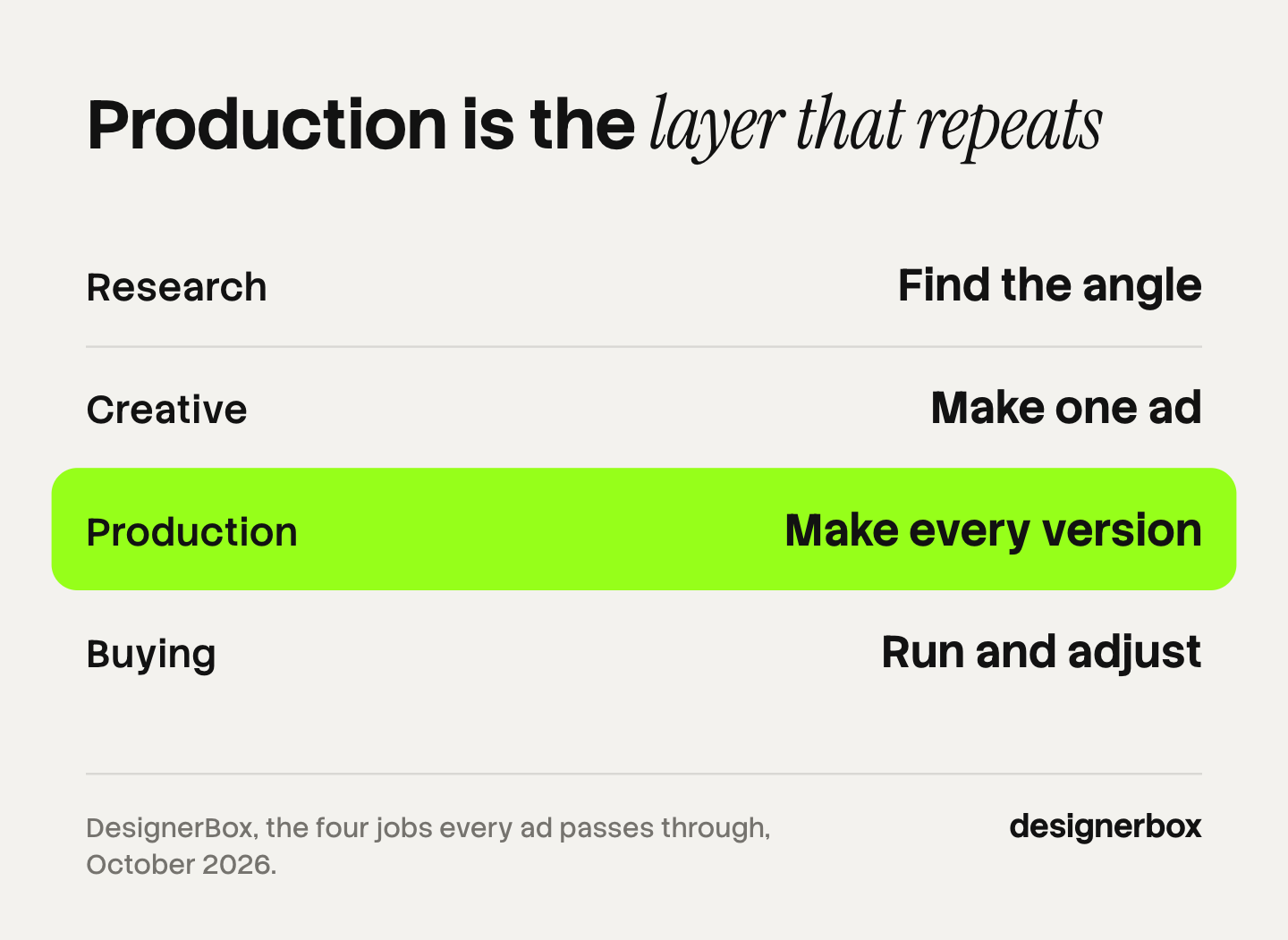
| Layer | The job | What AI does | What a person does |
|---|---|---|---|
| Research | Find the angle | Reads ad libraries, reviews and past results | Picks the angle and writes the brief |
| Creative | Make the first ad | Writes copy, makes images and video | Approves the concept |
| Production | Make every version | Resizes, translates and swaps products | Reviews the set, discards the misses |
| Buying | Run and adjust | Sets bids, moves budget, pauses weak ads | Sets the goal and the limits |
Production is the layer that repeats. A new concept arrives a few times a month. The sizes, languages and product swaps arrive every week, for every client. The agency workflow guide shows where those hours go on a fixed fee.
AI ad agency tools by job
No single tool is “the best AI ad agency software”, because the four layers are different jobs. Start with what the ad platforms include, then add a paid tool where the platform stops. Vendor facts below were read on each vendor’s own pages on 4 October 2026.
The ad platforms’ own tools
The platforms are the starting point, and they sit inside the ad account.
- Meta Advantage+ creative. It can generate up to five variations of primary text and headline, and background generation is available for Advantage+ catalog ads (Meta Business Help Center, October 2026).
- Google Performance Max. If an asset group has no video, Google may generate one or more videos from the assets in the group (Google Ads Help, October 2026). Asset Studio is the place in Google Ads to create and edit assets (Google Ads Help, October 2026).
- TikTok Symphony Creative Studio. It turns product information or a URL into a video and can add a digital avatar. TikTok labels the results as AI-generated (TikTok for Business, October 2026).
AI advertising tools by job covers these free tools in detail. For the wider agency stack, from project boards to reporting, see marketing agency tools by job.
Creative tools
AdCreative.ai generates ad banners, texts, product photoshoots and videos, and it scores creatives before you spend. Its plans are counted in brands, and its Enterprise tier adds brand-tuned models. Appier announced an agreement to acquire the company in February 2025 (adcreative.ai and appier.com, October 2026).
Predis.ai makes video ads, static ads and carousels, and it schedules and publishes them from one calendar. Its plans range from one brand to unlimited brands, and it has an API that is billed separately (predis.ai, October 2026). Media buying is outside its stated scope.
Pencil creates text, image and video ad assets, and it can launch and track ads on Facebook, Instagram, TikTok, YouTube, Google Display, DV360 and LinkedIn. Its Pro tier has unlimited users, brands and markets with role controls. The Brandtech Group acquired Pencil in June 2023 (trypencil.com and thebrandtechgroup.com, October 2026).
Production and ad serving tools
The Brief, formerly Creatopy, covers ad generation, adaptation into many sizes and ad serving in one editor. Its Team plan has 2 to 10 seats, and its API and white-label editor are on the Enterprise plan (thebrief.ai/pricing, October 2026). Creatopy alternatives compares it with seven other tools. What a creative management platform is explains the category.
Smartly joins creative, media and reporting in one platform for large advertisers, and it includes connected TV ads. It is sold through a demo (smartly.io, October 2026). It fits an agency with enterprise clients and large media budgets.
Buying and optimization tools
Madgicx focuses on Meta ads. Its AI Marketer audits the ad account daily, and it has an ad generator for Meta formats. Its reports also read data from Shopify, Google Ads, Google Analytics 4, Klaviyo and TikTok (madgicx.com, October 2026). Changes to bids and budgets on channels other than Meta are outside its stated scope.
Omneky writes, designs, launches and tunes ads across Google, Meta, TikTok, LinkedIn and Reddit. For agencies, each client is a brand with its own brand kit, ads, ad accounts and reports (omneky.com/agency, October 2026). It covers the most layers of the tools listed here.
| Tool | Main layer | Also covers |
|---|---|---|
| Meta, Google and TikTok tools | Buying | Basic creative |
| AdCreative.ai | Creative | Scoring |
| Predis.ai | Creative | Scheduling and publishing |
| Pencil | Creative | Launch and tracking |
| The Brief | Production | Ad serving |
| Smartly | Production and buying | Reporting |
| Madgicx | Buying on Meta | Meta creative |
| Omneky | Creative and buying | Client brands |
How far has agency AI adoption gone?
Adoption is wide, and most of it is still shallow. Two IAB studies show both sides.
In the IAB’s State of Data 2025 report, 70% of agencies, brands and publishers had not fully integrated AI across media planning, activation and analysis. The survey covered 529 companies (IAB, March 2025).
A later IAB study with Sonata Insights found that 83% of ad executives said their company had used AI in the creative process, up from 60%. That sample was 100 executives, so read it as a direction and not as a census (IAB, October 2026).
So most agencies use AI somewhere, and few run it through every stage. An agency that calls itself an AI ad agency should be able to show the second thing.
What must an AI ad agency disclose?
The agency that ships the ad carries the duty. Four rules matter most. This is general information, not legal advice.
- Meta. Meta applies an “AI info” label automatically when you use its own generative features, such as background or image generation. It detects content from other tools through metadata (Meta Business Help Center, October 2026).
- TikTok. TikTok Ads Manager lists AI-generated, synthetic or manipulated media under mandatory disclaimers (TikTok Business Help Center, October 2026).
- The FTC. Since 21 October 2024, a US rule has banned fake consumer reviews and testimonials. It covers a testimonial that misrepresents that the person giving it exists, and the FTC’s announcement names AI-generated fake reviews (FTC, August 2024). A generated presenter must not pose as a real customer.
- The EU AI Act. Article 50 has applied since 2 August 2026. Deployers must disclose deep fakes, and the European Commission says they cannot rely on the tool’s machine-readable mark alone (European Commission, October 2026).
AI disclosure in advertising covers each rule in full.
How to choose an AI ad agency
If you are hiring one, ask seven questions before you sign.
- Which of the four layers use AI, and which tools run each one?
- Who approves each ad before it goes live?
- How many versions do you test for each concept, and how do you pick the winners?
- How do you keep my brand the same across hundreds of ads?
- Who owns the creative files and the ad accounts when the contract ends?
- How do you label AI-made ads on each platform?
- How do you charge: by the hour, by the set or by the result?
A good answer names tools, people and numbers. A weak answer repeats the word “AI”.

Agency production in DesignerBox
DesignerBox is AI creative production for brands and agencies. In the four-layer stack it sits in creative and production. It does not buy media, and it does not replace the ad platforms.
Anyone can make an AI picture. Making hundreds that still look like your client’s brand is the hard part. You save one workflow for each client, with that client’s logos, fonts, palette and rules. A colleague runs it through an app, which is a workflow with a form. Batch runs one workflow over a sheet of up to 200 products, so row one and row two hundred get the same standard. Three critic steps score the results, and best-of-N keeps the best one. You still review every set before the client sees it. Then Reviews sends your client a page of pictures. The client opens the link with no account, chooses the pictures they want and sends the choice back to you.
The ad jobs it covers are the ones an agency repeats: ad images and video from a product photo, every platform size, and one ad rebuilt in another language. You see the cost before each run. The full workflow from the first product photo to the finished ad, in one subscription.
The limits matter for an agency. DesignerBox does not publish to an ad account. You download the results, or send them with a webhook or an S3 step. DesignerBox does not have a public API. It has 68 tools over MCP, so an AI chat such as Claude, ChatGPT or Cursor can run it. An agency that needs buying and creative in one tool should look at Smartly or Omneky.
Uploading your own photos and the commercial license start on the Pro plan. AI video, the image editor and the video editor start on the Premium plan. Team features, shared brand kits and white label are on the Ultra plan, and every plan below Ultra is one seat. Plans are on the pricing page.
Bring one client and the ad set you make for them each month. See DesignerBox for agencies.
FAQ
What is an AI ad agency?
It is an advertising agency that uses AI for research, creative, production and media buying, with people setting the strategy and approving the work. The client buys the same thing as before: ads that perform.
Is an AI advertising agency cheaper than a traditional agency?
Not always. AI lowers the cost of making each ad, and many agencies spend that saving on more versions and more tests. Ask how the agency charges and what you get for the fee.
What software does an AI ad agency use?
It uses a stack with four layers: research, creative, production and buying. Most agencies start with the tools inside Meta, Google and TikTok ad accounts, then add paid tools for creative and production.
Can AI replace an ad agency?
AI replaces tasks, and an agency is more than its tasks. Models can draft, resize and adjust bids. A person still sets the strategy, approves the ads and answers for what they say.
Do AI ad agencies have to label AI ads?
Yes, where the platform or the law requires it. Meta and TikTok both have AI labels for ads, and the EU AI Act’s Article 50 has applied since 2 August 2026. The agency that ships the ad carries the duty.
How do I start an AI ad agency?
Pick one kind of client and one repeatable deliverable, such as a monthly ad set. Build the workflow for that set once, price it by the set, and add a written review step before anything reaches the client.
Does DesignerBox replace an ad agency’s media tools?
No. DesignerBox makes and versions the creative. It does not set bids or publish to ad accounts, so an agency keeps its ad platform tools next to it.
Sources
- Meta Advantage+ creative text variations and background generation: Meta Business Help Center, October 2026
- Performance Max auto-generated videos: Google Ads Help, October 2026
- Asset Studio: Google Ads Help, October 2026
- Symphony Creative Studio and its AI-generated label: TikTok for Business, October 2026
- AdCreative.ai features, brand-based plans and Enterprise tier: (adcreative.ai and adcreative.ai/use-case/agencies, October 2026)
- AdCreative.ai acquisition agreement: (appier.com press release, February 2025)
- Predis.ai formats, brand limits and API: (predis.ai and predis.ai/pricing, October 2026)
- Pencil assets, launch channels and Pro tier: (trypencil.com/pricing, October 2026)
- Pencil acquisition: (thebrandtechgroup.com press release, June 2023)
- The Brief seats, API and white-label editor: (thebrief.ai/pricing, October 2026)
- Smartly suites and sale by demo: (smartly.io, October 2026)
- Madgicx AI Marketer, ad generator and reporting sources: (madgicx.com, October 2026)
- Omneky channels and agency brands: (omneky.com and omneky.com/agency, October 2026)
- AI integration across media planning, activation and analysis: IAB, State of Data 2025, March 2025
- AI in the creative process: IAB and Sonata Insights, The AI Gap Widens, October 2026
- AI info label on ads: Meta Business Help Center, October 2026
- Mandatory disclaimers for AI-generated media: TikTok Business Help Center, October 2026
- Rule on fake reviews and testimonials, 16 CFR Part 465: FTC, August 2024
- Article 50 duties and the 2 August 2026 date: European Commission, October 2026
- DesignerBox plan gates, batch and MCP tools: (DesignerBox pricing and product pages, October 2026)
Vendor facts verified from each vendor’s own pages as of October 2026. Individual results vary.