


A creative management platform (CMP) is software that builds ad creative from templates, makes every size and language version, routes the versions for approval and sends them to ad platforms. It is a different product from creative project management software, which tracks briefs and deadlines. It also differs from a DAM, which stores files, and from DCO, which picks the version each viewer sees.
A search for the term mostly returns lists of project management software. This guide defines the category, names the five jobs inside it and compares seven platforms on those jobs.
A note on bias. DesignerBox makes AI creative production software, and it appears in the comparison. This guide prints no vendor prices. Each vendor lists its plans on its own site.
Key Takeaways
- A CMP makes and ships ad versions. It builds from templates, adapts to sizes and markets, routes approvals and publishes to ad platforms.
- Three other products get mixed in. Project management software tracks the work. A DAM stores the files. DCO chooses the version at the impression.
- The category has five jobs. Template scaling, feed-based dynamic ads, approval and governance, publishing to ad platforms, and AI image and video production.
- No platform leads on all five. Each of the seven platforms here started from a different job.
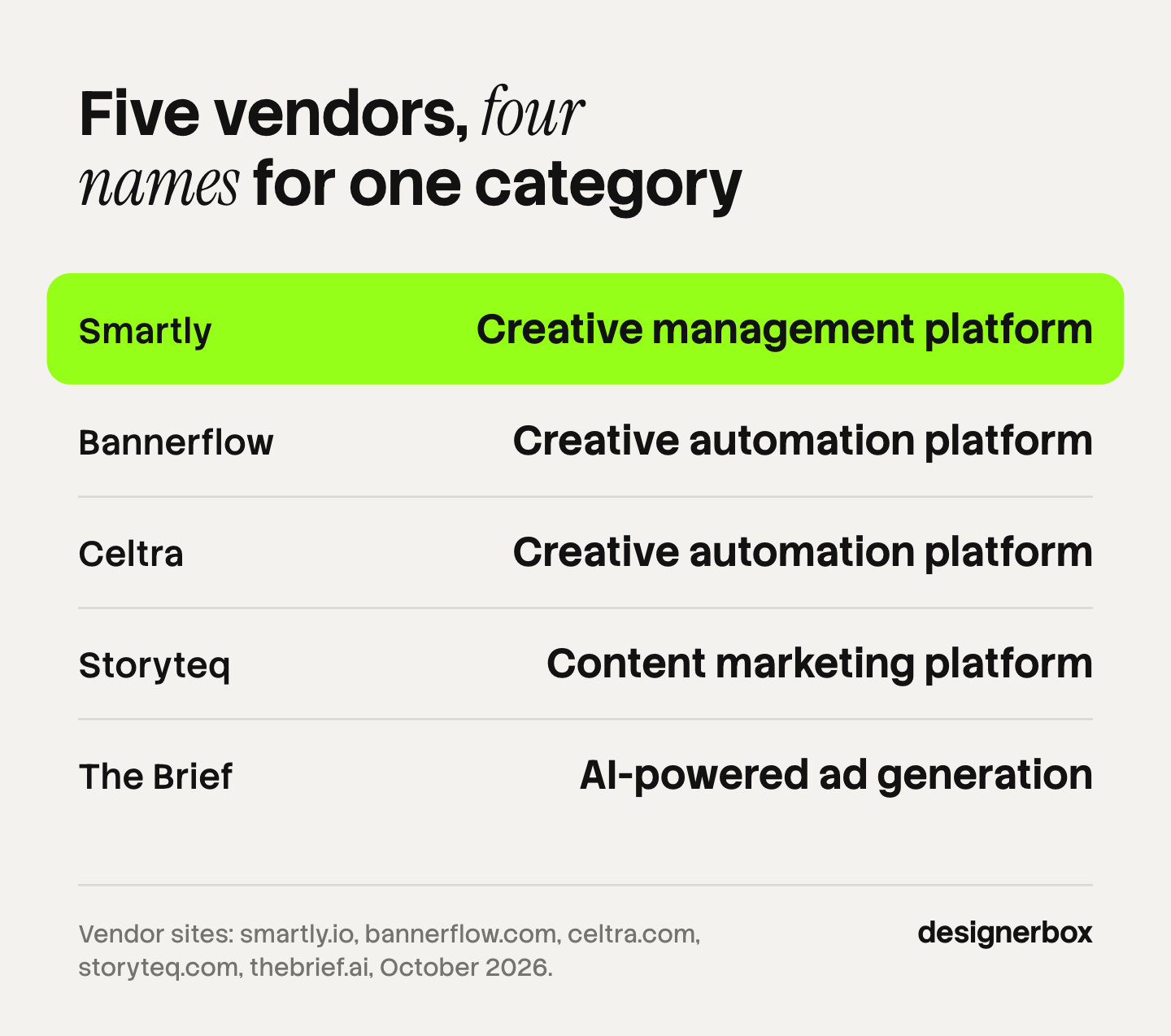
- The name is moving. Among Smartly, Bannerflow, Celtra, Storyteq and The Brief, only Smartly’s page still says creative management platform.
What is a creative management platform?
A creative management platform is one system for the production side of advertising. A designer builds a master creative with locked and editable parts. The platform turns it into every size, format and language. Reviewers approve the versions, and the platform publishes them to ad networks and social channels.
The category started in display advertising, so its vocabulary is banners, HTML5 and ad servers. In 2026 the vendors describe a wider product. Smartly calls its creative suite a “complete creative management platform” and says it covers video, image, display ads and connected TV (smartly.io/creative-suite, October 2026).
The name itself is changing. Bannerflow’s old creative management platform address now redirects to a home page titled “AI-powered creative automation platform” (bannerflow.com, October 2026). Celtra names its product Creative Automation (celtra.com/creative-automation, October 2026). Storyteq calls itself a content marketing platform, and The Brief leads with AI-powered ad generation (storyteq.com and thebrief.ai, October 2026).
So creative automation platform and creative management platform now describe the same shelf. What creative automation is explains the function underneath.
Creative management platform, project management software, DAM and DCO
Four products sit close together, and buyers often shortlist the wrong one. Each answers a different question.
- Creative project management software answers who does what by when. It holds briefs, tasks, timelines and proofs. It does not make an ad.
- A digital asset management system (DAM) answers where the approved file lives. It stores, tags and shares finished assets. Marketing asset management covers that job.
- Dynamic creative optimization (DCO) answers which version one person sees. An ad server usually assembles it at the moment of the impression. The guide to dynamic creative optimization covers it.
- A creative management platform answers how one approved concept becomes every version, and how those versions reach the ad platforms.
The products overlap. Storyteq includes an enterprise DAM and briefs inside its platform. Bannerflow and Smartly list DCO as a feature. So a job list filters better than a category name.
In ad tech, CMP also stands for consent management platform, the software behind a cookie banner. This guide is about the creative one.
The five jobs inside a creative management platform
Every platform in this category does some mix of five jobs. Write down which ones your team repeats every week.
- Template scaling. One master creative becomes every size, format and language.
- Feed-based dynamic ads. A product feed or a data sheet fills a template, and the ad updates when the data changes.
- Approval and governance. Reviewers approve each version, and brand rules lock what must not change.
- Publishing to ad platforms. The platform sends approved versions to ad networks and social channels, and it schedules them.
- AI image and video production. The platform makes the picture or the clip itself, where older platforms only arranged finished assets.
The first four are the original category. The fifth is newer, and it changes the buying question. A template arranges a product image. It cannot make one that does not exist yet.

The arithmetic explains why teams buy. One concept across four platforms and three formats is 12 files. Five concepts make 60. Ad variants at scale covers how many versions a spend level needs.
Creative management platform examples in 2026
Seven platforms follow, each described from the vendor’s own pages.
Celtra
Celtra covers the whole chain for large advertisers. Its Creative Automation product adapts approved concepts for every placement, audience and market. It connects generation, review, approval and media activation in one system. Celtra also describes catalog ads, generative AI for images, animation and video, and live-data creatives across more than 100 media platforms (celtra.com, October 2026).
Best for enterprise brands that want production, activation and services under one contract.
Bannerflow
Bannerflow is built around in-house display and social production. It lists a creative studio, scaling across formats, dynamic ads with feeds, localization and translation, DCO, and publishing with scheduling. Reviews and approvals run with version control. Channels include display, social media, digital out-of-home and in-store screens (bannerflow.com, October 2026).
Best for in-house teams that run display campaigns in many markets.
Storyteq
Storyteq starts from content operations. Its platform joins an enterprise DAM, an adaptation product and a hub for briefs, reviews and approvals. The adaptation product turns master assets into templates for digital, print and video, with AI translation into more than 60 languages. Its Commerce Engine builds promotional assets from pricing and product data. It names generative AI integrations with Gemini and Firefly (storyteq.com, October 2026).
Best for global brands whose local markets adapt central campaigns, print included.
Smartly
Smartly joins creative and media buying. Its creative suite offers image, video, audio and HTML5 templates. Teams adapt, approve and launch ads from one place. Its feature list includes dynamic product ads across Meta, TikTok, Snapchat and Pinterest, catalog management, and AI image and video generation (smartly.io, October 2026).
Best for performance teams that want creative and paid social buying in one platform.
Rocketium
Rocketium sells software and service together. It describes its product as creative intelligence, design software and human experts. A team sends a brief, AI agents run the software, and human experts review the work. The work includes resizing assets and making versions. Results cover paid social, product page and retail media assets, with review and approval inside the app (rocketium.com, October 2026).
Best for ecommerce and retail media teams that want delivered assets more than a new editor to learn.
The Brief
The Brief is the product once named Creatopy. Its ad editor imports PSD and Figma files, makes size and format variations, and animates on a timeline. Its plan page lists brand kits, design approval, data feeds, HTML5 export, ad serving on more than 25 networks and publishing to Meta and Google Ads. It also generates images and video with AI (thebrief.ai, October 2026). The Creatopy alternatives comparison covers the rename.
Best for small and mid-size teams that want a self-serve editor with ad serving.
Canva
Canva is a broad design app with three features from this category. Bulk Create links rows of data to a template, with up to 150 data fields. Brand Kit holds logos, colors, fonts and templates, and Canva AI uses it to generate designs. Design approvals require a review before publishing, with individual reviewers on Canva Teams and multiple approvers on Canva Enterprise (canva.com/help, October 2026). Canva alternatives for product visuals covers the tools next to it.
Best for teams that make static sets by hand and want brand control without an ad platform.
Creative management platforms compared by job
Every cell is the vendor’s own published statement, read in October 2026. “Not checked” means this guide did not confirm it on the vendor’s page.
| Platform | Template scaling | Feed-based ads | Approval | Publishing to ad platforms | AI image and video |
|---|---|---|---|---|---|
| Celtra | Yes | Yes | Yes | Yes | Yes |
| Bannerflow | Yes | Yes | Yes | Yes | Not checked |
| Storyteq | Yes, print included | Yes | Yes | Not checked | Through integrations |
| Smartly | Yes | Yes | Yes | Yes | Yes |
| Rocketium | Yes | Not checked | Yes | Not checked | AI agents and human experts |
| The Brief | Yes | Yes | Yes | Yes, by plan | Yes |
| Canva | Yes, from data rows | Not checked | Yes | Not checked | Yes, designs and images |
| DesignerBox | Resize and language versions | No, batch from a sheet | Critic steps, no ad approval flow | No | Yes |
A “Yes” says the job is in scope. Depth still differs by format, ad network and plan.
Who needs a creative management platform?
Two buyers get the most from one.
An agency lead runs the same campaign shape for many clients. On a fixed retainer, every hand-made version costs margin. The creative agency workflow maps where the hours go.
A brand team runs one campaign in every market and format. Local teams change the language and the offer, and the brand rules stay locked. Localizing ads without rebuilding them covers that step.
Count concepts, sizes, formats and markets for one month. A total in the hundreds, with the same shape each month, justifies a platform.
How to choose a creative management platform
Start from the five jobs.

- Rank the five jobs. Mark the two your team does every week. Shortlist the platforms that started from those jobs.
- Check your formats. HTML5 display, social video, print and in-store screens are different engines. Ask for yours by name.
- Ask where the picture comes from. If the product image does not exist yet, you need AI production or a shoot before any template.
- Read the publishing list. Compare the named ad networks with your media plan.
- Run one real campaign in a pilot. Use your own brand kit, sizes and seats.
When a smaller tool is enough
Three cases need less than a platform.
- A few static sets a month. A design app with a brand kit and a resize feature covers it.
- One channel. Google’s responsive display ads take uploaded images, headlines and logos and build the ad combinations for you (Google Ads Help, October 2026).
- A missing picture. If the gap is the product image or the video, a production tool is the fix.
DesignerBox fit and limits
DesignerBox is AI creative production for brands and agencies. In the five-job list it covers the fifth job, and part of the first.
Anyone can make an AI picture. Making hundreds that still look like your brand is the hard part. You set the brand once: logos, fonts, palette and rules. The workflow reads that brand record on every run. A saved workflow makes the product image from your own photo, builds the ad, resizes it for each placement and rebuilds it in another language with the layout redrawn. Batch runs one workflow over a sheet of up to 200 products, so row one and row two hundred get the same standard. You see the cost before each run. The full workflow from the first product photo to the finished ad, in one subscription.
The limits matter for a platform buyer. DesignerBox does not publish to an ad account or a store. You download the results, or send them with a webhook or an S3 step. It does not serve ads, make HTML5 banners or read a live product feed. Three critic steps score the results and best-of-N keeps the best one. That step checks quality, and it does not replace ad sign-off. A team that needs publishing and ad sign-off keeps a creative management platform for those jobs. DesignerBox does not have a public API. It has 68 tools over MCP, so an AI chat such as Claude, ChatGPT or Cursor can run it.
Uploading your own photos and the commercial license start on the Pro plan. AI video, virtual try-on, upscaling, the image editor and the video editor start on the Premium plan. There is a free plan, and it runs on sample products. Team features, shared brand kits and white label are on the Ultra plan, and every plan below Ultra is one seat. Plans and credits are on the pricing page.
The first job is one ad set, built once. Start from a template, add your brand and your products, and run it. See the templates.
FAQ
What is a creative management platform?
It is software that builds ad creative from templates, makes every size and language version, routes versions for approval and publishes them to ad platforms. Some platforms also connect product feeds for dynamic ads, and newer ones generate images and video with AI.
What does CMP mean in advertising?
It has two meanings. In creative production, CMP means creative management platform. In privacy and ad tech, CMP means consent management platform, the software that collects cookie consent.
What are examples of creative management platforms?
Celtra, Bannerflow, Storyteq, Smartly, Rocketium and The Brief all work in this category, and Canva covers part of it. Some list DCO as a feature, and Storyteq includes a DAM (vendor pages, October 2026).
Is a creative management platform the same as creative automation software?
Mostly, yes. Creative automation is the function: making many versions from one master. A creative management platform is the suite around that function, with approval, storage and publishing added. Vendors now use the two names for the same product shelf.
Is DesignerBox a creative management platform?
No. DesignerBox is AI creative production. It makes the images, ads and video from your product photos and your brand rules, and it shows the cost before the run. It does not publish to ad platforms or serve ads, so a team that needs those jobs uses it next to a platform.
Sources
- Celtra Creative Automation, generative AI for images, animation and video, review, approval and activation in one system, catalog ads and live-data creatives: (celtra.com and celtra.com/creative-automation, October 2026)
- Bannerflow features, channels, reviews and approvals, publishing and scheduling, and the redirect of its creative management platform address: (bannerflow.com, October 2026)
- Storyteq platform parts, adaptation formats, AI translation languages, Commerce Engine and generative AI integrations: (storyteq.com/content-marketing-platform/adaptation-studio, October 2026)
- Storyteq briefs, reviews and approvals: (storyteq.com/content-marketing-platform/collaboration-hub, October 2026)
- Smartly creative suite, template formats, and the adapt, approve and launch flow: (smartly.io/creative-suite, October 2026)
- Smartly dynamic product ads, catalog management, DCO and AI image and video generation: (smartly.io/all-features, October 2026)
- Rocketium product description, AI agents and human experts, resizing and versions, asset types and review in the app: (rocketium.com, October 2026)
- The Brief ad editor, imports, variations, animation and AI generation: (thebrief.ai, October 2026)
- The Brief brand kits, design approval, feeds, export formats, ad serving and publishing: (thebrief.ai/pricing, October 2026)
- Canva Bulk Create and the 150 data fields: (canva.com/help/bulk-create, October 2026)
- Canva design approvals by plan: (canva.com/help/design-approval, October 2026)
- Canva Brand Kit contents and Canva AI: (canva.com/pro/brand-kit, October 2026)
- Responsive display ads and how uploaded assets are combined: Google Ads Help, about responsive display ads, October 2026
- DesignerBox plan gates, batch and MCP tools: (DesignerBox pricing and product pages, October 2026)
Vendor facts verified from each vendor’s own pages as of October 2026. Individual results vary.