


An AI UGC agency makes creator-style video ads for clients with generated presenters, voices or scenes instead of filmed creators. The client buys more than clips. It buys the brief, the scripts, the review of every result and a clear answer on AI disclosure. The work runs in five stages, and the agency repeats them for each client every week.
The tools are open to anyone. A brand can buy the same video model the agency uses. So the agency’s value is the standing brief that keeps a client’s ads on brand, the review that stops a warped product from shipping, and the record of what was labeled and why.
This guide covers what an AI UGC agency delivers, when generated UGC fits and when a filmed creator fits, the five stages across many clients, the disclosure duties, and the questions to ask before you hire one. It is written for agency owners who want to run this work, and for brands who want to buy it.
Key Takeaways
- AI UGC is scripted advertising. It is creator-style video with a generated presenter. It is not content from a real customer.
- The agency sells the brief, the review and the disclosure. The generation is the part anyone can buy.
- One standing brief per client. The brand voice, the product facts and the claims that are allowed are set once and reused.
- Review in client batches. Checking one client’s twelve videos together catches drift that a mixed queue hides.
- The agency can be liable for disclosure. New York’s law applies to any person who produces or creates the ad, and that includes an agency.
- A generated presenter cannot review the product. A false testimonial breaks the FTC rule, whoever made the video.
What is an AI UGC agency?
An AI UGC agency is a creative agency that produces ads in the style of user-generated content with AI. A generated presenter speaks a script to the camera, often with product shots cut in. The agency plans the concepts, writes the scripts, generates and edits the videos, checks them, and delivers files sized for each ad platform. Some agencies also run the media.
The name carries a contradiction, so say it plainly. “User-generated” suggests a real customer. AI UGC has no customer in it. It borrows the look of a customer video: one person, a phone-shaped frame, plain speech. That is fine as a format. It becomes a problem only when the ad claims an experience nobody had.
For video outside the UGC format, see what an AI video agency delivers.
A plain UGC agency casts and briefs human creators. Many agencies now do both, and choose per ad. The background on the filmed side is in the UGC ads guide, and the legal line for the generated side is in AI UGC ads. For the full-service version, see what an AI ad agency is.
What does an AI UGC agency deliver?
A client should receive six things. The video files are one of them.
| Deliverable | What it is | Why the client needs it |
|---|---|---|
| Concepts | The angles to test this cycle, each in one line | So the batch tests arguments, not only wording |
| Scripts | Spoken lines and on-screen text, approved before generation | Claims are checked while they are still text |
| Videos | Edited ads, with captions and an end card | The thing that runs |
| Formats | Each ad in the sizes the placements need | One ad, several placements |
| Disclosure record | Which ads contain AI, and how each is labeled | Proof if a platform or regulator asks |
| Usage terms | Who owns the files and where they can run | No surprise when the client moves agencies |
The last two rows separate an agency from a tool subscription. A brand that buys a tool gets files. A brand that hires an agency should get files plus a paper record.

On volume: the number of videos a client needs depends on its ad spend, not on what the agency can produce. Published benchmarks for ad creative volume by spend tier give a starting point. Selling a client forty videos when its budget can test eight wastes both sides’ money.
AI UGC or creator UGC?
Choose per ad, by what the ad has to prove. Generated UGC fits ads that explain. Filmed UGC fits ads that vouch.
| The ad’s job | Generated presenter | Filmed creator |
|---|---|---|
| Explain what the product is | Fits well | Fits |
| Show a feature or a how-to | Fits well | Fits |
| Test many openings of one script | Fits well, at low cost per version | Slow and costly per version |
| Run the same script in several languages | Fits well | Needs a creator per language |
| Give a personal experience | No. Nobody had the experience | Yes, if it is true |
| Show a real result on a real person | No | Yes |
| Handle the product: unbox, pour, wear | Risky. Hands and products drift | Yes |
A mixed batch is common. The agency tests ten generated openings, finds the two angles that work, and then pays a creator to film those two with the real product in hand. The generated ads did the research. The filmed ads carry the claim. For software clients the split is different, and UGC ads for apps and SaaS covers it.
How the work runs across clients
One client is a project. Fifteen clients is a production line. The five stages below are the same for each client, and the gain comes from doing them in the same order every week.
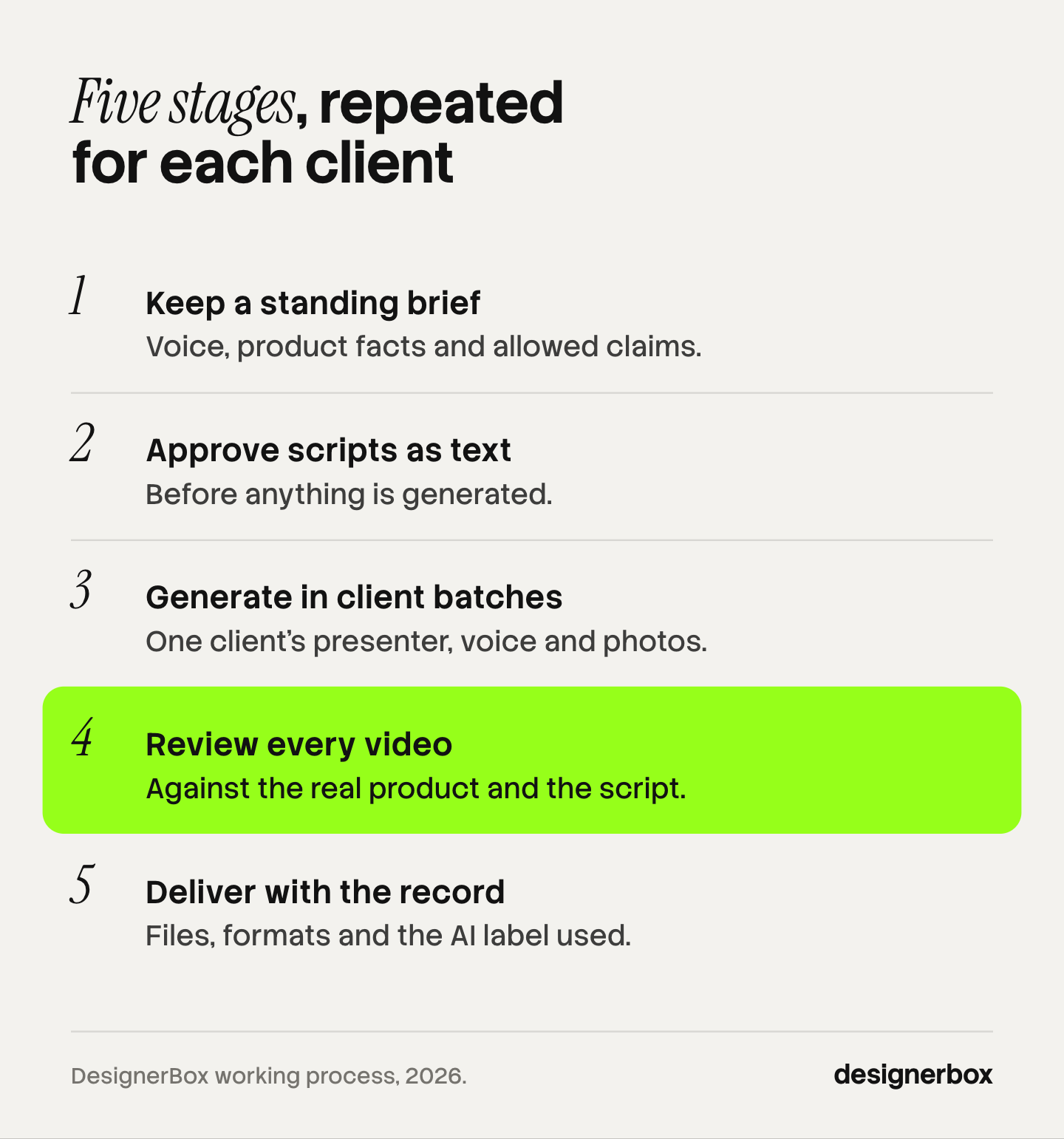
- Keep a standing brief per client. One document holds the brand voice, the product facts, the claims that have proof, the words the client bans and the look of the presenter. It is written once and updated, not rewritten per batch. A creative brief template is a good base.
- Write and approve scripts as text. The client approves the lines before anything is generated. A wrong claim costs nothing to fix in a script and a full redo to fix in a video.
- Generate in client batches. Run all of one client’s videos together, with that client’s presenter, voice and product photos. Mixing clients in one session is how one brand’s tone ends up in another brand’s ad.
- Review every video against the brief. Check the product in each clip against the real item: the logo, the print, the shape, the color. Check the spoken line against the approved script. Reject and re-run single videos, not the whole batch.
- Deliver with the record. Send the files, the format list and the disclosure record. Note which ads carry an AI label and which platform setting was used.
Two habits make the line hold. First, a named person signs off stage 4 for each client. Review that belongs to everyone gets skipped. Second, results go back into stage 1. When an angle wins, the standing brief says so, and next week’s scripts start from it. The build of a single ad is in how to make AI ads. The wider process is in the guide to the creative agency workflow.
Who must disclose that the ad is AI?
There are two questions, and agencies often answer only one. This is general information, not legal advice.
Does the client know? That is a contract matter. Say in the statement of work which deliverables use generated presenters, voices or scenes. A client that learns it from a platform label, after launch, has a fair complaint.
Does the viewer have to be told? That depends on the platform and the place.
- TikTok. Ads with AI-generated or significantly edited media are allowed if you “apply the AIGC label, or by adding a clear disclaimer, caption, watermark, or sticker of your own” (TikTok ads policy, October 2026).
- Meta. Meta adds an “AI info” label to an ad when it detects third-party AI (Meta Business Help Center, October 2026).
- New York. Any person who produces or creates an ad, and knows it contains a synthetic performer, must conspicuously disclose that in the ad. The civil penalty is $1,000 for a first violation and $5,000 for each later one (General Business Law 396-b, October 2026). “Produces or creates” covers an agency, not only the brand.
- California. A similar law, SB 1050, was signed on 16 September 2026 and takes effect on 1 January 2027 (California SB 1050, October 2026).
- European Union. Since 2 August 2026, a deployer who publishes a deep fake must disclose that it is AI-generated or manipulated, at first exposure at the latest (European Commission, October 2026). The Commission’s guidelines treat a realistic person who could plausibly exist as within that term.
Then there is the claim itself. Under the FTC’s rule, a business must not write, create or sell a testimonial that falsely suggests the speaker exists, used the product or had a stated experience (16 CFR 465.2, October 2026). “Write, create or sell” describes an agency’s work exactly. The FTC also says the rule “has no blanket prohibition on the use of AI-generated avatars in marketing” (FTC, October 2026). So a generated presenter may describe a product, and may not review it.
The working rule: make disclosure a default setting in stage 5, not a decision per ad. The longer list by place is in the guide to AI disclosure in advertising.
How AI UGC agencies charge
Three models are common. None is right for every client.
| Model | The client pays for | Fits when |
|---|---|---|
| Monthly retainer | A fixed number of concepts and videos each month | The client tests ads every week |
| Per batch | One set of videos for one campaign | A launch, or a first trial of the agency |
| Added to a media fee | Creative as part of managing ad spend | The agency already runs the account |
Generated UGC changes the sum inside a retainer. The agency no longer pays a creator per video, so the cost of a batch falls. What the agency does with that margin is a choice: more versions for the same fee, or the same versions and more time on review and strategy. The sums are worked through in the guide to agency creative pricing, and resale under the agency’s own name is covered in white label creative.
Questions to ask an AI UGC agency before you hire one
If you are the brand, these seven questions sort a production partner from a reseller of a tool.
- Who approves the script before generation? The answer should be you.
- Who checks each video against the real product? Ask for the person’s role, not “our QA process”.
- How do you keep my brand apart from your other clients? Listen for a standing brief and a fixed presenter.
- Which ads will carry an AI label, and who sets it? A good agency has a default.
- Will any generated presenter state a personal experience? The answer should be no.
- Who owns the files, the presenter and the scripts when we stop? Get it in the contract.
- What happens to a winning angle? Ask whether they film it with a real creator and the real product.
A tool list is a weaker signal than these answers. If you want to compare the tools themselves, see the AI UGC video tools for agencies.

One workflow per client
Anyone can make an AI picture. Making hundreds that still look like your brand is the hard part. For an agency the problem is larger: hundreds of videos that look like each client’s brand, and never like another client’s.
DesignerBox is AI creative production for brands and agencies. You build one workflow per client. The client’s brand rules are a record, and the workflow reads it on every run. Creator-style clips come from the client’s product photos and a script. A junior can run the same job as an app: they complete a short form and press Run. Batch runs one workflow over a whole sheet, and you keep or discard per row and re-run one row alone. For stills, Reviews sends your client a page of pictures. The client opens the link with no account, chooses the pictures they want and sends the choice back to you. The cost is shown before the run, so you can quote a batch before you make it.
The full workflow from the first product photo to the finished ad, in one subscription.
Here are the limits. Team features, shared brand kits and white label are on the Ultra plan, and every plan below Ultra is one seat, so an agency needs Ultra. DesignerBox does not publish ads: you download the results, or send them with a webhook or an S3 step. It does not set the platform’s AI label for you. An 8-second clip costs 40 to 560 credits, depending on the model, and AI video starts on the Premium plan. Plans and credits are on the pricing page.
The first job, built once
Start with one client and one repeated job. See how the setup works on the page for agencies.
FAQ
What does an AI UGC agency do?
It produces creator-style video ads for clients with generated presenters, voices or scenes. The work covers concepts, scripts, generation, editing, review and delivery in the sizes each ad platform needs. A good agency also keeps a record of which ads contain AI and how each one is labeled.
Is AI UGC the same as UGC?
No. UGC is content a real person made about a product. AI UGC is scripted advertising in the same style, with a generated presenter. It can explain and demonstrate. It cannot give a personal experience, because no person had one.
Is it legal for an agency to make AI UGC ads?
Generated presenters are allowed in advertising. The FTC says its rule has no blanket ban on AI avatars in marketing. The limits are on false testimonials, and on disclosure: TikTok requires a label, and New York requires a disclosure when an ad contains a synthetic performer. This is general information, not legal advice.
How many AI UGC videos does a client need each month?
It depends on the client’s ad spend and how many ads its budget can test. A small account can read a handful of versions a week. A large one can read many more. Size the batch to the test, not to what the tool can produce.
Should an agency tell clients the videos are AI-generated?
Yes. Put it in the statement of work. Platforms label AI content, so the client will find out, and it is better to hear it from you. Agreeing it at the start also settles who is responsible for the label.
Can a small agency run AI UGC for many clients?
Yes, if the process is fixed. A standing brief per client, scripts approved as text, generation in client batches, a named reviewer and a delivery record. The limit is review time, not generation time, so plan the team around stage 4.
Sources
- TikTok ads policy, misleading and false content: ads.tiktok.com, accessed October 2026
- Meta Business Help Center, AI info labels on ads: facebook.com/business/help/1010479435004531, accessed October 2026
- New York General Business Law 396-b: nysenate.gov, accessed October 2026
- California SB 1050: leginfo.legislature.ca.gov, accessed October 2026
- European Commission, Transparency obligations under Article 50 of the AI Act, questions and answers: digital-strategy.ec.europa.eu, accessed October 2026
- FTC, Consumer Reviews and Testimonials Rule: Questions and Answers: ftc.gov, accessed October 2026
- 16 CFR 465.2, via Cornell Legal Information Institute: law.cornell.edu/cfr/text/16/465.2, accessed October 2026
- DesignerBox pricing and product pages (designerbox.ai), October 2026
Platform policies and laws verified from TikTok, Meta, FTC, New York, California and European Commission pages as of October 2026. This is general information, not legal advice. Individual results vary.