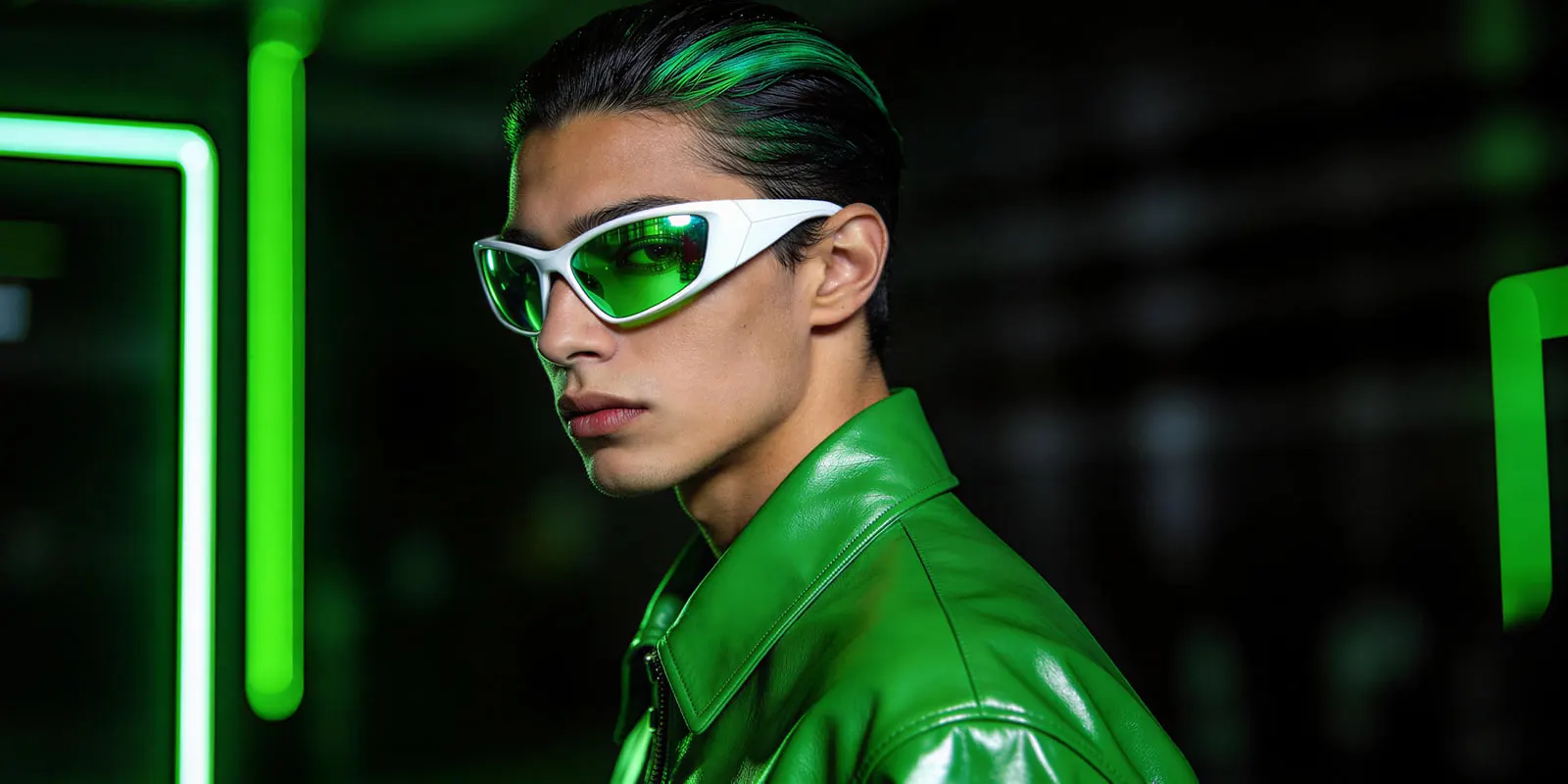
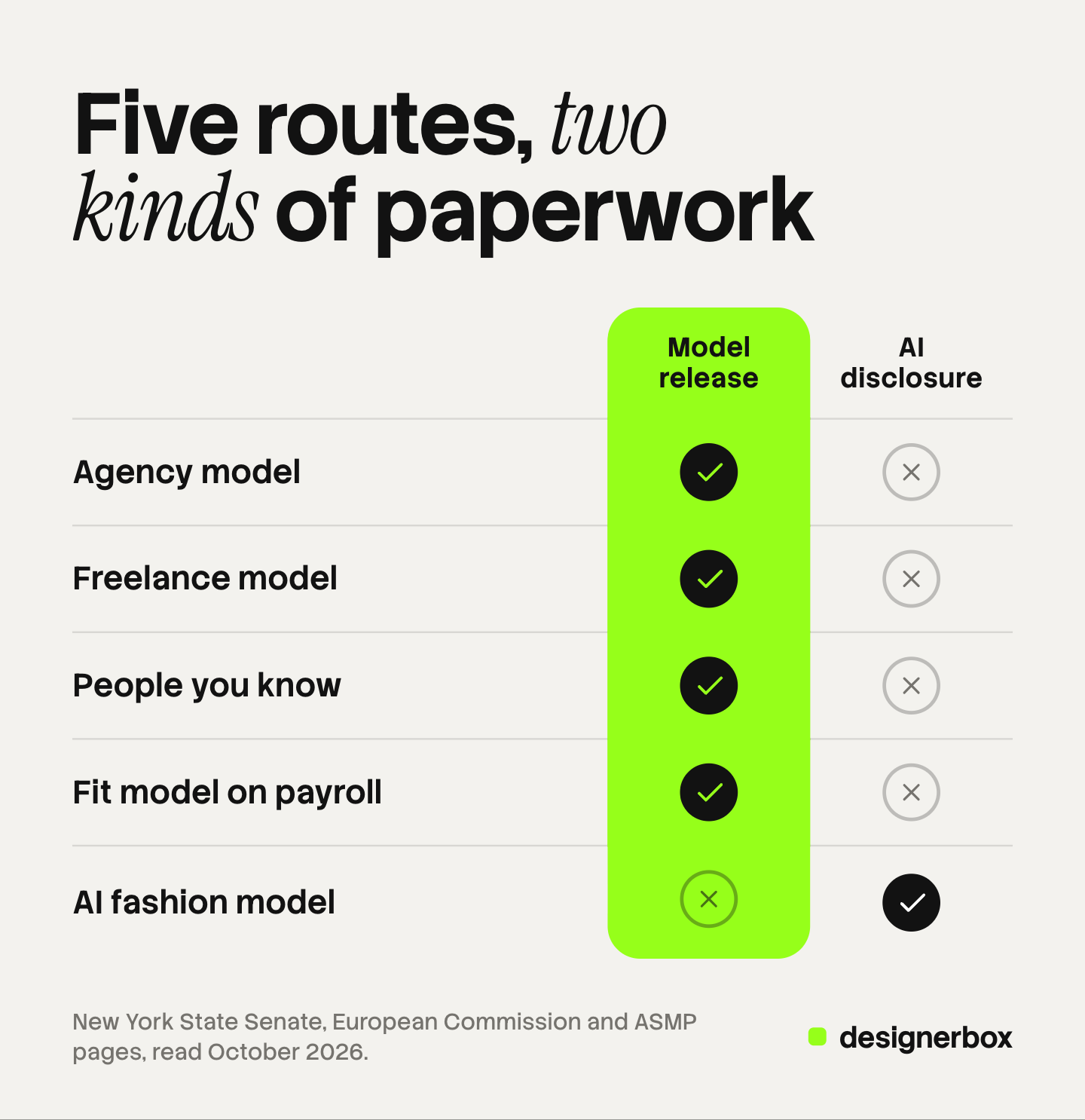
You can get a model for a clothing brand in five ways: book one through a model agency, hire a freelance model, ask people you know, use a fit model who already works for you, or make an AI fashion model. Each route gives you a person in the photo. Each one asks for different paperwork, a different lead time and a different budget.
This guide puts the five routes side by side for clothing brand owners, and for agencies that produce images for apparel clients.
Key Takeaways
- Five routes. Agency, freelance, people you know, a fit model on payroll, or an AI model. Choose per shot.
- Four routes need a release. A real person in a photo that sells clothes gives written consent. A friend and an employee do too.
- The fifth route swaps the release for a label. An AI model signs nothing, and disclosure rules can apply in New York and in the EU.
- The US median wage for models was $23.30 an hour in May 2025. A booking quote adds usage on top.
How do you find a model for a clothing brand?
You find a model for a clothing brand through one of five routes. The right one depends on the shot, the budget and how long you will use the image.
| Route | What you get | What you sign | What sets the lead time | Where it fits |
|---|---|---|---|---|
| Model agency | A professional from a managed roster, booked through an agent | A booking agreement and a release, with usage terms | Casting, the model’s calendar, the contract | Campaigns and shoots with a fixed date |
| Freelance model | A professional you book directly | A contract and a release that you prepare | Your own search and the model’s calendar | Lookbooks and small shoots |
| People you know | A friend, a customer or a team member | A release, signed by a parent for a minor | Their free time | A first collection, social posts |
| Fit model on payroll | A person whose body your sizes are built on | A release that is separate from the fitting work | Almost none | Fit-critical product pages |
| AI fashion model | A model you make once and reuse | No release. A disclosure where the law asks for one | The time to make and review the images | Catalog shots that repeat for every product |
No route is the best one for every shot. Most brands use two or three of them in one season.
Route 1: a model agency
A model agency represents models and books them for clients. The US Bureau of Labor Statistics says that almost all models sign with agencies. An agency promotes the model to clients and keeps a part of the model’s earnings (Bureau of Labor Statistics, October 2026).
You send the agency a brief with the date, the place, the kind of shoot and the usage you need. The agency sends back models who are free and who match. You choose, and the agency writes the booking.
This route is the most dependable one for a fixed date, because the agent handles the calendar and the contract. The limit is budget: you pay the model’s fee plus usage.
In New York, the Fashion Workers Act caps the commission an agency may charge the model at 20% (New York State Department of Labor, October 2026).
Route 2: a freelance model
A freelance model has no agency. The Bureau of Labor Statistics describes freelance models as people who market themselves to clients and apply for jobs directly. You find them on casting sites, on social platforms and through photographers.
You agree the fee with the model directly, and you take over the agent’s work. You check the portfolio, write the contract, prepare the release and plan for a late cancellation.
Ask for a composite card before you book. It shows the model’s best photographs with the body measurements, so you know if your sample size will fit. This route suits lookbooks and small shoots with flexible dates.
Route 3: people you know
Many first collections are shot on friends, customers or the founder. The route costs little, and the people already like the brand.
The risk is the paperwork that nobody asks for. A friend can change their mind, and a team member can leave. Without a signed release, you have no record of what the person allowed.
Treat a friend like a professional on paper. Agree what they receive: a fee, clothes or the photos. Write where the images will run and for how long, and get the signature before the shoot day. This route suits a first collection and social posts.
Route 4: a fit model already on payroll
A fit model is the person your patterns are tested on. The Bureau of Labor Statistics says fit models help the manufacturer or the designer achieve the best fit for new styles.
A fit model has one clear strength in front of a camera. The sample was built on this body, so the garment sits as you designed it.
Two limits apply. Posing is a different skill from standing for a fitting. And fitting work is one job, while appearing in your ads is another. Put the photo use in a separate written release. This route suits categories where fit decides the sale, such as denim, tailoring and swimwear.
Route 5: an AI fashion model
An AI fashion model is a person who does not exist, made with an image model. You define the face and the body once. You then put each garment on that model from a garment photo. AI fashion model generators compared compares the tools that do this.
The strength is repetition. The same model, light and pose can serve every product in a drop, with no calendar to match and no release to renew. Our guide on how to choose an AI virtual model covers the face, the size range and two tests to run first.
The limits are real. An AI image is made from a garment photo. It cannot record how the sample sat on a body, so someone must check each result against the real garment. A label duty can also apply.
Some vendors sell this route as a service, or as a license to a real model’s likeness. Our guide to the AI model agency compares those offers.
What you sign on each route
Every route with a real person ends in two documents: a release and a usage agreement. This section is general information, not legal advice.
The release. A model release is a written agreement that grants permission to use a person’s image in specific ways. The American Society of Media Photographers lists what it should define: where, how and for how long the images can be used, what the model receives, and a parent’s or guardian’s consent for anyone under 18 (ASMP, October 2026). Our guide to the model release form lists the six fields.
Why friends and staff need one too. In the United States, the right of publicity prevents the commercial use of a person’s name or likeness without permission. It comes mainly from state law (Cornell Legal Information Institute, October 2026). New York is one example. Its Civil Rights Law section 50 requires the written consent of any living person before a business uses their picture for advertising or trade (New York State Senate, October 2026).
Usage. Usage says where the image may run. It has three parts: the media, the time and the country. A standard grant is narrow. The Association of Photographers in the UK says a photographer’s original fee would normally include one year of use in a single country in two media, or two years in one medium (Association of Photographers, October 2026). A model’s usage is agreed separately and has the same three parts.
Extra rules in New York. The Fashion Workers Act has applied since 19 June 2025. A client pays at least 50% above the contracted hourly rate for work past eight hours in a 24-hour period. A client also needs the model’s clear written approval before it creates or uses a digital replica of the model. The approval names the scope, the purpose, the rate of pay and the length of time (New York State Department of Labor, October 2026).
How much does it cost to hire a model?
No public body publishes a standard booking rate for brands. The closest public figure is a wage. The median hourly wage for models in the United States was $23.30 in May 2025. The lowest 10% earned less than $16.44 an hour, and the highest 10% earned more than $63.21 (Bureau of Labor Statistics, October 2026).
A wage is what the model earns across all work. A quote to a brand has four parts: the time fee, the usage, the agency’s part and extras such as travel and overtime. Ask for the fee and the usage as two separate lines. Our guide to fashion photoshoot cost lists published rate ranges for each role on a shoot.
The AI route has a different cost shape. You pay for software and for the time to review each image. You pay no usage fee, because no person granted the use.
Disclosure and likeness rules for an AI model
An AI model signs no release, because there is no person to grant permission. Three rules can still apply.
New York. General Business Law section 396-b took effect on 9 June 2026. A business that produces an advertisement must conspicuously disclose a synthetic performer in it, where the business has actual knowledge. The civil penalty is $1,000 for a first violation and $5,000 for each later one (New York State Senate, October 2026).
California. The governor signed SB 1050 on 16 September 2026. His office says it requires explicit disclosure on video or audio advertisements that use AI-generated performers (Governor of California, October 2026). Check its start date before you run ads there.
The European Union. Article 50 of the AI Act has applied since 2 August 2026. Deployers must disclose deep fakes to a person at first exposure at the latest (European Commission, October 2026). The Commission’s guidelines of 20 July 2026 list realistic AI-generated human avatars as persons, so a realistic AI model is likely in scope. The guidelines are not binding.
A real face stays a real face. If the AI model is built from a real person, the release rules return. Our guide on whether AI fashion models are real people explains the three sources a face can come from.
Which shots merit a real person
Decide per shot. A clothing brand’s images fall into a few groups, and each group has a natural route.
| The shot | Route that fits | Why |
|---|---|---|
| Campaign hero | Agency or freelance model | The person is the message, and the image runs in paid media |
| Founder, team or customer story | People you know | Trust comes from the person being real and named |
| Fit-critical product page | Fit model or professional model | The photo is the buyer’s evidence of how the sample sits on a body |
| First on-model photo of a new style | A real person, any route | Later images are checked against it |
| Catalog front, side and back views | AI model | The same shot repeats for every product |
| Extra colors of a style already shot | AI model | The fit is already shown, and only the color changes |
A real person fits when the likeness is the point, or when the buyer will judge fit from this one photo. An AI model fits when the shot repeats and an approved real photo exists to check the result against. Our guide to AI models vs real models gives a rule for each slot in the product gallery.
If you are a model looking for brand work
Many people search this topic from the other side. The Bureau of Labor Statistics says most agencies let applicants email photos directly, and many hold open calls. A current portfolio and a composite card with your measurements are what a brand or an agency asks for first.
On-model sets in DesignerBox
DesignerBox is AI creative production for brands and agencies. It makes images, ads and video from your brand rules. An on-model set is one of the things it makes. Anyone can make an AI picture. Making hundreds that still look like your brand is the hard part.
For the fifth route, you save the model, the light and the framing once as a workflow. The workflow reads your brand rules on every run. A garment photo goes in, and an on-model set is the result. A batch runs the same workflow over a sheet, one product per row, so row one and row two hundred get the same model. The cost is shown before the run.
The full workflow from the first product photo to the finished ad, in one subscription.
The limits matter for this subject. DesignerBox is software. It does not represent real models, and it does not license a real person’s likeness. Virtual try-on is for garments only. You check every result against the real garment yourself. You download the results, or send them with a webhook or an S3 step. Every plan below Ultra is one seat.
Uploading your own photos and the commercial license start on the Pro plan. AI video, virtual try-on, upscaling, the image editor and the video editor start on the Premium plan. Plans and credits are on the pricing page.
There is a free plan, and it runs on sample products. Get started free
FAQ
How do I find models for my clothing brand?
Use one of five routes. Send a brief to a model agency, book a freelance model directly, ask people you know, use a fit model who already works for you, or make an AI fashion model.
How much do models cost for a clothing brand?
No public body publishes a standard booking rate. The US median hourly wage for models was $23.30 in May 2025, according to the Bureau of Labor Statistics. A quote to a brand adds usage, the agency’s part and extras to the time fee.
Do I need a model release if my friend models for free?
Get one. A release records what the person allowed, and payment does not change that. In New York, the law requires written consent before a business uses any living person’s picture for advertising or trade.
Can a fit model appear in product photos?
Yes, with a separate written release for the photo use. Appearing in ads or on product pages is a different use of the person’s likeness.
Do I have to say that my model is AI-generated?
In some places, yes. In New York, an advertisement must conspicuously disclose a synthetic performer. In the EU, deployers must disclose deep fakes, and a realistic AI model is likely in scope.
Sources
- Models: agencies and their share of earnings, freelance models, fit models, composite cards, how applicants reach agencies, and the May 2025 median and percentile hourly wages: US Bureau of Labor Statistics, Occupational Outlook Handbook, Models, accessed October 2026
- Fashion Workers Act: the 20% commission cap, overtime past eight hours, and written approval for a digital replica: New York State Department of Labor, Fashion Workers Act FAQs, accessed October 2026
- Written consent for advertising or trade use of a living person’s picture: New York Civil Rights Law section 50, accessed October 2026
- Synthetic performer definition, disclosure duty and penalties: New York General Business Law section 396-b, accessed October 2026
- California SB 1050, signed 16 September 2026: Governor of California, news release, accessed October 2026
- Article 50 of the EU AI Act: the 2 August 2026 date and disclosure at first exposure: European Commission, FAQ on Article 50 transparency obligations, accessed October 2026
- Realistic AI-generated human avatars as persons, and the non-binding status of the guidelines: European Commission, Guidelines on Article 50, C(2026) 5054, read September 2026
- Right of publicity as mainly state law: Cornell Legal Information Institute, Publicity, accessed October 2026
- Model release clauses: American Society of Media Photographers, Colorado chapter, model releases, accessed October 2026
- What a photographer’s original fee normally includes: Association of Photographers, usage calculator, accessed October 2026
- DesignerBox workflows, batch and plan gates: DesignerBox workflows page (designerbox.ai/product/workflows), batch page (designerbox.ai/product/batch) and pricing page (designerbox.ai/pricing), October 2026
Legal and wage facts verified on each publisher’s own page, October 2026, except the Commission guidelines, read September 2026. DesignerBox features verified on designerbox.ai, October 2026. Rates and rules vary by market.