


Testimonial ads are ads in which a real person describes a real experience with a product. The person can be a customer, a creator, an expert or a known name. The format works because the viewer believes the speaker exists and used the product. So the first question for every testimonial ad is who is speaking, and what proof sits behind the claim.
That question matters more now that AI can make a face, a voice and a quote in minutes. In the United States, a rule from the Federal Trade Commission bans a testimonial that misrepresents that the person exists. AI is still useful in testimonial advertising. It can edit, caption, resize and translate a real testimonial. It cannot supply the customer.
This guide is for a brand, or the agency that runs its ad account, that already runs creator-style ads. It covers six formats, the rules from their primary sources, and the line between what AI may make and what it may not.
Key Takeaways
- A testimonial ad is a claim about a real person. The viewer has to be able to trust that the speaker exists and used the product.
- There are six common formats. Quote card, star-rating static, video testimonial, creator clip, expert testimonial, and before and after. Each one needs different proof on file.
- A fake testimonial breaks a US federal rule. 16 CFR 465.2 covers a testimonial that misrepresents that the person exists, used the product, or had the stated experience.
- A paid creator needs a disclosure. The FTC’s Endorsement Guides say a connection the audience does not expect must be disclosed clearly.
- AI may edit a real testimonial. It can shorten, caption, resize and translate it, as long as the meaning stays the same.
- AI may not supply the customer. An invented person, an invented quote and an invented rating are all outside the line.
What are testimonial ads?
Testimonial ads are paid ads built on one person’s own account of a product. The FTC’s rule defines a consumer testimonial as an advertising message that consumers are likely to believe reflects “the opinions, beliefs, or experiences of a consumer who has purchased, used, or otherwise had experience with a product, service, or business” (16 CFR 465.1, read October 2026).

Two parts of that definition matter for advertisers. The first is the word “likely”. The test is what the viewer believes, so an ad can be a testimonial even if nobody calls it one. The second is the list of what counts. The same section says a testimonial can include “verbal statements, demonstrations, or depictions of the name, signature, likeness, or other identifying personal characteristics of an individual”. A face and a first name beside a quote are enough.
A testimonial differs from a review. A review is something a customer posts on a review page. A testimonial is that kind of statement used in the brand’s own advertising. Many testimonial ads start as reviews.
The six formats of testimonial advertising
Testimonial advertising comes in six common formats. Each one makes the same promise: a real person had this experience. They differ in who the person is and what the brand needs on file before the ad runs. This table sorts the testimonial ad examples by proof, because the proof is what you have to supply.
| Format | Who is speaking | What it must have behind it |
|---|---|---|
| Quote card | A customer, in a written quote | The original review or message, and permission to use it in an ad |
| Star-rating static | Many customers, as one number | The real rating, its source and the date you read it |
| Video testimonial | A customer on camera | A real user of the product, and a signed release |
| Creator or UGC-style clip | A paid or gifted creator | Real use of the product, and a disclosure of the payment or gift |
| Expert testimonial | A professional | Qualifications that match the claim |
| Before and after | A customer, with a result | Proof the result is real, and proof of what users typically get |
A few notes on the table.
Quote card. The Endorsement Guides allow an ad to shorten a person’s words unless the ad shows them as exact words, “such as through the use of quotation marks”. The statement “may not be presented out of context or reworded so as to distort in any way the endorser’s opinion or experience” (16 CFR 255.1, read October 2026). Our guide to static ad examples covers the layout side of this format.
Star-rating static. The FTC rule counts a rating as a review even with no text.
Creator clip. A creator who was paid, or who received the product for free, has a connection to the brand. Our UGC ads guide compares the ways to hire one.
Expert testimonial. The Guides say the expert’s qualifications “must in fact give the endorser the expertise that the endorser is represented as possessing”.
The rules on testimonial ads, source by source
Four sets of rules cover most testimonial ads: the FTC’s rule on reviews and testimonials, the FTC’s Endorsement Guides, each ad platform’s policies, and EU consumer law. The first is a rule with penalties. The second is a guide to how the FTC reads the law. This is general information, not legal advice.
The FTC rule on fake reviews and testimonials
The Rule on the Use of Consumer Reviews and Testimonials, 16 CFR Part 465, went into effect on October 21, 2024. The FTC says the rule “authorizes courts to impose civil penalties for knowing violations” (FTC questions and answers, read October 2026).
Section 465.2 is the core. It is a violation for a business “to write, create, or sell a consumer review, consumer testimonial, or celebrity testimonial that materially misrepresents, expressly or by implication”:
“(1) That the reviewer or testimonialist exists; (2) That the reviewer or testimonialist used or otherwise had experience with the product, service, or business that is the subject of the review or testimonial; or (3) The reviewer’s or testimonialist’s experience with the product, service, or business that is the subject of the review or testimonial.”
The same section covers a business that shares a testimonial it “knew or should have known” was false in one of those three ways. When the FTC announced the rule, it named “AI-generated fake reviews” as an example of a review by someone who does not exist (FTC press release, August 2024, read October 2026).
Section 465.5 adds company insiders. A testimonial by an officer, manager or employee needs a clear disclosure of that relationship, unless the relationship is already clear to the audience.
The FTC Endorsement Guides
The Guides, 16 CFR Part 255, explain how the FTC applies the law to endorsements. Four points matter most for testimonial ads (16 CFR Part 255, read October 2026).
- Real users. When an ad says the person uses the product, the person “must have been a bona fide user of it at the time the endorsement was given”.
- Actual consumers. Ads that present people as actual consumers “should utilize actual consumers in both the audio and video, or clearly and conspicuously disclose that the persons in such advertisements are not actual consumers”.
- The picture beside the quote. Using a testimonial “with the image or likeness of a person other than the actual endorser is deceptive if it misrepresents a material attribute of the endorser”.
- Paid connections. A connection that “is not reasonably expected by the audience” must be “disclosed clearly and conspicuously”. The Guides list payment and “free or discounted products” as examples.
On wording, FTC staff say that starting a post with “Ad:”, “Paid ad” or “#ad” would likely be effective. On a platform’s own disclosure setting, they say a platform offering it “is no guarantee that it’s an effective way” to disclose (FTC Endorsement Guides FAQ, read October 2026).
Typical results
A testimonial about a result carries a second claim: that other buyers can expect the same. The Guides say that if the brand cannot prove the result is typical, the ad “should clearly and conspicuously disclose the generally expected performance”. FTC staff add that phrases like “Results not typical” or “Individual results may vary” do not change how people read the ad.
Meta and TikTok
Meta. Meta defines branded content as organic content “for which the creator has been compensated by a brand or business partner”, and says this “may include when products and services are gifted for free”. The creator must tag the business partner (Meta Business Help Center, read October 2026). To run a creator’s post as a partnership ad, the advertiser needs permission from the partner whose handle the ad includes, and the partner can revoke it at any time (Meta Business Help Center, read October 2026).
TikTok. TikTok’s Branded Content Policy, with an effective date of August 31, 2026, covers content that “promotes or reviews” a brand “in exchange for payment or any other incentive”. The creator must enable the commercial content disclosure setting (TikTok Branded Content Policy, read October 2026).
TikTok’s ad policy adds two points. It does not allow “product effect comparisons, such as before-and-after results”. It also asks for an AIGC label, or a clear disclaimer, on content that is significantly modified by AI. Its examples include “making the primary subject say something they didn’t actually say, using AI voice-cloning” (TikTok advertising policies, last updated April 2026, read October 2026).
The EU
The Unfair Commercial Practices Directive lists practices that are unfair in all circumstances. Point 23c of Annex I is “submitting or commissioning another legal or natural person to submit false consumer reviews or endorsements, or misrepresenting consumer reviews or social endorsements, in order to promote products”. Point 23b covers stating that reviews come from consumers who used or purchased the product “without taking reasonable and proportionate steps to check that they originate from such consumers” (Directive 2005/29/EC, consolidated text, read October 2026).
What counts as a fake testimonial?
A fake testimonial is one that fails any of the three tests in section 465.2. The person does not exist. The person exists and never used the product. Or the person used it, and the ad changes what happened. All three are fake testimonials under the rule, and the production method does not matter.
AI makes the first kind easy, so the FTC answered a question about it directly. On AI stock avatars, its staff wrote: “The rule has no blanket prohibition on the use of AI-generated avatars in marketing.” They added that a company’s use of an avatar might be considered a testimonial, and “that would be prohibited under the rule only if the underlying testimonials were fake or false”.
So the avatar is allowed, and the fake customer story is banned. A generated presenter who explains what a product does is an ad. The same presenter who says “I have used this for three months” is a testimonial from nobody. Our guide to AI UGC ads covers that script line and the penalty amount in detail.
What AI may and may not make
AI may change the form of a real testimonial. It may not create the testimonial. That split follows from the texts above: every rule asks whether the person, the use and the experience are real, and none asks how the ad was edited. The lists below are our reading of those texts for common production tasks.
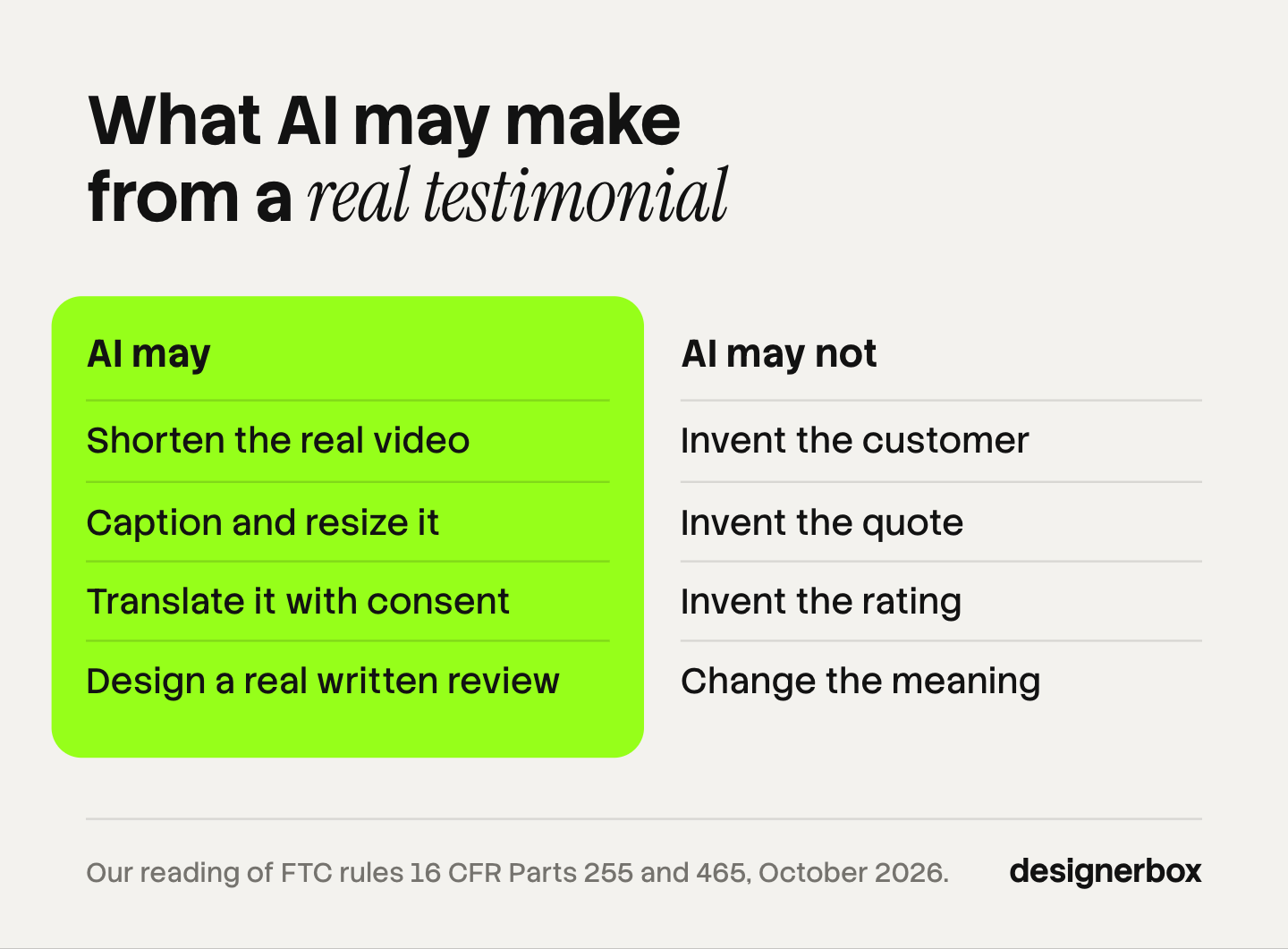
What AI may do with a real testimonial
- Shorten it. Cut a two-minute video to 20 seconds, as long as the shorter version keeps the speaker’s meaning.
- Caption and resize it. Add captions that match the spoken words, and make the vertical, square and wide versions.
- Translate it, with the speaker’s consent. Translated captions keep the real voice. A dubbed voice makes the speaker say words they did not say, so get consent first, keep the meaning, and add the AI label where a platform asks for one.
- Set a real written review as a static ad. The words stay the customer’s. The layout is yours.
- Make the product pictures around it. The product shot, the background and the end card make no claim about a person.
What AI may not do
- Invent the customer. An AI avatar or an invented person presented as a customer fails the first test.
- Invent the quote. A written quote from no one is the same failure in text.
- Invent the rating. A star rating that no review page shows misrepresents what customers think.
- Change the meaning. An edit that removes a doubt, or a translation that adds a result, distorts the experience.
One more case sits between the lists. A real review beside a generated face is a real quote with someone else’s picture. Use the customer’s own photo with permission, or use no face.
For deciding which clips need a real person at all, our guide to UGC style video sorts nine ad types with three tests.
How to collect a testimonial you can use in ads
Collect the testimonial, the permission and the proof at the same time. An ad account can run for months, and a question about one ad can arrive long after the customer’s message is lost. A short file for each testimonial answers it. These steps are working practice. They are not a legal standard.
- Ask every buyer the same way. The rule’s exception covers “generalized solicitations to purchasers”. Do not make a reward depend on a positive answer.
- Keep the original. Save the review, email or video file exactly as it arrived, with its date.
- Get permission in writing. Name the uses: paid ads, the platforms, the countries, the length of time, and whether you may shorten or translate it.
- Record proof of use. An order number is enough for most products.
- Record what the person received. A free product or a payment means a disclosure in the ad.
- Check a result claim before it runs. Ask what a typical buyer gets, and state that in the ad if the result is unusual.
- Check again later. The Guides say an advertiser may run the ad only while it has good reason to believe the person “remains a bona fide user of the product”.
A script helps a customer speak clearly, and the experience stays theirs. Our guide to the UGC script shows a structure that leaves the experience to the speaker.

Where AI avatar video generators fit
AI avatar video generators turn a script into a video of a presenter who speaks it. They are the tools most lists of UGC-style ad software rank. They fit a spokesperson, an explainer or a product demo, where the presenter is not presented as a customer.
The FTC’s answer on stock avatars allows this use. The risk starts with the script. If the lines claim personal use, the video becomes a testimonial with no person behind it.
Three checks apply before an avatar video runs as a paid ad:
- The vendor’s terms. Read each vendor’s own terms on paid advertising and on the rights to the face.
- The platform label. TikTok asks for the AIGC label or a clear disclaimer on fully AI-generated ad media.
- The framing. If a viewer could take the presenter for an actual consumer, the Guides call for a clear disclosure that the person is not one.
Our guide to the AI spokesperson covers the three kinds of presenter and the consent each one needs.
The work around a real testimonial in DesignerBox
DesignerBox does not supply customers, reviews or ratings. You bring the real testimonial. DesignerBox makes the parts of the ad around it, and it makes them the same way for every product.
Anyone can make an AI picture. Making hundreds that still look like your brand is the hard part.
- The product pictures. A workflow makes the packshot, the lifestyle scene and the end card that sit beside the quote, from your product photo.
- The static layout. You paste the real review, and the AI ad generator sets it as a static ad with your logo, fonts and colors from the brand profile.
- The sizes. The ads resizer makes the formats each placement needs.
- The language versions. The ad localizer rebuilds one ad in another language and redraws the layout. The translation still needs the customer’s consent and a check by someone who reads the language.
- The video edit. The video editor is a real timeline, with several tracks, transitions, animated text and audio. Transcription gives you the words for captions.
You save these steps once as a workflow, and the workflow reads your brand rules on every run. A batch runs it over a sheet of 200 rows, so each product gets the same card with its own real review. You see the cost before you press Run. The page on AI UGC shows the creator-style side of this work.
The full workflow from the first product photo to the finished ad, in one subscription.
The limits. DesignerBox does not collect reviews or store permissions. It does not clone voices, so it does not dub a customer in their own voice. It has a talking avatar with lip sync and text to speech with 20 voices. Use them for a presenter or a voice-over, never for a customer. It does not publish to an ad account. You download the results. Every plan below Ultra is one seat.
Uploading your own photos and the commercial license start on the Pro plan. AI video, virtual try-on, upscaling, the image editor and the video editor start on the Premium plan. Plans and credits are on the pricing page.
There is a free plan, and it runs on sample products.
FAQ
What is a testimonial ad?
A testimonial ad is a paid ad built on a real person’s own account of a product. The person can be a customer, a creator, an expert or a known name. The FTC’s rule defines a consumer testimonial by what viewers are likely to believe: that the message reflects the experience of a person who used the product.
Are fake testimonials illegal?
In the United States, 16 CFR 465.2 makes it a violation for a business to write, create or sell a testimonial that materially misrepresents that the person exists, used the product, or had the stated experience. The FTC says the rule authorizes courts to impose civil penalties for knowing violations. In the EU, false consumer reviews or endorsements are on the list of practices that are always unfair.
Can I use an AI avatar in a testimonial ad?
You can use an AI avatar in an ad. The FTC’s staff say the rule has no blanket prohibition on AI-generated avatars in marketing. The avatar cannot be presented as a customer with an experience it never had. Keep the avatar for a presenter or an explainer, and keep testimonials for real people.
Do I need permission to use a customer review in an ad?
Get it in writing. A review on your product page is the customer’s statement. An ad uses their words, and often their name or photo, to sell. Meta also requires the partner’s permission before an advertiser runs a partnership ad from that person’s handle.
Do paid testimonials need a disclosure?
Yes, under the FTC’s Endorsement Guides. A payment or a free product is a connection the audience may not expect, so the ad has to disclose it clearly. FTC staff say a post that starts with “Ad:”, “Paid ad” or “#ad” would likely be effective.
What does DesignerBox make for a testimonial ad?
DesignerBox makes the product pictures, the static layout, the sizes, the language versions and the video edit around a real testimonial. It does not supply customers or reviews. The cost is shown before the run.
Sources
- Electronic Code of Federal Regulations, 16 CFR Part 465, Rule on the Use of Consumer Reviews and Testimonials: the definitions in section 465.1, the three misrepresentations in section 465.2, the generalized solicitation exception, insider testimonials in section 465.5 (ecfr.gov, read October 2026)
- Electronic Code of Federal Regulations, 16 CFR Part 255, Guides Concerning the Use of Endorsements and Testimonials in Advertising: sections 255.1, 255.2, 255.3 and 255.5 (ecfr.gov, read October 2026)
- Federal Trade Commission, Consumer Reviews and Testimonials Rule: Questions and Answers: the October 21, 2024 date, civil penalties for knowing violations, the answer on AI stock avatars (ftc.gov, read October 2026)
- Federal Trade Commission, press release announcing the final rule: AI-generated fake reviews as an example (ftc.gov, August 2024, read October 2026)
- Federal Trade Commission, FTC’s Endorsement Guides: What People Are Asking: disclosure wording, platform disclosure settings, typical results (ftc.gov, read October 2026)
- Meta Business Help Center, About branded content on Facebook, Instagram and Threads (facebook.com, read October 2026)
- Meta Business Help Center, About partnership ad permissions (facebook.com, read October 2026)
- TikTok, Branded Content Policy, effective August 31, 2026 (tiktok.com, read October 2026)
- TikTok advertising policies, misleading and false content: before-and-after comparisons, the AIGC label, AI voice-cloning (ads.tiktok.com, last updated April 2026, read October 2026)
- Directive 2005/29/EC, Unfair Commercial Practices Directive, consolidated text of May 28, 2022: Annex I, points 23b and 23c (eur-lex.europa.eu, read October 2026)
- DesignerBox AI ad generator, video editor and plan gates: DesignerBox pages (designerbox.ai/ai-ad-generator, designerbox.ai/product/video-editor) and DesignerBox pricing (designerbox.ai/pricing), October 2026
Rules and platform policies verified on the pages listed above in October 2026. The lists of what AI may and may not make are our reading of those texts. Rules change, so check each page before an ad runs.