


An AI spokesperson is a presenter made with AI who speaks for a brand in video ads, product videos and social posts. There are three kinds: a stock avatar from a library, a custom character the brand owns, and a clone of a real person. The kind decides which consent you need, which label rules apply and where you can reuse the face.
Most guides to AI presenters start with a list of tools. That order hides the real decision. Two brands can use the same tool and carry very different duties, because one uses a library face and the other uses its founder’s face. The face decides the paperwork. The tool comes after.
This guide explains the three kinds, what each one needs, and what the FTC, New York, California, the EU, Meta and TikTok say about each. It is for a brand team, or the agency that makes its ads, choosing a presenter for many products.
Key Takeaways
- An AI spokesperson is one of three kinds. A stock avatar, a custom character, or a clone of a real person.
- Choose the face before the tool. Whose face it is decides the consent, the disclosure and the reuse rules.
- A clone needs written consent. New York and California both require consent before you use a real person’s likeness or voice in advertising.
- A custom character needs a label in some places. New York requires a disclosure when an ad shows a synthetic performer. The penalty is $1,000 for a first violation.
- No kind can give a fake testimonial. The FTC rule bans a testimonial that misrepresents that the person exists or used the product.
- A UGC avatar follows the same rules. The casual style changes nothing about consent or labels.
What is an AI spokesperson?
An AI spokesperson is a digital presenter that delivers a brand’s script on camera. The brand writes the words. A video model or an avatar tool makes the face, the voice and the lip movement. The same presenter can then appear in many ads, in many languages, without a new shoot each time. The talking avatar guide covers the five parts that keep a presenter series together.
The term covers several formats. A presenter in a clean, front-facing frame is the classic spokesperson video. A presenter in a bedroom or a car, filmed like a phone clip, is often called a UGC avatar or an AI UGC avatar. Ads built on either one are AI avatar ads. The format changes the look. It does not change who the face belongs to.
That last point is the subject of this guide. For the craft of the clip itself, see our guide on how to make a photo talk with AI, which covers the models, the steps and the audio.
What are the three kinds of AI spokesperson?
The three kinds are a stock avatar, a custom character and a clone of a real person. A stock avatar is a face you rent from a tool’s library. A custom character is an invented person that only your brand uses. A clone is a digital copy of a real, known person, such as a founder or a hired actor.
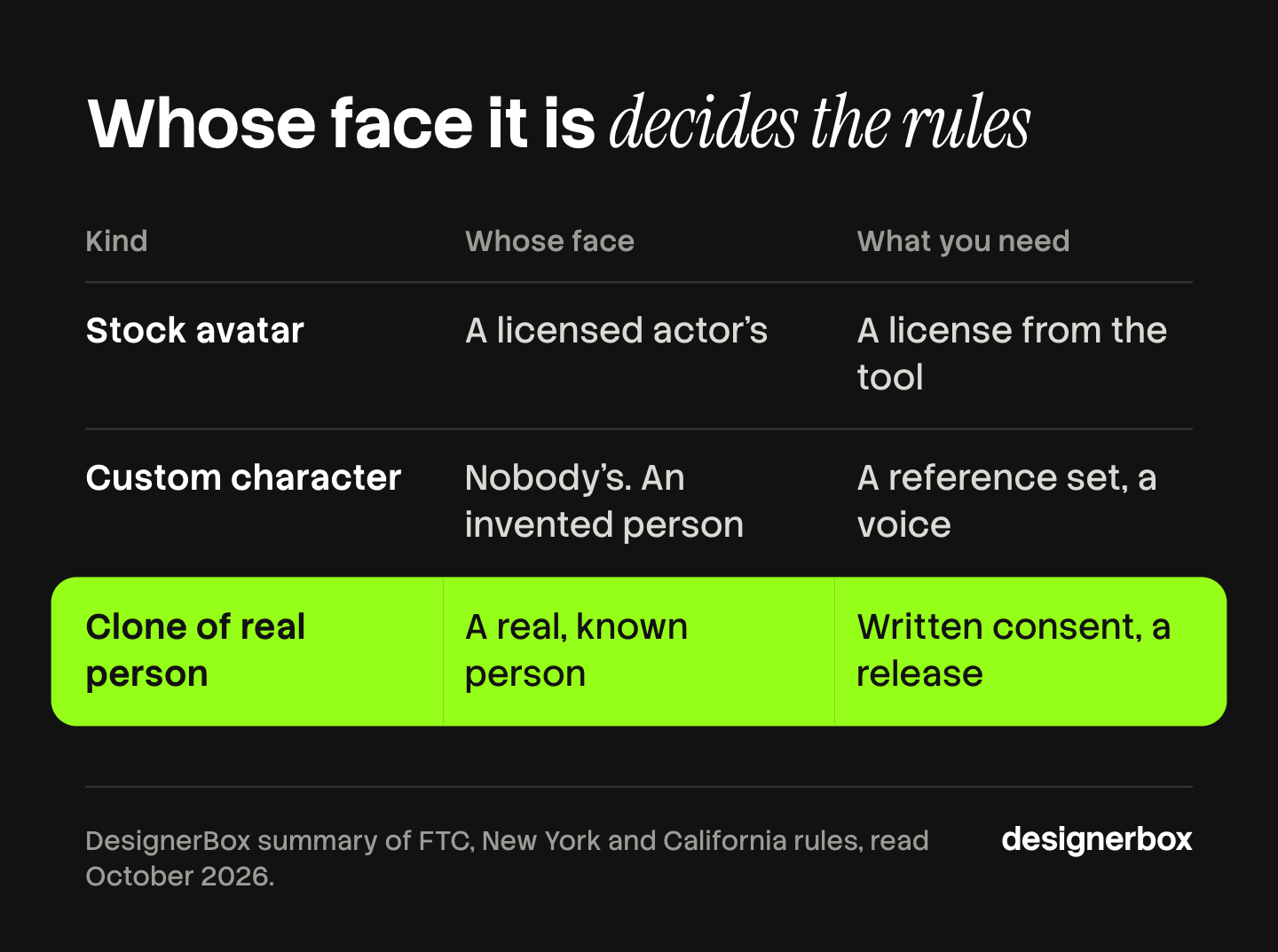
| Kind | Whose face | What you need | Rules that apply | Best for |
|---|---|---|---|---|
| Stock avatar | A licensed actor’s, or a library face | A license from the tool, and a check of its terms | The tool’s terms, platform labels, FTC rules on claims | Tests, training clips, short campaigns |
| Custom character | Nobody’s. An invented person | A reference set, a voice, a brand record | Synthetic performer laws, platform labels, FTC rules on claims | A long-running brand presenter |
| Clone of a real person | A real, known person | Written consent, a release, a voice agreement | Likeness and voice laws, deep fake disclosure, FTC rules on claims | A founder or expert the audience knows |
Stock avatar
A stock avatar is a ready-made presenter from a tool’s library. You choose a face, paste a script and get a video. Avatar tools describe how they clear these faces. Synthesia says its stock avatars “are built from footage of real actors who give their explicit consent and are paid each time their avatar is used” (synthesia.io, October 2026). HeyGen says its stock avatars are “approved for commercial use” (heygen.com, October 2026). Talking-avatar tools are one of four kinds of AI influencer generator.
A stock avatar is the fastest kind to start with. Its limit is ownership. The library is open to every customer of the tool, so another brand can use the same face. Read the tool’s terms for the uses it allows before you build a campaign on a library face.
Custom character
A custom character is an invented person. No real individual is behind the face. The brand designs the character, keeps the reference images and uses the same face in every ad. Because nobody else has those references, the character belongs to the brand in practice.
A custom character takes more work at the start. You need a reference set that holds the face steady, and a voice that stays the same. Our guide to building a consistent AI character covers the reference set and the models that hold identity.
Clone of a real person
A clone is a digital copy of a real person. Tools call it a custom avatar, a personal avatar or a digital twin. The person records a short video or supplies photos, and the tool builds a presenter that looks and sounds like them.
The avatar tools build consent into this step. HeyGen says: “Custom avatars require verified consent from the person being recreated” (heygen.com, October 2026). Synthesia asks the person to record a consent video, and says it is not possible to create an avatar of anyone “without the explicit consent of the person involved” (synthesia.io, October 2026).
A clone is the strongest kind when the audience knows the person. It also carries the most paperwork, as the next sections show.
What does each kind of AI spokesperson need?
Each kind needs four things: a right to the face, a right to the voice, a reference that keeps the presenter the same, and a rule for what the script may claim. The first two change with the kind. The last two apply to all three. This section is general information, not legal advice.
Stock avatar. The right to the face and voice comes from the tool’s license. Check three points in its terms: whether paid ads are allowed, whether the license ends when your plan ends, and whether some product categories are excluded. Keep a copy of the terms with the campaign files.
Custom character. There is no person to sign a release, so the work is production. Build the reference set first: the same face from several angles, in the same light. Choose one voice and keep it. Write the character’s rules next to the brand rules, so every team member uses the same face. Then decide the label for each market, because the law treats an invented presenter as its own category.
Clone of a real person. Get written consent before anyone records. In New York, a business that uses the “name, portrait, picture, likeness, or voice of any living person” for advertising “without having first obtained the written consent of such person” is guilty of a misdemeanor (nysenate.gov, Civil Rights Law section 50, read October 2026). In California, Civil Code section 3344 requires a person’s prior consent to use their name, voice, photograph or likeness for advertising. Damages are $750 or the actual loss, whichever is greater (leginfo.legislature.ca.gov, read October 2026). California’s SB 1111 adds a line to the same section: “a voice or likeness includes a digital replica” (leginfo.legislature.ca.gov, read October 2026).
A useful release for a clone states four things: which products and channels the clone may appear in, for how long, what the person is paid, and what happens to the clone when the person leaves the company. The last point matters most for a founder or an employee.
The voice needs the same care as the face. Both statutes above name voice. Our comparison of AI voiceover for UGC ads explains when a cloned voice is worth the extra consent.
What do the rules say about an AI spokesperson?
No rule read for this guide bans an AI spokesperson. The rules ask for three things: no fake testimonial, a disclosure in some places when the presenter is synthetic, and consent when the presenter is a real person. Each rule below is quoted from its own source, read in October 2026.
The FTC: no fake testimonial
The FTC’s rule on consumer reviews and testimonials makes it a violation for a business to write, create or sell a consumer testimonial that materially misrepresents “that the reviewer or testimonialist exists”, or that they used the product (law.cornell.edu, 16 CFR 465.2, read October 2026). The rule defines a consumer testimonial as an ad message that consumers are likely to believe reflects the experience “of a consumer who has purchased, used, or otherwise had experience with a product” (law.cornell.edu, read October 2026).
FTC staff answered the avatar question directly. “The rule has no blanket prohibition on the use of AI-generated avatars in marketing.” An avatar’s message might count as a testimonial, and that “would be prohibited under the rule only if the underlying testimonials were fake or false”. The same answer adds a warning for clones: it would violate the rule “to use a celebrity avatar without the celebrity’s permission to speak favorably about a product, if reasonable consumers would think that the celebrity actually gave a testimonial” (ftc.gov, read October 2026).
So the test is the script. A spokesperson who explains the product makes no personal claim. A spokesperson who says “I used it for a month” claims an experience that an invented person never had. Our guide to AI UGC ads covers that line and the penalty in detail.
The Endorsement Guides add one more point. Ads that present “actual consumers” should use actual consumers in both the audio and the video, or clearly disclose that the people shown are not actual consumers (law.cornell.edu, 16 CFR 255.2(c), read October 2026).
New York and California: synthetic performers
New York’s General Business Law section 396-b covers the custom character. A business that produces an ad must “conspicuously disclose in such advertisement that a synthetic performer is in such advertisement”, where it has actual knowledge. The penalty is $1,000 for a first violation and $5,000 for each later one. The law does not apply to audio advertisements (nysenate.gov, read October 2026). The governor’s office announced that the law is in effect (governor.ny.gov, read October 2026).
The definition matters for the three kinds. A synthetic performer is a digital asset meant to look like a human performer “who is not recognizable as any identifiable natural performer”. An invented character fits those words. A clone of a known person is recognizable, so the consent laws above are the ones to read for a clone. For a stock avatar built from a real actor’s footage, ask the tool and your lawyer which definition applies.
California passed a similar law. The governor signed SB 1050 on 16 September 2026, and it applies from 1 January 2027. It covers an ad that prominently includes a synthetic performer. The disclosure must use wording close to “this performance features a synthetic performer” or “no human performer is depicted” (leginfo.legislature.ca.gov, read October 2026).
The EU: deep fake disclosure
Article 50 of the EU AI Act has applied since 2 August 2026 (digital-strategy.ec.europa.eu, read October 2026). Article 50(4) says: “Deployers of an AI system that generates or manipulates image, audio or video content constituting a deep fake, shall disclose that the content has been artificially generated or manipulated” (AI Act Service Desk, read October 2026).
The Commission’s FAQ says a deep fake needs to resemble a person or thing “that exists, can plausibly exist or could have plausibly existed in reality”. It also says: “Deployers must disclose deepfake content to a natural person upon first exposure at the latest.” A realistic presenter of any of the three kinds can meet that description, so plan a visible label for EU placements.
Meta and TikTok: labels on ads
TikTok asks the advertiser to act. Its ads policy allows AI-generated media if you “apply the AIGC label, or by adding a clear disclaimer, caption, watermark, or sticker of your own”. It adds: “If we identify AI-generated content that has not been disclosed, your ad will be rejected or restricted” (ads.tiktok.com, last updated April 2026, read October 2026).
Meta labels ads itself. It says: “We will automatically apply an AI info label when we detect your ad was created or edited by third-party generative AI tools.” The label sits in the three-dot menu under About this ad. Advertisers must disclose AI themselves only in ads about social issues, elections or politics (facebook.com, read October 2026).
How do you choose an AI spokesperson?
Choose the face first, then the tool. Ask three questions in order. Does the audience need to know this person? Will the presenter appear for longer than one campaign? Where will the ads run? The answers point to one kind, and the kind tells you which tools and which paperwork you need.
- Does the audience know the person? If the value is a known founder or expert, you need a clone, with written consent. If nobody needs to know the presenter, a clone adds paperwork and no value.
- How long will the presenter appear? For a test or a short campaign, a stock avatar is enough. For a presenter who should become part of the brand, build a custom character that no other brand can use.
- Where will the ads run? List the markets and platforms. Mark New York, California from 2027, the EU and TikTok, and plan the label each one asks for.
- What will the script claim? Mark every line that states a personal experience. Rewrite it as a product fact, or give it to a real customer.
- Who keeps the files? Store the license, the release or the reference set with the campaign, so the next team can prove the right to the face.
A short rule covers most cases. Use a stock avatar to learn what works. Move the winning script to a custom character when the presenter becomes part of the brand. Use a clone only when the real person is the reason people listen.

When the kind is clear, compare tools for that kind. Our roundup of the best AI UGC ad tools sorts them by job. If the clip looks wrong after you pick one, the guide to realistic AI lip sync explains the usual cause.
One presenter across many products
Anyone can make an AI picture. Making hundreds that still look like your brand is the hard part. A spokesperson raises the same problem in video: the tenth ad must show the same face, the same voice and the same brand rules as the first.
DesignerBox is AI creative production for brands and agencies. For an agency that makes spokesperson ads for many products, the work that repeats is the variant: the same presenter, a new product, a new first line. You build the workflow once, with the presenter, the script rules and the brand. A saved workflow runs the same way on the next product, and batch runs it over a whole sheet of products.
These parts are live:
- The presenter. An avatar run returns nine fixed poses for 25 credits. There are also six ready-made avatars, and a talking avatar with lip sync.
- The voice. Text to speech has 20 voices, so one presenter keeps one voice.
- The brand. The brand is a record, and the workflow reads it on every run.
- The review. Critic steps score the results of a run, and best-of-N keeps the best one.
- The edit. The video editor is a timeline where you add captions and the label text a placement asks for.
The AI UGC page shows creator-style clips made from a product photo and a short brief. The full workflow from the first product photo to the finished ad, in one subscription.
The limits are these. DesignerBox does not collect consent for you: a release for a real person is your document, signed before any photo is uploaded. It does not publish ads to Meta or TikTok. You download the results, or send them with a webhook or an S3 step. An 8-second clip costs 40 to 560 credits, depending on the model, and the cost of a run is shown before you press Run. Team features are on the Ultra plan, and every plan below Ultra is one seat.
Uploading your own photos and the commercial license start on the Pro plan. AI video, virtual try-on, upscaling, the image editor and the video editor start on the Premium plan. Plans and credits are on the pricing page.
Scale content without limits
Decide whose face it is, then build the presenter once. See how agencies run one presenter for each client on the agencies page.
FAQ
What is an AI spokesperson?
An AI spokesperson is a presenter made with AI who delivers a brand’s script in video. It can be a stock avatar from a tool’s library, a custom character that only the brand uses, or a clone of a real person. The brand writes the words, and a model makes the face, the voice and the lip movement.
Is an AI spokesperson legal in ads?
FTC staff say the reviews and testimonials rule “has no blanket prohibition on the use of AI-generated avatars in marketing”. The limits are in the details. The presenter must not give a fake testimonial, some places require a disclosure, and a real person’s likeness needs consent. This is general information only.
What is a UGC avatar?
A UGC avatar is an AI presenter filmed in the style of a customer’s phone video: vertical, casual, in a real-looking room. It is one format of AI spokesperson. The same three kinds and the same rules apply. A UGC avatar must not claim a personal experience with the product.
Do I need consent to clone a real person as a spokesperson?
Yes. New York Civil Rights Law section 50 requires written consent before you use a living person’s likeness or voice in advertising. California Civil Code section 3344 requires prior consent. Avatar tools such as HeyGen and Synthesia also ask the person for consent before they build the clone.
Do AI avatar ads need a label?
It depends on the place and the kind. TikTok asks for its AIGC label or your own clear disclaimer on AI-generated ad media. New York requires a conspicuous disclosure when an ad shows a synthetic performer, and California does from 1 January 2027. In the EU, deployers must disclose deep fakes.
Can an AI spokesperson give a testimonial?
Not as a customer. The FTC rule at 16 CFR 465.2 bans a testimonial that misrepresents that the person exists or used the product. An AI spokesperson can explain and show a product. A personal result needs a real person who had it.
What does an AI spokesperson cost?
It depends on the kind and the tool. Each avatar tool lists its plans on its own pricing page. In DesignerBox, an avatar run returns nine fixed poses for 25 credits, the cost is shown before the run, and video starts on the Premium plan.
Sources
- 16 CFR 465.2, Fake or false consumer reviews, consumer testimonials, or celebrity testimonials, via Cornell LII: law.cornell.edu/cfr/text/16/465.2, read October 2026
- 16 CFR 465.1, Definitions, via Cornell LII: law.cornell.edu/cfr/text/16/465.1, read October 2026
- 16 CFR 255.2, Consumer endorsements, via Cornell LII: law.cornell.edu/cfr/text/16/255.2, read October 2026
- FTC, Consumer Reviews and Testimonials Rule: Questions and Answers: ftc.gov, read October 2026
- New York General Business Law, section 396-b: nysenate.gov, read October 2026
- New York State, Governor’s announcement that the synthetic performer law is in effect: governor.ny.gov, read October 2026
- New York Civil Rights Law, section 50: nysenate.gov, read October 2026
- California Civil Code, section 3344: leginfo.legislature.ca.gov, read October 2026
- California SB 1111, Digital replicas: leginfo.legislature.ca.gov, read October 2026
- California SB 1050, False advertising: synthetic performers: leginfo.legislature.ca.gov, read October 2026
- Governor of California, announcement of the signing of SB 1050, 16 September 2026: gov.ca.gov, read October 2026
- EU AI Act, Article 50, AI Act Service Desk: ai-act-service-desk.ec.europa.eu, read October 2026
- European Commission, FAQ on the transparency obligations under Article 50 of the AI Act: digital-strategy.ec.europa.eu, read October 2026
- TikTok Ads Policy, Misleading and false content, last updated April 2026: ads.tiktok.com, read October 2026
- Meta Business Help Center, About AI info on ads created or edited with generative AI tools: facebook.com, read October 2026
- HeyGen, AI avatars page (heygen.com/avatars), read October 2026
- Synthesia, AI avatars and custom avatar pages (synthesia.io/features/avatars, synthesia.io/features/custom-avatar), read October 2026
- DesignerBox plan gates and the video credit range: DesignerBox pricing page (designerbox.ai/pricing), October 2026
FTC rules, state laws, EU rules and platform policies checked against primary sources as of October 2026. Rules change, so check each page again before a campaign goes live. Individual results vary.