


A UGC style video is a short vertical video that looks like a customer filmed it on a phone, and a brand uses it as an ad. In 2026 you can film one with a real creator or make one with an AI presenter. Neither route is better for every ad. Three tests decide each ad: what the ad claims, whose account it runs from, and where it runs.
Most comparisons of the two routes end with the same advice: test with AI, then film the winner. That advice treats every ad as the same kind of ad. A testimonial and a product demo are different ads, with different rules. Our guide to testimonial ads covers the six formats and the proof each one needs. A plan that ignores the difference pays a creator for clips a model could make, or puts a made-up customer on screen.
This guide gives the three tests, a table that sorts nine common ad types, and a way to plan a month of ads with both routes. It is for a brand, or the agency that runs its ad account, deciding what to commission next.
Key Takeaways
- Decide per ad, never per campaign. One campaign usually holds ads that need a real person and ads that need none.
- Test 1 is the claim. An ad that claims a personal experience needs a person who had it. The FTC rule on reviews and testimonials bans a testimonial that misrepresents that the person exists or used the product.
- Test 2 is the account. TikTok Spark Ads and Meta partnership ads run from a creator’s handle, with the creator’s permission. An AI presenter has no account of its own.
- Test 3 is the place. TikTok asks for a label on AI-generated ad media. New York requires a disclosure when an ad shows a synthetic performer, and California does from 1 January 2027.
- A label has a cost, and the cost depends on the product. In one 2025 experiment, ads labeled as AI-made earned lower trust and purchase intent, and the drop was larger for laptops than for snacks.
- A real creator does not fix a false claim. The FTC tells creators they cannot describe an experience with a product they have not tried.
What is a UGC style video?
A UGC style video is an ad made in the look of user-generated content: vertical framing, a real room, natural light and one person talking to the camera. The brand plans it, pays for it and runs it as an ad. The look tells the viewer that a person like them is speaking. That is why the person on screen, and what they say, carries legal weight.
The term covers two different things. The first is the style: the framing, the pace and the captions. The second is the speaker: a real person with a real experience, or a presenter who plays one. A model can make the style. Only a person can have the experience. The generated version has its own guide: what AI UGC is, and its three kinds.
That split is the reason this decision works ad by ad. Some ads need only the style. Some ads are worth nothing without the speaker.
The two routes to a UGC style video
There are two routes. A real creator films the video on a phone, usually after you send the product and a brief. An AI presenter is generated: you supply a script and a product photo, and a video model returns a person saying the lines. The first route charges per video. The second charges per run, with no shoot.
The creator route. You find a creator, agree a fee and usage rights, ship the product and wait for the files. A single creator video averages $150 to $212, according to a marketplace rate guide (Influee UGC rates guide, dated April 2025, read October 2026). Usage rights and ad access are usually extra. Our UGC ads guide compares how creators, marketplaces and platforms charge.
The AI route. You write the script, add a product photo and choose a presenter. Each new version costs one more run, so ten openings cost little more than one. The result still needs a frame-by-frame check on hands, label text and lip sync. Our guide to AI UGC ads covers the FTC line and the penalty for a generated presenter in detail.
Speed and cost favor the AI route for almost every ad. That is why speed and cost cannot be the test. The three tests below are the ones that change the answer.
What does the ad claim?
The first test is the claim. If the ad claims a personal experience, such as a result, a review or a first reaction, a real person must have had that experience. If the ad shows what the product is and does, no personal experience is claimed, and a generated presenter can say it. This section is general information, not legal advice.

The FTC’s rule on consumer reviews and testimonials took effect on October 21, 2024. Under 16 CFR 465.2, a business must not write, create or sell a consumer testimonial that materially misrepresents that the person exists, that they used the product, or what their experience was (law.cornell.edu, read October 2026). The rule defines a consumer testimonial as an ad message that people are likely to believe reflects the experience of someone who used the product (law.cornell.edu, read October 2026).
The same rule leaves AI presenters alone when the script claims no experience. FTC staff guidance says: “The rule has no blanket prohibition on the use of AI-generated avatars in marketing.” It adds that an avatar’s testimonial “would be prohibited under the rule only if the underlying testimonials were fake or false” (ftc.gov, read October 2026).
So read the script, line by line.
| Script line | What it claims | Who can say it |
|---|---|---|
| ”The lid locks, so it does not leak in a bag.” | A product fact | AI presenter or creator, if true |
| ”Here is how the strap adjusts.” | A demonstration | AI presenter or creator |
| ”I have used it every day for a month.” | A personal experience | Only a person who did |
| ”My skin looked clearer in two weeks.” | A personal result | Only a person who had it, with proof for the claim |
| ”This is the first time I have opened the box.” | A first reaction | Only a person opening the box |
Two points follow from the table.
A real creator does not pass this test only by being real. The FTC’s guide for influencers says: “You can’t talk about your experience with a product you haven’t tried” (ftc.gov, read October 2026). A creator who reads a result from your script, without using the product, makes the same false claim as an avatar. Ship the product first, and let the creator say what happened. The paid relationship also needs a clear disclosure, and the FTC says the company is “ultimately responsible for what others do on your behalf” (ftc.gov, read October 2026).
A real review read by a generated presenter is a middle case. The words are true, and the face is not the customer. The FTC’s Endorsement Guides say that ads presenting “actual consumers” should use actual consumers in both the audio and the video, or clearly disclose that the people shown are not actual consumers (law.cornell.edu, 16 CFR 255.2(c), read October 2026). If you use this format, say on screen that a presenter is reading a customer’s review.
Whose account does the ad run from?
The second test is the account. Some ads run from the brand’s own handle. Others run from a creator’s handle, so the viewer sees the creator’s name and profile on the ad. An ad of the second kind needs a real account with a real owner who gives permission. A generated presenter cannot give that.
On TikTok, Spark Ads let a brand run ads from its own posts or from “organic posts made by other creators (with their authorization)”. TikTok says engagement from the ad is attributed to the original post (ads.tiktok.com, last updated June 2026, read October 2026).
On Meta, the format is the partnership ad. Meta says: “To run partnership ads, advertisers need permission from the partner whose handle the ad will include. Creators and other partners can revoke these permissions at any time” (facebook.com, read October 2026).
This test changes the plan in a practical way. If part of your media budget is set aside for creator-handle ads, that part needs creators, whatever the script says. Ask for the Spark Ads code or the partnership ad permission in the brief, so it is part of the fee. Our guide to writing a UGC script lists every field the brief needs.
An ad that runs from your own brand handle passes this test with either route.
Where does the ad run?
The third test is the place. A filmed creator needs no AI label. A generated presenter needs one on some platforms and in some states, and the rules differ. Check each placement and each market before you choose the route, because the label is part of the ad the viewer sees.
| Place | What it asks for when the presenter is generated | Source |
|---|---|---|
| TikTok ads | The AIGC label, or your own clear disclaimer, caption, watermark or sticker | TikTok ads policy, last updated April 2026 |
| Meta ads | No advertiser step for a product ad. Meta adds an “AI info” label when it detects AI | Meta Business Help Center |
| New York | A conspicuous disclosure in the ad that it shows a synthetic performer | General Business Law 396-b |
| California, from 1 January 2027 | A clear disclosure when a synthetic performer appears prominently | SB 1050, Chapter 246 of 2026 |
| European Union | Disclosure of deep fakes by the business that uses the AI system | AI Act, Article 50 |
TikTok. The ads policy allows AI-generated media if you “apply the AIGC label, or by adding a clear disclaimer, caption, watermark, or sticker of your own”. It adds: “If we identify AI-generated content that has not been disclosed, your ad will be rejected or restricted” (ads.tiktok.com, read October 2026).
Meta. Meta labels ads itself. It applies an “AI info” label when it detects that an ad was made or edited with third-party AI, and the label sits in the three-dot menu under About this ad. Meta says the feature may not be available in every region. Advertisers who deliver to the European Region, California, New York, India or Taiwan may get the option to disclose AI use themselves (facebook.com, read October 2026).
New York. The law has applied since 9 June 2026. A business that produces an ad must “conspicuously disclose in such advertisement that a synthetic performer is in such advertisement”, where it has actual knowledge. The penalty is $1,000 for a first violation and $5,000 for each later one (nysenate.gov, read October 2026).
California. The governor approved SB 1050 on 16 September 2026, and it applies from 1 January 2027. It covers ads that prominently include a synthetic performer. The disclosure wording must be close to “this performance features a synthetic performer” or “no human performer is depicted” (leginfo.legislature.ca.gov, read October 2026).
European Union. Article 50 of the AI Act has applied since 2 August 2026 (digital-strategy.ec.europa.eu, read October 2026). A realistic generated presenter can count as a deep fake that needs a disclosure. Our guide to AI disclosure in advertising covers the tests.
What a label costs
A label changes how people rate the ad. Two studies measured it.
One experiment showed people ads for snacks and for laptops, made by AI or by people, and labeled as AI-made or human-made. Ads labeled as AI-made earned lower trust and lower purchase intent. The author reports the effect was stronger for the laptops, the high-involvement product (Israfilzade, Equilibrium 20(4), published 30 December 2025, read October 2026).
NIM, a market research institute, ran a similar test with identical ads. People who were told an ad was AI-generated rated it as less natural and less useful, and their willingness to research or buy the product fell (nim.org, read October 2026).
Both are survey experiments with stills, so read them as direction. They were not run on live video ads. The direction still matters for this decision. Where the law or the platform makes you label the presenter, the label is part of the cost of the AI route. That cost is likely to be highest on products people research before they buy.
Which UGC style videos to generate and which to film
Run each planned ad through the three tests. If it claims a personal experience, film it with a person who had the experience. If it must run from a creator’s handle, film it with that creator. If it passes both, generate it, and add the label where the placement asks for one. The table applies the tests to nine common ad types. For the formats written out beat by beat, see 12 UGC video examples.
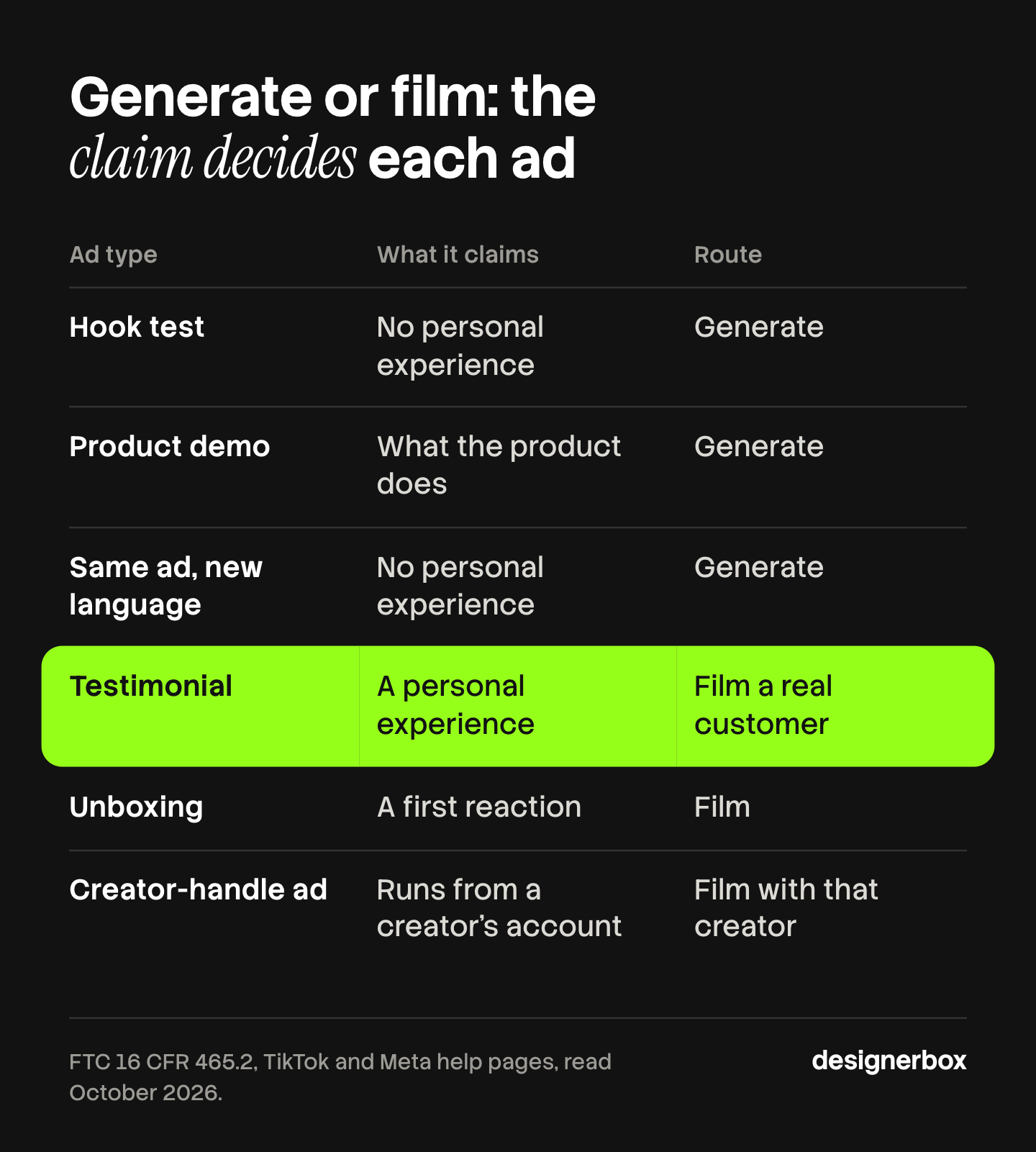
| Ad type | Claims an experience? | Needs a creator’s handle? | Route |
|---|---|---|---|
| Hook test, several openings on one body | No | No | Generate |
| Product demo or how-to | No | No | Generate, from your product photo |
| Feature explainer | No | No | Generate |
| Problem and solution skit | No, if the script states no result | No | Generate |
| The same ad in another language | No | No | Generate |
| Testimonial or customer story | Yes | No | Film, with a real customer |
| Unboxing and first reaction | Yes | No | Film |
| Before and after result | Yes | No | Film, and check the platform’s rules on comparisons |
| Spark Ad or partnership ad | Either | Yes | Film, with the creator who owns the handle |
Five of the nine pass both tests. Those five are also the ads you need the most versions of, because a hook test is only a test with several openings. The four ads to film are the ones where the person is the proof.
The before and after row has its own platform rule. TikTok’s ads policy does not allow product effect comparisons such as before-and-after results that may give viewers a false impression of the outcome (ads.tiktok.com, read October 2026).
One finding supports the split. A field study of 67 Meta campaigns for one publisher compared 26 creator-style campaigns with 41 brand-made ones. The creator-style campaigns had higher conversion rates and a higher return on ad spend (mdpi.com, Systems 13(2), February 2025, read October 2026). That study used real people, in one market and one category. It shows the style can work. It does not show that a generated presenter earns the same result. We found no public field test that compares the two routes on live video ads.
How to plan a month of UGC style video
Plan the month from the ad list. Write every ad the media plan needs, run each through the three tests, and total the two columns. Most plans end with a short list to film and a long list to generate. Brief the creators early, because filming takes the longest, and run the generated list while the products ship.
- List the ads, with the claim each one makes. One line per ad. Write the claim as the viewer hears it.
- Mark the ads that need a person. Every experience claim and every creator-handle ad goes in the film column.
- Mark the markets. For each generated ad, note where it runs and which label that place asks for.
- Brief the creators first. Ship the product, list the allowed claims, and ask for ad access and usage rights in the same brief.
- Run the generated list in versions. Keep one body and change the opening. Hook rate shows which opening stopped the most people.
- Read the results per route. Compare like with like: demo against demo, with one variable changed. Our guide to ad creative testing explains how many ads one ad set can read.
- Move the winners. A generated opening that wins becomes the first line of the next creator brief. A creator’s real result stays with the creator.
Step 7 is the limit of “test with AI, then film the winner”. You can move a hook, a structure or a product angle from a generated ad to a filmed one. You cannot move an experience in the other direction. A creator’s real result cannot be given to a generated presenter in the next round of versions.

Creator-style clips from one workflow
Anyone can make an AI picture. Making hundreds that still look like your brand is the hard part. The generated column of the plan is where that problem appears: five ad types, several openings each, for every product.
DesignerBox is AI creative production for brands and agencies. For an agency, the generated column is the work that repeats for each client. You build the workflow once, with the brand’s rules, the script rules and the product photo. A saved workflow runs the same way on the next product, and batch runs it over a whole sheet of products. The AI UGC page shows creator-style vertical clips made from a product photo and a short brief. The video editor is a timeline where you join each opening to the same body and add the label text a placement asks for.
The full workflow from the first product photo to the finished ad, in one subscription.
The limits are these. DesignerBox makes the generated column only. It cannot film a customer, and a generated presenter cannot claim an experience. It does not publish ads into TikTok or Meta: you download the results, or send them with a webhook or an S3 step. An 8-second clip costs 40 to 560 credits, depending on the model, and the cost of a run is shown before you press Run. Team features are on the Ultra plan, and every plan below Ultra is one seat.
Uploading your own photos and the commercial license start on the Pro plan. AI video, virtual try-on, upscaling, the image editor and the video editor start on the Premium plan. Plans and credits are on the pricing page.
Scale content without limits
Start with the ads that pass all three tests. See how agencies run them for each client on the agencies page.
FAQ
What is a UGC style video?
A UGC style video is a short vertical video that looks like a customer filmed it on a phone, and a brand runs it as an ad. The brand plans and pays for it. A real creator can film it, or an AI presenter can be generated from a script and a product photo.
What is an AI UGC creator?
An AI UGC creator is a generated presenter who appears in a creator-style ad in place of a hired person. The presenter can show and describe a product. The presenter cannot claim a personal experience with it, because no person had that experience.
Is AI UGC or real UGC better for ads?
It depends on the ad. Use a real person when the ad claims an experience, such as a testimonial, an unboxing or a result, or when it runs from a creator’s handle. A generated presenter fits demos, explainers and hook tests. We found no public field test comparing the two routes on live video ads.
Can an AI presenter give a testimonial?
Not as a customer. The FTC rule at 16 CFR 465.2 bans a testimonial that misrepresents that the person exists or used the product. A generated presenter may read a real customer’s review if the ad clearly says the person shown is not the customer.
Do I have to label a UGC style video made with AI?
In several places, yes. TikTok asks for its AIGC label or your own clear disclaimer on AI-generated ad media. New York requires a conspicuous disclosure when an ad shows a synthetic performer, and California does from 1 January 2027. Meta adds its own “AI info” label when it detects AI.
Does an AI label hurt ad results?
Two survey experiments suggest it can. Ads labeled as AI-made earned lower trust and purchase intent, and one study found a larger drop for a high-involvement product. Both used stills in a survey, so treat the finding as direction and test it in your own account.
How much does a UGC style video cost?
A single creator video averages $150 to $212 before usage rights, according to Influee’s rate guide (dated April 2025, read October 2026). A generated clip is priced per run. In DesignerBox the cost is shown before the run, and video starts on the Premium plan.
Sources
- 16 CFR 465.2, Fake or false consumer reviews, consumer testimonials, or celebrity testimonials, via Cornell LII: law.cornell.edu/cfr/text/16/465.2, read October 2026
- 16 CFR 465.1, Definitions, via Cornell LII: law.cornell.edu/cfr/text/16/465.1, read October 2026
- 16 CFR 255.2, Consumer endorsements, via Cornell LII: law.cornell.edu/cfr/text/16/255.2, read October 2026
- FTC, Consumer Reviews and Testimonials Rule: Questions and Answers: ftc.gov, read October 2026
- FTC, Disclosures 101 for Social Media Influencers: ftc.gov, read October 2026
- FTC, Endorsement Guides: What People Are Asking: ftc.gov, read October 2026
- TikTok Ads Policy, Misleading and false content, last updated April 2026: ads.tiktok.com, read October 2026
- TikTok Business Help Center, About Spark Ads, last updated June 2026: ads.tiktok.com, read October 2026
- Meta Business Help Center, About AI info on ads created or edited with generative AI tools: facebook.com, read October 2026
- Meta Business Help Center, About partnership ad permissions: facebook.com, read October 2026
- New York General Business Law, section 396-b: nysenate.gov, read October 2026
- California SB 1050, False advertising: synthetic performers, Chapter 246, Statutes of 2026: leginfo.legislature.ca.gov, read October 2026
- European Commission, FAQ on the transparency obligations under Article 50 of the AI Act: digital-strategy.ec.europa.eu, read October 2026
- Israfilzade, K., “AI-generated versus human-created advertising: Effects on consumer trust and purchase intent”, Equilibrium. Quarterly Journal of Economics and Economic Policy 20(4), published 30 December 2025: economic-policy.pl, read October 2026
- NIM, Consumer attitudes toward AI-generated marketing content: nim.org, read October 2026
- Directed consumer-generated content field experiment, Systems 13(2), 124, February 2025: mdpi.com, read October 2026
- Influee, UGC rates guide (dated April 2025), influee.co/blog/ugc-price, read October 2026
- DesignerBox plan gates and the video credit range: DesignerBox pricing page (designerbox.ai/pricing), October 2026
FTC rules, platform policies and state laws checked against primary sources as of October 2026. Rules change, so check each page again before a campaign goes live. Individual results vary.