

A UGC script is the written plan for what a creator says and shows in a user-generated content ad. It sets the hook, the beats, the words and the call to action, with seconds for each part. A 15-second ad fits about 45 spoken words at a normal reading pace, and a 30-second ad about 90. The script travels inside a brief that also sets shooting specs and deliverables.
Many UGC ads fail before the camera turns on. The script runs 120 words for a 30-second slot, so the creator rushes. The hook sits in second eight. Or the script asks a creator to promise a result the brand cannot prove. The video comes back unusable, and the next round costs the same again.
This guide gives six UGC script templates with seconds and word counts per beat, the brief a creator needs with them, and the lines FTC guidance says a script must not put in a creator’s mouth. The guide is for brands and agencies that brief creators, or generate creator-style ads, every week.
Key Takeaways
- Count words before you count scenes. People read aloud at about 183 words a minute on average. That is about 45 words for 15 seconds and 90 for 30.
- Leave room for silence. A product shot with no voice over it needs seconds too. Write 20% fewer words than the time allows.
- The hook goes first, in words and pictures. TikTok advises introducing the offer in the first 3 seconds and the hook in the first 6.
- Script three hooks, one body. The creator records each hook separately, so one shoot gives three ads to test.
- The brief carries the specs. 9:16 video, text outside the platform’s safe zones, no licensed music in Reels ads, and raw files delivered.
- A script cannot claim what the brand cannot prove. Under FTC guidance, the brand is liable for a paid creator’s false claim.
- Ask for ad access in the brief. A TikTok Spark Ads code or Meta partnership ad permission lets the ad run from the creator’s handle.
What is a UGC script?
A UGC script is the text a creator follows to film a user-generated content ad: the hook line, what they say about the problem and the product, what they show, and how they end. A good one reads like speech. It gives the creator the claims and the order, and leaves the exact words loose enough to sound like them.
A UGC script differs from a TV script in two ways. It is written for a phone screen, often watched with the sound off, so every spoken point also needs a visual or a caption. And it is written for testing: one body with several hooks, so the ad account can compare openings.
The script is one part of the job. The other part is the brief: who the viewer is, what the creator may claim, how to shoot, and what files to deliver. A creator with a script and no brief sends back a nice video in the wrong shape. A creator with a brief and no script sends back a video that says whatever came to mind.
How long should a UGC script be?
A UGC script should hold about 3 words per second of video, minus room for silent product shots. A meta-analysis of 77 studies put the average oral reading rate at 183 words per minute (Brysbaert, doi.org, 2019). That is about 45 words for 15 seconds and 90 for 30. The same paper puts audiobooks at 140 to 180 words a minute.
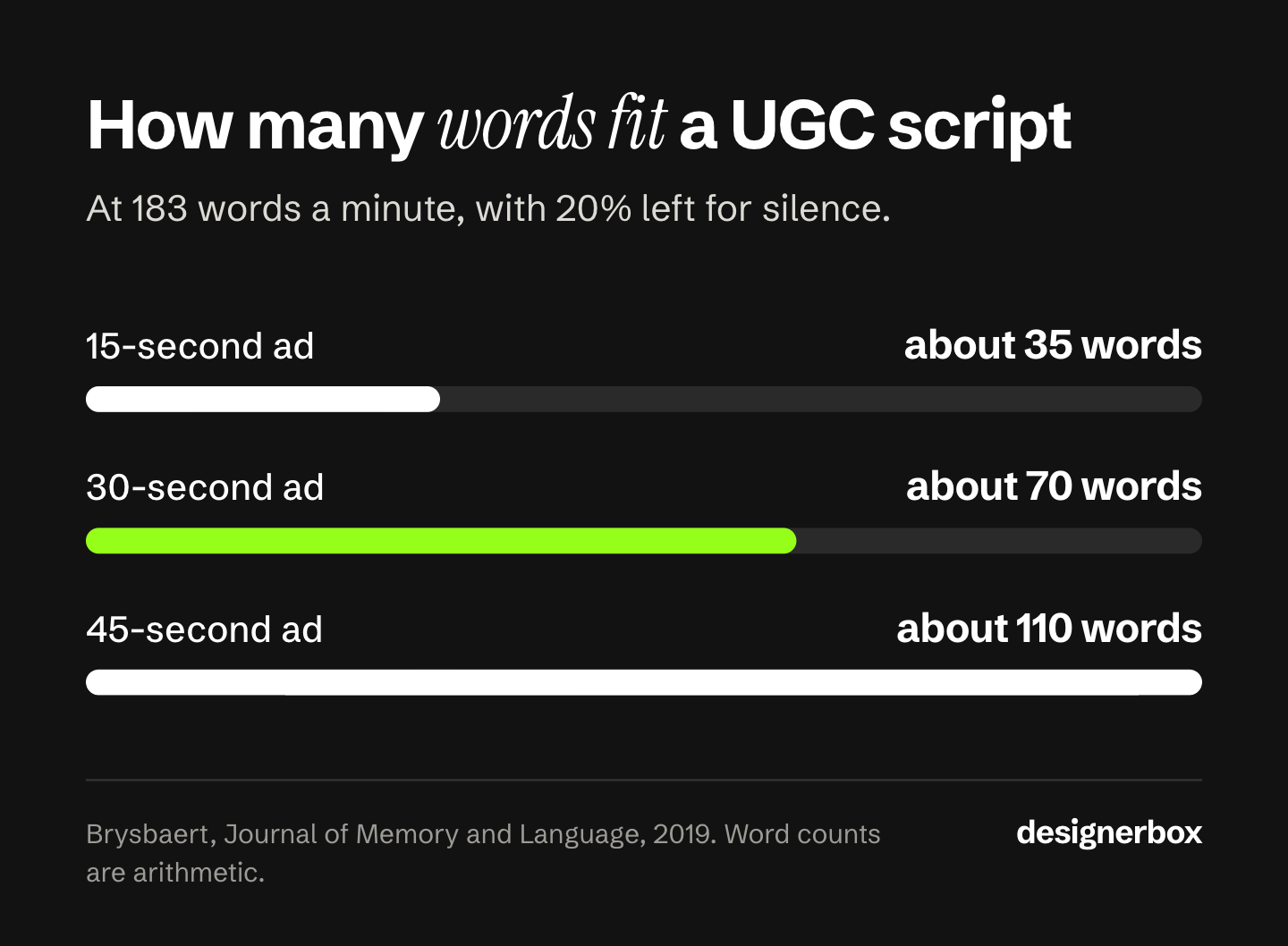
| Ad length | Words at 183 per minute | Words to write (20% for silence) | Beats that fit |
|---|---|---|---|
| 15 seconds | About 45 | About 35 | Hook, one proof, call to action |
| 30 seconds | About 90 | About 70 | Hook, problem, product, proof, call to action |
| 45 seconds | About 135 | About 110 | Hook, problem, product, two proofs, objection, call to action |
The word counts are arithmetic from the reading rate, not a platform rule. The 20% cut is our working rule: it leaves time for a demo shot, a pause after the hook and a product close-up with no voice.
Two platform notes on length. TikTok’s video advertising guide says “21–34 seconds performs best” for in-feed ads (ads.tiktok.com, read September 2026). Meta says Instagram Stories plays video ads under 16 seconds in full, and “video ads that are 16 seconds or longer may be split into separate Stories cards” (facebook.com/business/ads-guide, September 2026). If the ad will run in Stories, ask for a cut under 16 seconds.
What goes in the first 3 seconds of a UGC script?
The first 3 seconds of a UGC script hold the hook: one spoken line, one visual and one line of text on screen, all saying the same thing. TikTok advises: “Introduce your content proposition in the first 3 seconds for better recall and awareness”, and “Prioritize your hook in the first 6 seconds” (ads.tiktok.com, last updated June 2025).
Write the hook as a full sentence under 10 words. Four shapes work for most products:
- The result. “This is my kitchen counter after one wipe.”
- The problem, named exactly. “My jeans stretch out by lunch.”
- The comparison. “I switched from the gym-bag version to this one.”
- The objection. “I did not expect a drugstore serum to do anything.”
Script three hooks for the same body. The creator films each one as a separate clip. The editor then joins each hook to the same body, and you have three ads from one shoot. Which of them works is a number: hook rate shows which opening stopped the most people.
UGC script templates by ad type
A UGC script template gives the beats, the seconds and the word budget for one type of ad. The six templates below are for a 30-second ad, with about 70 words to write. Shorten each beat for 15 seconds. Every template starts with a hook and ends with one call to action.
1. Problem and solution (30 seconds)
| Beat | Seconds | Words | What happens |
|---|---|---|---|
| Hook | 0 to 3 | 8 | The problem in one line, with the product in hand |
| Problem | 3 to 9 | 16 | What the viewer has tried, and why it failed |
| Product | 9 to 18 | 22 | The product in use, one feature per sentence |
| Proof | 18 to 26 | 16 | The visible result, filmed, not described |
| Call to action | 26 to 30 | 8 | One action: the link, the code or the page |
2. Demo (30 seconds)
| Beat | Seconds | Words | What happens |
|---|---|---|---|
| Hook | 0 to 3 | 8 | The result shown first |
| Step 1 | 3 to 11 | 18 | The first use step, hands in frame |
| Step 2 | 11 to 19 | 18 | The second step, close-up |
| Result | 19 to 26 | 10 | The finished result, held on screen, little talk |
| Call to action | 26 to 30 | 8 | Where to buy |
3. Unboxing and first use (30 seconds)
| Beat | Seconds | Words | What happens |
|---|---|---|---|
| Hook | 0 to 3 | 8 | The box arriving, with a reason to watch |
| Open | 3 to 10 | 14 | What is inside, shown piece by piece |
| First use | 10 to 22 | 30 | The creator uses it for the first time, on camera |
| Honest note | 22 to 27 | 10 | One real detail: the size, the feel, the smell |
| Call to action | 27 to 30 | 8 | Where to buy |
4. Comparison (30 seconds)
| Beat | Seconds | Words | What happens |
|---|---|---|---|
| Hook | 0 to 3 | 8 | ”I tried both” with both products in frame |
| Old way | 3 to 12 | 20 | The old product or habit, and its real limit |
| New way | 12 to 22 | 22 | The product doing the same job, side by side |
| Verdict | 22 to 27 | 10 | Which one the creator keeps, and why |
| Call to action | 27 to 30 | 8 | One action |
5. Customer story (30 seconds, real customers only)
| Beat | Seconds | Words | What happens |
|---|---|---|---|
| Hook | 0 to 3 | 8 | The moment the customer noticed a change |
| Before | 3 to 11 | 18 | Their situation before the product |
| Use | 11 to 20 | 20 | How they use it, filmed in their space |
| After | 20 to 27 | 14 | What changed for them, in their own words |
| Call to action | 27 to 30 | 8 | One action |
6. Founder or maker (30 seconds)
| Beat | Seconds | Words | What happens |
|---|---|---|---|
| Hook | 0 to 3 | 8 | Why the product exists, in one line |
| Origin | 3 to 11 | 18 | The problem the founder had |
| How it is made | 11 to 21 | 22 | One material or process detail, shown |
| Proof | 21 to 27 | 14 | Something the viewer can check |
| Call to action | 27 to 30 | 8 | One action |
A customer story is only a customer story when the person is a real customer who used the product. If an actor or a generated presenter plays the customer, the FTC rules in the next sections apply, and the ad must say so.
What goes in a UGC brief?
A UGC brief is the one-page document a creator gets with the script. It says who the ad is for, what the creator may and may not claim, how to film, and what to deliver. It prevents the most common reshoot: a good video in the wrong format, with the wrong claim, or with music the ad account cannot use.
| Field | What to write |
|---|---|
| Product and offer | The product, the price and the one offer the ad carries |
| Viewer | Who watches: their problem and what they have tried |
| Allowed claims | The claims the brand can prove, word for word |
| Banned claims | The claims the creator must not make, such as “cures” or “guaranteed” |
| Script | The body, plus three hooks to film as separate clips |
| B-roll list | Each shot: product close-up, hands in use, result, packaging |
| Format | Vertical 9:16, at least 1080 x 1920, filmed on the rear camera, good light |
| Text and safe zones | No text or logos in the top 14%, the bottom 35% or 6% on each side |
| Sound | Voice only, or royalty-free music. No licensed music in Reels ads |
| Deliverables | Each hook, the body, the B-roll and the raw files, named by shot |
| Ad access | A TikTok Spark Ads code or Meta partnership ad permission, and for how long |
| Usage rights | Where the brand may use the video, and for how long |
| Deadline | Filming date, delivery date and one revision round |
The specs come from the platforms. TikTok’s creative best practices recommend “orienting vertically at 9:16, shooting at least 720P resolution” (ads.tiktok.com, June 2025). Meta’s Reels ad specs ask for 9:16 at 1440 x 2560 pixels and advise “leaving at least 14% of the top, 35% of the bottom, and 6% on each side of your asset free from text, logos, or other important creative elements”. The same page lists licensed music as something a Reels ad may not contain (facebook.com/business/ads-guide, September 2026).
Ad access decides whose handle the ad runs from. TikTok’s Spark Ads let a brand run ads “using organic posts made by other creators (with their authorization)” (ads.tiktok.com, September 2026). On Meta, “Branded content ads are now called partnership ads”, and advertisers “need permission from the partner whose handle the ad will include” (facebook.com/business/help, September 2026). Put the request in the brief, so it is part of the fee.
A shoot brief for product photos is a different document with different columns. For stills, see the shot list template. For a campaign brief that sits above every format, see the creative brief template.
What can a UGC script not make a creator say?
A UGC script cannot make a creator claim an experience they did not have, praise a product they did not like, or state a result the brand cannot prove. FTC guidance says these things directly. The brand, not only the creator, is responsible for what a paid creator says. This section is general information, not legal advice.
The FTC’s guide for social media influencers lists three lines a script must not cross (ftc.gov, read September 2026):
- “You can’t talk about your experience with a product you haven’t tried.”
- “If you’re paid to talk about a product and thought it was terrible, you can’t say it’s terrific.”
- “You can’t make up claims about a product that would require proof the advertiser doesn’t have.”
For health, beauty and supplement products, the FTC’s Health Products Compliance Guidance goes further (ftc.gov, December 2022, read September 2026). It is business guidance and says it “doesn’t have the force or effect of law”. The claim rules for two of those categories are in supplement advertising and makeup ads. Four points bear on a script:
- A testimonial carries the brand’s claim. Advertisers “should not make claims through consumer testimonials or expert endorsements that would be deceptive or couldn’t be substantiated if the advertiser made them directly”.
- The brand is liable for the creator. In the FTC’s Example 40, a paid blogger says a supplement cures acid reflux. The marketer has no evidence, so “the marketer is liable for the blogger’s misleading representation.”
- “Results not typical” does not fix a dramatic result. Testimonials with results “more dramatic than users can generally expect are likely to be deceptive”, and that disclaimer “don’t cure the deception.”
- Soft words do not help. It is “not enough to say that the product ‘may’ have the claimed benefit or ‘helps’ achieve the claimed benefit.”
The disclosure belongs in the video too. The FTC says the disclosure “should be in the video and not just in the description”, and that viewers “are more likely to notice disclosures made in both audio and video”. Write it into the script and the text overlay, not only the caption.
When the presenter is an actor or an AI avatar, two more rules apply. The FTC’s endorsement guides say an ad that presents people as actual consumers must use actual consumers, or clearly disclose that they are not (law.cornell.edu, 16 CFR 255.2(c), read September 2026). Its rule on reviews and testimonials bans a testimonial that misrepresents that the reviewer exists or used the product (law.cornell.edu, 16 CFR 465.2, read September 2026). What that means for generated presenters is covered in AI UGC ads and the FTC line.
How do you turn a UGC script into several ads?
Turn one UGC script into several ads by keeping the body and changing the parts viewers see first: the hook, the first frame, the text on screen and the length. One shoot with three hooks, a 30-second cut and a 15-second cut gives six ads. Test them together, keep the winner, and write the next script from what won.
- Film three hooks. Each is a separate clip, so the editor can join any hook to the body.
- Cut two lengths. A 30-second cut for Feed and TikTok, and a cut under 16 seconds for Stories.
- Caption every cut. Burn in the captions. TikTok recommends “5-10 words per second” for on-screen text.
- Name files by hook and length. The report then shows which hook won, not which file was uploaded first.
- Keep a script log. Note the hook, the claim and the result of each ad. The next brief starts from it.
For what creators charge per video and what the routes to a UGC ad cost, see the UGC ads guide. If the voice is generated, the three paths to an AI voiceover for UGC ads set how long a read can run.

Creator-style ads from one product photo
Anyone can make an AI picture. Making hundreds that still look like your brand is the hard part. A UGC script with three hooks and two lengths already asks for six versions, and each one needs the same product, colors and claims.
DesignerBox is AI creative production for brands and agencies. Scale your images, ads and video with AI and keep your brand on every piece: build the workflow once with your brand rules, run it on every product, see the cost before each run, and keep everything from the first product photo to the finished ad in one place. The UGC product video app makes a creator-style vertical clip from a product photo and a short brief.
AI UGC makes creator-style clips from your product photo. A talking avatar with lip sync reads your script, and text to speech offers 20 voices. You set the brand once, with its colors, logos and rules, and the workflow reads it on every run. The video editor is a real timeline, with several tracks, transitions, animated text and audio, so you can join each hook to the same body and cut the Stories version. The FTC rules above apply to a generated presenter in the same way as to a person: script only claims the brand can prove, and label the presenter where the rules ask for it.
The full workflow from the first product photo to the finished ad, in one subscription.
Here are the limits. DesignerBox does not publish ads into TikTok or Meta: you download the results, or send them with a webhook or an S3 step. Video starts on the Premium plan, and an 8-second clip costs 40 to 560 credits, depending on the model. The cost of a run is shown before you press Run. Uploading your own photos and the commercial license start on the Pro plan. Team features are on the Ultra plan, and every plan below Ultra is one seat. The free plan cannot make video.
A free plan for your first run
There is a free plan, and it runs on sample products. Start from a template and see the cost before you run it. Get started free.
FAQ
What is a UGC script?
A UGC script is the written plan for what a creator says and shows in a user-generated content ad. It sets the hook, the beats in order, the claims and the call to action, with seconds for each part. It reads like natural speech, so the creator can say it in their own voice.
How many words is a 30-second UGC script?
About 90 words at an average reading pace of 183 words a minute. Write about 70, so there is room for a silent product shot and a pause after the hook. A 15-second script holds about 35 to 45 words, and a 45-second script about 110 to 135.
What is the best UGC script template?
It depends on what the product needs to prove. A demo shows how it works. Problem and solution fits a product that fixes a known pain. A comparison fits a product that replaces a habit. Every template starts with a hook in the first 3 seconds and ends with one call to action.
What should a UGC brief include?
The product and offer, the viewer, the allowed and banned claims, the script with three hooks, a B-roll list, format specs (9:16, safe zones, no licensed music in Reels ads), the deliverables and raw files, ad access for Spark Ads or partnership ads, usage rights and the deadlines.
Can a UGC creator say a product worked if they never used it?
No. FTC guidance says a creator can’t talk about their experience with a product they haven’t tried. It also says a brand is liable when a paid creator makes a claim the brand cannot prove. This is general information, not legal advice. Check the rules for your market.
Should a UGC script be word for word?
Script the claims and the order word for word, and let the creator say the rest in their own voice. The hook and any claim that needs proof should stay exact. Everything else reads better when the creator rephrases it, as long as the meaning and the claims do not change.
Sources
- Brysbaert, M., “How many words do we read per minute? A review and meta-analysis of reading rate”, Journal of Memory and Language 109, 2019: doi.org/10.1016/j.jml.2019.104047, accessed September 2026
- TikTok Ads Help Center, Creative best practices for performance ads: ads.tiktok.com/resources/help/article/creative-best-practices, last updated June 2025, accessed September 2026
- TikTok for Business, Video advertising guide: ads.tiktok.com/business/en/guides/video-advertising-guide, accessed September 2026
- TikTok Ads Help Center, About Spark Ads: ads.tiktok.com/resources/help/article/spark-ads, accessed September 2026
- Meta Ads Guide, Instagram Reels video ads: facebook.com/business/ads-guide/update/video/instagram-reels, accessed September 2026
- Meta Ads Guide, Instagram Stories video ads: facebook.com/business/ads-guide/update/video/instagram-story, accessed September 2026
- Meta Business Help Center, About partnership ad permissions: facebook.com/business/help/442108830566254, accessed September 2026
- FTC, Disclosures 101 for Social Media Influencers: ftc.gov, accessed September 2026
- FTC, Health Products Compliance Guidance, December 2022: ftc.gov, accessed September 2026
- 16 CFR 255.2, Consumer endorsements, via Cornell LII: law.cornell.edu/cfr/text/16/255.2, accessed September 2026
- 16 CFR 465.2, Fake or false consumer reviews, via Cornell LII: law.cornell.edu/cfr/text/16/465.2, accessed September 2026
Platform specs and FTC guidance verified from TikTok, Meta and FTC pages as of September 2026. The TikTok creative best practices quotes were re-checked on 2 October 2026. Word counts are arithmetic from the cited reading rate. This is general information, not legal advice.