

Travel ads made with AI video work when the place on screen is real and the layers around it are generated. Film the room, the view, the pool and the guest. Generate the hook, the captions, the voiceover, the translations, the formats and a narrator who never claims a stay. The reason is legal as much as creative: in travel, the picture of the place is the product claim.
A hotel group with 12 properties wants UGC-style video for each one, in four languages, every season. A crew on location for each version does not fit the budget. A generated room or a generated guest looks like the answer, and both are the two things you should not generate.
This guide is for the agency or in-house marketer who runs ads for hotels, tour operators and destinations. It splits a travel ad into six layers, shows which rule covers each one, and ends with a production plan. It is general information, not legal advice.
Key Takeaways
- In travel, the place is the product. A generated room, view, pool or beach that the guest will not find on arrival is a misleading picture of what you sell. The FTC treats a representation as deceptive when it is likely to mislead a reasonable consumer and is material (ftc.gov, accessed October 2026).
- Four of six layers are safe to generate. The text layer, the voice layer, the format layer and a narrator who makes no stay claim.
- Two layers need real footage. The property or destination, and any person who says they stayed there.
- A generated guest is a rule problem by itself. 16 CFR 465.2 bans a testimonial that misrepresents that the testimonialist exists or had experience with the service (law.cornell.edu, accessed October 2026).
- A label does not repair a false picture. The UK’s CAP says disclosure alone is very unlikely to mitigate a fundamentally misleading message (asa.org.uk, accessed October 2026).
- Booking platforms have their own rule. Airbnb asks hosts to remove content where AI has been used to add amenities or attributes that are not part of a listing (airbnb.com, accessed October 2026).
Why are travel ads different from product ads?
Travel ads are different because the buyer cannot return the product. In ecommerce, a generated scene sits around a real product, and the product arrives in a box the buyer can send back. In travel, the scene is the product. The guest pays first, travels second and sees the room last. So the picture in the ad carries the whole claim.
That reverses the usual AI video rule. An ecommerce brand keeps the product real and generates the setting. A hotel or tour brand has to keep the setting real, because the setting is what it sells.
Travelers also plan for a long time, so each ad has many chances to shape the choice. Expedia Group’s Path to Purchase study, run with Luth Research, found that travelers view 141 pages of travel content on average in the 45 days before they book. Nearly three in five had no specific destination in mind at the start (Expedia Group, 2023 study, accessed October 2026). An ad that shapes that choice with a place that does not exist is the kind of claim the rules below cover.
The six layers of a travel video ad
A UGC-style travel video ad has six layers. Two of them make a claim about the place or about a stay. Four of them carry that claim to the viewer.
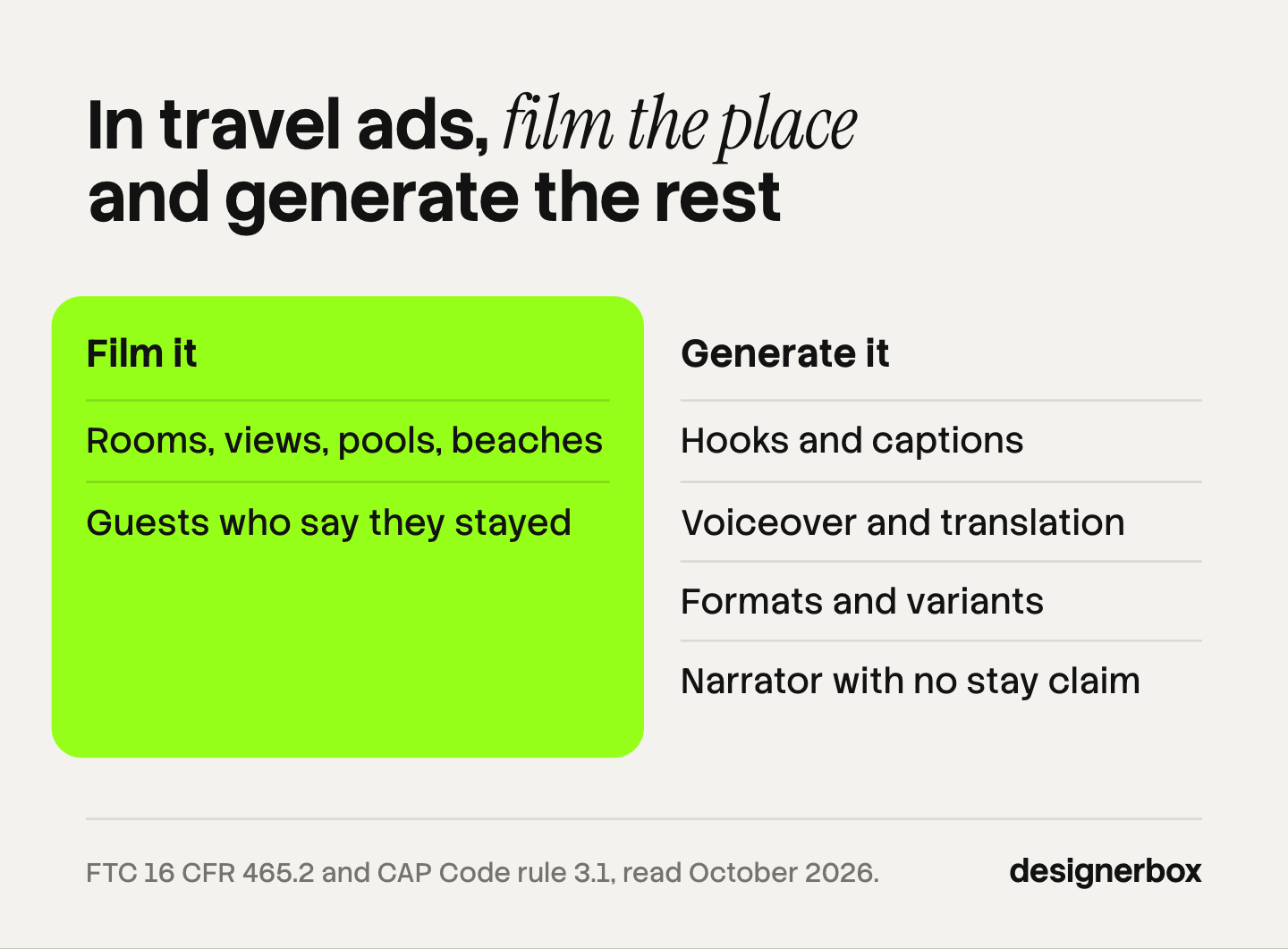
| Layer | What it is | Film or generate | Why |
|---|---|---|---|
| Place | Rooms, views, pools, beaches, food, the tour route | Film | It is the product claim |
| Guest | Anyone who says “I stayed here” or “I took this tour” | Film a real guest | A testimonial needs a real person with real experience |
| Text | Hook line, captions, on-screen copy | Generate | It restates what the footage shows |
| Voice | Voiceover, translation, dubbing | Generate | It narrates and makes no personal claim |
| Format | Vertical, square and wide cuts, lengths, variants | Generate | It changes the frame and leaves the content alone |
| Narrator | A presenter who explains and never claims a stay | Generate, with disclosure | The FTC rule bans a fake guest. It does not ban a generated host |
The rest of this guide takes the two real layers first, then the four generated ones.
What the property may look like on camera
The property on screen has to be the property the guest finds. Three rule sets say so, in three places.

United States. Section 5 of the FTC Act declares unfair or deceptive acts or practices in commerce unlawful (law.cornell.edu, accessed October 2026). The FTC’s Policy Statement on Deception sets the test: a representation, omission or practice that is likely to mislead a consumer acting reasonably, on a point that is material. A sea view in the ad and a car park from the window is material to a booking.
United Kingdom. CAP Code rule 3.1 says marketing communications must not materially mislead or be likely to do so (asa.org.uk, accessed October 2026). CAP’s advice on misleading advertising, dated 12 March 2026, says images that give an inaccurate impression of the product consumers will receive are likely to mislead. Its travel advice says descriptions of destinations, accommodation, facilities and amenities should not mislead (asa.org.uk, accessed October 2026). The same page records a ruling against a hotel ad that used the words “Secluded Haven” while construction work was under way (Kuoni Travel Ltd, 4 October 2017).
We did not find an ASA ruling on a generated hotel image. CAP’s position on AI is clear without one: the Codes have no AI-specific rules, and the existing rules apply however the content is made.
European Union. Article 6 of the Unfair Commercial Practices Directive treats a practice as misleading if it deceives or is likely to deceive the average consumer about the nature or the main characteristics of the product. The overall presentation counts. The practice must also cause, or be likely to cause, a purchase decision the consumer would not have made otherwise (eur-lex.europa.eu, accessed October 2026).
Booking platforms. Airbnb’s ground rules for home hosts say the photos and description should accurately represent the space. They add that Airbnb will ask hosts to remove content if AI or other digital technology has been used to edit flaws, hide damage, add amenities or attributes that are not part of a listing, or otherwise misrepresent it. Booking.com tells partners that travelers want a clear and realistic representation of a property, and asks them to avoid over-processed photos and illustrations (partner.booking.com, accessed October 2026).
Those are listing rules. They cover holiday let listing photos as well as hotel pages. An ad that sends a viewer to a listing should match it.
The gray area: motion on a real photo
Image-to-video sits between filming and generating. You give a video model a real photo of the suite and it returns a moving clip. The risk is that the model fills what the photo did not show. It can add a balcony rail, change the view, or put water where there is none.
So treat a clip made from a still as a claim you have to check. Watch every frame against the real room. Keep the camera move small, such as a slow push or a pan inside the original frame. If the clip shows anything the photo did not, cut it.
Can an AI guest say “I stayed here”?
No. A generated person cannot be a guest, because the FTC rule bans a testimonial from someone who does not exist or did not have the experience.
The FTC’s Rule on the Use of Consumer Reviews and Testimonials went into effect on 21 October 2024 (ftc.gov, accessed October 2026). Section 465.2(a) makes it an unfair or deceptive act for a business to write, create or sell a consumer testimonial that materially misrepresents that the testimonialist exists, that they had experience with the service, or what that experience was. The maximum civil penalty is $53,088 per violation, the figure the FTC published in January 2025, and courts can impose it for knowing violations (ftc.gov, accessed October 2026).
The Endorsement Guides add a second line. Under 16 CFR 255.2(c), an ad that presents people as actual consumers should use actual consumers in both the audio and the video, or clearly disclose that they are not (law.cornell.edu, accessed October 2026).
The UK rule is similar. CAP Code rule 3.47 requires marketers to hold documentary evidence that a testimonial is genuine, with contact details for the person who gave it. Rule 3.44 bans fake consumer reviews.
The FTC does not ban generated presenters. Its guidance says the rule has no blanket prohibition on the use of AI-generated avatars in marketing. The line is what the presenter says. “This hotel has 40 rooms and a rooftop pool” is narration. “I stayed here last week and loved it” is a testimonial, and it needs a person who did.
How do brands source real travel UGC?
Brands get real travel UGC in two ways: they ask guests for permission to use what guests already posted, or they host a creator who films the stay. Both give you the two layers you cannot generate, and both come with a rights step and a disclosure step.

Search results for “travel UGC” are mostly guides for creators who want hotel and tourism work, so creators are easy to find. For the brand, the checklist has four steps.
- Get permission in writing. A guest’s clip belongs to the guest. CAP Code rule 3.50 says marketing must not feature a testimonial without permission. On Instagram, a creator can give a partner a partnership ad code, which lets the brand run that post, story or reel as an ad (help.instagram.com, accessed October 2026).
- Write the usage terms down. Name the channels, the paid use, the markets, the length of the license and whether you may edit, caption and dub the clip. What you own after the shoot covers the license terms in detail.
- Disclose the free stay. Under 16 CFR 255.5, a material connection between endorser and seller must be disclosed clearly, and that includes free or discounted products (law.cornell.edu, accessed October 2026). The FTC’s own FAQ uses a resort as the example and suggests “XYZ Resort paid for my trip”. It says “#comped” and “#hosted” are not clear enough (ftc.gov, accessed October 2026).
- Keep the experience true when you edit. You may cut, caption and translate a real guest clip. You may not make the guest say something they did not say.
A hosted creator who stayed two nights is a real guest with a disclosed connection. That is the travel version of the creator brief in UGC ads: formats, costs and AI options.
The four layers that are safe to generate
Hooks, voice, formats and a narrator are safe to generate because none of them changes what the place looks like or who stayed there.
Text: hooks and captions. One real walk-through of a room supports many opening lines. Test “The view from room 412”, “What a four-night stay includes” and “Ten minutes from the old town” on the same footage. Video hook patterns lists seven structures to rotate. Every line must be true of the footage under it.
Voice: voiceover, translation and dubbing. Travel sells across borders, so language is the biggest multiplier. A generated voice can narrate the same cut in German, French and Spanish. Translate the captions too, and check each one, because German text often runs longer and can break the frame. Ad localization without rebuilding the layout covers that problem. If you dub a real guest, get their consent for the dubbed version, since the new audio makes them say words they did not speak.
Format: sizes, lengths and variants. One edit becomes a vertical cut for Reels and TikTok, a square cut for feeds and a wide cut for YouTube. Reframing changes the crop. Check that a crop does not hide something the guest would want to know.
Narrator: a presenter with no stay claim. A generated host can introduce the property, read the facts and give the booking details. Keep the script in the third person, and keep opinion words such as “my favorite” out of it. The FTC line for AI UGC ads explains where narration becomes endorsement.
Google’s Veo 3.1 shows what a generated clip is today: 4, 6 or 8 seconds, with natively generated audio (ai.google.dev, accessed October 2026). That length suits a narrator line or a short insert. It does not replace a walk through a real lobby. The clip ceilings of the main video models are listed in AI product video: six rules that decide if it works.
AI disclosure for travel ads
A generated narrator or a generated voice can trigger an AI disclosure duty, and the duty depends on where the ad runs.
- New York. General Business Law section 396-b requires an advertiser to disclose conspicuously that a synthetic performer is in an ad when it has actual knowledge of it. The civil penalty is $1,000 for a first violation and $5,000 for each later one (nysenate.gov, accessed October 2026). The law took effect on 9 June 2026.
- California. SB 1050 makes it unlawful to publish an ad that prominently includes a synthetic performer without a clear disclosure, with wording close to “this performance features a synthetic performer”. Its definition of a synthetic performer includes a voice, and “prominently” includes voicing the narration (leginfo.legislature.ca.gov, accessed October 2026). The governor approved it on 16 September 2026, and it takes effect on 1 January 2027, the default start date for a California law without an urgency clause.
- European Union. Article 50 of the AI Act has applied since 2 August 2026. Deployers must clearly label deep fakes (digital-strategy.ec.europa.eu, accessed October 2026).
- TikTok. Ads with completely AI-generated images, video or audio, or significant AI edits, need a label. TikTok says it rejects or restricts an ad when it finds undisclosed AI-generated content (ads.tiktok.com, accessed October 2026).
- Meta. Advertisers must disclose AI in ads about social issues, elections or politics. For other ads, Meta says it has used automated detection since 1 June 2026. When it finds third-party generative AI, it adds an “AI info” label in “About this ad” (transparency.meta.com, accessed October 2026).
A label covers the narrator. It does not cover a generated room. CAP’s guidance says it would almost certainly be against the rules to make a misleading claim and then try to disclaim it by saying AI was used. AI disclosure in ads sets out the rules in full.
Travel ad formats that work with this split
Five travel ad formats fit the split, and one does not. Each one below names the real layer and the generated layer.
| Format | Real layer | Generated layer | Verdict |
|---|---|---|---|
| Room or property walk-through | Phone footage of the real room | Hook, captions, voiceover, translations | Run it |
| Real guest clip, re-cut | The guest’s own footage, with permission | Captions, formats, subtitles in other languages | Run it |
| Day itinerary for a tour or destination | Real clips of each stop | Narration, on-screen route text | Run it |
| Fact answer: “what is included” | Real b-roll of the property | Generated narrator, with disclosure | Run it |
| Seasonal offer | Footage from that season | Price text, dates, formats | Run it, and check the price claim |
| ”Guest” reaction made by a model | None | Everything | Do not run it |
The seasonal row needs one more check. Summer pool footage in a January ad implies the pool is open in January. Match the footage to the dates on sale.
For the hotel that already has a library of clips, the work is mostly editing. How to edit AI-generated video clips into a finished ad covers the assembly. The sibling guide on AI UGC video for real estate applies the same real-place rule to property listings.
A production plan for one property
One property needs one shoot day and one edit that you reuse. Here is the order.
- Film the place once, on a phone. Walk each room type, the view from the window, the pool, breakfast and the street outside. Record in daylight and keep the clips unfiltered.
- Collect guest clips with permission. Ask at checkout or by message. Store the written permission next to the file.
- Write three hooks and one script per language. Third person for a narrator. First person only for a real guest’s own words.
- Cut one master edit. Put the real footage first and hold each shot long enough for the viewer to see the room.
- Generate the layers. Add the voiceover, the translated captions and the format cuts.
- Check each version against the room. Compare every frame with what a guest will find. Add the AI disclosure where a generated narrator or voice appears.
- Keep a file. Save the source footage, the permissions and the disclosure text. CAP rule 3.7 expects marketers to hold evidence for objective claims before the ad runs.
DesignerBox fit and limits
DesignerBox is AI creative production for brands and agencies. You build a workflow once with your brand rules, and you run it on every new piece of work. You see the cost before each run. The full workflow from the first product photo to the finished ad, in one subscription.
It is built for product brands and the agencies that serve them. A hotel or tour operator usually reaches it through its agency or its marketing team, and the fit is the four generated layers. The video editor is a timeline with several tracks, transitions, animated text and audio, so you cut your real footage there. A workflow rebuilds one ad in another language, and another makes the format cuts. The ready-made ads resizer and ad localizer apps are being built. Transcription and text to speech cover captions and voiceover, and a talking avatar with lip sync covers the narrator. A brand profile holds the hotel’s voice, logos, fonts and colors, and the workflow reads it on every run.
For an agency with many hotel clients, the value is repetition. Anyone can make an AI picture. Making hundreds that still look like your brand is the hard part. You build the hook, voice and format pass once as a workflow. Batch then runs it over a sheet of properties, with the same standard on row one and row two hundred, and you keep or discard each row.
DesignerBox has limits here. It does not film your property, and it does not check a clip against the real room for you. It does not publish to an ad account: you download the results. It does not apply a state disclosure line unless you add one to the workflow. An 8-second generated clip costs 40 to 560 credits, depending on the model.
Uploading your own photos and the commercial license start on the Pro plan. AI video, virtual try-on, upscaling, the image editor and the video editor start on the Premium plan. The free plan cannot make video. Team features, shared brand kits and white label are on the Ultra plan, and every plan below Ultra is one seat. Plans and credits are on the pricing page.
If you run creative for several travel clients, the agency page shows how one workflow per client works.
FAQ
Can I use AI video in travel ads?
Yes, for the layers that do not depict the place or a guest’s stay. Generate hooks, captions, voiceover, translations, format cuts and a narrator who makes no personal claim. Film the property and any guest testimony. Add an AI disclosure where a generated performer or voice appears and the law or the platform requires it.
Is it legal to show an AI-generated hotel room in an ad?
It is risky wherever the room differs from the one the guest receives. The FTC’s deception test, CAP Code rule 3.1 and Article 6 of the EU Unfair Commercial Practices Directive all ask whether the picture is likely to mislead a consumer about the product. A label that says AI was used does not fix a misleading picture.
What is travel UGC?
Travel UGC is video or photo content made by a guest or a hired creator about a real stay, tour or destination. The brand then uses it on its own channels and in ads. The brand needs written permission to use it, and a free or paid stay must be disclosed under 16 CFR 255.5.
Do hotel ads with an AI presenter need a disclosure?
In New York, yes, when the advertiser knows a synthetic performer is in the ad. California’s SB 1050 adds a similar duty from 1 January 2027. In the EU, deployers must label deep fakes under AI Act Article 50. TikTok requires a label on ads with completely AI-generated or significantly AI-edited media.
Can I translate a real guest video with AI?
Yes, with the guest’s consent for the translated version. Subtitles carry the lowest risk because the guest’s own voice stays. A dubbed voice makes the guest appear to speak words they did not say, so get permission in writing and keep the meaning the same.
How long should a travel video ad be?
Fifteen to thirty seconds suits most social placements. Use that time for real footage of the place. Generated clips are short: Veo 3.1 returns 4, 6 or 8 seconds, which fits a narrator line or an insert between real shots.
Does DesignerBox make travel ads?
It makes the generated layers: captions, voiceover, translated versions, format cuts and a narrator. You bring the real footage of the property. The cost of each run is shown before the run, and AI video starts on the Premium plan.
Sources
All accessed October 2026 unless marked.
- FTC Act section 5, 15 U.S.C. 45(a)(1), unfair or deceptive acts or practices: law.cornell.edu
- FTC Policy Statement on Deception, 14 October 1983: ftc.gov
- FTC Rule on the Use of Consumer Reviews and Testimonials, 16 CFR 465.2: law.cornell.edu
- FTC, Consumer Reviews and Testimonials Rule questions and answers, including the 21 October 2024 date and AI avatars: ftc.gov
- FTC inflation-adjusted civil penalty amounts for 2025: ftc.gov
- FTC Endorsement Guides, 16 CFR 255.2(c) on actual consumers: law.cornell.edu
- FTC Endorsement Guides, 16 CFR 255.5 on material connections: law.cornell.edu
- FTC, Endorsement Guides: What People Are Asking, including the resort trip example: ftc.gov
- CAP Code section 3, misleading advertising, rules 3.1, 3.7, 3.44, 3.47 and 3.50: asa.org.uk
- CAP AdviceOnline, Travel marketing: General, including Kuoni Travel Ltd, 4 October 2017: asa.org.uk
- CAP AdviceOnline, Misleading advertising, 12 March 2026: asa.org.uk
- CAP, Disclosure of AI in advertising: asa.org.uk
- Directive 2005/29/EC, Unfair Commercial Practices Directive, Article 6: eur-lex.europa.eu
- Airbnb, Ground rules for home hosts, listing accuracy: airbnb.com
- Booking.com for Partners, Understanding photo requirements for your property: partner.booking.com
- Expedia Group and Luth Research, The Path to Purchase, 2023: Expedia Group
- Instagram Help Center, how to create a partnership ad code: help.instagram.com
- New York synthetic performer disclosure, General Business Law 396-b: nysenate.gov
- California SB 1050, synthetic performers in advertising, effective 1 January 2027: leginfo.legislature.ca.gov
- European Commission, transparency obligations under Article 50 of the AI Act: digital-strategy.ec.europa.eu
- TikTok ads policy on misleading and false content, AI-generated content: ads.tiktok.com
- Meta ad standards, including automated AI detection from 1 June 2026: transparency.meta.com
- Google, Veo 3.1 clip durations and native audio: ai.google.dev
- DesignerBox plans and the video credit range: DesignerBox pricing page (designerbox.ai/pricing), October 2026
Regulatory and platform requirements checked against the primary sources listed above as of October 2026. Booking platform rules vary by platform and can change. Individual results vary.