

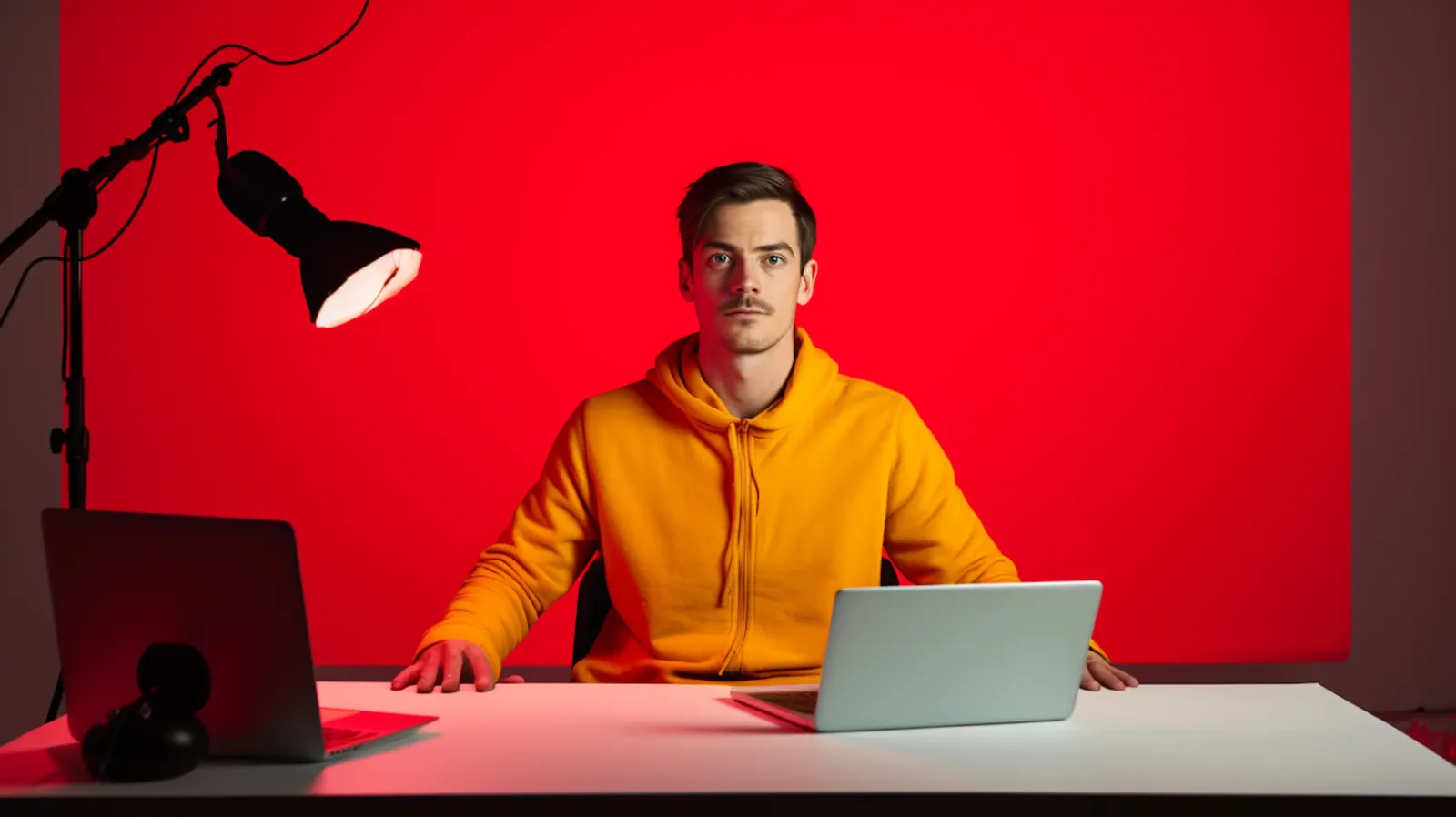
Video hooks are the first 3 seconds of a video: what the viewer sees, reads and hears before they decide to stay. A hook has three layers, the first frame, the text on screen and the spoken line. In a product ad all three say one true thing about the product. You test hooks by changing one layer and keeping the rest of the ad the same.
Most lists of video hooks are lists of sentences. A sentence is one layer of three, and it is the layer a viewer with the sound off never gets. A brand that tests five new lines on the same first frame has tested less than it thinks.
This guide covers the three layers, 7 hook patterns that fit product ads, what TikTok, Google and Meta publish about the first seconds, and a test you can read. It is written for performance marketers at brands and agencies who ship new video ads every week.
Key Takeaways
- A hook has three layers. The first frame, the text on screen and the spoken line. A list of opening sentences covers one of them.
- The first frame does the most work. It is the only layer that every viewer gets, with sound on or off.
- TikTok gives two time limits. It advises the content proposition in the first 3 seconds and the hook in the first 6 seconds.
- Product ads have 7 reliable patterns. Each one starts from something the camera can show: a result, a motion, a problem, a comparison, a number, a named buyer or an objection.
- Test one layer at a time. Keep the body of the ad the same, change one layer of the opening, and read hook rate against your own median.
- A hook is still an ad claim. A generated person who says “I used this” is a testimonial, and a false testimonial breaks the FTC rule.
What is a video hook?
A video hook is the opening of a video, built to make the viewer stay for the next part. In a paid ad it covers about the first 3 seconds. It is made of three things at once: the picture on screen, the text placed over it, and the first words spoken. A hook works when all three make the same promise and the rest of the video keeps it.
The 3-second mark comes from how the platforms count. Meta defines 3-second video plays as “the number of times your video played for at least 3 seconds, or for nearly its total length if it’s shorter than 3 seconds” (Meta Business Help Center, October 2026). The share of impressions that reach that mark is your hook rate, the number that tells you whether an opening worked.
Hooks matter in organic video too, but this guide is about ads for a product. That narrows the job. An ad hook has to stop the right buyer and say what the product is, and it has to be true.
The three layers of a video hook
Each layer reaches a different viewer. The first frame reaches everyone. The text reaches everyone who looks for one second. The spoken line reaches only the viewers with the sound on. Plan the layers in that order.
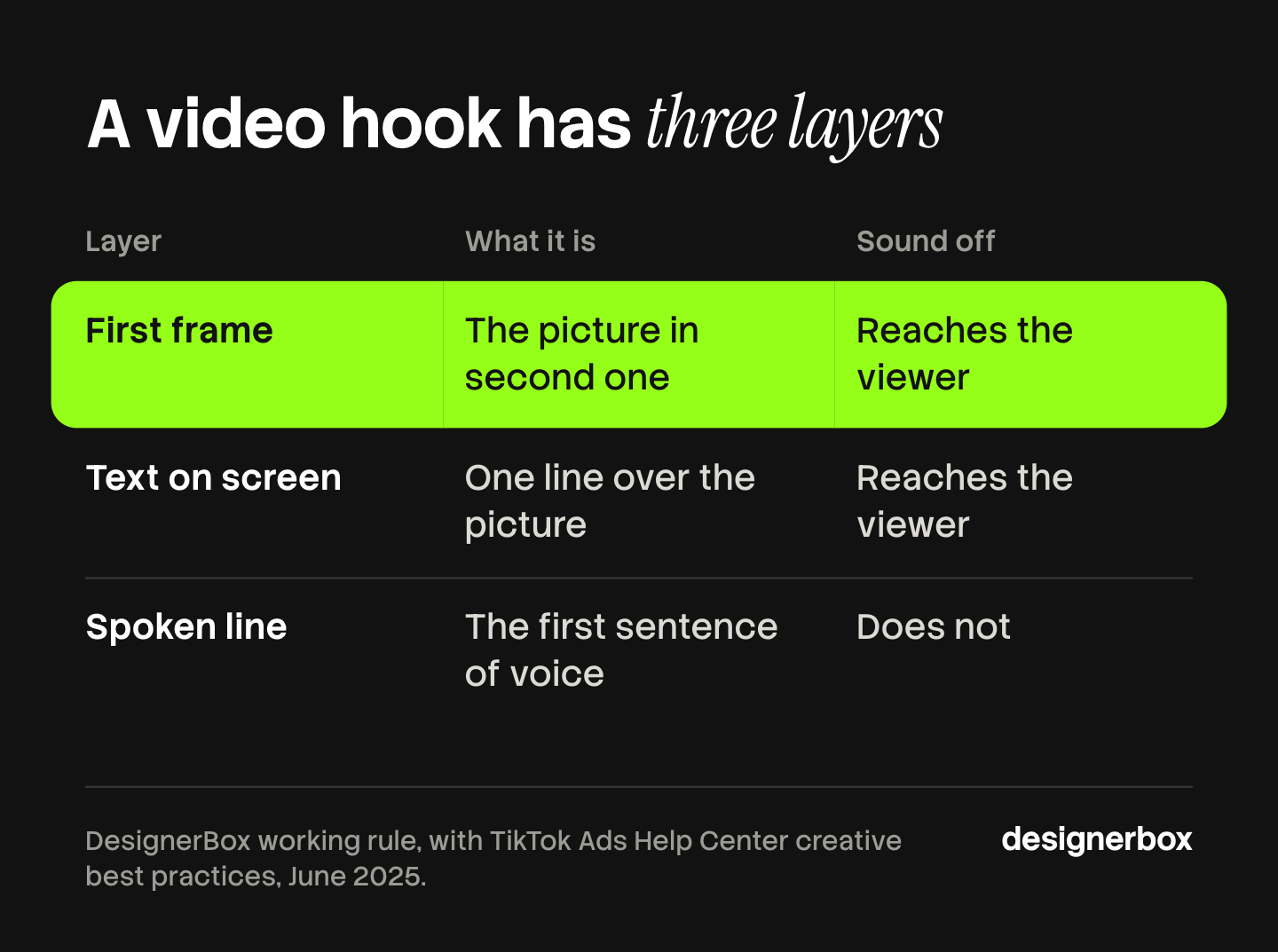
| Layer | What it is | Reaches viewers with sound off | What to check |
|---|---|---|---|
| First frame | The picture in the first second: the product, a hand, a face, a motion | Yes | Can a stranger name the product from this frame alone? |
| Text on screen | One line placed over the picture | Yes | Can it be read in the time it is on screen? |
| Spoken line | The first sentence of voice | No | Is it a full sentence under 10 words? |
Three working rules follow from the table.
The first frame is not a title card. A logo on a plain background gives the viewer nothing to watch. Open on the product in use, or on the result. Faceless reels depend on this, because no face holds the first second.
The text and the voice say the same thing. When the text says one thing and the voice says another, the viewer gets half of each. TikTok advises advertisers to “use captions or text overlays to provide context to your ad” and recommends “displaying 5-10 words per second when using text” (TikTok Ads Help Center, last updated June 2025). A 7-word line needs about one second on screen at that pace. Give it two.
The spoken line is written for the ear. Short words, one idea, no brand slogan. The UGC script guide covers the word counts for the rest of the script.
Video hook patterns for product ads
These 7 patterns fit ads for a physical product. Each one starts from the first frame, because that is the layer every viewer gets. The example lines are illustrations. Write your own from a true detail of your product.
| # | Pattern | First frame | Text or spoken line (example) | Fits |
|---|---|---|---|---|
| 1 | The finished result | The end state, already on screen | ”One coat. This is the wall.” | Products with a visible before and after |
| 2 | The motion | The product doing its job, mid-action | ”Watch the zipper.” | Anything that pours, folds, snaps, stretches or opens |
| 3 | The problem, shown | The thing the buyer already has, failing | ”Your pan does this too.” | Replacements for a product the buyer owns |
| 4 | The side by side | Two items in one frame | ”Same size. Half the weight.” | Products that win on one measurable feature |
| 5 | The number | A price, a count or a time as large text | ”40 washes. Same color.” | Claims you can prove with a test or a record |
| 6 | The named buyer | The product in the buyer’s setting | ”For anyone who runs in the rain.” | Products for a narrow use |
| 7 | The objection | A face, or the product and its price | ”I did not think a $60 pillow was worth it.” | Higher-priced products in a cheap category |
A few notes on how to use the table.

Patterns 1 to 5 need no person. The product carries the opening. That matters when you make many versions, because a product shot can be reused across markets and a spoken line cannot.
Patterns 6 and 7 need care. Pattern 7 is a personal statement. If a real customer or a paid UGC creator says it, it has to be their real view. If a generated presenter says it, it is a testimonial from someone who never used the product. The section on claims below covers why that matters.
One pattern per ad. A result, a number and an objection in the same 3 seconds give the viewer three things to process and no reason to pick one.
Pick the pattern from the product, not from a list. Ask what a camera can show about this product in one second. If the answer is a motion, use pattern 2. If nothing visible changes, patterns 4 and 5 give the viewer a fact instead. More worked openings for one channel are in the TikTok product ad examples.
What do TikTok, Google and Meta say about the first seconds?
The platforms publish less than the hook lists suggest. Here is what each one states on its own pages, read in October 2026.
TikTok gives two time limits. “Prioritize your hook in the first 6 seconds to boost engagement and increase watch time”, and “Introduce your content proposition in the first 3 seconds for better recall and awareness”. It also gives the structure it expects: “Have a hook, highlight your unique selling points, and end with a clear call-to-action” (TikTok Ads Help Center, last updated June 2025).
Google puts the opening first in its four principles for YouTube ads: Attention, Branding, Connection and Direction. The Attention principle reads “Hook and sustain attention with an immersive story” (Google Ads Help, October 2026). Google credits the four principles together with a 30% lift in short-term sales likelihood, from a Google and Kantar study of 11,000 ads in 2021 (Google, October 2026). That figure is for all four principles, not for the hook alone.
Meta defines the metric and gives no hook advice on that page. The 3-second video play is the count most advertisers build hook rate from. Meta publishes no “good” hook rate, and neither does TikTok.
What none of them publish: a list of opening lines that work. Every “proven hook” list comes from a vendor, an agency or a creator. Use such a list for ideas and trust your own test for the answer.
How do you test video hooks?
Test video hooks by keeping the body of the ad fixed and changing the opening. Make three to five openings for one body. Change one layer per version: a new first frame, or a new text line, or a new spoken line. Run them under the same budget and audience, then compare each hook rate with your own median for that placement.

The steps:
- Start from an ad that already converts. A new hook on a weak body tells you little. If hook rate rises and sales do not, the body is the problem.
- Write the openings as a table. One row per version, one column per layer. Mark the one cell that changed. A version with two changed cells is a new ad, not a hook test.
- Change the first frame first. It reaches every viewer, so it moves the number most often. Test text second and voice third.
- Keep everything after second 3 the same. Same clips, same offer, same end card.
- Give each version enough impressions to read. A small budget split five ways gives five results that are mostly noise. Ad creative testing covers the sample a readable test needs.
- Read hook rate with the numbers after it. An opening that raises hook rate and lowers conversion promised something the ad did not deliver. Keep the opening that raises both.
- Keep the winner and make the next set from it. The opening that won becomes the control for the next test.
How many openings you can test in a month depends on your spend. Ad creative volume by spend tier gives the published benchmarks. When a winning ad starts to slow down, a new opening on the same body is the cheapest refresh, and ad fatigue explains the signals to watch.
Claims a hook cannot make
A hook is the most-watched part of the ad, so it is also the part where a false claim does the most damage. Three rules apply. This is general information, not legal advice.
A number in a hook must be true and provable. “40 washes. Same color.” needs a wash test you can show. If you cannot prove it, use pattern 2 and show the product instead.
A personal statement must come from a real person’s real experience. The FTC’s rule on consumer reviews and testimonials took effect on 21 October 2024. Under it, a business must not write, create or sell a review or testimonial that falsely suggests the reviewer exists, used the product, or had a stated experience (16 CFR 465.2, October 2026). The FTC says the rule does not ban AI avatars in marketing. Using an avatar breaks the rule only if the testimonial behind it is fake or false (FTC, October 2026). So a generated presenter can describe the product. A generated presenter cannot say “I used this for a month”.
AI-made openings may need a label. TikTok allows ads with AI-generated or heavily AI-edited media. You must add the AIGC label or your own clear disclaimer, and TikTok rejects or restricts an ad with undisclosed AI content (TikTok ads policy, last updated April 2026). Meta checks ads for signs of third-party AI and adds an “AI info” label when it finds them (Meta Business Help Center, October 2026). AI UGC ads covers both rules in full.
Filmed or generated openings
A generated opening fits patterns 1 to 5, where the product is the subject. A filmed opening fits any hook that depends on a real person or a real result.
| The opening shows | Film it | Generate it |
|---|---|---|
| The product in motion, on a set or in a scene | Possible | Fits well, from a product photo |
| A side by side or a number card | Possible | Fits well |
| A real before and after | Yes | No. The result has to be real |
| A customer’s own experience | Yes, with a real customer | No |
| A presenter who describes the product | Possible | Possible, with the label where the platform asks for it |
Check every generated opening against the real product before it ships. Look at the logo, the print, the shape and the color. A warped label in the first frame is the first thing the buyer sees.
Hook variants from one approved ad
Anyone can make an AI picture. Making hundreds that still look like your brand is the hard part. A hook test asks for five openings of one ad, and each opening still has to show your product, your colors and your voice.
DesignerBox is AI creative production for brands and agencies. You build a workflow once with your brand, your products and your rules. Your approved ad and your product photo go in, and new first frames, new text lines and new sizes are the result. AI video ads turn a product photo into a short vertical clip, which covers patterns 1 to 5. The video editor is a real timeline, with several tracks, transitions, animated text and audio, so you can replace the first 3 seconds of a cut and keep the rest. Three critic steps score the results of a run, and best-of-N keeps the best one. You still watch every opening before it ships. The cost is shown before the run.
The full workflow from the first product photo to the finished ad, in one subscription. The setup for paid social is on the page for performance marketers.
Here are the limits. DesignerBox does not read your ad account, so hook rate stays in Meta Ads Manager or TikTok Ads Manager. It does not publish ads for you: you download the results, or send them with a webhook or an S3 step. An 8-second clip costs 40 to 560 credits, depending on the model. Team features are on the Ultra plan, and every plan below Ultra is one seat. The free plan cannot make video.
Uploading your own photos and the commercial license start on the Pro plan. AI video, virtual try-on, upscaling, the image editor and the video editor start on the Premium plan. Plans and credits are on the pricing page.
A free plan for your first run
There is a free plan, and it runs on sample products. Start from a template and see the cost before you run it. Get started free.
FAQ
What is a hook in a video?
A hook is the opening of a video, built to make the viewer stay. In a paid ad it covers about the first 3 seconds. It has three layers: the first frame, the text on screen and the spoken line. A hook works when all three make the same promise and the rest of the video keeps it.
How long should a video hook be?
Plan for 3 seconds. Meta counts a video play at 3 seconds, and TikTok advises advertisers to introduce the content proposition in the first 3 seconds and to prioritize the hook in the first 6 seconds. A spoken hook of under 10 words fits inside that time. The first frame has to work in the first second.
What makes a good hook for a product ad?
A good hook shows one true, specific thing about the product in the first frame, and the text and the voice repeat it. The viewer can name the product without sound. It uses one pattern, such as the finished result or the product in motion. It makes no claim the rest of the ad cannot prove.
How many video hooks should you test?
Three to five openings for one ad body is a workable set for most accounts. Each version changes one layer, and each needs enough impressions to read. A larger set on a small budget gives results you cannot tell apart. Compare each hook rate with your own median for the same placement.
Do video hooks work without sound?
Two of the three layers do. The first frame and the text on screen reach a viewer with the sound off, and the spoken line does not. Build the opening so the picture and the text carry the full message. Then add the voice as a third copy of the same message.
Can you make video hooks with AI?
Yes, for openings where the product is the subject: the finished result, the product in motion, a side by side or a number card. Film any opening that depends on a real person’s experience or a real before and after. Check each generated opening against the real product, and add the AI label where the platform asks for one. In DesignerBox the cost is shown before the run.
Sources
- TikTok Ads Help Center, Creative best practices for performance ads: ads.tiktok.com/resources/help/article/creative-best-practices, last updated June 2025, accessed October 2026
- Google Ads Help, About the ABCDs of effective video ads: support.google.com/google-ads/answer/14783551, accessed October 2026
- Google, ABCDs of effective video ads, with the Google and Kantar study of 11,000 ads (April 2021): business.google.com/us/resources/articles/abcds-of-effective-video-ads, accessed October 2026
- Meta Business Help Center, 3-second video plays: facebook.com/business/help/743427195703387, accessed October 2026
- Meta Business Help Center, AI info labels on ads: facebook.com/business/help/1010479435004531, accessed October 2026
- FTC, Consumer Reviews and Testimonials Rule: Questions and Answers: ftc.gov, accessed October 2026
- 16 CFR 465.2, via Cornell Legal Information Institute: law.cornell.edu/cfr/text/16/465.2, accessed October 2026
- TikTok ads policy, misleading and false content: ads.tiktok.com/help/article/tiktok-ads-policy-misleading-and-false-content, last updated April 2026, accessed October 2026
- DesignerBox pricing and product pages (designerbox.ai), October 2026
Platform guidance verified from TikTok, Google and Meta help pages as of October 2026. The example hook lines are illustrations, not test results. Individual results vary.