

Makeup ads have eight main formats: the swatch grid, the shade range, the texture close-up, the packshot, the application video, the before and after, the routine and the UGC review. Each one promises something about the product on skin. A makeup ad is believable when that skin, color and result are real. It is allowed when it also passes the rules of the market where it runs.
A beauty brand rarely lacks ad ideas. It lacks frames it can prove. A foundation launches in 30 shades, and last week’s best ad showed one of them on one face. The next ads have to show the other 29 the same way, in the same light, with no skin smoother than the product makes it.
This guide covers the eight formats, what each one needs to be believable, and the rules in the UK, the US, Norway and on Meta. It is for beauty and skincare brands with 20 to 500 products, and the agencies that make their ads. The shot list behind one product is on the beauty and skincare photography page. The photos themselves are covered in skincare product photography.
Key Takeaways
-
Every beauty format is a claim. A swatch claims a color. A before and after claims a result. The cosmetic claims rule in the EU and the UK covers pictures as well as words.
-
The “after” photo is judged like a written claim. The UK regulator says it has to show what buyers can generally get.
-
A filter on the product’s effect misleads. In February 2021 the ASA ruled against two tanning ads because a filter changed the skin tone.
-
An AI image of the result is a problem, label or not. The ASA says an AI image of a cosmetic’s effect is likely to be materially misleading if it does not match real results.
-
Some claims turn a cosmetic into a drug. The FDA names claims to “regenerate cells” or change melanin production, in ads as well as on labels.
-
Norway marks retouched skin. Since 1 July 2022, an ad with altered skin carries a standard mark of about 7% of the image.
What are the main makeup ad formats?
The main makeup ad formats are the swatch grid, the shade range, the texture close-up, the packshot, the application video, the before and after, the routine and the UGC review. The first four show the product. The last four show what it does on a face. The second group makes result claims, and result claims carry most of the rules.
| Format | What it shows | What makes it believable | Check first |
|---|---|---|---|
| Swatch grid | Each color on an arm or a hand | The real product, one light, no color edit | The color on screen matches the product |
| Shade range | Every shade on the skin tones it is made for | The same framing and light for every shade | Every shade shown is one you sell |
| Texture close-up | The cream, gel or powder out of the pack | Side light and the real consistency | A gel still looks like a gel |
| Packshot | The pack, with the label facing the camera | A product name you can read at thumbnail size | Props that suggest an ingredient are claims |
| Application video | The product being applied | One take, at real speed | No lash inserts or filters that add to the result |
| Before and after | One face at two moments | Same light, same angle, same styling | Drug claims in the US, the retouch mark in Norway |
| Routine | Several products in the order of use | Each step names the product in the frame | Each product needs its own proof |
| UGC review | A person talking about the product | A real customer, in their own words | Real customers, and any payment disclosed |
Pick the format by the claim you can prove. A new lipstick color fits a swatch grid. A serum with a measured result fits a before and after. Formats that are not specific to beauty, such as the receipt and the quiz, are in 30 static ad examples.
What makes a makeup ad believable?
A makeup ad is believable when the viewer can check it against their own face. They know what skin looks like up close. When the skin in the ad has no texture at all, they have a reason to doubt the photo, and the product with it.
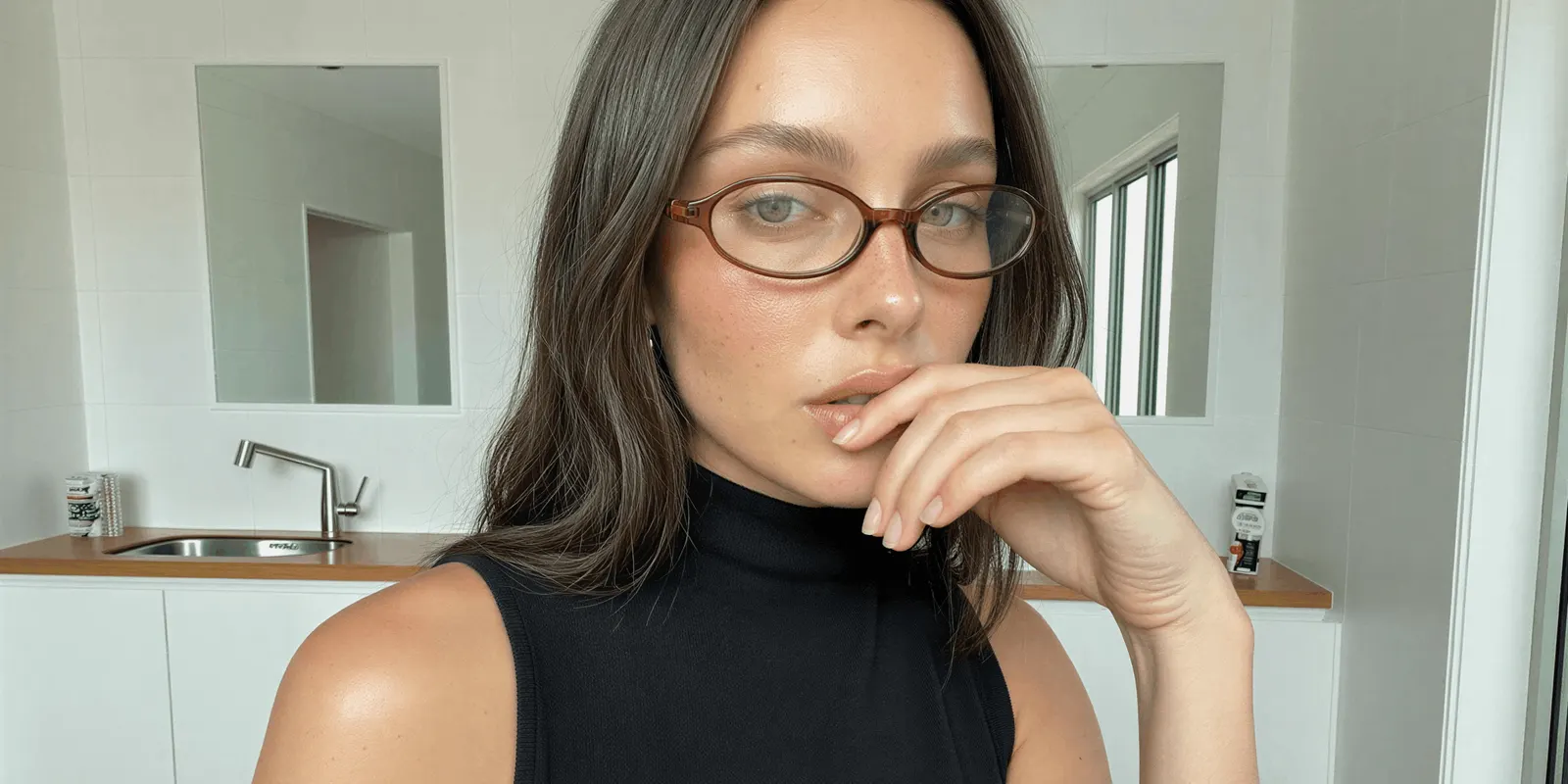
The UK regulator does not ask for plain ads. Its guidance says “consumers are likely to expect a degree of glamour in images for beauty products”. The limit is the product’s own effect: visual claims “should not misleadingly exaggerate the effect the product is capable of achieving” (asa.org.uk, September 2026). Four checks follow:
- Skin with texture. Pores, fine lines and freckles tell the viewer the face is real.
- Color the viewer can trust. Shoot swatches in neutral light, and hold the product next to the screen before the ad ships.
- The result from real use. The lashes in a mascara ad are the lashes the mascara gives.
- A person who is who the ad says. A customer is a customer, a paid creator is disclosed, and a generated face is never presented as a buyer.
Swatch, shade range, texture and packshot: the product formats
These four formats show the product itself. They make fewer result claims, so fewer rules apply. The rule they share: the picture matches the product that arrives.
The swatch grid. Each shade is drawn on skin, side by side. Use the same pressure, the same skin and the same light for every swatch. A grid shot in three sessions shows three kinds of light, and the real difference between shades gets lost.
The shade range. Each shade appears on the skin tone it is made for. It is also the job that returns with every launch: the same shot for every shade. A foundation in 30 shades needs 30 frames with the same crop, pose and light. If shade 27 is lit differently from shade 4, a buyer sees a gap in the range that does not exist.
The texture close-up. The product is out of the pack: a smear of cream, a drop of serum, a pressed powder broken with a finger. Side light shows the thickness. A gel shot to look like a balm is a false picture.
The packshot. The pack sits on a surface, label to the camera. Props are part of the claim. The EU regulation on cosmetic claims, No 655/2013, which the UK kept after Brexit, covers claims “in the form of texts, names, trademarks, pictures and figurative or other signs” (legislation.gov.uk, September 2026). A plant beside the bottle says the plant is in the formula.
Before and after, application, routine and UGC: the result formats
These four formats show what the product does to a face, so a regulator can test each one.

The before and after. The ASA says before and after images “are treated as objective claims just the same as written claims”. The “after” has to show what buyers can generally get. Its guidance describes a serum ad where a complaint was not upheld: both photos used the same styling, and no post-production created the “after” (asa.org.uk, September 2026). Copy that pattern: one light, one angle, one styling, and no retouching on the area the product treats.
In Norway the rule is a mark. Since 1 July 2022, a regulation requires a standard mark on ads where “a body’s shape, size or skin” was changed by retouching or other manipulation (lovdata.no, September 2026, our translation). The mark covers about 7% of the image, in the upper left corner. The Norwegian Consumer Authority counts the face as part of the body. Smoothing skin and removing wrinkles, freckles or moles need the mark. Makeup applied before the photo does not (forbrukertilsynet.no, updated August 2026).
The application video. The product is applied in one take, at real speed. The ASA guidance says lash inserts should not create an effect “beyond what can be achieved by a mascara on the model’s natural lashes”. Filters follow the same logic. In February 2021 the ASA ruled against two tanning ads on Instagram where a beauty filter changed the skin tone. The filters “were likely to have exaggerated the efficacy of the products” (asa.org.uk, September 2026). The ASA also said filters in ads are “not inherently problematic”. The risk is a filter on what the product changes.
The routine. Three to five products are applied in order: cleanser, serum, moisturizer, base. Each step is its own claim. Name the product in every frame, and give each one only the result it can support alone.
The UGC review. A person talks to the camera about the product. The FTC Endorsement Guides say people presented as “actual consumers” should be actual consumers, or the ad must “clearly and conspicuously disclose” that they are not (law.cornell.edu, 16 CFR 255.2, September 2026). A paid creator discloses the payment, and free product counts as a material connection (law.cornell.edu, 16 CFR 255.5, September 2026). Costs and AI options for this format are in the UGC ads guide.
Which rules decide what skincare advertising may show?
Six sets of rules cover what skincare advertising and makeup ads may show in the markets this guide covers. This is general information, not legal advice.
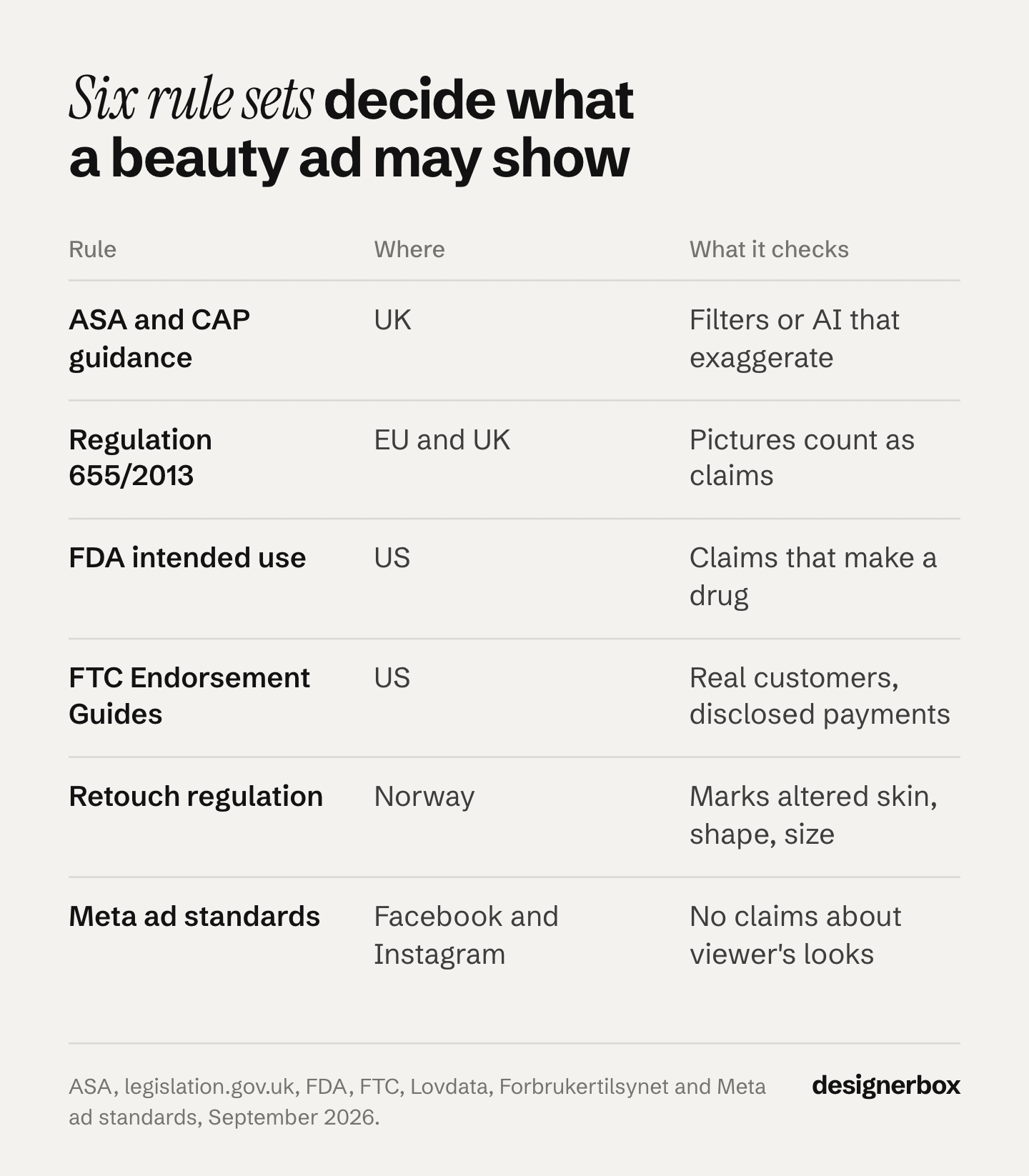
| Rule | Where | What it checks in a beauty ad |
|---|---|---|
| ASA and CAP guidance | UK | Retouching, lash inserts, filters or AI that exaggerate the effect |
| Regulation (EU) No 655/2013 | EU and UK | Text and pictures: performance must not “go beyond the available supporting evidence” |
| FDA intended use | US | Ad claims that make a cosmetic a drug |
| FTC Endorsement Guides | US | Real customers, typical results, disclosed payments |
| Retouched advertising regulation | Norway | A mark of about 7% of the image when skin, shape or size was altered |
| Meta advertising standards | Facebook and Instagram | No negative statements about appearance, no claims about the viewer |
The FDA line. In the US, intended use decides whether a product is a cosmetic or a drug. Claims “in advertising, on the Internet, or in other promotional materials” set intended use. The FDA lists claims that a product will “increase or decrease the production of melanin (pigment) in the skin, or regenerate cells” as drug claims. Makeup and moisturizers with sun-protection claims are both cosmetics and drugs (fda.gov, September 2026). One ad headline can put a product under drug rules.
The Meta line. Meta’s personal attributes policy rejects “Ready to upgrade your skin to look younger?” and accepts “Our new lotion and creams fight wrinkles like never before!” (transparency.meta.com, September 2026). The first describes the viewer. The second describes the product. Meta’s health and wellness policy bars cosmetic ads with “statements of inferiority about physical appearance”. Its list of ads for people 18 or older includes “general cosmetic products, procedures, surgeries depicting before and after transformation” (transparency.meta.com, September 2026). The same policy says its age limits do not apply to “non-permanent cosmetic and beauty products such as creams, makeup”. For a before and after ad, the careful choice is an audience of 18 or older. Meta approval checks the platform rules only. The laws above still apply.
The AI line. The ASA says “it is likely to be materially misleading to include an AI generated image showing the effect of a cosmetic product that does not accurately reflect real-world results and rely on a disclosure that AI was used to rebut the misleading impression created” (asa.org.uk, September 2026). Platform label rules for AI images are in AI disclosure in ads. Where skin retouching tools stop is in AI skin and photo retouching tools.
How to make variants of a winning beauty ad
Keep the claim that won, and change what the ad does not depend on. A winning swatch ad can run in every shade. A winning English ad can run in German. Each variant keeps the evidence the original had.
Meta separates two kinds of variant. “Creative iteration might produce two ads with identical visuals, but different text CTAs, while creative diversification would generate two distinctly different pieces of creative” (facebook.com/business, September 2026). A beauty brand can add creative without adding claims in three ways:
- Across shades. The same frame in every shade you sell.
- Across formats. The same claim as a swatch grid, a texture close-up and a routine.
- Across markets. The same ad in another language and size, with the local rule checked. The Norway version of a retouched ad needs the mark.
One format in 30 shades and four ad sizes is 120 files, as an illustrative count. The size each platform asks for is in image ad specs for five platforms. How many variants an account can test each month is in ad variants at scale. Perfume ads use the same plan for one fragrance campaign in every market.
Beauty ads as a workflow
Anyone can make an AI picture. Making hundreds that still look like your brand is the hard part. In beauty, every frame also has to stay true to the product in the pack.
DesignerBox is AI creative production for brands and agencies. You build an ad format once as a workflow: your product photo, the layout, the brand rules and the ad sizes. You set the brand once, and the workflow reads it on every run. Batch runs one workflow over a whole sheet of products, so every shade gets the same frame. You keep or discard per row, and re-run one row on its own. The cost is shown before each run.
The AI ad generator starts from your own product photo. One ad can be resized to the formats ad platforms need, or rebuilt in another language with the layout redrawn. The skincare range guide puts every bottle on one surface, in one light. The beauty video guide shows how to make a short clip from one product photo. AI video starts on the Premium plan. The free plan cannot make video. The full workflow from the first product photo to the finished ad, in one subscription.
Use AI for the frame around the product: the surface, the light, the crop, the size and the language. Keep the result on skin real, because the ASA line on AI images applies to every tool. A person in a generated clip is not a customer, so use that clip as a product demo and never as a review.
Here are the limits. DesignerBox does not publish into Meta or TikTok. You download the results, or send them with a webhook or an S3 step. Uploading your own photos and the commercial license start on the Pro plan. Team features, shared brand kits and white label are on the Ultra plan, and every plan below Ultra is one seat. The beauty and skincare page has the full shot list for one product.
A free plan for your first run
There is a free plan, and it runs on sample products. Start from a template and see the cost before you run it. Get started free.
FAQ
Can I use a beauty filter in a makeup ad?
Yes, if the filter does not change the result the product claims. In February 2021 the UK ASA ruled against two tanning ads because a filter changed the skin tone, which was the product’s effect. A lip filter in a lipstick ad raises the same problem.
Are before and after photos allowed in skincare ads?
Yes, if they are honest. The UK ASA treats a before and after as an objective claim, and the “after” must show what buyers can generally get. Use the same light, angle and styling for both photos. Meta lists before and after ads for cosmetic products among ads for people 18 or older, so target adults.
Can I use AI to make makeup ads?
Yes, for the parts that are not the result: the background, the light, the layout, the sizes and the language. The ASA says an AI image of a cosmetic’s effect that does not reflect real-world results is likely to be materially misleading, and an AI label does not fix it.
Which skincare ad claims make a product a drug in the US?
The FDA decides by intended use, and claims in advertising count. It lists claims that a product will regenerate cells, or increase or decrease melanin production, as drug claims. Makeup and moisturizers with sun-protection claims are both cosmetics and drugs.
Do I have to label retouched beauty ads?
In Norway, yes. Since 1 July 2022, an ad where retouching changed body shape, size or skin carries a standard mark of about 7% of the image. Removing freckles, wrinkles or moles counts. Other markets have their own rules, so check each one before an ad runs there.
Sources
- ASA and CAP, “Beauty and Cosmetics: The use of production techniques” (glamour, before and after as objective claims, lash inserts, filters): asa.org.uk, updated 18 August 2025, accessed September 2026
- ASA, “The (mis)use of social media beauty filters when advertising cosmetic products”: asa.org.uk, 11 February 2021, accessed September 2026
- ASA, “Disclosure of AI in advertising: striking the balance between creativity and responsibility”: asa.org.uk, 29 May 2025, accessed September 2026
- Commission Regulation (EU) No 655/2013, UK retained text: Article 1 at legislation.gov.uk/eur/2013/655/article/1 and the Annex criteria at legislation.gov.uk/eur/2013/655/annex, accessed September 2026
- FDA, “Is It a Cosmetic, a Drug, or Both? (Or Is It Soap?)”: fda.gov, content current as of 11 September 2024, accessed September 2026
- FTC Endorsement Guides, 16 CFR 255.2 and 16 CFR 255.5, via Cornell LII: law.cornell.edu/cfr/text/16/255.2 and law.cornell.edu/cfr/text/16/255.5, accessed September 2026
- Forskrift om merking av retusjert reklame, FOR-2022-06-17-1114: lovdata.no, in force 1 July 2022, accessed September 2026
- Forbrukertilsynet, guide to marking retouched advertising: forbrukertilsynet.no, updated August 2026, accessed September 2026
- Meta Advertising Standards, Privacy Violations and Personal Attributes: transparency.meta.com, accessed September 2026
- Meta Advertising Standards, Health and Wellness: transparency.meta.com, accessed September 2026
- Meta, “Demystifying creative diversification”: facebook.com/business/news, 16 December 2025, accessed September 2026
- DesignerBox pricing page (designerbox.ai/pricing), September 2026: feature gates
Beauty ad rules verified from the ASA, legislation.gov.uk, the FDA, the FTC, Lovdata, Forbrukertilsynet and Meta as of September 2026. The ASA guidance on production techniques, the FDA page and Forbrukertilsynet’s guide were re-checked on 2 October 2026. Individual results vary.