

Instagram affiliate marketing means you earn a commission when a follower buys a product through your link or product tag. On Instagram the link can sit in your bio, in a Story link sticker, in a product link on a reel or feed post, in a broadcast channel, or in a direct message. You need a public professional account for the paid features, and you must disclose the commission.
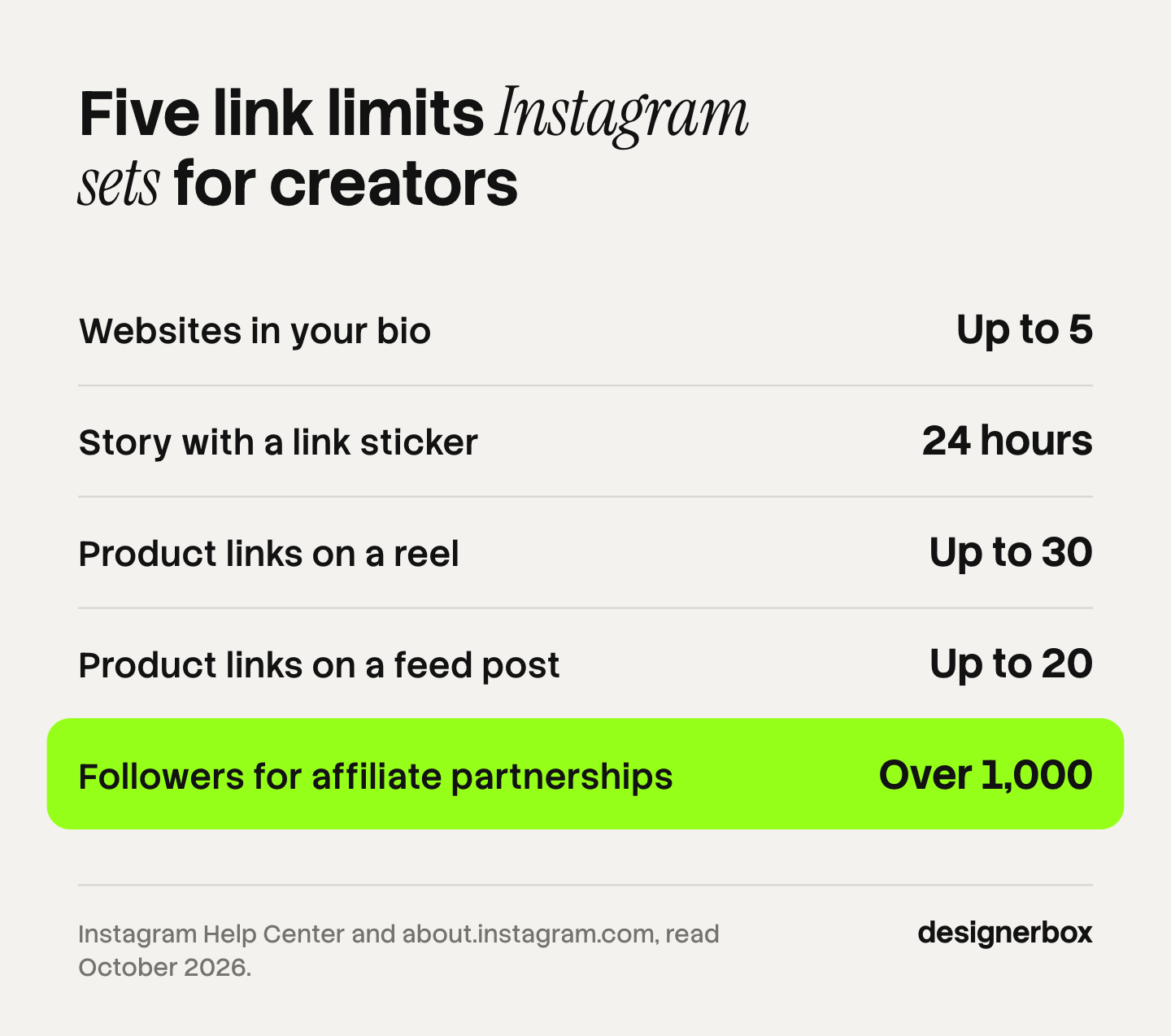
Instagram does not treat every link the same way. A bio holds five websites. A story disappears after 24 hours. A reel can carry 30 product links, but only for products in a catalog that Meta holds. Each placement has its own rule, and each rule is on a different help page.
This guide is for creators who run their content as a one-person business. We read every Instagram rule below on Instagram’s own pages in October 2026.
Key Takeaways
- Five link placements exist. Bio, Story link sticker, product links on reels and feed posts, broadcast channels and direct messages.
- Instagram has its own affiliate feature. Its Help Center calls it affiliate partnerships. It needs a public professional account, more than 1,000 followers and a supported market.
- The affiliate partner pays you. Instagram’s page says Meta does not process commission payments.
- A commission is a paid connection. The FTC says “affiliate link” alone may not be a clear disclosure. “Paid link” next to the link should be enough.
- Only show what you tried. The FTC says you cannot talk about your experience with a product you have not tried.
- Volume is the hard part. Five linked products a week in three formats is 15 pieces of content, every week.
What is Instagram affiliate marketing?
Instagram affiliate marketing is a way to earn from recommendations. A brand or an affiliate network gives you a tracked link or a code. You show the product in your content. When a follower buys through your link, the brand or the network pays you a commission.
Two kinds of program exist. The first lives outside Instagram: a network or a brand gives you a link, and you place it where Instagram allows links. The second is Instagram’s own feature, affiliate partnerships, which puts a product link on your reel or feed post.
Our guides to the Mavely app, the TikTok Shop affiliate program and the Amazon Influencer Program cover three of them.
Which Instagram account type do you need?
You need a professional account, and for most creators that means a creator account. Instagram has two professional types. It says business accounts are best for retailers, local businesses, brands, organizations and service providers. It says creator accounts are best for public figures, content producers, artists and influencers (help.instagram.com, October 2026).

You can change the type of your Instagram creator account at any time. In the app, open Settings and activity, then Account type and tools, then Switch to professional account, and choose Creator. One thing changes on that day. Instagram says a private account becomes public, and all pending follow requests are accepted.
Where can an affiliate link go on Instagram?
A link can go in five places, and each one has a limit. The table lists what Instagram’s own pages say about each placement.
| Placement | What Instagram allows | The limit to know |
|---|---|---|
| Bio | Up to 5 websites on your profile | Anyone on or off Instagram can see them |
| Story link sticker | A sticker that opens any URL when tapped | A story lasts 24 hours unless you save it to a Highlight. New accounts may not have the sticker |
| Product link on a reel or feed post | Paste a product link, affiliate links included, with Add products | Up to 30 products on a reel and 20 on a feed post. The product must be in a business catalog on Meta |
| Broadcast channel | Messages to people who join your channel | You need a public account with more than 1,000 followers. Instagram is still releasing channels |
| Direct message | A reply to a person who asked for the link | We found no Instagram help page that sets a link rule for messages |
Read in October 2026 on the Instagram Help Center pages for profile websites, product links in reels and channels, and in Instagram’s posts on the link sticker and Stories.
Instagram says Add products is not available to everyone, and that the link must go to one physical item. Messages work at small scale. For many requests, our guide to Instagram comment to DM automation explains the limits Meta sets.
A post that works brings comments that ask for the link. CreatorFlow, built by the same team as DesignerBox, answers a keyword comment with a DM that holds the link. It works on Reels, posts and Stories (creatorflow.so, October 2026). Put your disclosure in that DM as well. For the rest of the stack, CreatorFlow’s creator tools directory lists 190+ tools by job, from link-in-bio and email to scheduling and affiliate platforms (creatorflow.so/creator-tools, October 2026).
Does Instagram have its own affiliate program?
Yes, with limits. Instagram’s Help Center has a page called “About affiliate partnerships on Instagram”. It says affiliate partnerships allow eligible creators to add affiliate product links to their content and earn a commission when people buy through them (help.instagram.com, October 2026).
To use the feature, the page says you must:
- Be 18 years of age or older.
- Have a public professional account on Instagram.
- Have more than 1,000 followers.
- Be located in a supported market. Instagram says availability varies.
- Comply with Meta’s monetization policies.
Three more facts from the same page matter. The feature is rolling out gradually, so an eligible creator may not have it yet. The affiliate partner pays the commission, and Meta does not process these payments. And Meta hides the product tag when the tagged product does not appear in the reel or post.
The page states no commission rate and does not list the supported markets. Check your own professional dashboard under Monetization, then Affiliate programs, before you plan around it.
How do you get brand deals, and what label do they need?
A brand deal is a different thing from an affiliate link. In a brand deal the brand pays you, or sends you a free product, for content. Meta calls this branded content. It defines it as content that “features or is influenced by a business partner for an exchange of value, such as monetary payment or free gifts” (help.instagram.com, October 2026).
Meta’s Branded Content Policies set three rules for the creator:
- You must post branded content with the branded content tool. In the app it shows as the paid partnership label.
- You must tag the brand with its prior permission.
- You cannot accept value for content that does not feature you or that you did not help create.
Meta answers how to get brand deals only in part. Its eligibility page asks for an Instagram professional account, an “authentic, established presence” and “a sufficient follower base” (help.instagram.com, October 2026). It gives no follower number. Your affiliate posts are a record of how you show a product. You can send that record to a brand when you ask for a deal.
Instagram publishes no threshold for how to become an Instagram influencer either. The numbers it does publish are the two above: more than 1,000 followers for affiliate partnerships, and more than 1,000 for a broadcast channel. The working parts of that job are in our guide on how to become a fashion influencer.
What are Instagram Collabs?
Instagram Collabs let two or more accounts publish one post as co-authors. The creator of the post invites another account. If that account accepts, Instagram adds its username to the post, shares the post with its followers and shows it on its profile (help.instagram.com, October 2026).
Three limits apply. You can add up to 5 collaborators to a post. You cannot add collaborators to stories. And only the original creator can delete the post.
A Collab does not replace disclosure. If a brand paid for the post, the branded content rules above still apply.
Affiliate posts fall under the same label. Instagram’s guide to branded content says a post with an affiliate product link from a third-party program should use the paid partnership label, because the link earns commission (help.instagram.com, October 2026).
What do you have to disclose?
You have to disclose that you earn from the link. This section is general information, not legal advice.
The US Federal Trade Commission answers affiliate questions in its Endorsement Guides FAQ (ftc.gov, October 2026). Four of its answers apply to an Instagram creator:
- Say it in plain words. The FTC suggests a line such as “I get commissions for purchases made through links in this post.”
- “Affiliate link” alone may not be enough. The FTC says consumers might not understand that the term means you are paid. It says “Paid link” right next to an affiliate link should be adequate.
- A platform label may not be enough either. Asked if a creator can rely on a platform’s built-in disclosure, the FTC answers “Not necessarily.”
- Your experience has to be real. The FTC says “You can’t talk about your experience with a product if you haven’t tried it.”
That last answer matters for AI images. If you show a product you never held, or present an AI picture as your own experience, you have a problem with the FTC guidance and with your audience. Use AI to change the setting of a product you own. Our guide to UGC-style product photography explains where a casual product photo becomes a testimonial.
Meta has its own AI rule. It says it may require a label when content has photorealistic video or realistic-sounding audio that was digitally created or altered, including with AI. It says this requirement does not apply to images, and that images may still receive a label if its systems detect AI (meta.com, October 2026).
Which formats carry product best, and what size are they?
Each format does a different job for a link.
- Reels show the product in use, and a reel can carry product links.
- Carousels hold up to 20 photos and videos, which fits a roundup. See affiliate roundup images for the layout.
- Stories carry the link sticker. The sticker opens any URL, and the story lasts 24 hours.
Instagram publishes these sizes on its help pages (reel sizes, photo resolution, carousels, October 2026):
- Reels: an aspect ratio between 1.91:1 and 9:16, at least 30 frames per second, and a minimum resolution of 720 pixels. The recommended cover is 420 by 654 pixels.
- Photos: a width of up to 1080 pixels, with an aspect ratio between 1.91:1 and 3:4. At 1080 pixels wide, that is a height between 566 and 1440 pixels.
- Carousels: one orientation for the whole post.
Our guide to Instagram product photos shows how to frame one product for the 3:4 feed and the profile grid.
How much content does affiliate income take?
More than one shoot a week can supply. An affiliate link pays only when a person buys, so income follows the number of products you show well, week after week.

Here is our own example, not a measured figure. You link five products a week. Each one needs a reel, a carousel slide and a story frame. That is 15 pieces of content a week.
Three things reduce the work. Photograph every product you own in one session, on one surface with one light. Ask the brand for images with usage terms. Or make variations from your own photo, so one real picture of a product you hold becomes several settings.
Weekly product content in DesignerBox
DesignerBox is AI creative production for brands, creators and agencies. You take one real photo of a product you own, and you get the other settings and formats for it without a new shoot each day. The subject of every picture is the product you link.
Anyone can make an AI picture. Making hundreds that still look like your brand is the hard part. In DesignerBox you save your look once as a workflow: the surface, the light and the framing. The workflow runs the same way on the next product. You can start from a template for product backgrounds or for feed posts and carousels. The cost is shown before each run.
The full workflow from the first product photo to the finished ad, in one subscription. There is a free plan, and it runs on sample products. Uploading your own photos and the commercial license start on the Pro plan. AI video, virtual try-on, upscaling, the image editor and the video editor start on the Premium plan. Plans and credits are on the pricing page.
A creator who posts a few times a month may not need DesignerBox. DesignerBox does not post to Instagram. You download the results and post them yourself, with your disclosure.
FAQ
How many followers do you need for Instagram affiliate marketing?
Instagram’s pages set no follower minimum for a bio link or a Story link sticker. Its affiliate partnerships feature needs more than 1,000 followers, a public professional account, an age of 18 or older and a supported market.
Does Instagram pay creators for affiliate sales?
No. Instagram’s Help Center says the affiliate partner pays the commission and Meta does not process these payments.
Is #ad enough for an affiliate link on Instagram?
The FTC asks for a clear and conspicuous disclosure. It says “affiliate link” alone may not be understood, and that “Paid link” next to the link should be adequate. A plain sentence about your commission follows the FTC’s own example.
Does an affiliate post need the paid partnership label?
Yes, according to Instagram’s own guide. It lists a post with a link from a third-party affiliate program as a case for the paid partnership label, because the link earns commission (help.instagram.com, October 2026). Add your own clear disclosure as well.
Can you use AI images in Instagram affiliate posts?
Meta does not require a label on AI images, but it may add one when it detects AI. The FTC says you cannot talk about your experience with a product you have not tried, so show products you own.
Sources
- Instagram Help Center, “About affiliate partnerships on Instagram.” help.instagram.com, accessed October 2026
- Instagram Help Center, “About Product Links in Reels.” help.instagram.com, accessed October 2026
- Instagram Help Center, “Set up a professional Instagram account.” help.instagram.com, accessed October 2026
- Instagram Help Center, “Add a website to your Instagram profile.” help.instagram.com, accessed October 2026
- Instagram Help Center, “Create a channel on Instagram.” help.instagram.com, accessed October 2026
- Instagram, “Expanding Sharing Links in Stories to Everyone,” 27 October 2021. about.instagram.com, accessed October 2026
- Instagram, “How to Use Instagram Stories.” about.instagram.com, accessed October 2026
- Meta, Branded Content Policies. help.instagram.com, accessed October 2026
- Meta, “Eligibility requirements for partnership ads and branded content on Instagram and Facebook.” help.instagram.com, accessed October 2026
- Instagram Help Center, “Create collaborative posts on Instagram.” help.instagram.com, accessed October 2026
- Instagram Help Center, “Reel size and aspect ratios on Instagram.” help.instagram.com, accessed October 2026
- Instagram Help Center, “Image resolution of photos you share on Instagram.” help.instagram.com, accessed October 2026
- Instagram Help Center, “Share a post with multiple photos or videos on Instagram.” help.instagram.com, accessed October 2026
- Meta Help Center, how AI-generated content is identified and labeled on Meta products. meta.com, accessed October 2026
- US Federal Trade Commission, “FTC’s Endorsement Guides: What People Are Asking.” ftc.gov, accessed October 2026
- CreatorFlow, comment-to-DM on Reels, posts and Stories. creatorflow.so, accessed 2 October 2026
- CreatorFlow, creator tools directory, 190+ tools in eleven groups. creatorflow.so/creator-tools, accessed 2 October 2026
- DesignerBox pricing page (designerbox.ai/pricing), October 2026
Instagram link placements, affiliate partnership rules, branded content rules and post sizes verified from Instagram and Meta help pages, and disclosure guidance from the FTC, as of October 2026. Individual results vary.