

Skincare product photography has three problems most product shoots do not. The packaging is glass or high gloss, so it mirrors the room instead of showing itself. The texture is the product, and a sealed bottle hides it. And the label carries information that EU law requires to stay legible, so it cannot be styled into soft focus. The shot set that answers all three is five images.
A serum photographs beautifully and still gets returned. The buyer saw a dewy 30ml bottle lit like jewelry, then opened a box holding something the size of a lipstick, with a texture nothing in the gallery had shown them. Nothing in the photo was retouched. The two things they wanted to judge were never in frame.
Beauty sits at the sharp end of ecommerce photography for a reason other categories avoid. A cosmetic image is not only a picture. Under EU cosmetics law it is part of the product’s presentation, and presentation is regulated alongside the words on the pack.
This covers the five-shot set, why glass is difficult to light, how to shoot a texture that reads on a phone, what the labeling rules mean for your crop, and the line between styling a photo and making a claim you have to be able to prove.
Key Takeaways
- Five shots carry a skincare listing: a packshot on white, a label frame, a texture shot, a scale reference, and the product in use. Each answers a different question and none substitutes for another.
- Glass photographs its surroundings, not itself. A clear bottle shows whatever is behind and beside it. Control what it reflects and refracts and you have controlled the image.
- Texture is the shot most brands skip and buyers want most. A sealed bottle tells you nothing about whether a serum is watery, tacky or a thick balm, and that is the attribute people ask about.
- Your label is legally required to stay readable. Regulation 1223/2009 Article 19 requires the mandatory information to appear “in indelible, easily legible and visible lettering”, covering the responsible person, contents, durability or period after opening, precautions, batch number, function and the full ingredient list (eur-lex.europa.eu, September 2026).
- A picture is a claim, and that sits in the binding text. Regulation 655/2013 applies to claims “in the form of texts, names, trademarks, pictures and figurative or other signs” (eur-lex.europa.eu, September 2026). EU guidance then treats “contains moisturising aloe vera” and “prominently picturing aloe vera” as the same problem.
What makes skincare product photography hard?
Skincare product photography is hard because three properties of a cosmetic product compound, and each one defeats a different part of a normal product shoot.
The packaging is transparent, translucent or glossy. Clear glass has no surface tone of its own, so it renders as whatever sits behind it, refracted and flipped. Frosted glass and gloss plastic behave like partial mirrors, picking up the softbox, the ceiling and the photographer.
The contents are the actual purchase and they are sealed inside. Nobody buys a bottle. They buy a lightweight gel or a rich cream, and a packshot of an opaque pump tells them neither.
The label is dense, small and legally load-bearing. A cosmetic label carries an INCI ingredient list, a batch code and a period-after-opening symbol, all set at the smallest type on the pack. Any treatment that softens or crops that text removes information the buyer is entitled to read.
A cotton t-shirt forgives all three. It is opaque, it scatters light evenly, and its label is a courtesy rather than a legal instrument.
The five-shot set a skincare listing needs
| Shot | What it answers | Where it goes |
|---|---|---|
| Packshot on white | What exactly am I buying | Main image, marketplace listing |
| Label and panel | What is in it, and how do I use it | Secondary image, the compliance frame |
| Texture | What does the formula feel like | Secondary image, the one that converts |
| Scale in hand | How big is this bottle, really | Secondary image, the returns preventer |
| In use or on skin | What does this look like in a routine | Ad creative and social |
The packshot carries the marketplace requirement. The label frame carries the information the buyer is legally owed. The texture shot answers the question every review asks. The scale shot prevents the return. The in-use shot does the selling. It is also the hardest frame to generate, because a hand on the bottle is where AI virtual models break.
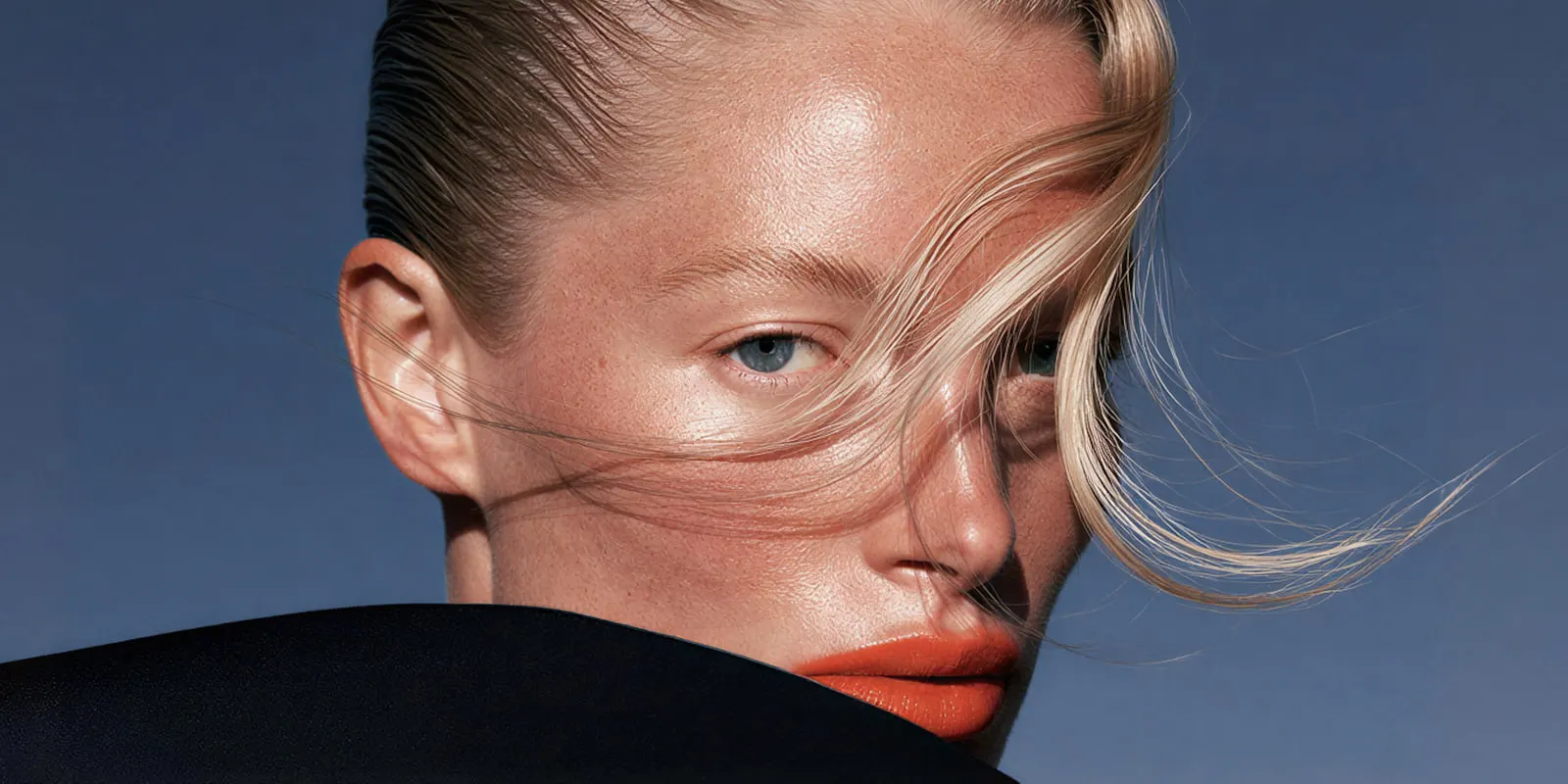
Many beauty brands shoot the packshot and the in-use lifestyle frame, then fill the remaining gallery slots with more angles of the same bottle. That adds files without answering a single new question. The order a product gallery should follow puts scale and detail ahead of atmosphere for exactly this reason.
Glass, droppers and the reflection problem
A clear bottle has no color of its own in a photograph. It transmits, refracts and reflects, so what you capture is the room, bent through a lens made of glass and serum.
The fix is to control what the bottle has to work with.
Light the background, not the bottle. For clear glass, the cleanest result usually comes from putting a large diffused source behind the product and letting the bottle transmit it. The liquid glows, the glass edges go dark where they refract, and you get a defined shape without a single hard glare spot on the front.
Build the edges with black, not white. Two black cards, one either side just out of frame, give the glass dark vertical bands to reflect. Those bands are what reads as the bottle’s outline. A pure white surround leaves clear glass looking like a faint smudge with nothing to define it.
Kill the label’s own reflection. Coated and foiled labels are the most reflective element on the pack, and they sit exactly where the camera is pointed. Move the light off-axis so the specular return goes away from the lens rather than into it, and keep the label plane slightly angled to the sensor.
Watch the far wall of the bottle. With transparent liquid, the camera sees the inside of the back of the bottle through the front. Anything printed there appears reversed inside the product. Rotate the bottle until the back label sits behind the front label rather than beside it.
Droppers and pumps add a fourth problem. A glass pipette full of serum acts as a cylindrical lens, magnifying and inverting whatever is behind it. Shot against a busy scene it fills with visual noise. Shot against a plain gradient it reads as a clean line of product, which is why almost every serum hero uses a simple backdrop.
All of this takes set-up time. A glass bottle needs more lighting work and more retouching than a matte box of the same size, so plan more time per frame for it.
Drinks share the glass problem with a regulator attached. Bottle product photography covers the label rules that apply once the vessel holds a beverage.
Which of these failures can be repaired after the fact, and which force a reshoot, is covered in how to fix product photo lighting.
Texture is the product, and the bottle hides it
A shopper’s questions about a serum are rarely about the packaging. They want to know whether it sits under makeup, whether it is sticky, and whether a “cream” is a lotion or a balm.
Four texture frames cover almost every formula:
- The swatch. A single dispense on a clean surface or on skin, lit from the side so the edge catches. Side light is what makes a gel look like a gel, because viscosity only reads through the shape of the shadow at the rim.
- The pull. Product stretched between two fingers or lifted on a spatula. This is the frame that separates a thin essence from a thick balm in a single image.
- The macro. Close enough to show whether the formula is smooth, grainy, or carrying visible exfoliant particles.
- The rub-in. Product on skin, partly worked in, showing finish. Matte, dewy or greasy is a real purchase criterion and no packshot shows it.
Shoot texture on a surface that does not compete. Textures are low contrast and low saturation, so a marble slab with heavy veining will win the frame and the product will vanish into it.
A hand in the frame usually adds its own cost. soona, for example, prices models and services apart from the photos you order (soona.co/pricing, September 2026). That is worth knowing before a swatch brief turns into a casting. It is also the cost that AI models for product photos aim to replace, since a generated hand answers the same scale question.
Overhead is the natural angle for swatches, and a full range of textures laid out together is one of the few genuinely useful uses of the format. The two constraints that decide whether that works across a whole catalog are in the flat lay photography rules.
The label has to stay legible, and that is a legal requirement
This is the part that separates cosmetics from most other categories, and it is worth knowing before anyone briefs a hero image. This is general information, not legal advice.

Regulation (EC) No 1223/2009 governs cosmetic products in the EU, and was retained in UK law after exit. Article 19 states that cosmetic products may be made available on the market only where the container and packaging bear the required information “in indelible, easily legible and visible lettering” (eur-lex.europa.eu, September 2026).
Fragrance allergens add one more change. Regulation (EU) 2023/1545 adds 56 more fragrance allergens that must be named in the ingredient list. The limits are 0.001% in leave-on products and 0.01% in rinse-off products, so fragranced skincare is covered as well as perfume. The regulation says products that do not comply could be placed on the EU market until 31 July 2026. They can be made available on the EU market until 31 July 2028. That puts a refresh cycle on the one frame that has to stay readable. Perfume photography covers that deadline and what it does to an existing photo archive.
Seven items sit under that requirement: the responsible person’s name and address, the nominal content, the date of minimum durability or the period after opening, precautions for use, the batch number, the product function where it is not obvious from presentation, and the full ingredient list preceded by the word “ingredients”.
The US sets a letter size for the ingredient list, and Article 19 does not. Under 21 CFR 701.3(b), the ingredient declaration must be in letters not less than one sixteenth of an inch high. Section 701.3(p) allows one thirty-second of an inch when the package has less than 12 square inches of surface for labeling (ecfr.gov, September 2026). Article 19 asks for easily legible and visible lettering, and it sets no letter height.
One thirty-second of an inch is about 0.8mm. On a 15ml serum bottle, the text you are legally required to keep readable is at or below what a listing thumbnail can resolve.
That rule is written about the physical pack rather than about your photography. It has two practical consequences for the image set anyway.
The first is that your listing needs a frame where that text is readable at the size it will be viewed. A buyer checking for an allergen or a fragrance ingredient is doing so from the gallery, not from a bottle they do not have yet.
The second is that any treatment which softens, warps or re-renders that text has degraded information the buyer is entitled to. Shallow depth of field across a label, heavy grain, and generated type all fail the same test. Photograph the panel flat and sharp, and keep atmosphere for the frames that are not carrying the mandatory information.
The line between styling a photo and making a claim
Cosmetic claims in the EU are governed by Commission Regulation (EU) No 655/2013, which sets six common criteria: legal compliance, truthfulness, evidential support, honesty, fairness, and informed decision-making. It has applied since 11 July 2013.
Article 1 settles the question of whether photography is in scope, and it does so in the binding text rather than in guidance. The regulation applies to claims “in the form of texts, names, trademarks, pictures and figurative or other signs” that convey product characteristics explicitly or implicitly (eur-lex.europa.eu, September 2026). In the regulation’s own text, a picture is a claim. The makeup ads guide applies the same test to swatches and before-and-after ads.
US rules take a similar view of images. The FTC’s health products guidance says a marketer is responsible for claims “suggested or reasonably implied” in advertising, pictures included. Wellness branding covers what that means for the images a brand repeats.
The detail that matters for photography sits in the technical document on cosmetic claims, agreed by the Sub-Working Group on Claims and endorsed by the Working Group on Cosmetic Products in its July 2017 version. The document is explicit that it is not a European Commission document, that it is a collection of best practice for case-by-case application by member states, and that its views are not legally binding. National authorities and national courts decide individual cases.
Read it anyway, because it is the clearest published statement of how regulators think about beauty imagery.
Under truthfulness, the document says neither the general presentation of the cosmetic product nor individual claims made for it should be based on false or irrelevant information. It then addresses ingredient claims and gives this example: the claim “contains moisturising aloe vera” or prominently picturing aloe vera should not be made if the product itself has no moisturizing effect (technical document on cosmetic claims, September 2026).
That single line is the one to remember. A photograph of an ingredient is treated the same way as a sentence about it. Botanicals arranged around a bottle state that the ingredient is present and doing something.
Under honesty, the document says presentations of a product’s performance should not go beyond the available supporting evidence, and addresses altered imagery directly: claims about efficacy should not be based on electronically manipulated before and after images where the display is misleading as to the performance of the product.
Three things follow for anyone producing beauty creative:
Props are claims. Sliced fruit, botanicals and lab glassware around a bottle imply composition and mechanism. Use ingredients the formula contains at a meaningful level.
Before and after imagery needs evidence behind it. The rule is about whether the display misleads on performance. A brightened, smoothed or re-lit “after” frame does exactly that, whether the change came from a retoucher or an AI model.
Skin in your ad is part of the presentation. A texture-free complexion next to a claim about texture is a performance claim made in pictures.
The UK arrives at the same place from a different direction, and its advertising regulator has addressed AI imagery in this exact category. The ASA says there is no blanket legal requirement in the UK to disclose the use of AI in ads. It also says it is likely to be materially misleading to include an AI generated image showing the effect of a cosmetic product that does not accurately reflect real-world results. Disclosure alone, it adds, is very unlikely to mitigate the harm caused by a fundamentally misleading message (asa.org.uk, 29 May 2025, accessed September 2026).
Read those two together and the practical rule is short. The ASA says a label can help in some cases, such as making clear that an influencer is AI-generated. A label does not repair a claim about what the product does to skin.
The advertising and disclosure rules that sit on top of this, including the EU AI Act transparency article that has applied since 2 August 2026 and the individual marketplace policies, are covered in what marketplaces require for AI-generated product images.
Where generated imagery helps, and where it must not go
The useful split is presentation against product.
Safe to generate. Backgrounds and surfaces. Styled scenes, shelves and bathroom settings. Seasonal treatments of the same bottle. Hands applying the product where the hand is a display stand rather than a result. Multiple angles of the same physical bottle from one good original. Overhead compositions of a full range, which suit beauty because the bottles are small and the whole line fits one frame. A flat lay template handles that layout. Relighting a correctly shot bottle for a different scene, with a relighting template.
Not safe to generate. The label text and the ingredient panel. The color and viscosity of the formula. The fill level. The pack shape and closure. Any depiction of a result on skin that is offered as evidence of what the product does. Any ingredient prominently pictured that the formula does not meaningfully contain.
The line is the same one the EU guidance draws. Change the room and you have styled a photo. Change the formula, the label or the skin outcome and you have described a different product, or made a claim you now have to substantiate.
On-skin work has one extra trap. A macro of cream on a cheek puts pores, fine lines and real texture at the same magnification as the product, and the reflex is to smooth all of it. A light clean-up that keeps real skin texture is what a skin retouch template should do. A smoothing pass that removes texture entirely has quietly turned a styling frame into a performance claim.
In practice this means the input matters more than the prompt. Everything should come from one accurate photograph of the actual product, so the generated set keeps the real bottle shape, the real label and the real fill. DesignerBox has a page on beauty and skincare product photography, and a hero product shot template is one place to start the packshot.
What a full range costs to shoot conventionally, and where the reshoot cycle hides the real number, is in what brands really pay for a product photoshoot. The general test for whether an output still represents the physical item is in what to check before you ship a product photo.
Get the five-shot set right on one bottle, then run the same steps on the rest of the range. In DesignerBox you save the shot list, the lighting and the brand rules as a workflow. The saved workflow runs the same way on the next product. It starts each time from that product’s own photograph, so the real pack shape and label carry through. Batch runs one workflow over a whole sheet of products. The image editor, the video editor, your brand rules and your Assets sit in the same place. The full workflow from the first product photo to the finished ad, in one subscription. Uploading your own photos and the commercial license start on the Pro plan. AI video, virtual try-on, upscaling, the image editor and the video editor start on the Premium plan. Plans and credits are on the pricing page. To build the first one, start from the templates. The cost is shown before the run.
FAQ
How do you photograph skincare products in glass bottles?
Light the background rather than the bottle. A large diffused source behind clear glass transmits through the liquid and defines the shape, which avoids the hard glare you get from lighting the front. Add a black card either side, just out of frame, to give the glass dark edges to reflect, since those bands are what reads as the bottle’s outline. Keep the light off-axis so the label’s specular reflection travels away from the lens.
What lighting is best for skincare product photography?
Large and soft for the pack, directional for the texture. A big diffused source relative to a small bottle produces a broad gradient instead of a hot streak, which is what makes glass and gloss look controlled. Texture works the opposite way: viscosity only reads through the shadow at the edge of a swatch, so side light at a low angle is what separates a thin essence from a thick balm.
How many photos does a skincare listing need?
Five types as a minimum: a packshot on white, a label and panel frame, a texture shot, a scale reference, and the product in use. Marketplaces allow more slots and most brands fill them with extra angles of the same bottle, which adds files without answering a new question. A second texture frame is worth more than a fourth angle of the pack.
Can I use AI-generated images for skincare listings?
For the background, the scene, the styling and the surface, yes. For the label text, the ingredient panel, the formula color and viscosity, the fill level and any depiction of a result on skin, no. Generate from an accurate photograph of the actual product so the output inherits the real bottle and the real label, and photograph the ingredient panel rather than rendering it, since that frame reproduces information the buyer is entitled to read.
Are before and after photos allowed for skincare?
They are allowed with evidence behind them. EU guidance on cosmetic claims states that claims about efficacy should not be based on electronically manipulated before and after images where the display is misleading as to the performance of the product, and that presentations of a product’s performance should not go beyond the available supporting evidence (technical document on cosmetic claims, September 2026). The document is best-practice guidance rather than binding law, and national authorities assess individual cases. Retouching the “after” frame is the specific failure it describes.
Does a photograph count as a cosmetic claim in the EU?
Treat it as one. The EU technical document on cosmetic claims puts “contains moisturising aloe vera” and “prominently picturing aloe vera” in the same category, and says neither should be made if the product has no moisturizing effect. Regulation 655/2013 sets six common criteria for claims, and the general presentation of the product falls under truthfulness alongside the individual wording. Props that imply an ingredient or a mechanism carry the same burden as text.
Why does skincare get returned even when the photos are accurate?
Usually texture and scale. A gallery full of pack shots tells a buyer nothing about whether a cream is light or heavy, so they build an expectation from the styling and it does not survive first use. Bottle size is second, because a 30ml serum and a 100ml lotion occupy identical space in a listing thumbnail. A texture frame fixes the first and a shot of the bottle in a hand fixes the second.
Sources
- Regulation (EC) No 1223/2009 on cosmetic products, Article 19, labeling, EUR-Lex, accessed September 2026
- Commission Regulation (EU) No 655/2013 on cosmetic claims, Articles 1 and 3 and the Annex, EUR-Lex, accessed September 2026
- Technical document on cosmetic claims, agreed by the Sub-Working Group on Claims, version of 3 July 2017, accessed September 2026. The document says it is not a European Commission document and that its views are not legally binding
- Commission Regulation (EU) 2023/1545 on the labeling of fragrance allergens, recitals 6 and 7 and the transition notes in the Annex, accessed September 2026
- 21 CFR 701.3, designation of ingredients, paragraphs (b) and (p), accessed September 2026
- ASA, Disclosure of AI in advertising, 29 May 2025, accessed September 2026
- soona pricing page, how models and services are priced (soona.co/pricing, September 2026)
Cosmetic labeling and claims rules verified from primary sources as of September 2026. Rules change; check the source pages before you publish a campaign. Individual results vary.