
Perfume ads look the way they do because a screen cannot carry a scent. The ad cannot let you smell the perfume. So it sells what the scent should feel like: a mood, a character you want to be and a place you want to be in. The bottle carries the brand. Six formats repeat, and a small fragrance brand can make each one without a film budget.
The most famous example cost millions to make. Guinness World Records lists a four-minute Chanel No. 5 film, directed by Baz Luhrmann and starring Nicole Kidman, as the world’s most expensive TV advertisement. It was made in 2004 and cost £18 million ($33 million) to produce (guinnessworldrecords.com, September 2026). A brand with 40 scents has the same job on a smaller budget: a campaign for every launch, in every market and every format.
Every format starts from a good photo of the real bottle, and AI fragrance product photography starts from that photo. This guide puts the six formats in one table, with the small-brand route for each. It is for fragrance brands with 20 to 500 products, and for the agencies that make their campaigns. The perfume photography guide covers the full product image set.
Key Takeaways
-
A screen cannot carry a scent. The ad sells a mood, a person and a place. The bottle carries the brand.
-
Smell and emotional memory are linked. A small 2004 study found more amygdala activity when a meaningful smell cued a memory than when sight cued it.
-
Six formats repeat. The bottle hero, the notes still life, the UGC review, the CGI splash, the face of the brand and the mood film.
-
Shoot the real bottle first. Every format shows the bottle or ends on it, and each AI frame must match it.
-
Check the label rules. In the EU, a realistic AI-made person can count as a deepfake, and a deepfake needs a clear label. TikTok asks for a label on AI-generated ad media.
-
Reviews must be real. The FTC rule on fake reviews has applied since 21 October 2024, and it covers AI-generated fake reviews.
-
One concept makes 12 files. Four platforms, with three formats on each.
Why do perfume ads look the way they do?
A shoe ad can show the shoe on a foot. A perfume ad can show only the bottle, and the bottle is packaging. Fragrance marketing starts from one fact: the scent cannot reach the viewer through a screen. So the ad shows what the scent should feel like: a light, a season, a person, a place. The viewer brings the rest from memory.
Research on smell and memory helps explain that choice. In a 2004 brain-imaging study, researchers used a personally meaningful smell to cue a memory. It produced more activity in the amygdala and hippocampal regions than any other cue, including the same memory cued by sight (Herz and colleagues, Neuropsychologia, 2004). The study had five participants, so treat it as a small first result. An earlier study found that memories cued by a smell were more emotional than memories cued by the smell’s name (Herz and Cupchik, Chemical Senses, 1995). Neither study tested ads.
A print ad can carry the scent itself. Arcade Beauty, which makes the ScentStrip fragrance sampler, says it “pioneered this technology in 1979”. The strip holds fragrance oil between two layers of paper (arcadebeauty.com, September 2026). A phone screen has no strip, so a feed ad has only pictures and sound.
What are the 6 perfume ad formats?
Six formats repeat in fragrance ads: the bottle hero, the notes still life, the UGC review, the CGI splash, the face of the brand and the mood film. Three sell the bottle and the liquid inside it. Two sell a person. One sells a place. They differ most in effort, from one photo of the real bottle to a crew on location.
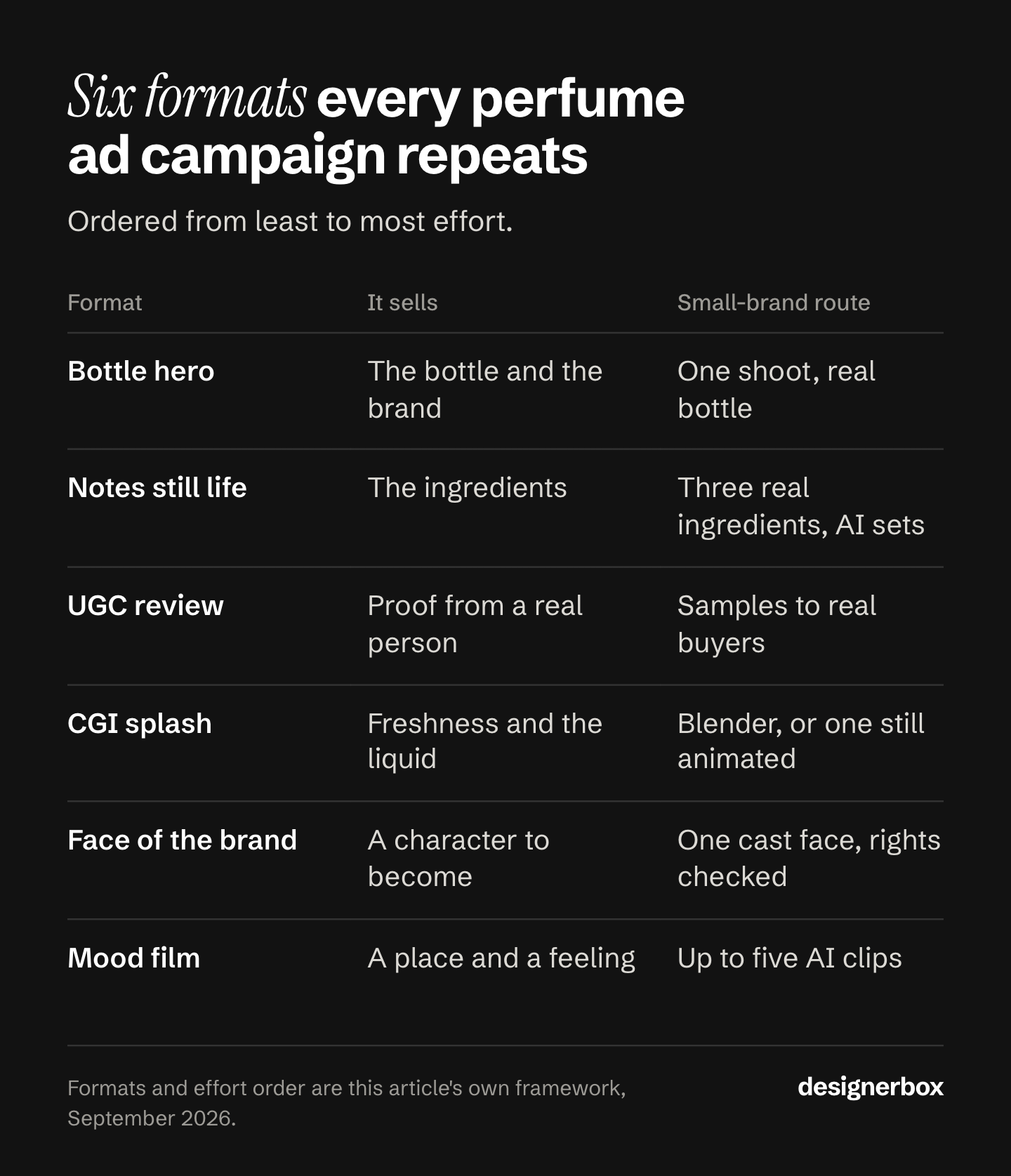
The table runs from the least effort to the most.
| Format | What it sells | What the studio version needs | The small-brand route |
|---|---|---|---|
| Bottle hero | The bottle and the brand | One sharp photo of the real bottle, with controlled light on the glass | Shoot the bottle once on a plain background, then place it in new scenes |
| Notes still life | The ingredients | The bottle with the raw materials its notes name | Style three real ingredients with the bottle, then add new sets with AI images |
| UGC review | Proof from a person who smelled it | Real buyers or paid creators, samples, a disclosure | Send samples, ask for honest clips, add the bottle as the last frame |
| CGI splash | Freshness and the liquid | A 3D model of the bottle, a liquid simulation, render time | Model the bottle in Blender, or animate one still with an image-to-video model |
| Face of the brand | A character the buyer wants to be | A model or an ambassador, usage rights, a shoot | One cast face in every file, with the rights and the labels checked |
| Mood film | A place and a feeling | A director, a location, a crew, music | Three to five short AI clips, cut on a timeline with music and the bottle at the end |
The order is an estimate of effort only. We found no public data that ranks these formats by sales, so test them against each other. In all six, the bottle in the ad must match the bottle in the box.
Formats that sell the bottle
The bottle hero
The bottle hero is the bottle alone, lit so the viewer sees the glass, the cap and the label at once. Glass is the hard part, because a clear bottle reflects the room around it. The guide to bottle product photography covers the light and the label rules for glass.
Shoot the real bottle once, on a plain background. That photo becomes the reference for every AI scene after it. An image model can change the letters on the label, the shape of the cap or the color of the liquid. So compare each AI frame with the real bottle before it ships.
The notes still life
A fragrance lists its notes in three layers. Top notes are what you smell first, heart notes come next, and base notes last the longest. The notes still life puts the bottle beside the materials those notes name: bergamot peel, a vanilla pod, a block of cedar.
Buy the three main ingredients, style them with the real bottle and shoot one frame. AI images can then add new backgrounds and new arrangements. Show only notes the fragrance contains. The perfume photography guide above explains why a product picture counts as a claim in the EU.
The CGI splash
The CGI splash shows liquid, mist or ice moving around the bottle. It sells freshness. The studio version needs a 3D model of the bottle, a liquid simulation and render time.
Blender, the 3D tool, is free and open source (blender.org, September 2026), so the cost is skill and time. The faster route starts from one still. Google says Veo 3.1 takes up to three reference images “of a single person, character, or product”. It says the model “preserves the subject’s appearance in the output video” (ai.google.dev, October 2026). Check the label in every frame anyway. Google lists 22 October 2026 as the earliest shutdown date for the Veo 3.1 preview models in the Gemini API, and names Gemini Omni Flash as the replacement (Gemini API deprecations, October 2026). The steps for turning a product photo into a video ad apply here, shot by shot.
Formats that sell a person
The face of the brand
The face of the brand is a model, an actor or an ambassador who represents the scent. The ad asks the buyer to want to be that person. The Chanel film above is the most expensive example of this format.
A smaller brand casts one face for the whole campaign. That can be a hired model, with usage rights for every market and format you plan. It can also be an AI-generated person. Then keep it the same person in every frame, and read the label rules below before the ad runs. AI influencer marketing covers how to test an AI character first. Makeup ads use the same face format, with extra rules for retouched skin.
The UGC review
A UGC review (UGC means user-generated content) is a real person who has smelled the fragrance, speaking on camera in their own words. It answers the question the other formats cannot: what does it smell like to someone like me?
In the US, the FTC rule on consumer reviews and testimonials has applied since 21 October 2024 (ftc.gov, September 2026). Under 16 CFR 465.2, a business must not create a testimonial that falsely suggests the person exists or used the product (law.cornell.edu, September 2026). The FTC announced the rule as a way to “deter AI-generated fake reviews” (ftc.gov, August 2024). It also says the rule has “no blanket prohibition on the use of AI-generated avatars in marketing”. So an AI person can present the bottle. It should not claim to have worn the scent.
Free samples matter too. The FTC says the FTC Act applies when someone receives free products “with the expectation that you’ll promote or discuss the advertiser’s products” (ftc.gov, September 2026). A creator who got a free bottle should say so clearly in the post.
The format that sells a place: the mood film
A mood film is a short film of a place, a light and a feeling, with the bottle in the last frame. It shows where the scent belongs instead of describing it: a pool at noon, a city at night, a room after rain. The Chanel film above is a mood film with a famous face.
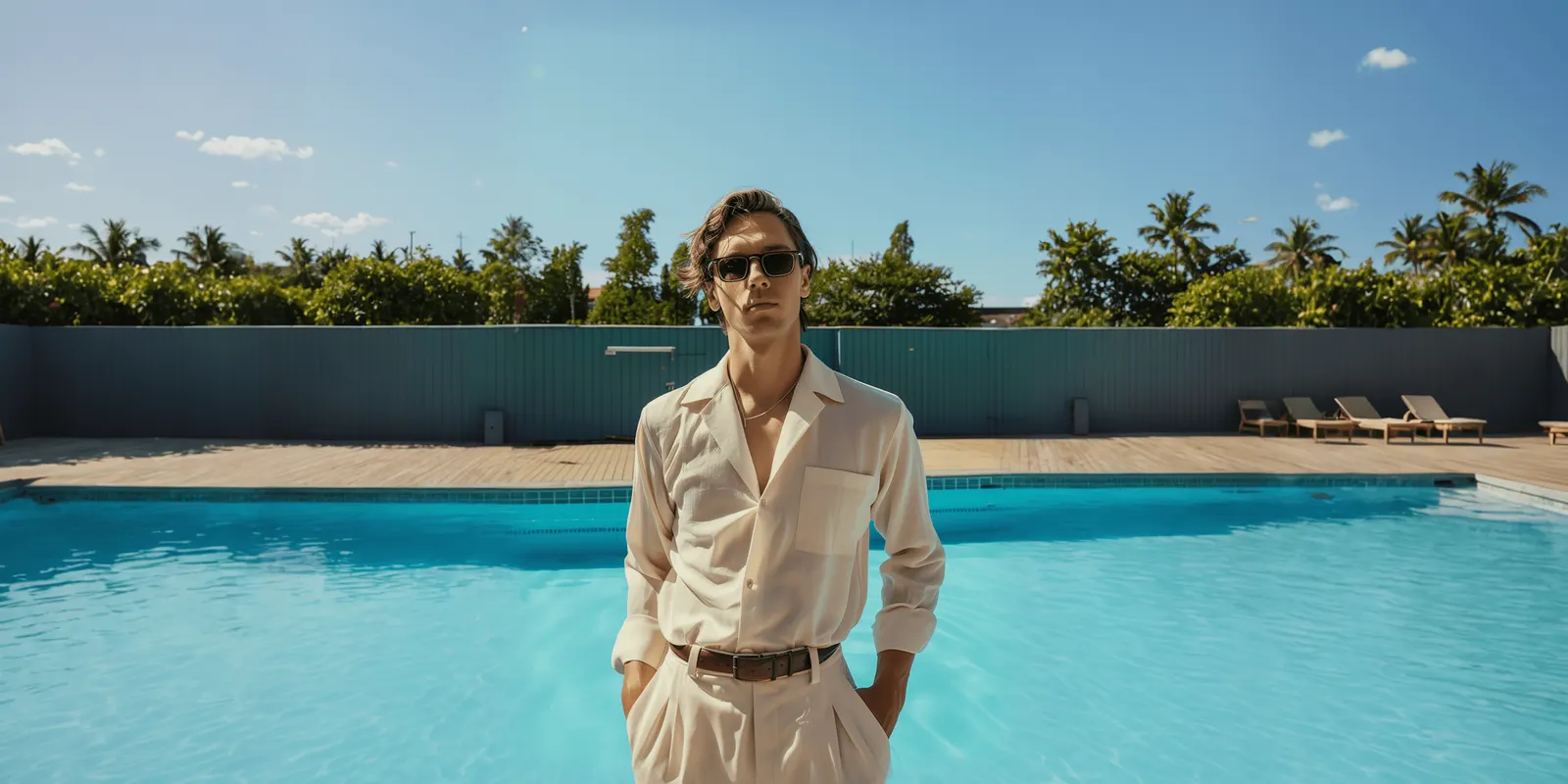
The studio version needs a director, a location, a crew, a cast and music. The small-brand version is a shot list of up to five clips:
- The place. One wide shot that sets the light and the season.
- The detail. A hand, a fabric, water or skin in the same light.
- The person. The face of the brand, if the campaign has one.
- The bottle in the scene. The real bottle, in the same light.
- The end frame. The bottle hero, with the name of the scent.
Each clip can start as a still and move with an image-to-video model. Google’s Veo 3.1 page lists clips of 4, 6 or 8 seconds, in 16:9 or 9:16, and says the model “natively generates audio with video”. Cut the clips on a video timeline with music and short text. The guide to AI cinematic ad styles names ten looks you can direct.
AI in perfume ads: labels and rules
This is general information, not legal advice. Platform rules change often, so check each page before a campaign runs.
| Where | What triggers a label or a rule | What to do |
|---|---|---|
| Meta (Facebook, Instagram) | Ads made or heavily edited with Meta’s own AI tools, and ads where Meta detects third-party AI | Expect an “AI info” label in the ad menu |
| TikTok ads | Ad media that is fully AI-generated or significantly modified by AI | Apply the AIGC label, or your own clear disclaimer |
| EU AI Act, Article 50 | A deepfake: AI content that resembles a real or plausible person, object, place or event and could falsely appear authentic | Disclose it clearly, at first exposure at the latest |
| FTC (United States) | A fake review or testimonial, including an AI-generated one | Use real reviews from real buyers, and disclose free products |
Meta says it will “automatically apply an AI info label” when you use its own tools, such as Image Generation. It also labels ads when it detects third-party AI through methods such as C2PA. The feature may not be available in every region (facebook.com/business/help, September 2026). TikTok asks for the AIGC label or your own clear disclaimer, and it rejects or restricts ads with undisclosed AI content. Changes to lighting, color or the background do not count (ads.tiktok.com, last updated April 2026).
In the EU, Article 50 of the AI Act has applied since 2 August 2026. The European Commission’s FAQ says “Deployers must disclose deepfake content to a natural person upon first exposure at the latest” (digital-strategy.ec.europa.eu, last updated 24 July 2026). The deployer is the business that uses the AI system, such as the brand or its agency. A deepfake resembles someone or something that exists or “can plausibly exist”, and could falsely appear authentic. A photorealistic AI face of the brand can meet that test, so treat it as likely in scope. The same FAQ says AI background scenes and special effects in standard film production “are not likely” to make content falsely appear authentic.
One fragrance campaign in every market and format
One campaign concept on four platforms, with three formats on each, makes 12 files. Add a second language and it makes 24. That is why the plan matters more than any single shot. Creative assets explains how the file count grows by placement, size and language.
Some parts stay fixed in every file: the bottle, the face, the color grade, the end frame and the line. Other parts change: the aspect ratio, the length, the text and the language. TikTok lists vertical 9:16 as the recommended shape for its in-feed ads (ads.tiktok.com, last updated June 2026).
- Lock the bottle hero and the end frame first. Every other file uses them.
- Make each film master twice, in 9:16 and in 16:9. You cannot crop one into the other without losing the frame.
- Cut short versions from each master. For example, a 6-second cut and a 15-second cut.
- Write the on-screen text last. Keep one short line per frame, and translate it for each market.
- Check every file before it ships. Compare the bottle with the real one, and apply the label rule for that platform.
The stills from the bottle hero and the notes still life also work as static fragrance ads. The guide to static ad examples sorts 30 static formats and the rule each one has to pass.
Perfume ads as a workflow
Anyone can make an AI picture. Making hundreds that still look like your brand is the hard part. A brand with 40 scents needs the same bottle hero, the same light and the same end frame on every one of them.
DesignerBox is AI creative production for brands and agencies. You add the real bottle photo, then build the campaign once as a workflow: the bottle hero, the notes still life, the scene and the sizes. AI fragrance product photography starts from your own bottle photo. The AI ad generator makes ads from the stills. AI video ads start from one product photo. The video editor is a real timeline, with several tracks, transitions, animated text and audio.
You set the brand rules once, and the workflow reads them on every run. Batch runs one workflow over a whole sheet of products, so each scent is one row. You review the results in one pass, keep or discard per row, and re-run one row alone. Three critic steps score the results, and best-of-N keeps the best one. One ad can be rebuilt in another language with the layout redrawn, and resized to the formats ad platforms need. The full workflow from the first product photo to the finished ad, in one subscription.
Here are the limits. DesignerBox does not post your ads to Meta or TikTok. You download the results, or send them with a webhook or an S3 step. You still compare every label with the real bottle. AI video and the video editor start on the Premium plan. An 8-second clip costs 40 to 560 credits, depending on the model. The free plan cannot make video. Uploading your own photos and the commercial license start on the Pro plan. Team features, shared brand kits and white label are on the Ultra plan, and every plan below Ultra is one seat.
A free plan for your first run
There is a free plan, and it runs on sample products. Start from a template and see the cost before you run it. Get started free.
FAQ
Why do perfume commercials look so strange?
A screen cannot carry a scent. So the ad shows the mood, the person and the place the scent should feel like, and the bottle carries the brand. Studies link smell to emotional memory, which helps explain why brands choose scenes over descriptions.
What is the most expensive perfume ad ever made?
Guinness World Records lists a four-minute Chanel No. 5 film as the world’s most expensive TV advertisement. Baz Luhrmann directed it and Nicole Kidman starred in it. It was made in 2004 and cost £18 million ($33 million) to produce.
How can a small fragrance brand make ads without a film budget?
Shoot the real bottle once, then build the other formats from that photo. Make a notes still life from three real ingredients, ask real buyers for review clips, and build a mood film from up to five short AI clips. Check every frame against the real bottle.
Do AI-generated perfume ads need a label?
Often, yes. TikTok asks for a label on fully AI-generated or significantly edited ad media. Meta labels ads made with its own AI tools, or with third-party AI it detects. In the EU, a realistic AI-made person can count as a deepfake, and a deepfake needs a clear label.
Can I use AI-written reviews in fragrance ads?
No. The FTC rule on consumer reviews and testimonials, in effect since 21 October 2024, makes it unlawful for a business to create a review that falsely suggests the reviewer exists or used the product. The FTC says it covers AI-generated fake reviews. Use real reviews from real buyers.
How many files does one fragrance campaign need?
One concept on four platforms, with three formats on each, makes 12 files. A second language makes 24. Plan the set first, so the bottle, the face and the end frame match in every file.
Sources
- Guinness World Records, most expensive advertisement (commercial) on television: guinnessworldrecords.com, accessed September 2026
- Herz R.S., Eliassen J., Beland S., Souza T., “Neuroimaging evidence for the emotional potency of odor-evoked memory”, Neuropsychologia 42 (2004), 371-378: doi.org/10.1016/j.neuropsychologia.2003.08.009, accessed September 2026
- Herz R.S., Cupchik G.C., “The emotional distinctiveness of odor-evoked memories”, Chemical Senses 20 (1995), 517-528: doi.org/10.1093/chemse/20.5.517, accessed September 2026
- Arcade Beauty, ScentStrip technology: arcadebeauty.com, accessed September 2026
- Blender Foundation, About Blender: blender.org, accessed September 2026
- Google, Generate videos with Veo 3.1 in the Gemini API: ai.google.dev, accessed October 2026
- Google, Gemini API deprecations (Veo 3.1 preview models, earliest shutdown 22 October 2026): ai.google.dev, accessed October 2026
- FTC, Consumer Reviews and Testimonials Rule: Questions and Answers: ftc.gov, accessed September 2026
- FTC, final rule banning fake reviews and testimonials: ftc.gov, August 2024, accessed September 2026
- 16 CFR 465.2, via Cornell LII: law.cornell.edu/cfr/text/16/465.2, accessed September 2026
- FTC, The FTC’s Endorsement Guides: What People Are Asking: ftc.gov, accessed September 2026
- Meta Business Help Center, AI info labels on ads: facebook.com/business/help/1010479435004531, accessed September 2026
- TikTok Ads Policy, Misleading and false content: ads.tiktok.com, last updated April 2026, accessed September 2026
- TikTok Auction In-Feed Ads specifications: ads.tiktok.com, last updated June 2026, accessed October 2026
- European Commission, Transparency obligations under Article 50 of the AI Act (FAQ): digital-strategy.ec.europa.eu, last updated 24 July 2026, accessed September 2026
- DesignerBox pricing page (designerbox.ai/pricing), September 2026: plans and feature gates
Research, records and ad rules verified from Neuropsychologia, Chemical Senses, Guinness World Records, Google, Meta, TikTok, the FTC and the European Commission as of September 2026. Google’s Veo 3.1 guide and deprecations page and TikTok’s in-feed ad specifications were re-checked on 2 October 2026. Individual results vary.