
Product photography rates come in four structures: per hour, per image, per day and per project. Guides published or updated in 2026 put a product image at $25 to $350 and a shoot day at $500 to $5,000. Retouching, the usage license, rush work, styling and shipping are billed on top. The structure decides who pays when a shoot runs long or the shot list grows.
Two groups search for rates: photographers who need to set one, and buyers with two quotes that do not match. Both groups need the same thing: a way to read the structure behind the number.
Key Takeaways
- Four structures. A product shoot is priced per hour, per image, per day or per project. Many photographers mix two of them.
- Each structure moves risk. Per hour and per day put a slow shoot on the buyer. Per image and per project put it on the photographer.
- A wage is not a rate. The US median wage for employed photographers was $21.47 an hour in May 2025. A billing rate also has to cover unbilled hours and business costs.
- Two fees, then expenses. ASMP’s buyer guide separates the photography fee from the licensing fee, with expenses listed after both.
- One unit compares every quote. Add every line, then divide by the images you accept.
What are product photography rates in 2026?
Product photography rates in 2026 depend first on the unit the photographer bills. The table shows the published ranges for each unit. The two guides do not name the survey or data behind their numbers, so read them as direction and never as a market average.
| Unit | Published range | Source |
|---|---|---|
| Per hour, entry-level photographer | $50 to $150 | VSCO photography pricing guide (vsco.co, October 2026) |
| Per hour, professional photographer | $100 to $300 | VSCO photography pricing guide (vsco.co, October 2026) |
| Per image, product photography | $25 to $175 | VSCO photography pricing guide (vsco.co, October 2026) |
| Per image, product photography | $50 to $350 | Shopify blog, product photography pricing (October 2026) |
| Per day, product photographer | $500 to $3,000 | Shopify blog, product photography pricing (October 2026) |
| Per day, commercial photography | $800 to $5,000 | VSCO photography pricing guide (vsco.co, October 2026) |
The American Society of Media Photographers (ASMP) says antitrust law stops it from setting or suggesting prices (ASMP, October 2026). A range you read online is therefore one publisher’s estimate.
These ranges price one shoot. What a catalog costs over a year is a different question, and our guide to product photoshoot cost answers it per product. Our guide to ecommerce product photography applies the per-image range to a full set of listing images.
The four rate structures
Each structure answers one question: who pays when the plan and the shoot day differ?
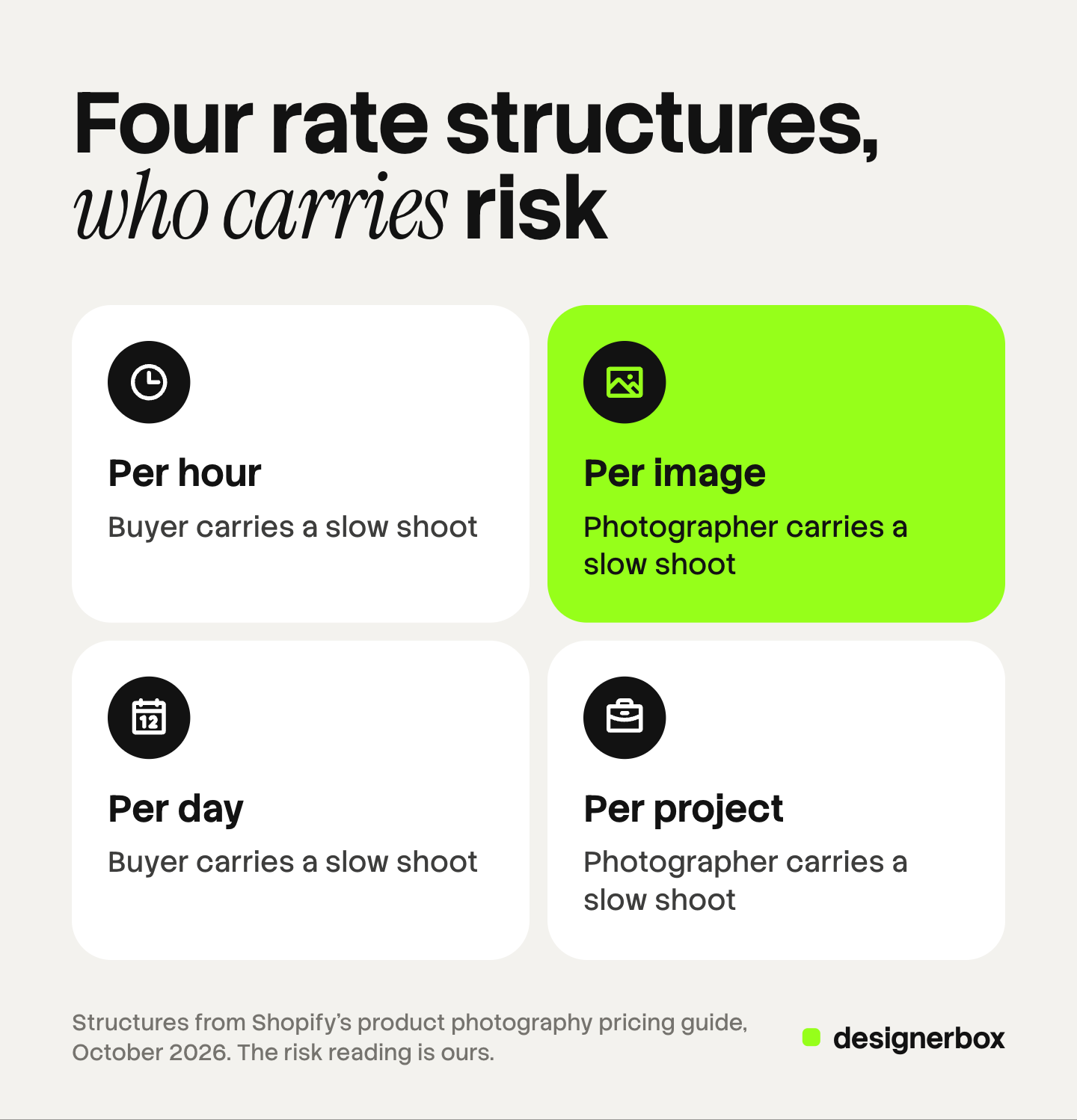
| Structure | You pay for | Who carries a slow shoot | Who carries a longer shot list |
|---|---|---|---|
| Per hour | Time on set, and often editing time | Buyer | Buyer |
| Per image | Each finished, delivered image | Photographer | Buyer |
| Per day | A full or half day with the photographer | Buyer | Photographer, until the day is full |
| Per project | The whole job at one price | Photographer | Photographer, unless the scope is written |
Per hour. The buyer pays for time. This fits small or uncertain jobs. Shopify’s guide names the weakness: a job that takes longer than planned can use the budget early.
Per image. The buyer pays a set price for each finished image. Shopify’s guide says the simplicity of this structure makes costs easy to forecast. The photographer carries the slow product, so difficult materials often get a higher image price.
Per day. The buyer books the photographer’s day. A prepared team with a written shot list gets more images from the same fee. An unprepared team pays the same fee for fewer.
Per project. One price covers the whole job. Shopify’s guide warns about project creep here, where a job with no clear goal takes twice as long. A fixed price works when the scope is written and both sides sign it.
Mixed. Shopify’s guide notes that many photographers combine structures. A common mix is time for the shoot, then a price per finished image for the editing.
Why a rate is higher than a wage
Photographers who set a first rate often start from a wage. That starting point is too low, and the public data shows why.
The US Bureau of Labor Statistics puts the median hourly wage for photographers at $21.47 in May 2025. The lowest 10% earned less than $14.82, and the highest 10% earned more than $44.14 (BLS Occupational Outlook Handbook, October 2026).
Those figures describe employees. BLS states that its pay data does not include self-employed workers. The same page says 67% of photographers are self-employed.
A business owner also does work no client pays for. BLS lists it: advertising, scheduling, equipment, supplies, records and bills. The rate has to pay for those hours and for the equipment.
Here is an illustration, with assumed inputs. Take the BLS median annual wage of $44,660 as the income target. Assume $20,000 a year in business costs and 800 billable hours. The rate is ($44,660 + $20,000) / 800, or about $81 an hour. Change the two assumptions to your own numbers and run it again.
The line items above the rate
The rate is one line of a quote. ASMP’s guide for buyers describes a quote in three parts: a photography fee, a licensing fee and expenses (ASMP, Working with an Assignment Photographer, October 2026). Some photographers show the two fees as one number.
| Line item | What it pays for | What to ask |
|---|---|---|
| Retouching | Editing after the shoot. Billed per image or per hour | Which edits does the image price include? |
| Usage license | The right to use the images in named media, for a set time and territory | Which media, how long, which countries? |
| Rush | Delivery faster than the standard timeline | What is the standard timeline? |
| Styling and crew | Assistants, stylists, models, prop rentals, travel and insurance, which ASMP lists as itemized expenses | Which of these apply to this job? |
| Shipping | Sending products to the photographer and back | Who pays for the return? |
Retouching. Photo retouching rates follow the same split as shoot rates: per image for a defined edit, per hour for open-ended work. A basic clean is often inside the image price. Our guide to product photo retouching lists what each level of edit includes.
Usage license. ASMP says licensing fees reflect how widely and for how long the images will be used. More extensive rights cost more. VSCO’s guide puts commercial licensing fees at $250 to $10,000 (vsco.co, October 2026). The UK Association of Photographers says a base fee normally includes one year of use in one country in two media (AOP usage calculator, October 2026). Our guide to image licensing and usage rights explains the four terms of a license.
Rush. Shopify’s guide puts rush fees at 25% to 200% of the total job cost.

How to convert a quote into cost per accepted image
Two quotes in two structures cannot be compared line by line. Convert both to one unit: the cost of each image you accept and use.
Cost per accepted image = (fees + license + expenses + rush) / accepted images
An accepted image is one that passes your review and goes live. A delivered image that you reject is a cost with no result.
The example below is illustrative. Every number is an assumption chosen to show the arithmetic.
| Quote A, per day | Quote B, per image | |
|---|---|---|
| Fee | $2,000 for one day | $60 x 40 images = $2,400 |
| Usage license | $500 | $500 |
| Shipping | $150 | $150 |
| Total | $2,650 | $3,050 |
| Images delivered | 40 | 40 |
| Images accepted | 34 | 40, because the contract includes reshoots |
| Cost per delivered image | $66.25 | $76.25 |
| Cost per accepted image | $77.94 | $76.25 |
Quote A looks cheaper per delivered image. After six rejections it costs more per accepted image. The acceptance count is an assumption here. Use the count from your last shoot.
How to read a quote, and how to write one
A quote is clear when the buyer can fill in the formula from it. These checks work for both sides.
If you are the buyer, ask for five things in writing:
- The structure, and what happens when the shoot runs past the planned time.
- The number of finished images, and who chooses them.
- The edits included in the price, and the price of each extra edit.
- The license: media, term, territory and exclusivity.
- The reshoot terms for images that miss the brief.
ASMP advises buyers to license the rights they plan to use, and to agree a price for extra rights at the start. That keeps the first invoice lower and the later one predictable.
If you are the photographer, write the same five things first. A product photography price list with one number per image invites comparison on that number alone.
Both sides gain from a written scope. Our guide to ecommerce photography services shows how studios state minimums and extras.
Where AI changes the rate question
AI image tools do not change the four structures. They change how many times a brand has to buy a shoot. Our guide on whether AI will replace photographers sorts which shots stay with a camera.
A shoot produces two kinds of image. The first is the accurate record of the product. The second is every variation of that record: a new background, a new crop, a seasonal scene, an ad format. Each variation used to need more set time, so it used to sit inside the rate.
With AI, a variation can be made from one approved photo. Spend moves from repeat capture to variation, and each variation still needs a review. The approved photo still has to be shot, lit and color-checked by a person. Our guide to the source product photo lists what that photo needs.
Variations from one approved photo
DesignerBox is AI creative production for brands and agencies. It makes images, ads and video from your brand rules and your approved pictures. A product photo is one input among several.
Anyone can make an AI picture. Making hundreds that still look like your brand is the hard part. You build a workflow once with your brand rules. Batch then runs it over a sheet, and row one and row two hundred read the same rules.
The cost is shown before the run. You can put that number into the formula above, next to a photographer’s quote.
The same workspace makes the ad and the video from those images. The full workflow from the first product photo to the finished ad, in one subscription. For the product side, see AI product photography.
The limits matter for this comparison. DesignerBox does not shoot your product, so the source photo is still a photographer’s job. You review every result yourself. You download the results, or send them with a webhook or an S3 step. Every plan below Ultra is one seat, and the free plan runs on sample products.
Uploading your own photos and the commercial license start on the Pro plan. AI video, virtual try-on, upscaling, the image editor and the video editor start on the Premium plan. Plans and credits are on the pricing page.
FAQ
What are typical product photography rates in 2026?
Published guides put product photography at $25 to $175 per image (vsco.co, October 2026) or $50 to $350 per image (Shopify blog, October 2026). The same guides put a day at $500 to $3,000 and $800 to $5,000. Neither guide names its data.
What is a typical photographer day rate?
Shopify’s guide puts a product photographer’s day at $500 to $3,000. VSCO’s guide puts commercial photography day rates at $800 to $5,000. A day rate buys time. Ask how many finished images the photographer expects from the day, and whether editing is included.
How much should I charge for product photography?
Start from your costs and your billable hours. Add your income target to your yearly business costs, then divide by the hours you can bill. Compare the result with published ranges. Then decide which structure fits the job: time for uncertain work, per image or per project for defined work.
What are photo retouching rates based on?
Retouching is billed per image when the edit is defined, such as a background clean. It is billed per hour when the work is open-ended, such as a composite. Ask which edits the image price already includes, and get the price of each extra edit in writing.
What is a usage fee on a photography quote?
A usage fee, or licensing fee, pays for the right to use the images. ASMP says it reflects how widely and for how long the images will be used. Paid ads, more countries and longer terms raise it. Ask for the license terms in writing.
Does AI lower product photography rates?
AI does not set a photographer’s rate. It lowers the number of images a brand needs from a shoot, because variations can come from one approved photo. In DesignerBox the cost of a run is shown before the run. The source photo still needs a photographer.
Sources
- US Bureau of Labor Statistics, Occupational Outlook Handbook, Photographers: median hourly wage of $21.47 in May 2025, the 10th and 90th percentiles, the median annual wage of $44,660, 67% self-employed, and the note that pay data does not include self-employed workers: bls.gov, accessed October 2026
- American Society of Media Photographers, Working with an Assignment Photographer: photography fees, licensing fees, itemized expenses and the advice to license planned use: asmp.org, accessed October 2026
- American Society of Media Photographers, licensing guide: antitrust law and why ASMP does not set or suggest prices: asmp.org, accessed October 2026
- Association of Photographers, usage calculator: what a base fee normally includes: the-aop.org, accessed October 2026
- Shopify blog, product photography pricing: per-image and per-day ranges, rush fees, and the pricing models: shopify.com, accessed October 2026
- VSCO, photography pricing guide: hourly ranges by experience, product photography per image, commercial day rates and licensing fees (vsco.co/learn/photography-pricing-guide, accessed October 2026)
- DesignerBox batch, plan gates and the cost shown before a run: DesignerBox batch page and pricing page (designerbox.ai/product/batch, designerbox.ai/pricing), October 2026
BLS, ASMP, AOP, Shopify and VSCO facts verified on each publisher’s own page, October 2026. The two pricing guides do not name the data behind their ranges. The billing-rate example and the two-quote example are illustrative arithmetic with assumed inputs. Rates vary by market, product and license terms. Individual results vary.