A product photoshoot is priced per day or per SKU. Expect $25 to $75 per image for white-background listing shots and $100 to $500 for styled lifestyle work, or $1,000 to $5,000 for a full studio day. The quote covers the photographer, studio hire, a stylist, models if the product is worn, and post-production. Worn categories carry the hand or body model as a separate line, which is why shooting a bracelet range prices differently from shooting a boxed product.
That is the number every pricing page gives you. It is also the number that misleads you, because it prices one shoot and your catalogue does not stand still.
Your quote assumes a single event. Your business runs a cycle: a new colourway in March, a packaging refresh in June, a marketplace that changes its image spec in September, three SKUs discontinued and four added. Each one sends you back to the studio, and the second shoot rarely gets a volume discount because it is small.
This breaks down what a photoshoot costs in 2026, then reframes it around the unit that governs the budget: cost per SKU per year.
Key Takeaways
- Per-image rates run $25 to $75 for white-background shots and $100 to $500 for styled lifestyle images, verified across published studio rate cards in July 2026.
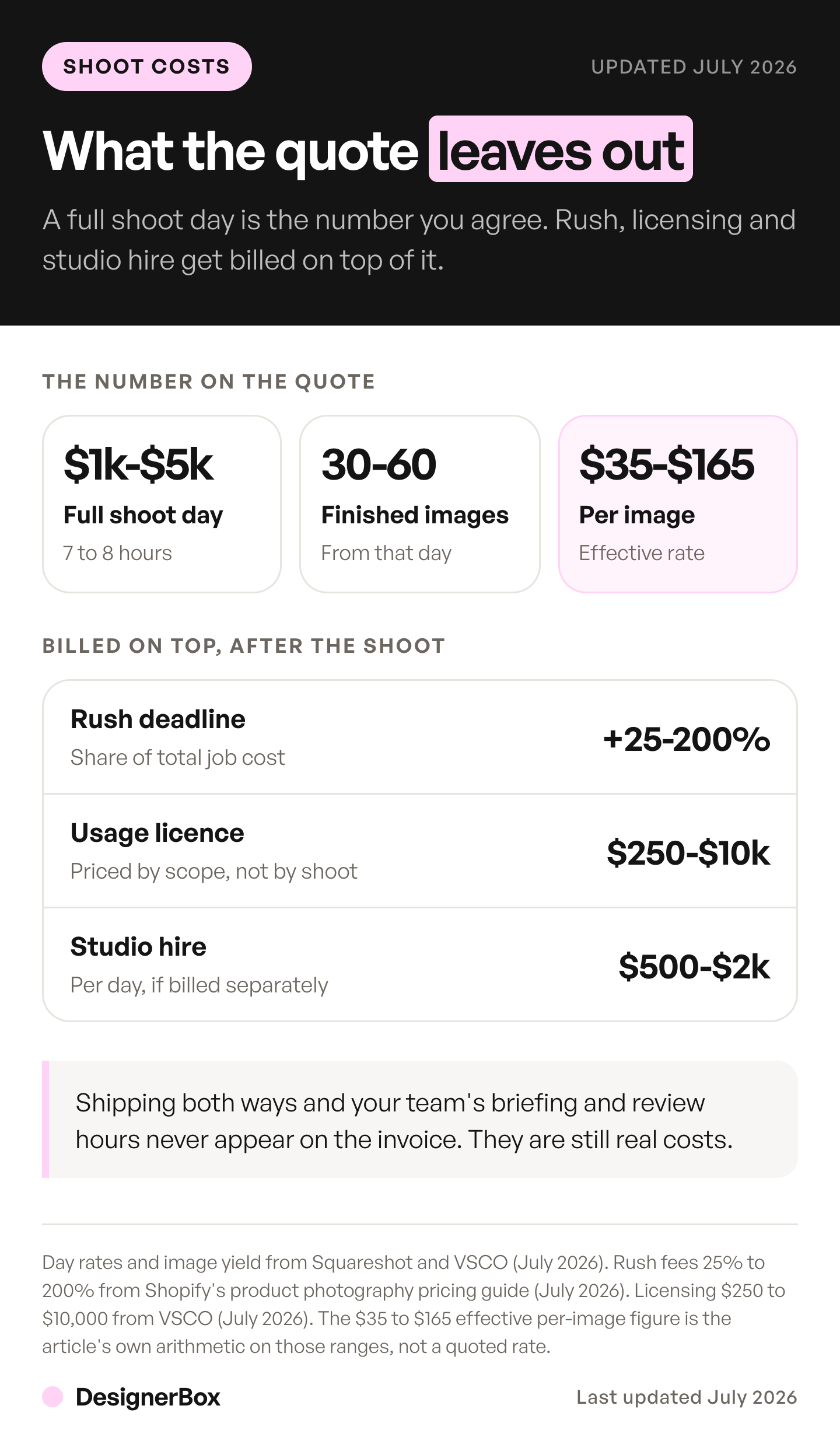
- A full studio day costs $1,000 to $5,000 and yields roughly 30 to 60 finished images, putting the effective rate at $35 to $165 each.
- The quote is not the spend. Retouching, shipping products to the studio, usage rights, rush fees, and internal coordination land on top of the headline rate.
- Reshoots are the real cost driver. A per-image rate prices one shoot. Catalogue churn means you buy a slice of that catalogue again every drop.
- Cost per SKU-year beats cost per image as a planning unit, because it captures the churn the per-image rate hides.
- Generating from one photo changes the shape of the cost, not just the size. You still need one accurate photo of the real product.
How much does a product photoshoot cost in 2026?
Product photography is sold three ways, and the model matters more than the number. Per-image pricing charges a set fee per delivered shot. Day rates buy the photographer’s time and everything on set. Project pricing quotes the whole job. Per-image is the easiest to compare and the easiest to underestimate, because it says nothing about how many images you need.
Published rates as of July 2026:
| What you are buying | Typical range | Notes |
|---|---|---|
| White-background listing image | $25 to $75 each | Basic retouch, single angle |
| Styled or lifestyle image | $100 to $500 each | Props, surfaces, art direction |
| On-model or fashion image | $150 to $500+ each | Adds casting and a fitting |
| Flat lay | $40 to $300 each | Varies with prop and set build |
| 360-degree spin | $100 to $500 per product | Priced per product, not per frame |
| Half-day rate (3 to 4 hours) | $500 to $3,500 | Usually includes a set image count |
| Full-day rate (7 to 8 hours) | $1,000 to $5,000+ | Yields roughly 30 to 60 finished images |
| Studio hire, if billed separately | $500 to $2,000 per day | On top of the photographer |
Sources: Squareshot per-image and day-rate bands (squareshot.com, July 2026), Lars Miller Media’s published tiers (larsmillermedia.com, July 2026), and VSCO’s photography pricing guide, which puts product work at $25 to $175 per image and commercial day rates at $800 to $5,000 (vsco.co, July 2026).
Shopify’s own guide is the most useful Tier-1 anchor for apparel, because it prices per product rather than per image: basic flat lay or mannequin shots at $10 to $30 per product, model photoshoots at $100 to $500+ per product, and lifestyle or on-location shoots at $500 to $2,000+ per shoot (shopify.com/blog/product-photography-pricing, July 2026).
Those flat lay rates assume the set holds together, and what decides whether a flat lay set is consistent is the rig discipline, not the day rate.
Pricing per product is convenient and it understates the job on Shopify, where the image count follows the variant matrix rather than the SKU list. Counting the Shopify variant math first usually changes the quote you should be asking for.
The spread is wide because the inputs are wide. A matte t-shirt and a polished watch are not the same shoot. A Brooklyn studio and a regional one are not the same rate. Ranges this broad are a signal to stop shopping on rate and start counting images. Reflective categories price highest: published US rates for handbag product photography run $39 to $55 an image on white and $225 with a model. Prop-heavy categories carry a different premium, because a decor catalogue needs the same styling budget for a $28 candle as for a $900 chair. Furniture prices highest of all on logistics rather than on the shot, and the furniture cost breakdown sets studio day rates against CGI per render. Beauty stacks both problems, since skincare product photography pays for reflective glass and then pays again for the texture and label frames a packshot cannot supply.
Apparel carries one extra line most quotes bury. The invisible-mannequin composite that fills a clothing catalog is priced separately from the shoot, and what ghost mannequin work costs per garment runs from about a dollar for retouching alone up to $75 an image for a studio that shoots and edits it for you.
What the quote does not include
The headline rate is the beginning of the invoice. The costs that get added afterwards are predictable, which means they are budgetable, and most brands still leave them out.
- Retouching. Sometimes bundled at a basic level, charged separately once you want more than dust removal.
- Shipping. Your products have to reach the studio and come back, and someone has to pack them.
- Usage rights. Licensing is priced separately from shooting. VSCO puts commercial licensing at $250 to $10,000 depending on scope (vsco.co, July 2026). Ask what the quote covers before you run the image as a paid ad.
- Rush fees. Shopify puts rush deadlines at 25% to 200% of the total job cost (shopify.com, July 2026). Snappr’s guide cites 25% to 50% for rush and 10% to 20% for peak season, though that page is dated November 2024, so treat it as directional (snappr.com, accessed July 2026).
- Coordination. Briefing, scheduling, shot-listing, reviewing, and requesting fixes are hours somebody on your team is paid for. They do not appear on the photographer’s invoice, and they are real.
None of this makes photographers expensive. It makes the per-image rate an incomplete unit.
Why cost per image is the wrong unit
Cost per image measures a transaction. Your catalogue is not a transaction, it is a subscription you did not sign.
Work an example. Fifty SKUs, seven images each, is 350 images. At $40 each that is $14,000, and you shoot it once. Seven is not arbitrary either, it is roughly what the types of product photography a listing needs adds up to. Then the year happens. Two colourways per SKU on a third of the range. A seasonal campaign that needs lifestyle versions of your top twenty. A marketplace that changes its aspect ratio. A hero product that gets repackaged.
None of those is a full reshoot. Every one of them is a small shoot, and small shoots have the worst unit economics you can buy: volume discounts start around 100 images, so a twelve-image top-up pays close to full rate, plus a minimum, plus shipping, plus another round of coordination.
The useful unit is cost per SKU per year: total annual imagery spend, including reshoots and their overhead, divided by the number of SKUs you sell. It is the only number that survives contact with a catalogue that changes.
That unit also exposes a second question the budget never asks, which is which SKUs get any spend at all. Why allocation decides more than cost per image works through the products your shoot calendar has been skipping.
Run it and the picture inverts. The first shoot is rarely what hurts. It is budgeted, approved, and everyone remembers it. The damage is the eleven small ones nobody planned, each too small to negotiate and too urgent to postpone.
Each of those small shoots also re-enters the booking queue, which is the cost the invoice never shows. Where a product launch waits puts numbers on the calendar side of the same cycle.
Some categories generate those small shoots faster than others. A nine-flavour supplement range is one bottle shape and nine label colourways, so the spend scales on flavours rather than on products. What a supplement image set costs works that arithmetic through, and a six-flavour drink range does the same thing with a regulated label on top, which bottle product photography prices out. Knitwear does the same thing seasonally, and colourway multiplication in a knit drop is the line item that quietly doubles a season. Small leather goods invert it: one wallet is a half-day tabletop job, but what a wallet shoot really bills for is the macro and the glare retouch, not the studio time.
What changes when you generate from one photo

The honest version of this argument is not that generated imagery is free. It is that it moves the cost from a per-shoot variable to a fixed monthly one, and it removes the reshoot’s setup entirely.
You still need one accurate photo of the real product. That is the constraint, and it does not go away, which is why it is worth checking that a model holds your product before you build a catalogue on it. It is also what separates this from the other kinds of AI product mockups, where the input is a design file or nothing at all. What goes away is everything downstream: the angles, the backgrounds, the lighting, the lifestyle scenes, and the second, third, and eleventh trips back for a colourway.
The economics are worth stating plainly. In DesignerBox, generating or editing an image costs 5 credits. The Basic plan is $15 a month and includes 500 credits, which is 100 images a month. Pro is $35 for 1,000 credits, Premium $75 for 2,500, and Ultra $200 for 8,000. The free plan starts at 112 credits with no credit card. Worth checking what each plan buys before you size one, because commercial use starts at Pro.
Set that against the reshoot cycle rather than against the first shoot, because that is where the comparison is fair. Vendors quoting a 90% saving are measuring the shoot line, and it is worth knowing what that 90% figure counts before it reaches a budget deck. A twelve-image colourway top-up is a studio minimum, a shipping run, and a week of calendar. It is also 60 credits. Those twelve sit next to the originals on the same page, and holding the model, the light and the crop steady across a drop is its own discipline.
Which tool you run that on is a separate question, and the entry prices sit well below a single studio day. We compare the field, with every price read from the vendor’s own page, in our roundup of the best AI product photography tools, and go head to head with one of them in seven Photoroom alternatives.
What that does not do is replace the photographer on the shoot that produces your source image. Somebody still has to photograph the real product accurately, and that shot is what everything else is built from. The one-click product apps are built around that constraint rather than around pretending it does not exist.
If the worry is that generated imagery reads as generic, that is a real failure mode with a specific cause: assets built from a text prompt rather than from your actual product. Everything here starts from the photograph of the real thing, which is why nothing comes out looking generic AI. The gallery is the honest test of that claim.
How to budget for it
Stop pricing the shoot. Price the year. Before you count anything, sort the shot list by what each frame takes to produce, because the tiers in fashion photoshoot ideas, shoot it or generate it carry costs roughly 40x apart.
- Count the SKUs you will sell, not the ones in the system.
- Count images per SKU. Front, back, three-quarter, detail, scale, in-use, and one per variant. Seven or eight is a realistic full set for most catalogues, and the order they appear in on the page matters as much as the count.
- Apply a churn rate. What fraction of the catalogue changed last year? Colourways, packaging, discontinuations, platform spec changes. That fraction, times your image count, is next year’s reshoot volume.
- Add the overhead per reshoot event, not per image: minimum charges, shipping, coordination hours.
- Divide by SKUs. That is your cost per SKU-year, and it is the number to compare approaches against.
Run the same count across paid, email and organic and you have the full-year creative requirement, not just the catalogue one. The DTC playbook for fashion brands works that out channel by channel.
Most brands find step 3 is where the budget lives, and it is the step that never appears on a quote.
Ecommerce brands are one of five team types that use AI creative tools, and each one prices this calculation differently depending on catalogue size and reshoot churn. For apparel the cost line is rarely all-or-nothing, because only some gallery slots depend on a model at all.
The same per-asset arithmetic across video, stills and avatars sits in the AI creative cost benchmark.
FAQ
How much does a product photoshoot cost per image?
White-background listing images run $25 to $75 each and styled lifestyle images $100 to $500 each as of July 2026, based on published studio rate cards. On-model work starts around $150. The spread depends on product complexity, geography, photographer experience, and whether licensing is included.
How much is a full day of product photography?
A full-day shoot of 7 to 8 hours runs $1,000 to $5,000 depending on the photographer’s tier, and studio hire adds $500 to $2,000 if it is billed separately. A day typically yields 30 to 60 finished images, which puts the effective per-image cost at roughly $35 to $165.
Why are reshoots so expensive relative to their size?
Because the cost is per event, not per image. Volume discounts generally begin around 100 images, so a small top-up pays close to full rate while still incurring a session minimum, shipping both ways, and the same coordination overhead as a large shoot. Twelve images can cost a disproportionate share of a 350-image shoot.
Is AI product photography cheaper than a photoshoot?
It changes the shape of the cost. Generation is a fixed monthly subscription instead of a per-shoot variable, and in DesignerBox an image is 5 credits, with 500 credits included at $15 a month. It does not remove the need for one accurate photo of the real product, which is what the generated set is built from.
For catalogue work the unit to price is the set rather than the image, since a preset that returns six shots per run costs 30 credits and covers a listing in one pass.
What hidden costs should I expect on a photoshoot quote?
Retouching beyond a basic pass, shipping products to and from the studio, usage and licensing rights, rush fees of 25% to 200% of the job, peak-season premiums, and your own team’s coordination hours. Ask specifically what the quote includes and what the licence covers before the shoot.
How many images does each product need?
Plan for front, back, three-quarter, side, top, detail, and in-scale shots, plus one per variant. Seven is a reasonable baseline for a complete listing, and marketplaces often set their own minimums and aspect ratios on top. Generative AI fashion imagery has to meet those same minimums, including Google’s 500 x 500 pixel floor.
What is a realistic annual photography budget for a small catalogue?
Take your SKU count, multiply by images per SKU, price at the per-image rates above, then add the reshoot volume implied by last year’s catalogue churn plus per-event overhead. The churn portion is the part most budgets miss, and for brands with frequent drops it can rival the original shoot.
Sources
- Per-image bands and day-rate bands for product photography: (squareshot.com, July 2026)
- Published photography tiers used for the rate ranges: (larsmillermedia.com, July 2026)
- Product work at $25 to $175 per image, commercial day rates at $800 to $5,000, and commercial licensing at $250 to $10,000: (vsco.co, July 2026)
- Apparel pricing quoted per product, and rush deadlines at 25% to 200% of total job cost: (shopify.com/blog/product-photography-pricing, July 2026)
- Rush fees of 25% to 50% and peak-season premiums of 10% to 20%, from a page dated November 2024 and treated as directional: (snappr.com, accessed July 2026)
- DesignerBox credit costs, plan allocations and the Pro-tier commercial licence verified against live product configuration, July 2026
Rates verified from published studio rate cards and pricing guides at squareshot.com, larsmillermedia.com, vsco.co, snappr.com and shopify.com as of July 2026. DesignerBox credit costs and plan allocations verified against live product configuration, July 2026. Photography rates vary by market, product category, and licensing terms. Individual results vary.