


B2B ads are paid ads that one business shows to the people who buy for another business. They run mostly on LinkedIn, Meta, Google Search and YouTube. Most of the people who see them cannot buy today, so a B2B ad has two jobs: stay in memory until the buyer is ready, and earn a click when they are. Each job needs a different format.
The hard part is the audience size. A B2B team often targets a few thousand job titles at a few hundred companies. The same people see the same ad many times, and the ad stops working sooner than a consumer ad does.
This guide covers which B2B ad format fits which buying stage, the specs on each channel from the platforms’ own pages, three award-winning B2B ad examples from 2026, and how a small team or an agency makes the number of versions the platforms ask for.
Key Takeaways
- Most buyers are not buying today. LinkedIn’s B2B Institute puts it at 95% of potential buyers who “aren’t ready to buy today”. Most B2B ads are seen by people who will buy later.
- The format follows the buying stage. Video and expert posts build memory. Document ads teach. Single image ads carry proof. Search ads meet the buyer who is ready.
- LinkedIn asks for a large audience and several ads. It suggests 300,000 members for Sponsored Content and 4 to 5 ads in each campaign, with the weakest one replaced every 1 to 2 weeks.
- Small audiences tire an ad quickly. Meta says creative fatigue occurs “when an audience has seen the same creative too many times”. A narrow B2B audience reaches that point sooner.
- The 2026 award winners sold an idea first. The Cannes Lions Creative B2B Grand Prix went to SKF, a bearing maker, for a campaign about tidal energy.
- The specs differ on every channel. One concept needs a 1200 x 628 image for LinkedIn, a 4:5 image for Meta, 30-character headlines for Google Search and a 6-second cut for YouTube.
What are B2B ads?
B2B ads are ads that a business pays for to reach buyers at other businesses. The product can be software, machinery, a service or a wholesale supply. The buyer is a person with a job title, a budget and colleagues who also have a say. That is the difference from a consumer ad, where one person sees the ad and decides alone.
B2B advertising also runs on a longer clock. LinkedIn’s B2B Institute, working with the Ehrenberg-Bass Institute, calls this the 95-5 rule: “95% of your potential buyers aren’t ready to buy today”. Its page gives the reason in buying cycles: “75% of companies buy computers once every 4 years, 80% of companies change banking services once every 5 years” (business.linkedin.com, October 2026).
So a B2B ad plan has two parts. One part is for the large group that will buy later. Its goal is that the buyer remembers the brand. The other part is for the small group that is buying now. Its goal is a form, a demo or a call.
Software is one branch of this. If your product is software, SaaS ads covers the five formats that work when there is no physical product to photograph, and what they cost per lead.
Why do B2B ads wear out so quickly?
B2B ads wear out quickly because the audience is small and the budget reaches the same people again and again. A consumer brand can show one ad to millions of new people. A B2B team that targets finance directors at mid-size manufacturers in three countries has no such supply of new viewers.
The platforms state the limits in their own help pages:
- LinkedIn: “The minimum audience size required for an ad set is 300 member accounts, but we suggest a minimum of 50,000 to drive results.” For Sponsored Content and Sponsored Messaging it suggests 300,000 (linkedin.com/help, October 2026).
- Meta: “Creative fatigue occurs when an audience has seen the same creative too many times.” Ads Manager shows a “Creative fatigue” status when an ad’s cost per result is twice the cost of your past ads, or more (facebook.com/business/help, October 2026).
Many B2B target lists are well under 300,000 people. That is a choice the team makes on purpose, because a tight list wastes less money. The cost of that choice is wear. The same ad meets the same person on Monday, Wednesday and Friday.
There are three ways to slow it:
- Widen the audience. On LinkedIn, start with location and two other targeting criteria, which is LinkedIn’s own advice.
- Lower the budget on that audience. The ad is shown fewer times to each person.
- Supply new ads. This is the only fix that also gives the buyer something new to see.
Most B2B teams end with the third one. Ad fatigue covers the signals to watch and how to refresh a winning ad without losing it.
Which B2B ad format fits each buying stage?
A B2B buyer moves through four stages: out of market, researching, comparing and ready to buy. Each stage has a different question, so each stage needs a different format. An ad that asks for a demo is wasted on a person who has not heard of you. A brand film is wasted on a person who is typing your category into Google.
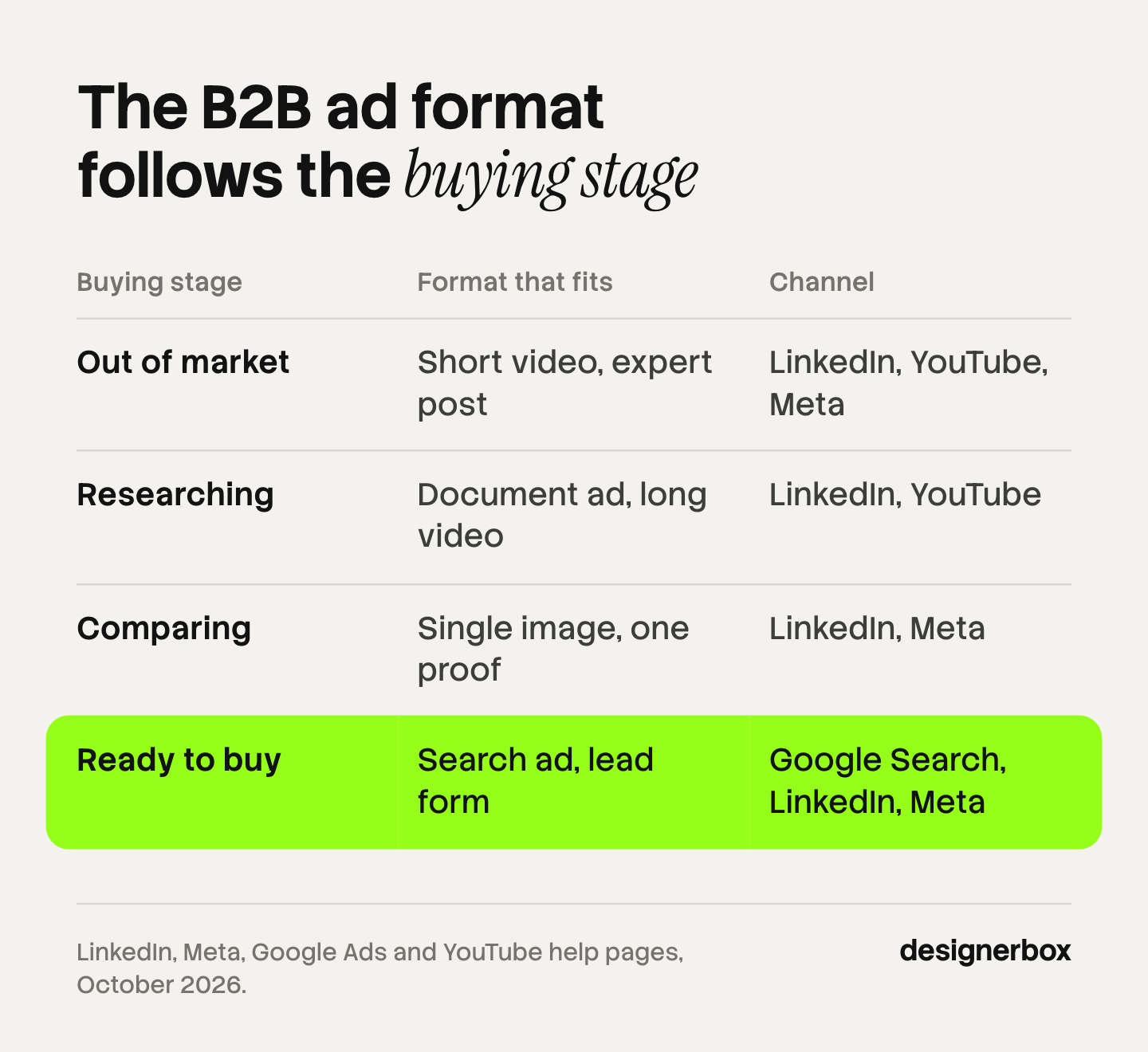
| Buying stage | The buyer’s question | Format that fits | Channel |
|---|---|---|---|
| Out of market | ”Who are these people?” | Short video, a sponsored post from an expert | LinkedIn, YouTube, Meta |
| Researching | ”How do others solve this?” | Document ad, long video | LinkedIn, YouTube |
| Comparing | ”Why this one?” | Single image ad with one proof point | LinkedIn, Meta |
| Ready to buy | ”Who can I talk to?” | Search ad, lead form ad | Google Search, LinkedIn, Meta |
Out of market. The goal is memory. Use a short video or a post from a named person at your company. LinkedIn’s Thought Leader Ads sponsor posts from “company employees, industry experts, customers, or content creators”, as single image or video ads (business.linkedin.com, October 2026). Do not ask for a demo here.
Researching. The buyer has a problem and reads about it. A LinkedIn document ad puts a short guide in the feed. LinkedIn accepts PDF, DOC and PPT files up to 100 MB and recommends fewer than 10 pages (business.linkedin.com, October 2026).
Comparing. The buyer has a short list. A single image ad with one number, one customer name or one certificate helps them defend the choice to colleagues. Every proof point has to be real and current.
Ready to buy. The buyer searches for the category or the brand. A search ad answers the query, and a lead form removes the landing page step.
What are the specs for B2B ads on each channel?
The specs for B2B ads differ on every channel, so one concept becomes several files. These numbers are from each platform’s own page, read in October 2026.
| Channel and format | Size or length | Text limits |
|---|---|---|
| LinkedIn single image ad | 1200 x 628 (1.91:1), 1200 x 1200 (1:1) or 720 x 900 (4:5), up to 5 MB | Headline 70 characters, intro text 150 |
| LinkedIn video ad | 3 seconds to 30 minutes, up to 500 MB, in 4:5, 9:16, 16:9 or 1:1 | Same as single image |
| LinkedIn document ad | PDF, DOC or PPT, up to 100 MB, fewer than 10 pages recommended | Headline 70 characters, intro text 150 |
| Meta feed image ad | 4:5 at 1440 x 1800, up to 30 MB | Primary text 50 to 150 characters, headline 27 |
| Google responsive search ad | Text only | Up to 15 headlines of 30 characters, up to 4 descriptions of 90 |
| YouTube skippable in-stream ad | No maximum, under 3 minutes recommended, skip after 5 seconds | None in the video |
| YouTube bumper ad | 6 seconds, no skip | None in the video |
Sources: LinkedIn’s single image, video and document spec pages, Meta’s ads guide, Google Ads Help on responsive search ads and YouTube Help on video ad formats, all October 2026.
For the still formats alone, image ads lists the specs on five platforms and when one image beats a carousel or a video.
A few notes for each channel:
LinkedIn. The targeting is by job title, company and seniority, which is why most B2B plans start here. LinkedIn says to write headlines under 150 characters in general and to “keep descriptive copy under 70 characters”, because longer text can be cut on desktop. It also says content with larger visuals tends to get “up to 38% higher CTR” (business.linkedin.com, October 2026). For video, AI video tools for LinkedIn compares seven options.
Meta. Facebook and Instagram have no job title targeting like LinkedIn’s. B2B teams build the audience from their own customer list. A Meta for Business guide for B2B advertisers, dated August 2020, suggests a 1% to 3% lookalike audience built from paying customers (facebook.com/business, October 2026). That page is six years old, so test it before you rely on it.
Google Search. This is the ready-to-buy channel. A responsive search ad is text only, and Google assembles it from the headlines and descriptions you supply. Write each headline so it makes sense alone.
YouTube. The 6-second bumper repeats one idea to people who are out of market, and a viewer cannot skip it. A viewer can skip a longer in-stream ad after 5 seconds, so the brand and the point go in the first 5.
B2B ad examples from the 2026 award lists
The three B2B ad examples below come from public award lists in 2026. The results quoted are the entrants’ own figures from their case films. No independent party measured them.
SKF, “The Faroe Islands Space Program”. SKF makes bearings, a product few people think about. Cannes Lions gave this campaign the Creative B2B Grand Prix on 22 June 2026, from 355 entries and 11 Lions in the category. The festival says the work “created an actual space program that brought SKF’s belief in frictionless work to life”. The jury president said: “SKF proved that creative bravery in a commodity category delivers real business results” (canneslions.com, October 2026). The agency’s case study reports more than 1,250 media placements in 140 markets and 25 million views of its films (adsoftheworld.com, October 2026).
Centivo, “How Dare We”. Centivo sells health plans to employers. The campaign, by the agency Territorial, won the 2026 Webby Award for best B2B campaign in advertising (marketingbrew.com, April 2026).
Logitech, “Bye Bye, Dongle”. Logitech won the 2026 Webby Award for B2B branded content with this title, on the same list. The name states the buyer’s problem in three words.
Two things are common to all three. Each one sells one idea, and none of them is a feature list. Each one also has a title a buyer can repeat to a colleague. That matters when most of the audience will buy later: a buyer cannot recall a list of features in two years, and they can recall a space program run by a bearing company.
These are large-budget campaigns. A small team cannot copy the budget. It can copy the method: one idea, stated in a few words, repeated in every format.
LinkedIn ad examples by format
LinkedIn ad examples are free to study. LinkedIn’s Ad Library is “a publicly available database” of ads that have run on the platform, and it keeps each ad for one year after its last impression (linkedin.com/help, October 2026). Search for a company in your category and sort what you find into four groups:
- Single image with one claim. A headline of a few words set on the image, and one proof point under it. Check that the claim can be read on a phone.
- Document ad. The first page works as the ad. It needs a title that promises one result, because the reader sees only that page before they decide to swipe.
- Thought leader ad. A post from a person, sponsored by the company. It reads as an opinion. A product pitch here reads as an ad and loses the reason for the format.
- Video ad. Most feed video plays without sound, so the first frame and the captions carry the point.
Count how many different ads one advertiser runs at once, and how many share one layout with a new headline. That count is a fair estimate of the volume your own plan needs. Ad spy tools covers the ad libraries on the other platforms.
How many B2B ads does a small team need each month?
A small B2B team needs about 2 to 4 new ads a month for each live campaign, if it follows LinkedIn’s guidance. LinkedIn says: “Include 4-5 ads in each campaign” and “Every 1-2 weeks, pause the ad with the lowest engagement and replace it with new ad creative” (business.linkedin.com, October 2026).
Here is the arithmetic for one plan, as an illustration:
| Item | Count |
|---|---|
| Campaigns, one for each buying stage | 4 |
| Live ads, at 4 to 5 in each campaign | 16 to 20 |
| New ads a month, at one replaced every 1 to 2 weeks | 8 to 16 |
| Sizes for each new ad on LinkedIn and Meta | 2 to 4 |
| Files to make each month | 16 to 64 |
The upper end is more than one file each working day. An agency with ten B2B clients multiplies it by ten. A studio that sells that monthly set under its own name will find the pricing and the rights checks in white label content.
The new ads do not need new ideas each time. Hold the idea and the layout. Change one thing: the headline, the proof point, the image or the job title the ad speaks to. A test stays readable only when you know which thing changed, which ad creative testing explains. Ad variants at scale sizes the monthly batch against spend, and creative strategy covers the weekly loop that decides what to make next.
Check the label rules before a campaign with AI-made images or video starts. The platforms and several markets set different rules, and AI disclosure in advertising lists them.
One brand standard for every client
Anyone can make an AI picture. Making hundreds that still look like your brand is the hard part. In B2B ads the brand is often the only thing a buyer keeps from an ad they saw two years before they bought, so every file has to carry the same colors, type and logo placement.
DesignerBox is AI creative production for brands and agencies. For an agency with several B2B clients, the job is the same set of ads every month for each client. You build it once as a workflow: the client’s brand profile, the layout and the steps. Each client gets a brand profile with voice, logos, fonts, palette and rules, and the workflow reads it on every run. A colleague runs the workflow as an app, with a form. They add the headline and the proof point and press Run.
The ads resizer makes one ad in the sizes each platform needs. The ad localizer rebuilds one ad in another language and redraws the layout. Batch runs one workflow over a whole sheet of headlines or products, and you review the results in one pass. You keep or discard per row. The cost of a run is shown before you press Run.
The full workflow from the first product photo to the finished ad, in one subscription.
Here are the limits. DesignerBox does not write your strategy or choose the idea. No image model draws your real product screen or checks your claims, so you supply the screenshot and the proof. It does not publish into LinkedIn, Meta or Google. You download the results, or send them with a webhook or an S3 step. Uploading your own photos and the commercial license start on the Pro plan, and AI video starts on the Premium plan. An 8-second clip costs 40 to 560 credits, depending on the model. Team features, shared brand kits and white label are on the Ultra plan, and every plan below Ultra is one seat. Plans are on the pricing page. DesignerBox for agencies shows how the setup works for several clients.
FAQ
What is a B2B ad?
A B2B ad is a paid ad that one business shows to buyers at another business. It sells software, equipment, supplies or services to people who buy as part of their job. It usually aims for a lead, a demo or brand memory, because a business purchase takes several people and a long time.
What is the best platform for B2B advertising?
No single platform is best for every stage. LinkedIn targets by job title and company, so it suits the researching and comparing stages. Google Search reaches buyers who are ready to buy. YouTube and Meta reach a wide audience, which suits buyers who are out of market.
How are B2B ads different from B2C ads?
B2B ads reach a smaller audience, and several people share the decision. LinkedIn’s B2B Institute says 95% of potential buyers are not ready to buy today. So a B2B ad often builds memory first, and asks for a form or a demo later. A B2C ad can ask one person to buy now.
What makes a good B2B ad example?
A good B2B ad example sells one idea in a few words and repeats it in every format. The 2026 Cannes Lions Creative B2B Grand Prix went to SKF for “The Faroe Islands Space Program”. The jury president praised its “creative bravery in a commodity category”.
How often should you refresh B2B ads?
LinkedIn recommends 4 to 5 ads in each campaign. Every 1 to 2 weeks, pause the ad with the lowest engagement and replace it. On Meta, check the Delivery column for the “Creative limited” and “Creative fatigue” statuses. Small audiences need a refresh sooner, because the same people see the ad more often.
What size should a LinkedIn ad be?
LinkedIn recommends 1200 x 628 pixels for a horizontal single image ad, 1200 x 1200 for square and 720 x 900 for vertical 4:5. The file can be up to 5 MB. The headline holds 70 characters and the intro text 150.
Can you make B2B ads with AI?
Yes, for the frame, the scene, the sizes and the language versions. You still supply the real product image, the claim and the proof. Read every headline before an ad ships. In DesignerBox, the cost is shown before the run.
Sources
- LinkedIn B2B Institute, The 95-5 rule, business.linkedin.com, accessed October 2026.
- LinkedIn Marketing Solutions Help, Target audience size best practices, linkedin.com/help, accessed October 2026.
- LinkedIn, Sponsored Content tips, business.linkedin.com, accessed October 2026.
- LinkedIn, Single image ad specifications, business.linkedin.com, accessed October 2026.
- LinkedIn, Video ad specifications, business.linkedin.com, accessed October 2026.
- LinkedIn, Document ad specifications, business.linkedin.com, accessed October 2026.
- LinkedIn, Thought Leader Ads, business.linkedin.com, accessed October 2026.
- LinkedIn Help, LinkedIn’s Ad Library, linkedin.com/help, accessed October 2026.
- Meta Business Help Center, Creative fatigue recommendations in Meta Ads Manager, facebook.com/business/help, accessed October 2026.
- Meta, Ads guide, Facebook Feed image, facebook.com/business/ads-guide, accessed October 2026.
- Meta for Business, B2B best practices: building lookalike audiences, 19 August 2020, facebook.com/business, accessed October 2026.
- Google Ads Help, About responsive search ads, support.google.com, accessed October 2026.
- YouTube Help, YouTube video ad formats, support.google.com, accessed October 2026.
- Cannes Lions, 73rd Cannes Lions International Festival of Creativity announces first winners, 22 June 2026, canneslions.com, accessed October 2026.
- Ads of the World, The Faroe Island Space Program (case study), June 2026, adsoftheworld.com, accessed October 2026. Results are the entrant’s own figures.
- Marketing Brew, The advertising, media, and PR award winners from the 30th annual Webby Awards, 21 April 2026, marketingbrew.com, accessed October 2026.
- DesignerBox plan gates, the video credit range and the cost shown before each run: DesignerBox pricing page (designerbox.ai/pricing), October 2026.
B2B ad specifications, platform guidance and award results verified from the sources above as of October 2026. Platforms change their specs often, so check them again before a campaign launches. Individual results vary.