


Claude ads means one of three things. Ads shown inside Claude do not exist, because Anthropic keeps Claude ad-free. Claude can read an ad account and report on it through a connector. Claude can also help make an ad campaign. It writes the brief, the concepts and the copy by itself, and a connected tool makes the images and the video.
This guide answers the first two meanings in short sections. Then it teaches the third. You will see the six steps of an ad campaign made from an AI chat, who does each step, and where a person still decides.
The reader in mind is a performance or creative agency, or a marketing lead at a brand. Every fact about Anthropic, Meta and Google below was read on the company’s own page in October 2026.
Key Takeaways
- Claude shows no ads. Anthropic wrote in February 2026 that “Claude will remain ad-free”.
- Claude can read an ad account through a connector. Meta hosts a server for this. Google’s server is read-only.
- Claude writes, plans and analyzes. The brief, the concepts, the copy and the test plan are text work.
- Claude does not render photos or video. A connected tool does that over MCP, and Claude sends the request.
- An AI ad campaign has six steps. Brief, concepts, static ads, video ads, variants and formats.
- A person keeps three jobs. Account access, spend and the final approval.
What does Claude ads mean?
The search term has three meanings, and the results page for it mixes all of them. The table shows each one and the short answer.
| Meaning | Short answer | Where it happens |
|---|---|---|
| Ads shown inside Claude | There are none | Anthropic’s own policy |
| Claude reads or changes an ad account | Yes, through a connector | An ad platform’s MCP server |
| Claude makes ad creative and campaigns | Text by itself, images and video through a connected tool | The chat, plus a creative tool over MCP |
A fourth group searches for Anthropic’s own commercials for Claude. This guide does not cover those.
People also write the term as Claude for ads. That phrase nearly always means the second or third row.
Does Claude show ads?
No. Anthropic published a post called “Claude is a space to think” on 4 February 2026. It says: “There are many good places for advertising. A conversation with Claude is not one of them.” It also says: “We want Claude to act unambiguously in our users’ interests. So we’ve made a choice: Claude will remain ad-free” (anthropic.com, October 2026).
The same post says users will not see sponsored links next to their conversations. So a brand cannot buy a placement inside Claude today.
The post leaves one door open for commerce. Anthropic writes that “AI will increasingly interact with commerce, and we look forward to supporting this in ways that help our users”. That sentence describes tasks a user starts. It does not describe ad placements.
Claude and your ad accounts
Claude reaches an ad account through MCP. MCP, the Model Context Protocol, is “an open-source standard for connecting AI applications to external systems” (modelcontextprotocol.io, October 2026). An ad platform runs a server, and Claude calls the server’s tools from the chat.
Meta runs one. Meta describes it as “a Meta-hosted Model Context Protocol server that lets you manage Meta ads directly from an AI agent” (developers.facebook.com, October 2026). It lists seven tool categories, including reporting and ad creation. Meta ads MCP covers the server, the sign-in and the rules in detail.
Google documents a server too, with a smaller scope. Google’s guide says: “This implementation is strictly read-only. It cannot modify bids, pause campaigns, or create new assets” (developers.google.com, October 2026). So Claude can report on a Google Ads account through it. Claude cannot change the account through it.
There is also an open-source project with the name Claude Ads. Its page describes it as “Claude-first, portable paid-media operations for agencies, consultants, and in-house performance teams” (github.com, October 2026). It runs inside Claude Code, covers 12 ad platforms and carries an MIT license. Its page says it works read-only by default. Anthropic did not make it.
These servers and skills read numbers and manage campaigns. None of them makes a new image or a new video. AI ad agent sorts the three kinds of agent by the access each one needs.
What Claude does by itself in an ad campaign
Claude is strong at the text half of a campaign. Anthropic’s own Marketing plugin shows the scope. It has seven commands: draft content, campaign plan, brand review, competitive brief, performance report, SEO audit and email sequence (claude.com, October 2026). Every one of them writes or analyzes text.

For ads, that covers four jobs:
- The brief. Claude turns your notes into one page: the buyer, the offer, the proof and the platform.
- The concepts. Claude writes several angles for the same product, each with a different argument.
- The copy. Claude writes headlines, primary text and video scripts to each platform’s length limits.
- The analysis. Claude reads an exported report and names the ads that did well and the ads that did not.
The limit is the picture. Anthropic’s help center says: “Claude doesn’t generate photos or illustrations the way image-generation tools do” (support.claude.com, October 2026). Claude builds diagrams and charts in a conversation. It does not make a product photo or a video clip. Claude for marketing lists the text jobs and where they stop.
What needs a connected tool over MCP
Images and video need a second tool. Claude writes the prompt and calls the tool. An image model or a video model inside that tool makes the file.
Anthropic calls the link a custom connector. Custom connectors that use remote MCP work on the Free, Pro, Max, Team and Enterprise plans, and Free users are limited to one (support.claude.com, October 2026). You open Customize, then Connectors, and add the server’s address.
Two separate guides cover each half. Can Claude generate images explains the image loop and what it costs. Claude AI video generator explains the video loop and where it stops.
The same idea works outside Claude. ChatGPT MCP shows how to add a server there.
Several creative tools now offer an MCP server. Check three things before you connect one. Check who hosts it, what it can change, and whether it shows the cost of a request. Anthropic’s advice is short: “Only connect Claude to servers built and hosted by organizations and applications you trust.”
How an AI ad campaign gets made from a chat
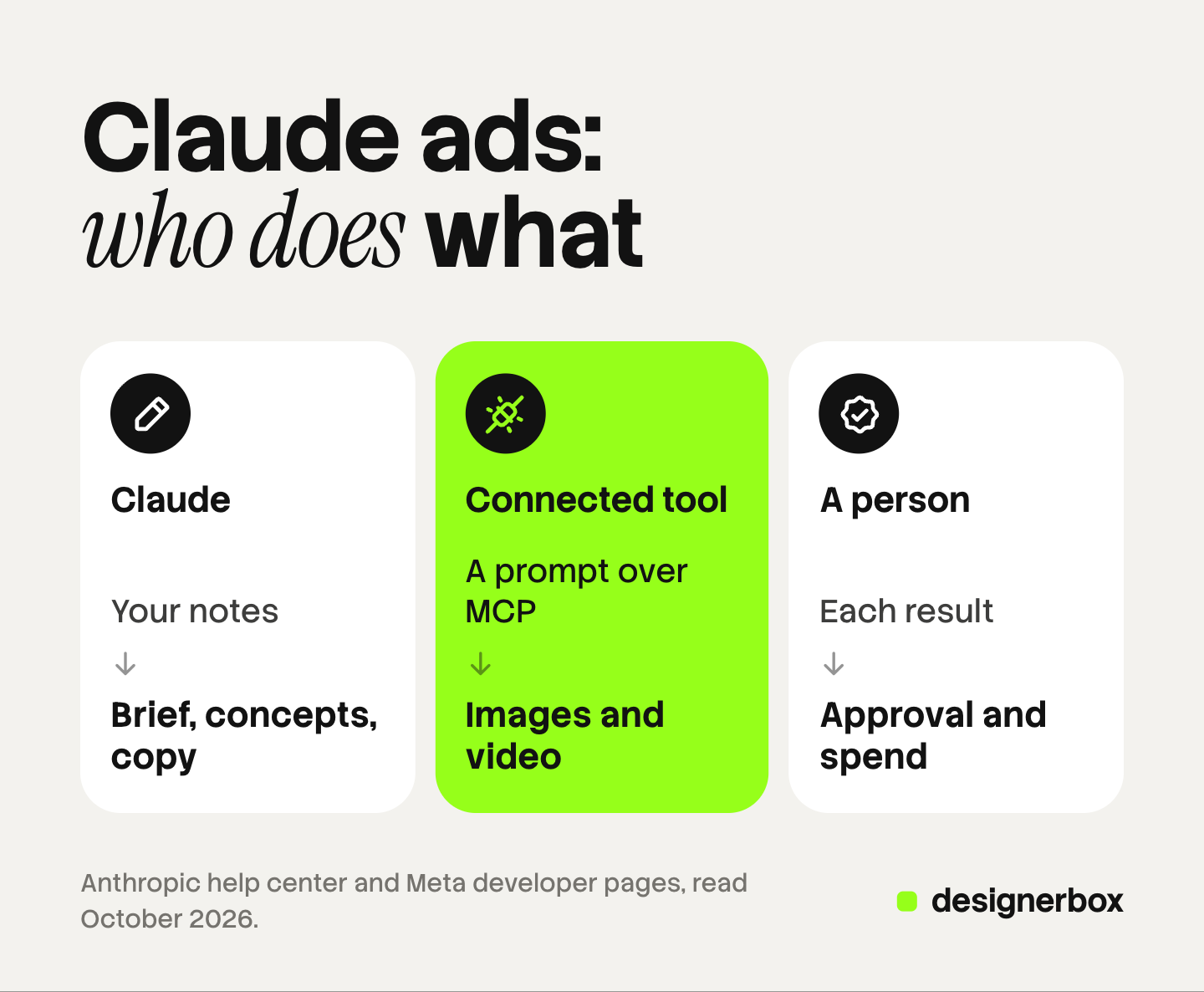
A full AI ad campaign has six steps. The table shows who does each step and what you check before the next one.
| Step | Who does it | What you check |
|---|---|---|
| 1. Brief | Claude, from your notes | The buyer, the offer and the proof are true |
| 2. Concepts | Claude | Each concept argues a different point |
| 3. Static ads | A connected tool, called by Claude | The product, the logo and the text are correct |
| 4. Video ads | A connected tool, called by Claude | You watch every clip yourself |
| 5. Variants | Claude plans them, the tool makes them | Each variant changes one thing |
| 6. Formats | A connected tool or a designer | Nothing important is cut at each size |
Step 1: the brief. Give Claude the product, the buyer, one claim you can prove and the platform. Ask for one page. A weak brief makes every later step weak, so correct it now.
Step 2: the concepts. Ask for five concepts that differ in argument. One leads with the problem, one with the result, one with proof. Reject any two that would win or lose for the same reason.
Step 3: static ads. Claude sends each approved concept to the connected tool with your reference image. Approve one image before you ask for ten. Compare each result against the brief and the reference image.
Step 4: video ads. Start from an approved still where the tool allows it. A wrong direction costs less to fix on a still than on a finished clip. Watch every clip yourself before you approve it.
Step 5: variants. Ad platforms accept many versions. One Performance Max asset group takes up to 15 headlines, up to 20 images and up to 15 videos (support.google.com, October 2026). Change one thing per variant, so a test result means something.
Step 6: formats. Each placement has its own size. Read the current specification on the platform’s help page before you resize. Check that the product and the text stay inside the frame at every size.
What still needs a person
Three jobs stay with a person, even when the chat does the rest.
Account access. Someone with the right role signs in and decides what the chat may touch. Anthropic tells users to review tool approval requests carefully. It says to click “Allow always” only for a server and a tool you trust to run unsupervised.
Spend. Meta builds a stop into its own server. Its developer page says: “Write tools create entities in a paused state; your AI client asks for confirmation before activation” (developers.facebook.com, October 2026). An ad starts to spend money when a person confirms.
Approval. A person checks that each claim is true and that each image shows the real product. A person also checks the platform’s rule for labels on AI-made ads. Those rules differ by platform and by country.
A chat is fast at making options. It does not know which claim your legal team allows. It does not know which image your client would reject.
Images, ads and video inside the chat
DesignerBox is AI creative production for brands and agencies. It makes the images, ads and video a campaign needs, with your brand rules applied. A brief is one input. A product photo and an ad that already works are others.
DesignerBox runs inside an AI chat such as Claude, ChatGPT or Cursor over MCP. The DesignerBox MCP page has the server address and the steps for each client. Other creative tools have MCP servers too.
Anyone can make an AI picture. Making hundreds that still look like your brand is the hard part. In DesignerBox you build a workflow once with your brand, your products and your rules. The chat then runs that saved workflow, so the tenth ad follows the same rules as the first.
Video works the same way, and the AI video ads page shows those workflows. An 8-second clip costs 40 to 560 credits, depending on the model. The cost is shown before the run. The full workflow from the first product photo to the finished ad, in one subscription.
Here are the limits. DesignerBox does not connect to an ad account, and it does not read your ad results. You download the results, or send them with a webhook or an S3 step. Every plan below Ultra is one seat. Uploading your own photos and the commercial license start on the Pro plan. AI video, virtual try-on, upscaling, the image editor and the video editor start on the Premium plan. Plans and credits are on the pricing page.
Campaign creative for agency teams
An agency that writes its briefs in Claude still needs images and video for every client. See how agencies use DesignerBox
FAQ
Does Claude have ads?
No. Anthropic wrote on 4 February 2026 that Claude will remain ad-free. The same post says users will not see sponsored links next to their conversations. A brand cannot buy an ad placement inside Claude today.
Can Claude make ads?
Claude makes the text parts of an ad: the brief, the concepts, the headlines and the video script. Claude does not render photos or video. For those, Claude calls a connected creative tool over MCP, and that tool makes the file.
Can Claude run my Meta or Google ad account?
Claude can connect to Meta’s ads MCP server, which has tools for reports and for ad creation. Meta says its write tools create ads in a paused state. Google’s MCP server for Google Ads is read-only, so Claude can report on that account and cannot change it.
What is the Claude Ads project on GitHub?
It is an open-source skill for Claude Code with an MIT license. Its page says it covers 12 ad platforms and works read-only by default. Anthropic did not make it. It audits and manages paid media, and it does not make images or video.
What are the steps of an AI ad campaign?
There are six: the brief, the concepts, the static ads, the video ads, the variants and the formats. Claude does the first two by itself. A connected tool makes the images and the video. A person approves each stage before the next one starts.
What does a person still do?
A person gives account access, confirms spend and approves each ad. A person also checks that every claim is true and that AI-made ads carry the label each platform requires. The chat prepares options, and the person decides.
Does DesignerBox connect to an ad account?
No. DesignerBox makes the images, ads and video inside the chat over MCP. You download the results, or send them with a webhook or an S3 step. You see the cost of a run before you press Run.
Sources
- Anthropic, “Claude is a space to think” (4 February 2026): Claude remains ad-free, no sponsored links, the commerce sentence: anthropic.com, October 2026
- Anthropic Help Center, “Can Claude produce images?” (updated 16 March 2026): support.claude.com, October 2026
- Anthropic Help Center, “Get started with custom connectors using remote MCP”: plans, steps, security guidance: support.claude.com, October 2026
- Anthropic, Marketing plugin: seven commands: claude.com, October 2026
- Model Context Protocol, introduction: modelcontextprotocol.io, October 2026
- Meta for Developers, Ads MCP Server overview: Meta-hosted server, seven tool categories: developers.facebook.com, October 2026
- Meta for Developers, Ad creation and management tools: paused state and confirmation: developers.facebook.com, October 2026
- Google Ads API documentation, Google Ads MCP server: read-only note (last updated 30 September 2026): developers.google.com, October 2026
- Google Ads Help, Performance Max asset requirements: headline, image and video limits per asset group: support.google.com, October 2026
- Claude Ads, open-source project page: description, license, platforms, read-only default (github.com/AgriciDaniel/claude-ads), October 2026
- DesignerBox plans and feature gating: DesignerBox pricing page (designerbox.ai/pricing), October 2026
Platform and vendor features checked against each company’s own pages as of October 2026. This is general information, not legal advice. Individual results vary.