
A Claude AI image generator is Claude connected to a real image model over the Model Context Protocol. Claude writes the prompt and calls the tool. Nano Banana Pro, GPT Image 2 or FLUX renders the pixels. Claude itself renders nothing, and Anthropic says so directly: “Claude doesn’t generate photos or illustrations the way image-generation tools do” (support.claude.com, updated March 2026).
Search the phrase and you get two kinds of result. Product pages promising images inside your chat window, and forum threads asking why the feature is missing. Neither explains the part that decides whether this is useful to a brand: the connected model bills you per image and the rate moves with the model you pick, the output is only your product if you supply your product, and the review step behaves differently from video.
This guide covers what Claude contributes, what the connected model contributes, what each model charges, and the one advantage the image loop has over the video one. Written for marketing and ecommerce teams who want product visuals out of a chat window and want the real mechanics first.
Key Takeaways
Claude renders nothing. It plans, writes prompts and calls tools. Every pixel comes from a separate image model reached over a connector.
Native visuals are HTML, not photographs. Claude builds diagrams, charts and interactive visuals in a conversation using web building blocks, and Anthropic is explicit that these “aren’t photos or illustrations” (support.claude.com, updated April 2026).
Claude Design composes, it does not shoot. Anthropic’s design product makes layouts, slides and prototypes, offering campaign visuals “ready for a designer to polish” (claude.com, accessed September 2026).
Connectors work on every plan. Custom connectors using remote MCP run on Free, Pro, Max, Team and Enterprise, with Free capped at one (support.claude.com, accessed September 2026).
Claude can see what came back. It reads JPEG, PNG, GIF and WebP (platform.claude.com, accessed September 2026), so the generate, review and regenerate loop closes inside the chat. The video version of this loop cannot.
One photo in beats one prompt in. A text-only brief invents a product that resembles yours. Editing from your real packshot keeps the item that ships to the customer.
The model you pick moves the price. In DesignerBox an image runs 4 to 22 credits depending on the model, so the same brief costs 3.5x more on the default than on the cheapest one. You can see the number before you run it.
Can Claude generate images by itself?
No. Claude is a text and reasoning model with vision for reading images you upload. There is no diffusion model and no render step inside it.
What it does make natively is narrower and often misunderstood. Claude builds custom diagrams, charts and interactive visuals directly in a conversation. Anthropic draws the line clearly: “Custom visuals aren’t photos or illustrations. Claude builds them using HTML, the same building blocks as web pages, so they’re interactive and specific to your question rather than static images” (support.claude.com, updated April 2026).
That is genuinely useful for a chart in a deck. It is not a product photograph.
Anthropic Labs also ships Claude Design, released in research preview in April 2026 for Pro, Max, Team and Enterprise subscribers (anthropic.com, April 2026). It creates designs, prototypes, slides and one-pagers, and exports to Canva, PDF, PPTX or standalone HTML. The product page offers “marketing collateral: landing pages, social assets, and campaign visuals, ready for a designer to polish.”
Read the end of that sentence. Claude Design arranges a layout. It does not photograph a product, put a garment on a model, or light a scene.
Claude does plenty of visual work. Every bit of it composes or transforms assets that already exist, so the shot that does not exist yet still needs a camera or a generation model.
What a Claude AI image generator means in practice
The connection layer is what changed, not Claude.

The Model Context Protocol is an open standard Anthropic published for building two-way connections between AI tools and outside systems (anthropic.com, November 2024). A remote MCP server exposes a set of tools with descriptions. Claude reads those descriptions, decides which one fits your request, fills in the arguments and calls it.
If one of those tools runs an image model, asking Claude for a packshot returns a packshot. Claude still did not make it. It commissioned it.
This is why the phrase is confusing. Every “Claude AI image generator” on the market is a different company’s model behind a connector, and the thing you are choosing is the model and the workspace, not Claude.
What each layer contributes
Strip the marketing away and the work splits cleanly. Claude does four language jobs.
It turns a sentence into a shot brief. You say “our ceramic mug, on a kitchen counter, morning light, room for a headline on the left”. Claude returns a structured prompt with the surface, the light direction, the lens feel and the negative space. Briefs are the thing image models are worst at receiving from humans.
It writes in the model’s dialect. Each model responds to different phrasing. Claude translates intent into something a specific model handles well, which is otherwise a skill you buy with burned credits. If you would rather learn it by hand, our product photography prompt guidance covers the craft directly.
It picks the tool. Given several image models with different strengths, Claude reads the tool descriptions and routes the brief. Fast draft, or the one that renders legible text.
It runs the batch. Ask for one product across six angles and Claude issues six calls, tracks them and reports back. Boring and genuinely useful.
The connected model contributes everything you can see. Resolution, texture, how the light falls, whether the label reads. No amount of clever prompting moves a limit the model does not have.
Which model renders what
Claude routes the brief from the tool descriptions, and that default is usually right. Override it when the shot has a specific demand. These are the claims each provider makes on its own pages, not our benchmarks.
| Shot demand | Ask for | What the provider states |
|---|---|---|
| Packaging, labels, any legible type in frame | Nano Banana Pro | Google calls it “the best model for creating images with correctly rendered and legible text directly in the image”, at up to 4K (blog.google, November 2025) |
| A set that keeps the same product or person across frames | Nano Banana Pro | Uses “up to 14 images and maintaining the consistency and resemblance of up to 5 people” (blog.google, November 2025) |
| Editing from a photograph you already own | GPT Image 2 | ”Supports flexible image sizes and high-fidelity image inputs”, and processes every image input at high fidelity automatically (developers.openai.com, accessed September 2026) |
| Cut-outs for a PDP or a composite | GPT Image 2 | Transparent backgrounds entered preview in August 2026 (developers.openai.com, accessed September 2026) |
Two provider caveats worth carrying into a brief. OpenAI states its own limits plainly: the maximum edge length is 3840px, both edges must be multiples of 16px, the long-to-short ratio must not exceed 3:1, and “although significantly improved, the model can still struggle with precise text placement and clarity” (developers.openai.com, accessed September 2026). If the packaging copy has to be readable, that is the reason to route the shot elsewhere.
Google also moved the catalogue under this. Nano Banana 2 shipped in February 2026 and replaced Nano Banana Pro as the default across the Fast, Thinking and Pro tiers of its own app, with Pro retained for specialised work (blog.google, February 2026). This is normal for the category. Model specs move monthly, which is the main argument for a workspace that carries several rather than a subscription tied to one.
The image models with their own detail page are listed at designerbox.ai/models, and the model picker for product photography runs one brief through each so you can compare on your own product.
The limits nobody mentions
Four constraints decide whether this holds up on real work, and none appears in a typical setup guide. All four come from Anthropic’s own connector documentation.
A five minute ceiling per call. The tool result timeout on Claude and Claude Desktop is 300 seconds (claude.com, accessed September 2026). Single images finish well inside that. A request that fans out into a large batch can exceed it, which is why batch jobs are better issued as several calls than one.
A result size cap. Around 150,000 characters per tool result on Claude and Claude Desktop, and 25,000 tokens in Claude Code. Well-built servers return a link to the asset rather than the asset itself, so this rarely bites, but it is why a connector hands back a URL instead of a giant file.
Your server must be on the public internet. Claude connects to a remote MCP server from Anthropic’s cloud, not from your laptop (support.claude.com, accessed September 2026). A local server on your own machine is not reachable this way.
Images come back as real image content. The protocol defines an image content type for tool results, and Anthropic’s connector documentation lists text and image-based tool results as supported (modelcontextprotocol.io, accessed September 2026). That is the mechanism behind the review loop below.
Where the image loop beats the video loop
This is the part most setup guides miss, and it is the strongest practical reason to start with images.
Claude reads images. Its vision support covers JPEG, PNG, GIF and WebP (platform.claude.com, accessed September 2026). So when a generated image comes back, Claude can look at it, compare it against your brief, notice that the logo is warped or the shadow direction is wrong, and issue a corrected call.
That closes the loop inside one conversation. Generate, inspect, adjust, regenerate.
Video does not work this way. A rendered clip cannot be watched by the assistant that commissioned it, so the review step falls back to a human opening the file. Our companion piece on the Claude AI video generator covers that limit and the per-second pricing that makes it expensive to iterate blind.
The practical consequence: approve a still first, then animate the approved frame. It moves your iteration onto the cheap asset and keeps the expensive render for something already signed off.
Two honest limits on Claude’s review. It judges composition, framing, obvious artefacts and whether the brief was followed. It is not a colour-managed proof, and it will not catch a subtle brand tint being off. Keep a person on final approval for anything customer facing.
What it costs
Two separate bills, and confusing them is the most common budgeting mistake here.
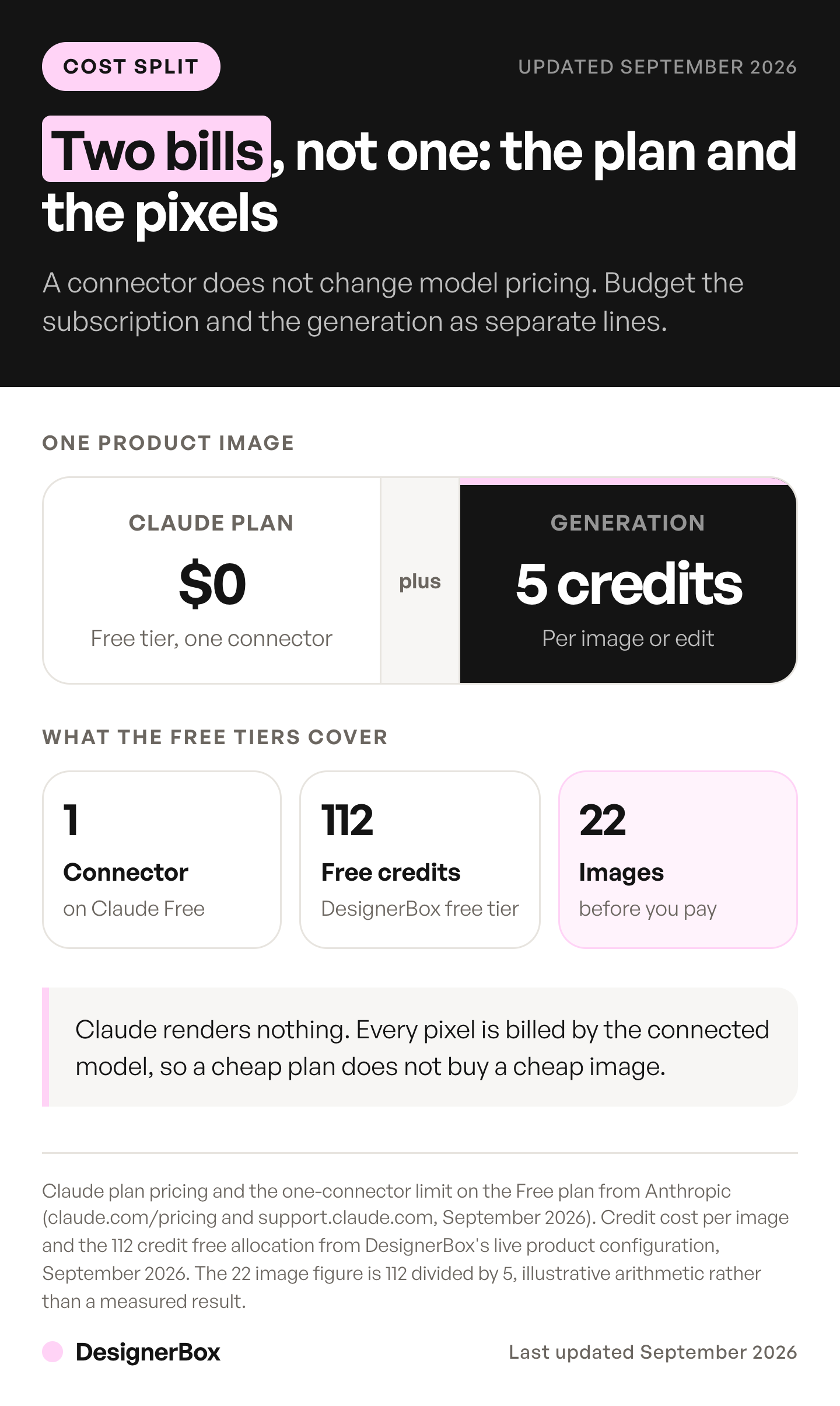
Claude charges for the assistant. From Anthropic’s pricing page (claude.com, accessed September 2026): Free at $0, Pro at $17 a month billed annually or $20 monthly, Max from $100 a month, Team at $20 per seat billed annually or $25 monthly. The Free tier includes connectors with remote MCP, capped at one.
The connected server charges for the pixels. The connector does not change model pricing. In DesignerBox that is credits, and there is no flat per-image rate. The price is set by the model that runs the shot.
| Image model | Credits per image |
|---|---|
| Seedream 5 | 4 |
| FLUX Pro 1.1 | 5 |
| Kontext Multi | 5 |
| Nano Banana 2 | 7 |
| FLUX 2 Flex | 7 |
| Nano Banana Pro, the DesignerBox default | 14 |
| GPT Image 2 | 22 |
Fixed-price operations sit next to that list. A basic upscale is 3 credits. An avatar set of nine fixed poses is 25. A brand storyboard runs 10 for a 2x2 and 25 for a 5x5. Video is charged per second of output, so an 8-second clip lands between 40 and 560 credits depending on the model and the resolution.
Plan against the spread, because it is the whole cost story. Routing a rough draft to Seedream 5 and the packaging shot to Nano Banana Pro is a 3.5x difference on the same brief. Claude reads the tool descriptions and picks a default, and it is usually right, but tell it which end of the range a job belongs on when the answer matters.
Monthly allocations run 112 on Free, 500 on Basic at $15, 1,000 on Pro at $35, 2,500 on Premium at $75 and 8,000 on Ultra at $200, all billed monthly. The free tier’s 112 credits is 8 images on the default model or 28 on the cheapest one, which is enough to test whether the connection earns a place in your workflow. Current plan detail sits on the pricing page.
Two gating details worth knowing before you plan around this. The commercial licence starts at the Pro tier. AI video needs Premium or higher.
Setting it up
For an individual on Pro or Max, adding a connector takes five clicks (support.claude.com, accessed September 2026):
- Open Customize, then Connectors.
- Click the plus, then “Add custom connector”.
- Enter the remote MCP server URL.
- Add OAuth credentials under Advanced settings if the server requires them.
- Click Add, then enable the connector per conversation from the plus menu.
On Team and Enterprise plans an owner adds the connector under Organization settings first. Members then connect individually.
DesignerBox exposes 68 tools over MCP, covering image and video generation, avatars, brand profiles, assets and templates, and saved workflows. The client setup and server address live at designerbox.ai/mcp/connect, and DesignerBox for Claude covers what the tools do once connected. Our MCP launch walkthrough runs the whole connection start to finish.
The difference between a lookalike and your product
This is where a Claude AI image generator stops being a novelty and starts being useful to a brand, and it has nothing to do with model quality.

Ask any image model for “a ceramic mug on a counter” and you get a ceramic mug. Not yours. The handle is wrong, the glaze is wrong, and the logo is invented. For a mood board that is fine. For a product detail page it is unusable, and for a paid ad it is a claim about a product you do not sell.
The fix is to start from the real photograph. Upload your packshot and use an edit or scene operation rather than a text-to-image one. The model then relights, reframes, re-angles or re-stages the object you ship. Same cost, completely different asset.
Two things make that repeatable across a catalogue. A brand profile that the workflow reads on every request, so the tenth image matches the first, which is the drift problem our guide on AI brand consistency covers in full. And a saved workflow for the sequence, so the next SKU runs the same steps rather than a fresh conversation. The written half of that setup can live in a skill that calls image tools, which tells Claude the order and the review rules. DesignerBox publishes the Product Photoshoot Agent as a pre-built version of exactly that job.
That is the difference between a chat trick and a production step. Build the job once with your brand and your product photo, then run the same steps on row two and row two hundred. The set-up guide for the generation side sits at image generation, and if the whole marketing workflow is the question rather than the images alone, our piece on Claude for marketing maps which stages Claude serves well and where the production gap sits.
FAQ
Can Claude AI generate images?
Not by itself. Anthropic’s help centre states Claude does not generate photos or illustrations the way image tools do. It builds diagrams, charts and interactive visuals in HTML inside a conversation, and Claude Design composes layouts and slides. To get a photograph you connect an image model over MCP, and that model does the rendering.
Is there a free Claude AI image generator?
The connector itself is free. Custom connectors using remote MCP work on the Claude Free plan, limited to one connector. The generation is what costs money, because the connected server bills per image and the rate depends on the model. In DesignerBox the free tier includes 112 credits, which is 8 images on the default model or 28 on the cheapest one before you pay anything.
How do I generate images in Claude?
Add a remote MCP server that exposes image tools, then ask in plain language. Open Customize, then Connectors, add the custom connector URL, authorise it, and enable it in the conversation. After that “make three packshots of this mug on a white background” is a valid instruction and Claude routes it to the model.
Which image model should I use from Claude?
Let Claude route it from the tool descriptions, then override when you have a reason. The choice depends on the shot: editing fidelity on an existing photograph, legible text rendering on packaging, or raw speed for drafts. Price is the second reason to override, because a DesignerBox image runs 4 to 22 credits by model. The models with a detail page are listed at designerbox.ai/models.
Can Claude edit an image I already have?
Yes, through the connected server rather than natively. Claude reads the image you upload, describes what needs to change, and calls an edit tool with your file as the input. This is the mode that matters for product work, because the output keeps your actual item instead of generating a lookalike.
Will the images be mine to use commercially?
That depends on the server you connect, not on Claude. Check the licence terms of whichever generation service sits behind the connector. In DesignerBox the commercial licence begins at the Pro tier, so verify your plan covers the use before running paid media with the output.
Can Claude review the images it generated?
Yes, and this is the real advantage over video. Claude reads JPEG, PNG, GIF and WebP, so it can inspect a returned image, compare it to the brief and issue a corrected call. Treat it as a first pass on composition and obvious errors, not as a colour proof. Final approval stays with a person.
Does this work in Claude Desktop and Claude Code?
Custom connectors using remote MCP are supported across Claude, Cowork and Claude Desktop on Free, Pro, Max, Team and Enterprise plans. The same server works from Claude Code and other MCP clients, which is why one connection covers several places you work.
Sources
- Anthropic, “Can Claude produce images?” (support.claude.com, updated March 2026)
- Anthropic, “Custom visuals in chat” (support.claude.com, updated April 2026)
- Anthropic, “Claude Design” (anthropic.com, April 2026) and (claude.com, accessed September 2026)
- Anthropic, “Get started with custom connectors using remote MCP” (support.claude.com, accessed September 2026)
- Anthropic, “Introducing the Model Context Protocol” (anthropic.com, November 2024)
- Anthropic, “Vision” developer documentation (platform.claude.com, accessed September 2026)
- Anthropic, “Pricing” (claude.com, accessed September 2026)
- Anthropic, “Building connectors” (claude.com, accessed September 2026)
- Model Context Protocol, “Tools” specification, version 2026-07-28 (modelcontextprotocol.io, accessed September 2026)
- Google, “Nano Banana Pro” (blog.google, November 2025) and “Nano Banana 2” (blog.google, February 2026)
- OpenAI, “GPT Image 2” (developers.openai.com, accessed September 2026) and “Image generation guide” (developers.openai.com, accessed September 2026)
Claude capabilities, plan availability and pricing verified against Anthropic’s own documentation as of September 2026. DesignerBox credit costs and plan allocations from the live product configuration, September 2026. This category changes monthly. Individual results vary.