

AI influencer marketing is a brand using a generated character, instead of a hired creator, to front its ads and social posts. The character can show the product on camera, speak a script and appear in paid ads. It works best when you test a few characters on the same script first, keep the one your buyers respond to, and label it as AI where the rules ask.
The term has a second meaning. It also covers AI tools that help brands find and manage human creators. This guide is about the first meaning: a character your brand makes and owns.
A method for picking that character circulates widely on social media. Build a large cast of AI characters, one for every kind of customer. Record one performance. Swap each character into it with motion transfer. Watch which character people relate to. Then build ads and whole accounts around the winner. Part of that method is sound, and part of it cannot give you a readable answer. This guide separates the two, for a brand with 20 to 500 products or the agency running its ads.
Key Takeaways
- Test the character, not the whole ad. Hold the script, product, cut and voice fixed, so the character is the only thing that changes.
- Motion transfer makes that possible. Kling Motion Control and Alibaba’s Wan-Animate both move a new character through a recorded performance.
- Three to five characters, not hundreds. Reading a 20% click-through difference takes about 43,000 impressions per character. A hundred characters need over four million impressions before you learn anything.
- Read purchases, not comments. Likes and comments measure attention to a post. The character you keep is the one with the lowest cost per purchase.
- Credibility is the steadiest driver. A 2026 review of 49 studies found credibility was one of the most consistent drivers of purchase intent for virtual influencers.
- Label it. The FTC counts virtual influencers as endorsers, TikTok asks you to label realistic AI people, and the EU has required deep fake labels since 2 August 2026.
What is AI influencer marketing?
AI influencer marketing means a generated character does the job a paid creator used to do. It presents the product, reads the script and appears in ads and posts under the brand’s control. The character never needs a shipping address or a new contract. It can appear in the next ad next week, with the same face and the same voice.
The appeal for a brand is control and repetition. You decide what the character looks like, what it says and where it appears. A viewer who sees the same person in ten ads starts to recognize them, which is the effect brands pay recurring creators for.
The risk is the other side of the same control. A character that says “I use this every morning” is claiming an experience it never had. That line is where most of the legal rules below apply.
Why the character is the variable worth testing
The person on screen changes how a viewer reads the whole ad. Research on virtual influencers gives some direction on what matters, and the findings are more specific than “relatable”.
A systematic review of 49 studies, published in May 2026, found that credibility was one of the most consistent predictors of purchase intent (Frontiers in Human Dynamics, May 2026). The same review found that virtual influencers tied to the product category did better than ones with no link to it. Moderate human likeness worked better than extreme realism.
The review found one more thing that matters for testing. Human-like virtual influencers beat anime-style ones only when the sponsorship was not disclosed. Once the ad was disclosed, the advantage disappeared. So a test run without labels can pick a winner that loses its edge the moment you label it.
Category matters too. In a lab study of 120 university students, human endorsers produced a better ad attitude and higher purchase intent than virtual ones for a vitamin C supplement ad (Frontiers in Psychology, January 2026). That is one category and one audience. It is still a reason to test an AI character against a real person before you replace one with the other.
How record-once character swapping works
Motion transfer takes the movement from one video and applies it to a different character. You record one performance: a person holds the product, turns it, smiles and points at the label. The model then produces the same performance with a new face and body.
Two models show how it works. Kling Motion Control copies movement from an uploaded reference video of 3 to 30 seconds onto a character image, with output at 720p or 1080p (Kling API documentation, September 2026). Alibaba’s Wan-Animate has a replacement mode that puts a new character into the original video and keeps the scene’s lighting and color tone (arXiv, September 2025).
The useful part is control. Every character performs the same gestures, at the same moments, in the same room. If one character wins, the win belongs to the character and not to a better take.
Motion transfer has limits. The source recording sets the ceiling: bad light and a shaky hand carry into every version. Hands on the product and small text on a label are common failure points, so check those frames in every result. Our guide to choosing the input for realistic AI video covers why a video input holds motion better than a text prompt.
Why hundreds of characters cannot be read
A large cast sounds thorough. In an ad account it produces noise.
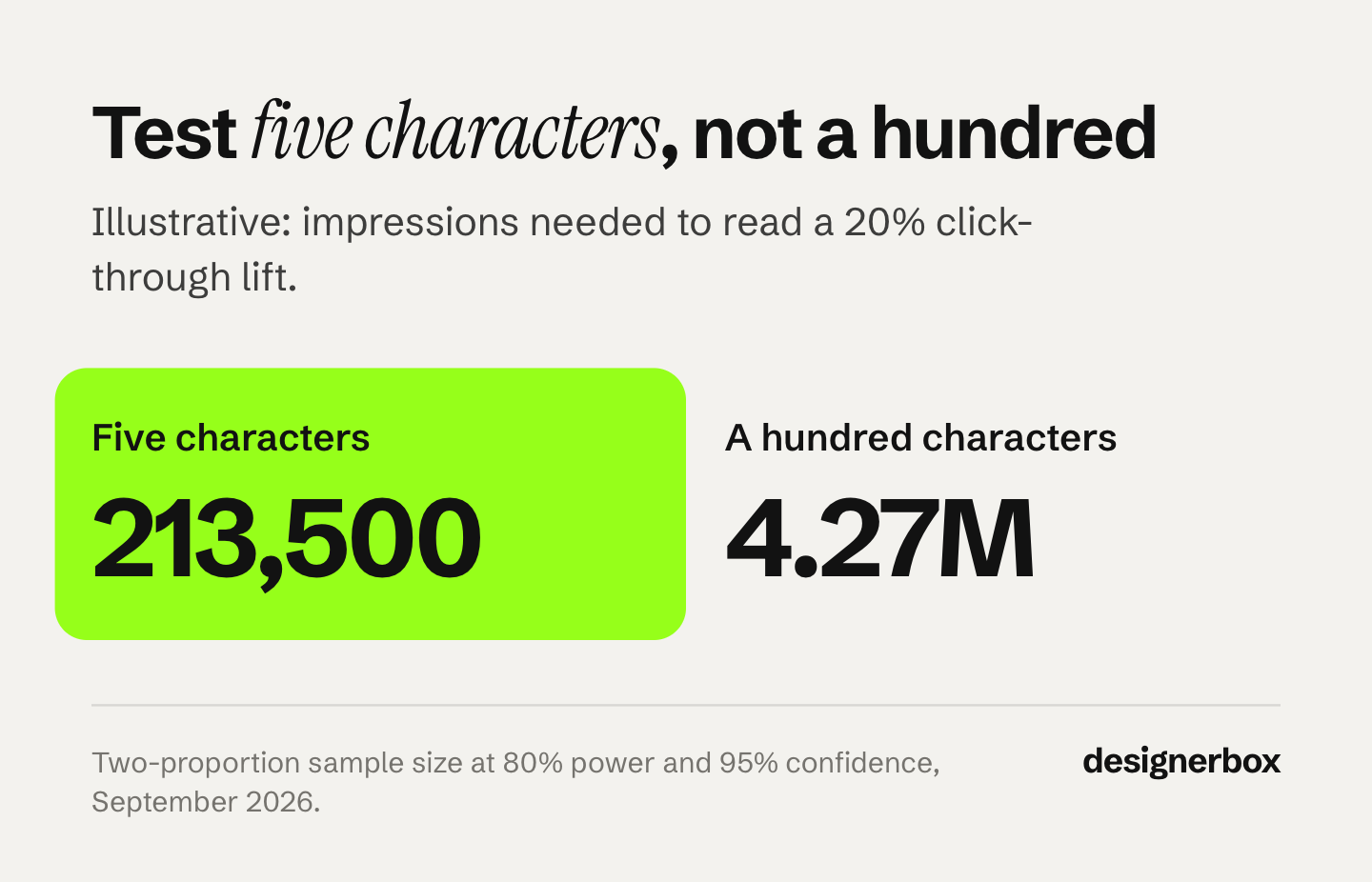
To read a 20% difference in click-through rate from a 1% baseline, you need about 42,700 impressions per variant, at 80% power and 95% confidence. That figure comes from the standard two-proportion calculation in our ad creative testing guide. Five characters need about 213,500 impressions in total. A hundred characters need about 4.27 million, and that only buys a click-through answer. Purchases need far more.
The ad platforms are built for small tests. Meta’s A/B testing tool compares up to five versions (Meta for Business, September 2026). A hundred characters in one ad set is not a test either, because the delivery system gives most of the budget to the ad it predicts will win, early and on thin data.
Comments do not fix this. Comments and likes measure how much people react to a post. They can come from people who will never buy. A comment gate or a giveaway inflates them further. The character to keep is the one that lowers cost per purchase, and only a controlled test shows that.
How to run a character test you can read
A readable test changes one thing and measures it long enough. Here is the order that works.
- Write down your two or three buyer types. Use your customer data: age band, why they buy, what they worry about. Each character should match one buyer type you can name.
- Build three to five characters. One per buyer type, plus a control. The control can be a real person you already use, or your current best ad.
- Lock everything else. One script, one product, one recorded performance, one edit, one voice style. The first three seconds must be identical except for the face.
- Launch together, then wait. Use the platform’s A/B tool, start all versions at once and leave them for at least seven days. On Meta, adding a new ad to a running ad set resets learning.
- Read in order. Hold rate first, then click-through, then cost per purchase. A character that holds attention but does not sell is a hook, not a presenter.
- Test the winner with its label on. Run the winner again with the AI disclosure you will use in the live account. The review above shows that disclosure can erase a human-like character’s edge.
Keep the loser data. A character that lost for one product can win for another category, because product fit is one of the stronger effects in the research.

What the law and the platforms ask of an AI influencer
The rules follow the character, not the tool that made it. This is general information, not legal advice.
| Rule | What it says | What it means for your character |
|---|---|---|
| FTC Endorsement Guides, US | The FTC’s 2023 update made its endorsement definition cover virtual influencers (ftc.gov, June 2023) | Your AI character is an endorser. The endorsement rules apply to it |
| FTC reviews and testimonials rule, US | No blanket ban on AI avatars. The rule applies when the testimonial behind them is fake or false (ftc.gov, September 2026) | The character can show and explain the product. It must not claim it used the product |
| TikTok Community Guidelines | Creators must label AI-generated or heavily edited content that shows realistic people (tiktok.com, September 2026) | An account run by a realistic AI character labels its posts |
| TikTok ads policy | AI-generated ad media needs the AIGC label or your own clear disclaimer. Undisclosed AI ads are rejected or restricted (ads.tiktok.com, September 2026) | Turn on the disclaimer in every campaign |
| Meta, organic posts | People must disclose organic posts with photorealistic AI video or realistic AI audio (transparency.meta.com, September 2026) | Instagram and Facebook video from the character needs the AI label |
| Instagram, profile label | Instagram has a profile label called “AI-generated profile”. A profile that features an AI-generated person should turn it on. Instagram says it limits the reach of such profiles when they do not add the label (Instagram for Creators, published 31 August 2026, accessed October 2026) | An Instagram account built around the character turns the profile label on |
| EU AI Act, Article 50 | Since 2 August 2026, deep fakes must be disclosed the first time a person sees them (European Commission, September 2026) | A photorealistic character may count as a deep fake if viewers could take it for a real person |
The FTC line is the one most AI influencer plans cross. Its rule makes it unlawful to create a testimonial that misrepresents that the reviewer exists, used the product, or had the stated experience (16 CFR 465.2, September 2026). For knowing violations, the maximum civil penalty is $53,088 per violation. Our article on AI UGC ads and the FTC line walks through which scripts cross it.
Two more limits apply to the character itself. Never build it from a real person’s photos without written consent. TikTok also bans AI content that falsely shows a public figure endorsing a product, even with a label (TikTok Support, September 2026). If you record a performer for motion transfer, get a written release that covers reuse of that recording in AI video. Retailer affiliate programs add their own terms: the Walmart Creator program requires creators to disclose a realistic AI-made person to viewers.
From test winner to brand character
The test gives you one character. The next job is to keep that character the same across every ad, every product and every month.

Consistency is where a winning character is most often lost. A face that drifts between ads looks like a different person, and the recognition you tested for does not build. Our guide to building a consistent AI character covers the reference set and the release that hold one face across 40 assets.
Build narrow at this stage. One character, owned by the brand, labeled as AI, with a written brief: who they are, what they may say, and the claims they must never make. Put that brief where every person and every tool that makes content for the character can read it.
Some brands then give the character its own social account. That is a bigger promise than an ad. People who follow an account expect a person behind it, so the label has to be on the profile and on the posts. On Instagram, the profile label is “AI-generated profile”. The TikTok and Meta rules above still apply to every post.
An account like that needs the same tools a human creator uses. Our guide to AI tools for content creators sorts them by six weekly jobs. For the rest of the stack, CreatorFlow’s creator tools directory lists 190+ tools by job, from link-in-bio and email to scheduling and affiliate platforms. CreatorFlow is built by the same team as DesignerBox (creatorflow.so/creator-tools, October 2026).
One presenter on every product
Anyone can make an AI picture. Making hundreds that still look like your brand is the hard part. DesignerBox is AI creative production for brands and agencies. It runs the steps around a character test as one workflow.
You start from a product photo and a script. You pick a ready presenter or build your own. An avatar run returns nine fixed poses for 25 credits, and those poses hold one face across a series. The speech is lip-synced, with 20 voices to choose from. Your brand rules sit in a brand profile, and the workflow reads it on every run.
For a character test, you run the same workflow once per character. The script, the product and the cut stay the same. After the test, batch runs the winning character across your whole catalog, and you review the results in one pass. The video editor is a real timeline, with several tracks, captions, animated text and audio. The cost of each run is shown before you start it. The full workflow from the first product photo to the finished ad, in one subscription.
The limits, stated plainly. DesignerBox does not list motion transfer from your own recording as a step. If you want one filmed performance under every character, you record it and run it in a tool such as Kling first. The video editor then takes those clips on the timeline beside the generated ones.
AI video starts on the Premium plan. Uploading your own photos and the commercial license start on the Pro plan. Team features are on the Ultra plan, and every plan below Ultra has one seat. Plans and credits are on the pricing page. You download the results, or send them with a webhook or an S3 step.
For agencies running this for several clients, the agency page shows how one workflow serves each brand. To see the clip format itself, the AI UGC page shows the presenter workflow from product photo to finished clip.
A free plan for your first run
There is a free plan, and it runs on sample products. Start from a template and see the cost before you run it.
FAQ
Do AI influencers work for brands?
They can, but the evidence depends on the category. A 2026 review of 49 studies found credibility was one of the most consistent drivers of purchase intent, and product fit helped too. A 2026 lab study found human endorsers beat virtual ones for a supplement ad. Test an AI character against your current best ad before you switch.
How many AI characters should I test?
Three to five. Meta’s A/B testing tool compares up to five versions. Reading a 20% click-through difference takes about 43,000 impressions per character. A large cast spreads the budget so thin that no result is readable.
What is motion transfer in AI video?
Motion transfer copies the movement from one video onto a different character. You record one performance, and the model makes the same performance with a new face and body. Kling Motion Control and Alibaba’s Wan-Animate both do this.
Do I have to disclose an AI influencer?
In most places, yes. TikTok asks creators to label realistic AI people and asks advertisers to label AI ad media. Meta requires disclosure of photorealistic AI video in organic posts. Instagram asks a profile that features an AI-generated person to add its “AI-generated profile” label. The EU requires deep fake labels at first exposure. The FTC treats a virtual influencer as an endorser.
Can an AI influencer review my product?
It can show the product and explain what it does. It must not claim it used the product or describe an experience it never had. Under the FTC rule, a testimonial that misrepresents the reviewer’s existence or experience is unlawful.
Can I build an AI influencer from a real person’s photos?
Only with that person’s written consent. TikTok also bans AI content that falsely shows a public figure endorsing a product. A fully generated face avoids the likeness problem, but it still needs an AI label.
What does an AI influencer cost to run in DesignerBox?
The cost of each run is shown before you start it. An avatar run returns nine fixed poses for 25 credits. An 8-second video clip costs 40 to 560 credits, depending on the model. AI video starts on the Premium plan.
Sources
- Zhou et al., Virtual influencer attributes and purchase intention: a systematic review, Frontiers in Human Dynamics, 20 May 2026
- Persuasive differences between human and virtual influencers in health supplement advertising: evidence from eye-tracking, Frontiers in Psychology via PMC, 6 January 2026
- Wan-Animate: Unified Character Animation and Replacement, arXiv, 17 September 2025
- Kling API documentation, Motion Control, kling.ai, accessed September 2026
- Meta for Business, A/B testing, facebook.com, accessed September 2026
- FTC, updated Endorsement Guides announcement, ftc.gov, 29 June 2023
- FTC, Consumer Reviews and Testimonials Rule: Questions and Answers, ftc.gov, accessed September 2026
- 16 CFR 465.2, via Cornell Law School LII, accessed September 2026
- FTC, inflation-adjusted civil penalty amounts for 2025, ftc.gov, accessed September 2026
- TikTok Community Guidelines, integrity and authenticity, tiktok.com, accessed September 2026
- TikTok ads policy, misleading and false content, ads.tiktok.com, accessed September 2026
- TikTok Support, AI-generated content, tiktok.com, accessed September 2026
- Meta Community Standards, misinformation, transparency.meta.com, accessed September 2026
- Instagram for Creators, the “AI-generated profile” label, creators.instagram.com, 31 August 2026, accessed 2 October 2026
- European Commission, Transparency obligations under Article 50 of the AI Act, FAQ, accessed September 2026
- CreatorFlow creator tools directory, 190+ tools in eleven groups: creatorflow.so/creator-tools, accessed 2 October 2026
- DesignerBox AI UGC page (designerbox.ai/ai-ugc) and pricing page (designerbox.ai/pricing), September 2026
Research, platform policy and regulation checked against primary sources as of September 2026. Instagram’s “AI-generated profile” label was checked on 2 October 2026. This is general information, not legal advice. Rules change, so re-check before you launch a campaign. Individual results vary.