
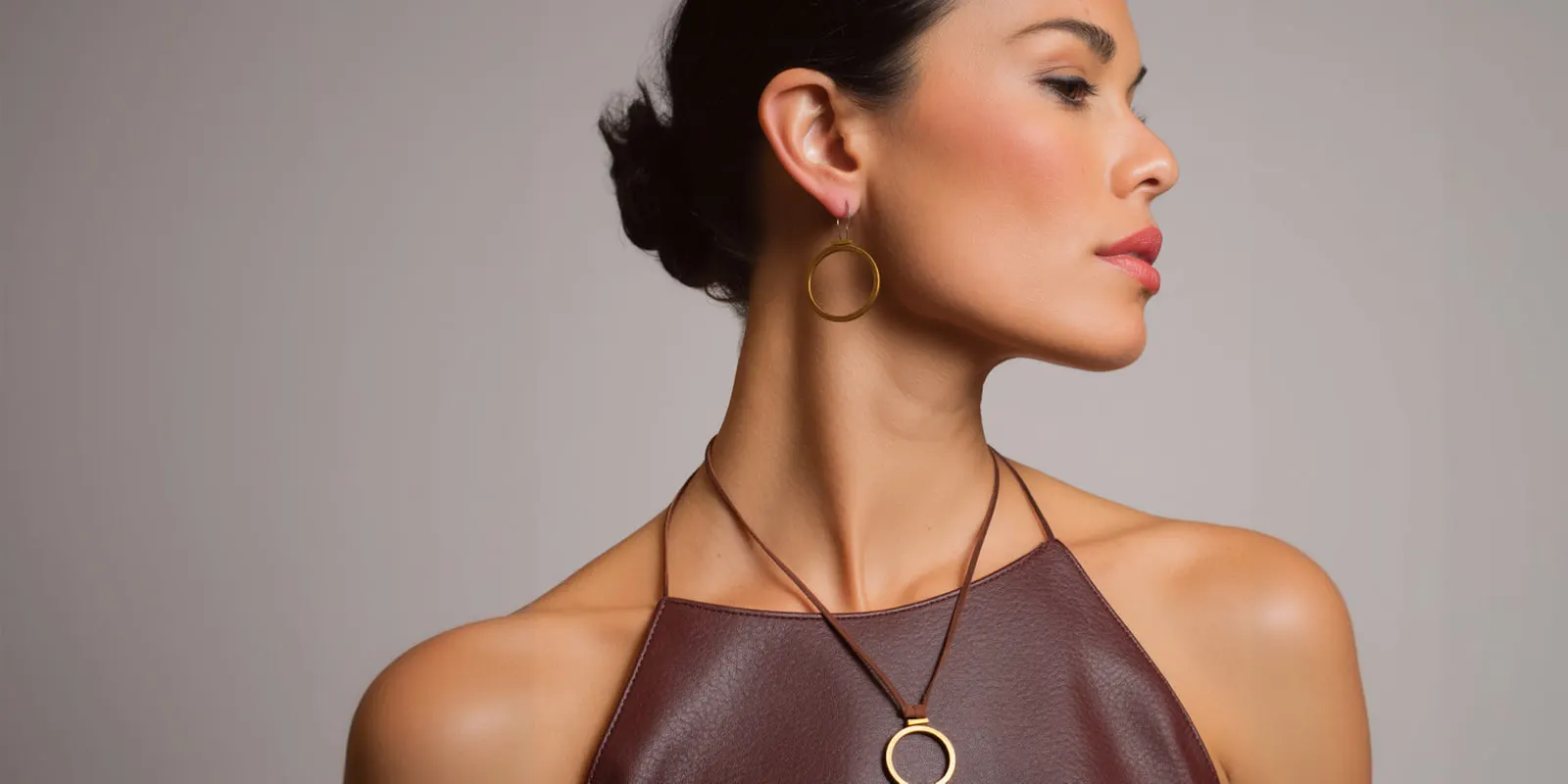
Necklace photography needs six shots: a full packshot on white, a pendant macro, a clasp and chain detail, a length shot on a bust form, a worn shot, and a layering shot. The hard parts are specific to necklaces. A chain will not lie straight, a flat photo hides the length, and the pendant drop changes with every neckline.
A ring has a size number. An earring has an ear. A necklace has a length in inches, and most buyers cannot picture 18 inches against their own neck. The photo set has to do that work for them.
This guide covers the six shots, how to control a chain, how to show length and drop truthfully, layering, reflections, Amazon’s two sets of main image rules, and the FTC guidance that applies to a jewelry picture. It is written for brands with 20 to 500 products and for the agencies that shoot for them.
Key Takeaways
- Six shots, six questions. Packshot, pendant macro, clasp and chain detail, length on a bust form, worn, and layered. Each one answers something the others cannot.
- A flat photo shows shape and hides length. A 16 inch chain and a 20 inch chain look almost the same on a white table.
- Length names have published ranges. Jewelers of America lists choker at 14 to 16 inches, princess at 17 to 19 and matinee at 20 to 25 (Jewelers of America, October 2026).
- Amazon has two rule pages and they differ. The jewelry page asks for 80 percent fill and caps the longest side at 2,100 pixels. The general page says 85 percent.
- No model and no mannequin on Amazon’s main image. The worn shot and the bust shot belong in the additional images.
- A picture is a claim. The FTC Jewelry Guides cover depictions as well as words.
Why necklace photography is its own problem
Necklace photography shares its lighting problems with the rest of the jewelry set. Polished metal mirrors the room, and stones need a hard light to show facets. Our guide to reflections, scale and color in jewelry product photography covers that shared craft.
Three problems belong to necklaces alone. The first is the chain. It is a long, flexible line with no natural shape, so it curls, twists and kinks on any surface.
The second is length. A ring listing sells a size the buyer has to name. A necklace listing sells a position on the body, and that position depends on the buyer’s neck and neckline.
The third is drop. A pendant hangs below the chain, so the lowest point of the piece sits lower than the length number suggests. Earrings and bracelets have their own versions of the fit question, covered in the four-shot set for earrings and the clasp, fit and drape shot list for bracelets.
The six-shot set for a necklace listing
Each shot answers one question. If two of your images answer the same question, replace one.
| Shot | The question it answers | How to frame it |
|---|---|---|
| Full packshot | What is the whole piece | Whole necklace on pure white, clasp closed, chain in a clean curve |
| Pendant macro | What do the stone, setting and finish look like | Pendant fills the frame, bail visible |
| Clasp and chain detail | How does it fasten, what is the link style | Clasp, extender and three or four links, side on |
| Length on a bust form | Where does it sit | Neck and upper chest of the form in frame, straight on |
| Worn | How big is it on a person | Collarbone to chin, plain neckline, hair cleared |
| Layered | How does it pair with other lengths | Two or three necklaces, each length readable |
Amazon recommends at least six additional images and one video beside the main image (Amazon product image requirements, October 2026). The six shots here fill that space with six different answers.
The clasp shot is the one most listings skip. It shows the closure type, the extender chain and the link construction. A buyer who has broken a thin spring ring before looks for that frame.
How to make a chain lie straight
A chain follows gravity. Lay it flat and it has no direction to follow, so it keeps every bend it had in the box. Three methods fix this, and each suits a different shot.
Hang it. Suspend the necklace from two points above the frame with thin clear line. Gravity pulls each side straight and the pendant finds the true center. This gives the cleanest V shape for a packshot. Remove the line in editing.
Tilt the surface. Rest a white board at a steep angle and drape the necklace over the top edge. The chain pulls straight under its own weight. Shoot square to the board so the shape is not distorted.
Place it by hand. For a true flat lay, set the clasp first, then draw the chain into a curve with tweezers or a toothpick. A tiny dot of museum wax under the pendant stops it from rotating.
Check four things before you press the shutter. The clasp is closed. No link is twisted. The pendant faces forward on its bail. The two sides of the chain mirror each other.
Fine chains also collect dust and fibers. Clean the piece with a blower and a lint-free cloth first. Dust on a macro frame takes longer to retouch than to wipe.
Necklace lengths and pendant drop
Length is the fact a necklace buyer most needs and a flat photo least provides. Baymard’s testing found that 42% of users try to judge a product’s size from the product page images (Baymard Institute, October 2026). For a necklace, size means where it sits.
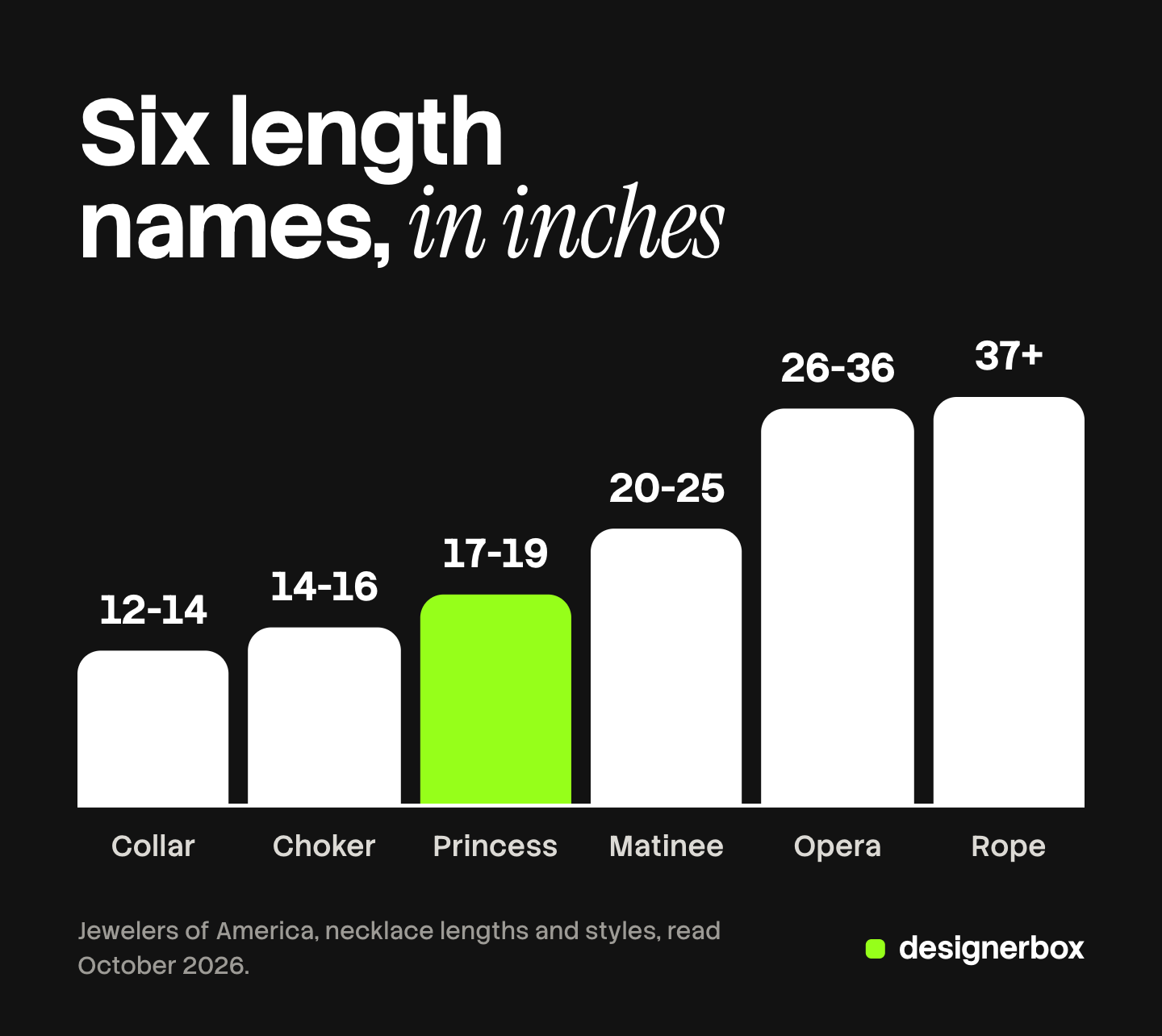
Jewelers of America, the US trade association, publishes these length names and ranges (Jewelers of America, October 2026).
| Length name | Inches | Where it sits |
|---|---|---|
| Collar | 12 to 14 | Above the neckbone, against the throat |
| Choker | 14 to 16 | At the base of the neck |
| Princess | 17 to 19 | Below the neckbone |
| Matinee | 20 to 25 | From below the collarbone to the bust |
| Opera | 26 to 36 | Below the bust |
| Rope | 37 and longer | Below the navel when worn as one strand |
Other jewelers publish slightly different ranges, so treat the names as labels and the inches as the fact. Put the inches in the title and the first bullet.
Three rules keep the length shot truthful.
- Shoot the length you sell. If the listing offers 16, 18 and 20 inches, show each one on the same bust form, in the same frame. Do not show one and describe the others.
- Measure the drop. State the pendant height including the bail. An 18 inch chain with a 1 inch pendant ends lower than an 18 inch chain alone.
- Do not pin the chain shorter. Pinning the back of a chain to raise the pendant makes a better picture of a different length.
The same care applies to the stone. A pendant macro shows the stone far larger than life, so publish its dimensions beside the image.
Flat, bust or on-model
The three setups do different jobs. A full necklace set uses all of them.
| Setup | What it shows well | What it cannot show |
|---|---|---|
| Flat or hung on white | The whole piece, the chain style, the true shape | Length on a body, movement |
| Bust or neck form | Where each length sits, the drop | Skin tone, real scale against a face |
| On a model | Scale, styling, how it moves with clothing | Fine detail of clasp and links |
A flat photo gives a necklace its natural overview, because the whole shape reads at once from above. It is the right setup for the main image. It is the wrong setup for the length question.
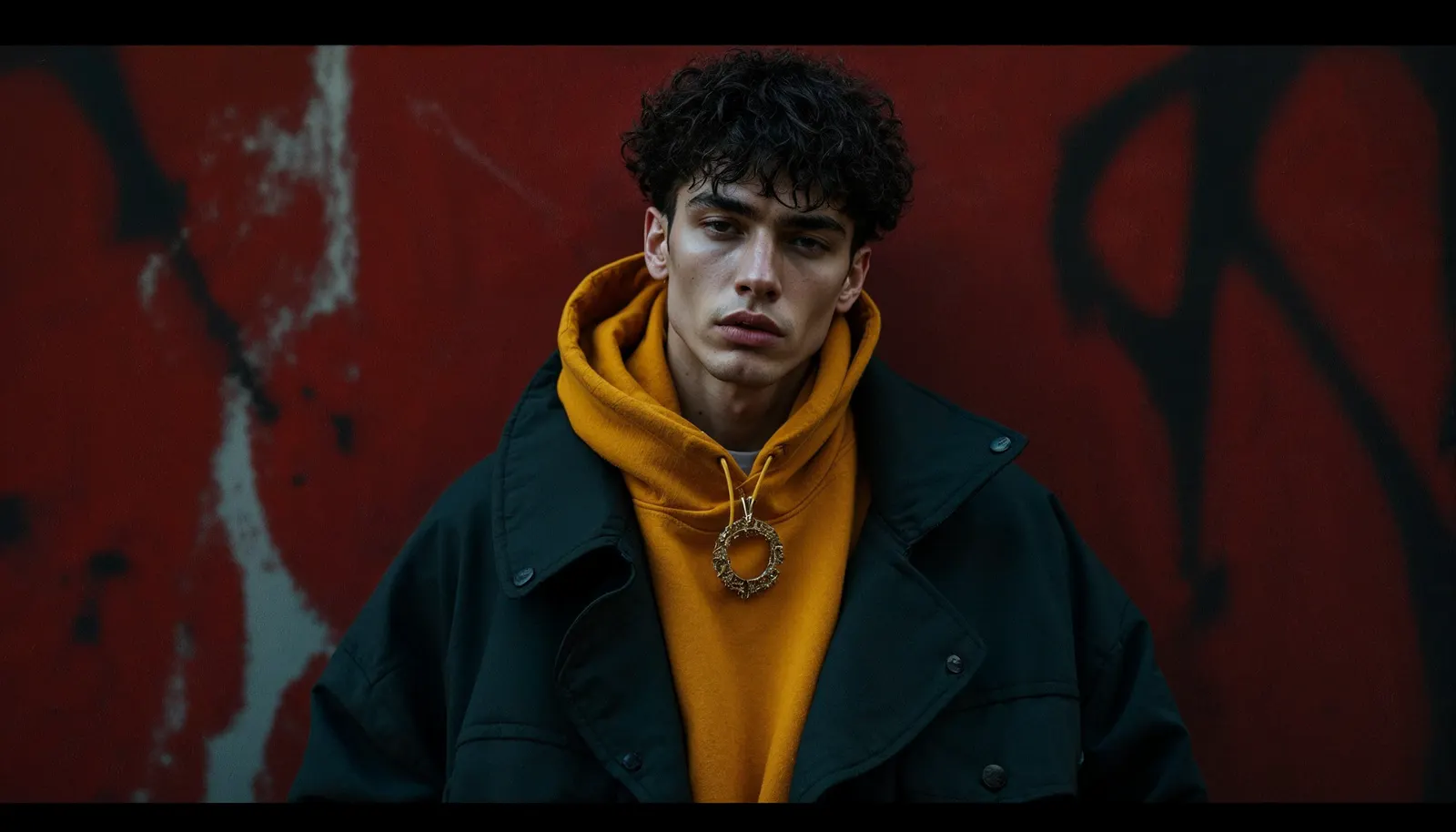
A bust form is the most repeatable length reference. Use one form for the whole catalog, mark where the camera stands, and every length shot becomes comparable. Pick a form in a matte, neutral color so it does not add reflections.
The worn shot carries scale best. Keep the neckline plain and the hair behind the shoulders. A crew neck suits short lengths, and a V neck suits a pendant. Over heavy clothing, a pendant sits higher and further forward than on skin, so match the styling to how your buyer will wear it.
Jewelry photography props for a necklace
Props for a necklace fall into two groups. Forms hold the piece in a worn position: a bust, a neck form or a T-bar stand. Surfaces set the mood for a styled frame: linen, stone, a ceramic dish or a jewelry box. For every other support, see our 17 jewelry photoshoot ideas.
Good jewelry photography ideas start from the piece. A fine gold chain suits a soft fabric that it can sink into. A heavy silver link suits a hard surface such as slate. Keep props matte, because a glossy prop adds a second set of reflections to control.
Props belong in the additional images and in ads. Amazon’s general rules ask sellers not to show props that are not included with the product on the main image. If the necklace ships in a gift box and you show the box, say in the listing that it is included.
Layering shots
Layered necklaces sell as a set even when each is a separate listing. The layering shot shows which lengths work together.
Leave a visible gap between the layers. Lengths that are 2 inches apart usually separate cleanly on a bust form. Lengths closer than that tend to tangle and read as one piece.
Vary the weight as well as the length. Put the finest chain highest and the pendant lowest. Then name every piece in the caption or the alt text, so the buyer knows which one this listing sells.
Shoot the layered frame last. Chains tangle fast, and separating three fine chains can cost more time than the rest of the set.
Reflections on a moving chain
Every link in a chain is a small curved mirror. A ring has one band to light. A chain has hundreds of surfaces, each pointing a different way.
Soft, wide light is the base. A light tent or two large diffused sources give each link a smooth highlight. Then add a strip of black card on each side, outside the frame. The dark edge it reflects gives the links their shape.
Movement is the second problem. A hung necklace swings for a long time after you touch it. Wait for it to settle, use a tripod and a remote release, and choose a fast shutter speed if the room has any draft.
Depth of field is the third. At macro distance only a few millimeters are sharp. Shoot the pendant square to the camera, or take several frames at different focus points and merge them.
Amazon main image rules for a necklace
Amazon publishes two pages that apply to a necklace main image, and they give different numbers. Check both before a large upload.
| Rule | Jewelry page (G50211) | General page (G1881) |
|---|---|---|
| Background | Pure white, RGB 255, 255, 255 | Pure white, RGB 255, 255, 255 |
| Product fill | At least 80 percent of the image area | 85% of the image |
| Longest side | 500 to 2,100 pixels | 500 to 10,000 pixels |
| Zoom | 1,000 pixels or larger | 1,000 pixels or more |
| Model or mannequin | Neither on the main image | No part of a mannequin |
| Extras | Only what the customer receives | No props that are not included |
Sources: Amazon jewelry requirements and Amazon product image requirements, both read October 2026.
The jewelry page has one line written for necklaces. In a close-up, such as a pendant necklace, part of the item can run past the image edge. The seller then fades the product at the outer edge, so the border stays white.
That line matters because a long chain is mostly empty space. A full 24 inch necklace in a square frame leaves the pendant tiny. The fade lets you frame the pendant and the lower chain as the main image. Then show the full length in the additional images.
A bust form is not named on either page. The safe reading is to keep it away from the main image, since both pages exclude mannequins. Other channels set their own limits. Our ecommerce product photography guide lists the specs for five channels, and our guide to what each marketplace allows on product images compares the marketplace rules.
What a necklace photo claims
The FTC Jewelry Guides sit at 16 CFR Part 23. They apply to claims made “through words, symbols, emblems, logos, illustrations, depictions, product brand names, or through any other means” (16 CFR 23.0, October 2026). A product photo is a depiction. Amazon’s jewelry page also tells sellers to follow these guides.
Four parts matter for a necklace picture.
- Stone size. Note 3 to section 23.1 says a depiction that shows a gemstone “in greater than its actual size may mislead consumers, unless a disclosure is made about the item’s true size” (16 CFR 23.1, October 2026).
- Vermeil. The guides describe vermeil as sterling silver plated with gold of at least 10 karat fineness, at a minimum of 2.5 microns of fine gold (16 CFR 23.4, October 2026). Do not grade a plated chain to look like solid gold.
- Sterling. The guides say the word may mislead unless the metal is at least 925 parts per thousand pure silver (16 CFR 23.5, October 2026). A hallmark in a clasp macro is part of that claim.
- Pearls. For a cultured pearl strand, the guides ask for “cultured” or “cultivated” directly before the word pearl (16 CFR 23.20, October 2026).
The guides do not bind the FTC or the public. The FTC may still act under the FTC Act against a claim that conflicts with them, and it must then prove the practice is unfair or deceptive. This section is general information, not legal advice.
The practical rule is short. Photograph the real metal, the real stone and the real clasp. Edit dust, background and light. Leave color, size and construction as they are.
Necklace sets across a brand’s catalog
DesignerBox is AI creative production for brands and agencies. It makes images, ads and video from your own inputs, and a product photo is one of those inputs. Anyone can make an AI picture. Making hundreds that still look like your brand is the hard part.
For a necklace range, the split is the one this guide draws. You photograph the packshot, the pendant macro and the clasp, because those frames are facts about the piece. A saved workflow then builds the styled scenes and worn frames around that photo. It reads the same brand rules on every run.
A batch runs that workflow over a sheet of up to 200 rows. Row one and row two hundred get the same light, crop and background. The cost is shown before the run, and you keep or discard each result yourself. The wider product side is on the AI product photography page.
Three limits are worth knowing. Virtual try-on covers garments only, so a necklace on a model is an image workflow built from your photo. Check every result against the real piece, using the accuracy checks for a product photo. DesignerBox does not send finished work to a marketplace, so you download the results, or send them with a webhook or an S3 step.
Uploading your own photos and the commercial license start on the Pro plan. AI video, virtual try-on, upscaling, the image editor and the video editor start on the Premium plan. Plans and credits are on the pricing page.
The full workflow from the first product photo to the finished ad, in one subscription. There is a free plan, and it runs on sample products. Get started free
FAQ
How do you photograph a necklace so the chain lies straight?
Hang the necklace from two points with thin clear line, or drape it over the top edge of a tilted white board. Gravity pulls the chain straight in both setups. For a flat lay, set the clasp first and draw the chain into a curve with tweezers. Check that no link is twisted before you shoot.
How many photos does a necklace listing need?
Six cover the questions a buyer asks: a full packshot, a pendant macro, a clasp and chain detail, a length shot on a bust form, a worn shot and a layered shot. Amazon requires one compliant main image and recommends at least six additional images and one video.
Can I use a model or a bust on the Amazon main image?
No. Amazon’s jewelry page says the main image shows no mannequin and no model, and the general image page excludes any part of a mannequin. Use the flat or hung packshot as the main image. Put the bust form and the worn shot in the additional images.
How do I show necklace length in a photo?
Show each length you sell on the same bust form, in the same frame, and add one worn shot from collarbone to chin. State the length in inches in the title. Add the pendant height with the bail, because the drop lowers the point where the piece ends.
What props work for necklace photography?
Use a matte bust or neck form for length, and soft or hard surfaces such as linen or slate for styled frames. Keep props away from the Amazon main image, which shows only what the customer receives. Avoid glossy props, because they add reflections to the chain.
How do you stop reflections on a necklace chain?
Use soft, wide light from a tent or two large diffusers, so each link gets a smooth highlight. Add black card at the sides, outside the frame, to give the links a dark edge. Let a hung necklace stop moving before you shoot, and use a tripod.
Can DesignerBox make necklace photos?
It makes the styled scenes and worn frames around your own photo of the necklace, and a batch repeats one workflow over up to 200 rows. You see the cost before you press Run. The packshot, the macro and the clasp shot should come from your camera, and you should check each result against the real piece.
Sources
- Amazon jewelry image requirements: pure white, the fade for a pendant close-up, no mannequin or model, 500 to 2,100 pixels, 80 percent fill, FTC guidelines: Amazon Seller Central, Jewelry, read October 2026
- Amazon general image rules: 85% fill, 500 to 10,000 pixels, zoom at 1,000 pixels, no props, no mannequin, six additional images and one video: Amazon Seller Central, product image requirements, read October 2026
- Necklace length names and ranges: Jewelers of America, necklace lengths and styles, read October 2026
- FTC Jewelry Guides, 16 CFR Part 23: scope and status (23.0), deception and Note 3 (23.1), vermeil (23.4), silver (23.5), pearl (23.20), read October 2026
- 42% of users try to judge product size from product page images: Baymard Institute, the current state of product page UX, read October 2026
- DesignerBox batch and workflows: DesignerBox batch page (designerbox.ai/product/batch), October 2026
- DesignerBox plan gates: DesignerBox pricing page (designerbox.ai/pricing), October 2026
Amazon, FTC, Jewelers of America and Baymard facts verified on each publisher’s own page, October 2026. DesignerBox features verified on designerbox.ai, October 2026. This is general information, not legal advice. Individual results vary.