Pants photography is the image set that proves a trouser’s rise, seat, leg line and hem break before anyone can try it on. Amazon files pants under a waist-down crop that runs from slightly above the navel down to below the feet. That single line settles the frame, puts footwear inside your main image, and rules out the seated shot most buyers want to see.
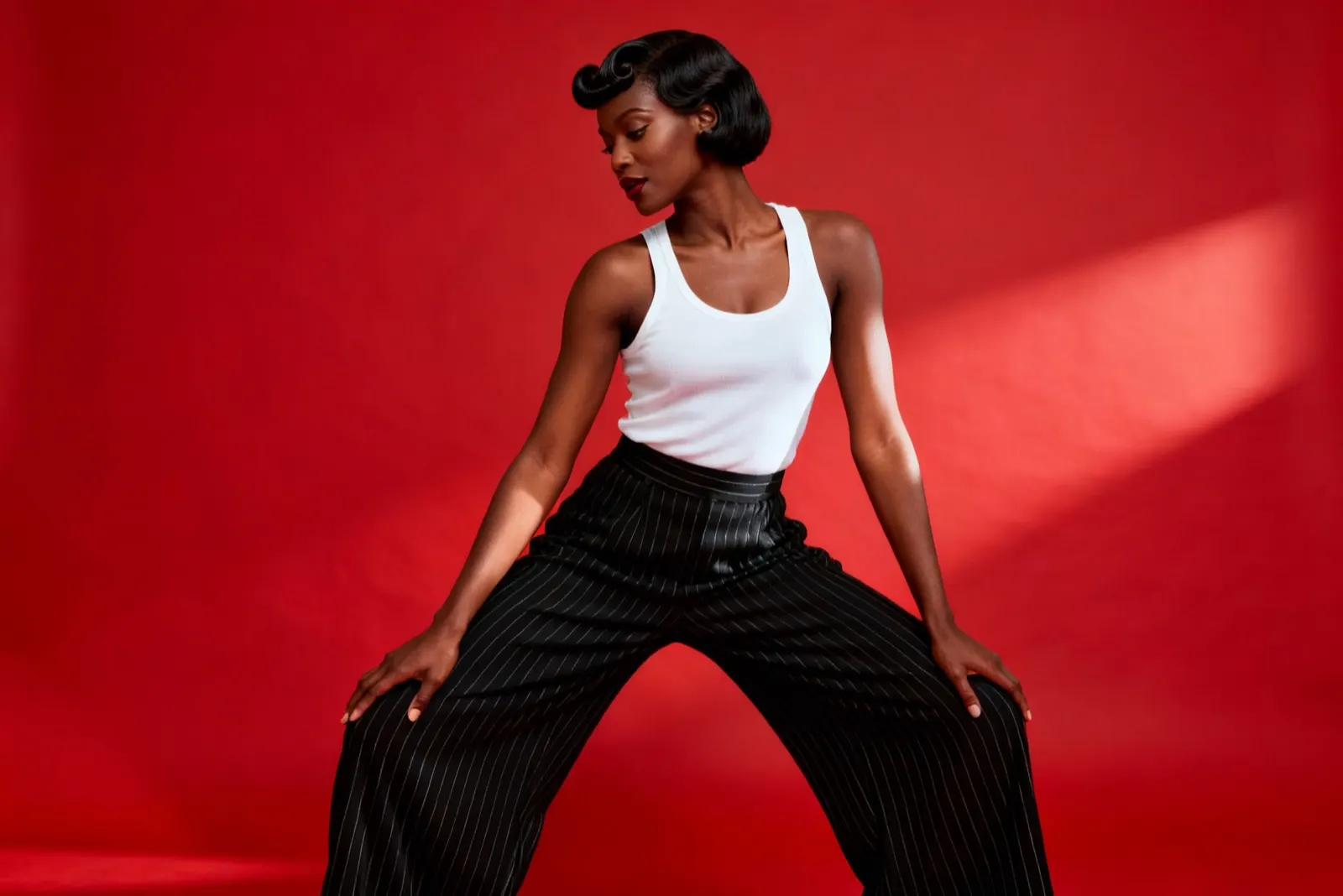
The hero photograph at the top of this page is a good picture of a wide-leg trouser and a failing product shot. The hem is cropped off, the background is red rather than white, and the stance hides the front rise. Three rules broken in one frame, and every one of them is published.
Most trouser guides skip all of this. They open on steaming and a two-light setup, then hand you a library of poses to pick from. This guide runs the other way round: the crop class first, because a platform rule decides it, then the shot list that survives the rule, then honest arithmetic on what the set costs per frame.
Key Takeaways
- Amazon crops trousers waist-down, below the feet. Its Seller Imaging Guide recommends a waist-down image for products falling “slightly above the navel & below the ribcage down to below the feet” and names pants and jeans first in that group (Amazon Seller Imaging Guide: Clothing & Accessories, Spring 2021, accessed August 2026).
- That frame includes shoes, and the same guide bans props not included with the purchase. Bottoms are the only apparel class where the compulsory crop forces a second product into the shot. Style it as neutral footwear, not as an accessory.
- The seated fit shot cannot be your main image. “Models kneeling, leaning, or lying down” sits on Amazon’s main image DON’T list, and the seated frame is the one that answers rise and thigh fit. It belongs in the alternates, and it still belongs in the set.
- Ghost mannequin is off the main slot for trousers. The guide lists ghost mannequins and visible mannequins as main image DON’Ts, and says all adult apparel should be imaged on-model.
- Separate the musts from the recommendations. White background, 85% fill and single product are stated as musts. The crop class and on-model are stated as recommendations. Both matter, but only one group gets an image rejected outright.
- A drop with shorts in it splits across two crop classes. Shorts falling above the knee move to Amazon’s square class, so a mixed bottoms line needs its shot list sorted by inseam before anyone books a studio day.
- Generated imagery splits cleanly on trousers. Backgrounds, colourways, scene variants and crop formats derive from one good capture. Hem break on a specific inseam, fabric weight and how a seat fits are properties of the physical garment.
What is pants photography?
Pants photography is product photography for a garment where almost every selling point sits below the waist and only exists on a body. A trouser has a rise that decides where it sits, a seat that decides whether it fits, a leg line that decides the silhouette, and a hem break that decides whether it reads as tailored or sloppy.
None of those four survive a flat laydown. The same rectangle of cloth photographs identically whether it hangs as a straight leg or a wide leg, because flat removes the volume that separates them. A laydown tells a shopper the colour and roughly the shape, and stops there.
That makes trousers closer to a dress shoot than a t-shirt shoot. It is a geometry problem first and a styling problem second, and the compulsory frame is decided by a rule you did not write.
Amazon crops trousers from the ribcage to below the feet
Amazon’s Seller Imaging Guide sorts apparel into crop classes by where the garment sits on the body rather than by product name. Bottoms land in the waist-down class, and the guide states the frame in one sentence: a waist-down image is recommended for products falling slightly above the navel and below the ribcage, down to below the feet.
The categories it names in that class are pants and jeans, shorts and skirts, and leggings and pyjama bottoms.
| Crop class | Frame runs | Bottoms it covers |
|---|---|---|
| Waist down | Slightly above the navel or below the ribcage, down to below the feet | Pants and jeans, shorts and skirts, leggings and pyjama bottoms |
| Square | Above the navel and below the ribcage, down to below the hands and above the knee | Underwear, swim bottoms, and bottoms falling above the knee |
Two things follow immediately. Your frame has a fixed top edge near the ribcage, so the model’s face is out of the main image by design, and your frame has a fixed bottom edge below the feet, so the floor is in it.
Read that alongside the guide’s other main image rules and the shape of the shoot is set before anyone picks a lens. Main images must have a pure white background at RGB 255, 255, 255. The product must fill at least 85% of the image area. The image must show a single product rather than stacked multiples, unless the listing is a multipack. Clothing images must be at least 1,600 pixels in height, which is the threshold that switches on zoom.
One caveat worth carrying: the guide is stamped Spring 2021 and marked “for informational purposes only” on every page. Treat it as the published baseline and confirm the current style guide for your subcategory in Seller Central before a launch. The broader channel-by-channel picture sits in our ecommerce product photography spec, and the full garment-by-garment version is in clothing photography.
Musts and recommendations are not the same thing
Almost every guide flattens these into one list. The source does not.
The background, the 85% fill, the single-product rule and the pixel floor are written as musts. The crop class and the on-model instruction are written as recommendations. The DON’T list is a prohibition.
That distinction changes how you triage a shoot. A trouser image on a grey background is a compliance failure. A trouser image cropped at the ankle is a weaker listing that will probably still go live. Fix both, but know which one holds up a launch.
The shoe problem in your main image
Here is the bind that belongs to bottoms and to nothing else.
The waist-down crop runs below the feet. Amazon’s main image DON’T list bans “food, drink, handbags, accessories, or props not included with purchase”. A trouser listing does not ship with shoes. So the compulsory frame requires you to photograph a second product you are not selling, in the one image where extra products are prohibited.
Every other apparel class avoids this. A top-body crop ends above the knee. A full-length crop for a dress runs below the feet too, but a floor-length hem covers the footwear. Trousers are the case where the frame is guaranteed to show shoes and the hem is guaranteed not to hide them.
Worth knowing if you also sell the footwear: Amazon and Zalando both specify the left shoe for a footwear main image, which is a rule shoe photography has to follow and a trouser listing does not.
There is no published carve-out that resolves it. What experienced apparel teams do instead is make the footwear disappear rhetorically:
- Keep it neutral and plain. A simple shoe in a colour close to the floor or the trouser reads as part of the styling rather than as a second product.
- Never let it compete. No visible logos, no contrast colourway, no hardware that pulls the eye. Branded sneakers in a main image invite exactly the scrutiny you are trying to avoid.
- Match it to the hem. The shoe height changes where the hem breaks, so a heel and a flat produce different leg lines on the same trouser.
- Keep the same pair across the range. It removes a variable from every comparison a shopper makes between your SKUs.
None of that is stated in the guide. It is the practical reading of two published rules that pull against each other, and it is the part of a trouser shoot most likely to get flagged.
The best pants shot is the one that cannot be your hero
The single most informative trouser frame is the seated one. Sitting is where a rise proves itself, where a thigh either has room or does not, and where a stiff fabric reveals that it will not move with the wearer. Buyers who have been burned on fit look for it first.
Amazon’s main image DON’T list includes “models kneeling, leaning, or lying down”.
So the frame that resolves the most buyer doubt is prohibited in the slot that carries the listing. That is not a reason to skip it. It is a reason to plan the set around a split:
The constrained slot. One standing, front-facing, waist-down frame on pure white, feet included, 85% fill, no lean, no crouch, no prop.
The free slots. Everything else. Seated fit, back view, walking, waist detail, fabric close-up, styled context, laydown. Amazon recommends five to seven images per listing and asks for a clear front and back plus additional angles, so the alternates carry most of the actual selling.
That split is the whole trouser shoot. One image obeys a published rule, the rest do the persuading. Guides that hand you a pose library without saying which poses are prohibited in the hero slot leave you to discover the boundary after upload.
The shot list for a trouser drop
Six frames cover a trouser SKU. Amazon names the alternates with a variant code in the filename, which maps them to the right slots on upload.
| Shot | Code | On or off figure | What it proves | Constrained? |
|---|---|---|---|---|
| Front, waist down, standing | MAIN | On-figure | Rise, leg line, hem break, full length | Yes, fully |
| Back | PT01 | On-figure | Seat fit, rear pocket line, back rise | No |
| Seated fit | PT02 | On-figure | Rise under load, thigh room, fabric give | No |
| Waist and hardware detail | PT03 | On-figure | Belt loops, closure, pleats, front rise | No |
| Laydown | FL01 | Off-figure | Flat shape, full colourway, true colour | No |
| Fabric close-up | PT13 | Off-figure | Weave, twill line, denim texture, stitching | No |
Order matters in production, not just on the page. Shoot the constrained frame first while the styling is exactly compliant, then break the setup for the alternates. Doing it the other way round means re-dressing the model to get back to a clean hero.
Two frames carry more weight on trousers than on other garments. The back view sells the seat, which is the fit complaint that generates returns, and the activewear shot list works through why the back frame earns its slot on leggings for the same reason. The fabric close-up matters because denim, twill, wool crepe and linen all photograph as “dark fabric” at listing size and only separate at zoom.
A drop with shorts in it splits across two crop classes
Amazon’s square class covers “underwear, swimwear, and bottoms that fall above the knee”. Shorts sit there. Trousers sit in waist-down.
For a bottoms line that ships both, that is two different frames, two different setups, and two different sets of styling decisions inside what a brand thinks of as one drop. The square crop runs down to below the hands and above the knee, so the feet are out of it, which incidentally removes the shoe problem entirely for shorts.
The consequence for planning is concrete: sort the shot list by inseam before booking anything, not by SKU name or by colourway. A capsule of eight trousers and four shorts is not twelve identical setups. It is two setups run six times each, and the crop class tells you which is which. Dresses hit the same rule from the other end, where every length lands in one class, and dress photography walks that version through.
Where generated imagery holds on trousers, and where it breaks
The split on bottoms is cleaner than on most garments, because the things that matter are either surface properties or volume properties.
Where it holds. Backgrounds and scene variants from one good capture. Colourway swaps across a range that was photographed once. Crop and aspect variants for a marketplace, a PDP and a vertical social cut. Styled context frames that carry no compliance load. The alternates, in other words, which is most of the set.
Where it breaks. Hem break on a stated inseam against a stated model height. Fabric weight, which is the difference between a trouser that hangs and one that stands away from the leg. Seat fit on a real body. Those are properties of the physical garment, and a model that has not seen your sample is inferring them.
The honest boundary for a trouser line is this. Photograph the garment properly once, on a body, at the compulsory crop. Derive the rest. A brand that generates the compliance frame from a description rather than from a capture is publishing a guess about its own product in the one image a marketplace checks.
Ghost mannequin sits inside this discussion and outside the main slot. It is a legitimate technique for the alternates and a prohibited one for the hero on adult apparel, and ghost mannequin photography covers where each channel lands on it. The laydown frame is the other off-figure option, and flat lay photography covers the setup.
For the on-figure frames, on-model photography with AI works through matching generated images to a catalogue you have already shot, which is the practical constraint for a brand mid-range rather than mid-launch. In DesignerBox, Model Studio covers the worn frames from a flat garment photo, and the model catalogue lists which of the 13 models handles which job.
Disclosure when the person is generated
If a photorealistic generated person wears your trousers, three 2026 rules may reach you. Amazon asks sellers to tag such images with a “contains-synthetic-performer” keyword in the dc:subject XMP field before adding them to listings. New York’s synthetic performer law requires conspicuous disclosure in advertising. The EU AI Act’s Article 50 transparency duty became applicable on 2 August 2026.
None of them ban generated imagery. All of them ask you to say so. If you only regenerated the background behind a real capture, most of these do not reach you. Labeling AI-generated fashion images has the full version with the current sources.
What a trouser set costs, per frame
Cost per day is the wrong unit for a bottoms line, because the reshoot cycle is where the money goes. Per frame is the number that lets you compare options and product photoshoot cost breaks down the traditional side in detail.
The arithmetic on the generated side is fixed and easy to state. An image generation or edit costs 5 credits in DesignerBox. A six-frame trouser set is 30 credits. Basic is $15 a month for 500 credits, which is around 16 six-frame sets, or roughly 100 individual images. Pro is $35 for 1,000 credits and is the tier where the commercial licence starts, which matters for anything going onto a listing or into paid media. Free starts at 112 credits with no card, enough to run one full set and a few variants before deciding.
The line item that scales badly on trousers is the colourway reshoot. A range that photographs every colour separately pays the setup cost once per colour. A range that photographs the fit once and derives the colourways pays it once. That is the specific saving worth going after first, and it does not require changing anything about how the compulsory frame gets made.
Two honest limits. Video is priced per second of output and is far more expensive than stills, so a trouser campaign that adds motion should budget it separately from the image set. Team collaboration, shared brand kits and API access sit on the Ultra tier at $200 a month, so a single-brand team below that is working single-seat. Full plan detail is on pricing, and published spend ranges by team size are in the 2026 AI creative cost benchmark.
FAQ
What crop does Amazon require for pants and jeans?
Amazon’s Seller Imaging Guide recommends a waist-down image for pants and jeans, framed from slightly above the navel or below the ribcage down to below the feet. It is written as a recommendation rather than a hard requirement, unlike the pure white background, the 85% fill and the 1,600 pixel minimum height, which are stated as musts.
Can I use a flat lay as my main image for trousers?
Not on adult apparel on Amazon. The guide says all adult apparel should be imaged on-model, and lists ghost mannequins and visible mannequins among the main image DON’Ts. A laydown is a legitimate and useful alternate, named FL01 in Amazon’s file convention, and it carries true colour better than any on-figure frame.
Do shoes have to be in the pants main image?
The recommended waist-down crop runs below the feet, so in practice yes. Amazon separately bans props not included with the purchase from the main image, which puts the two rules in tension for bottoms specifically. Keep the footwear plain, unbranded and colour-matched so it reads as styling rather than as a second product.
Why can’t the seated shot be the main image?
Amazon’s main image DON’T list includes models kneeling, leaning or lying down. The seated frame is the one that proves rise and thigh fit under load, so it belongs in the set, just in an alternate slot rather than the hero.
How many images does a trouser listing need?
Amazon recommends a minimum of five and a maximum of seven images per listing, including a clear front and back plus additional angles. Six frames cover a trouser SKU comfortably: front, back, seated fit, waist detail, laydown and a fabric close-up.
Do shorts follow the same rules as trousers?
No. Bottoms falling above the knee move to Amazon’s square class, framed above the navel down to below the hands and above the knee. The feet are outside that frame, so shorts avoid the footwear problem entirely. Sort a mixed bottoms drop by inseam before planning the shoot.
Can AI generate my trouser main image?
It can produce the frame, and the compliance geometry is straightforward to hit. The risk is what the image asserts about fit. Hem break on a stated inseam, fabric weight and seat fit are properties of the physical garment, so the reliable pattern is to capture the compulsory frame once from the real sample and derive the alternates, the colourways and the crops from it.
Sources
- Amazon Seller Imaging Guide, Clothing and Accessories, Spring 2021 edition, retrieved August 2026. Waist-down and square crop classes, main image DO’s and DON’Ts, on-model instruction, file naming convention, background, fill percentage and resolution requirements.
- Amazon synthetic performer image tagging notice, Seller Forums, July 2026.
- New York General Business Law section 396-b, synthetic performer disclosure, effective June 2026.
- European Commission guidelines on transparency of AI-generated content, EU AI Act Article 50, applicable 2 August 2026.
- DesignerBox plan allocations and credit costs, product brief, August 2026.
Marketplace image rules verified against Amazon’s Seller Imaging Guide for Clothing and Accessories as of August 2026. That guide carries a Spring 2021 edition stamp and is marked informational, so confirm the current style guide for your subcategory before a launch. Individual results vary.